There is a structural shift happening in how healthcare and pharma companies win provider business, and most marketing teams have not fully accounted for it yet.
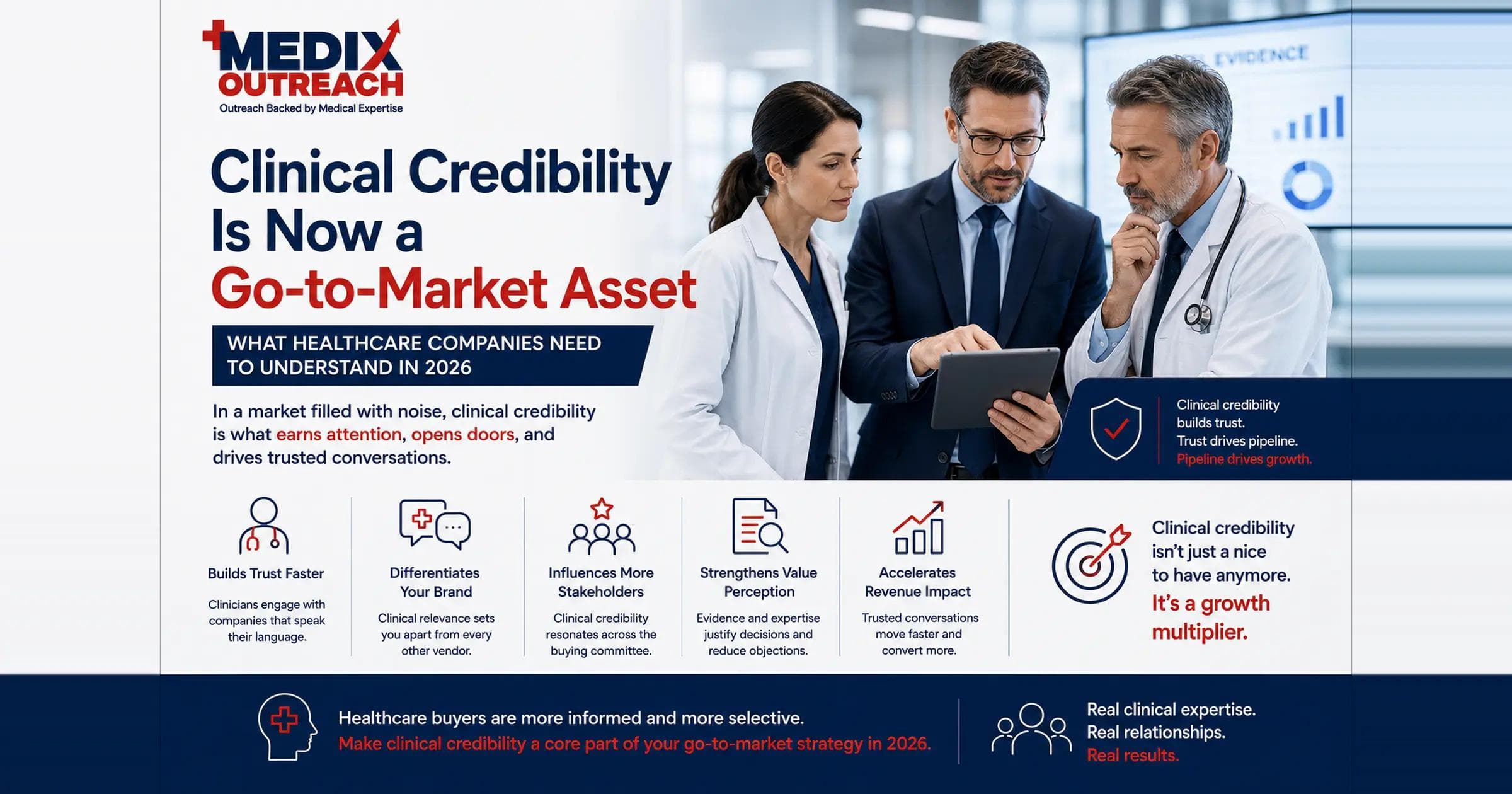
In 2026, clinical E-E-A-T, which stands for Experience, Expertise, Authoritativeness, and Trust, is the most valuable currency in healthcare B2B marketing. Authenticity has outperformed high-production polish. This is not just a content marketing principle. It describes how healthcare buyers are evaluating the vendors they engage with, the messages they respond to, and the companies they ultimately choose to work with. (Source: DemandWorks Media)
Clinical credibility has moved from a nice-to-have positioning element to a functional go-to-market asset. Companies that understand how to build and deploy it are shortening sales cycles, winning higher-value accounts, and generating referrals through provider networks that no paid channel can replicate.
What clinical credibility actually means in a sales context
Clinical credibility is not about having medical advisors listed on a website or publishing research citations in a pitch deck. In a go-to-market context, it means that every touchpoint a provider has with your company, from the first outreach message to the demo call to the follow-up sequence, reflects a genuine understanding of how healthcare operates.
In practice, that means:
- Knowing the difference between how a primary care practice evaluates a new platform and how a health-system procurement team does.
- Understanding what keeps a clinic operations director up at night versus what motivates a Chief Medical Officer to sponsor a new technology internally.
- Being able to discuss clinical workflow fit without needing the provider to explain basic terminology.
Thought leadership in healthcare B2B now means more than publishing articles. It involves engaging in scientific discussions, showcasing innovation, and hosting expert panels that resonate with both the scientific and business communities. The companies doing this well are not just generating content. They are demonstrating, through every interaction, that they belong in the room. (Source: KNB Communications)
Mid-article CTA
Need help building your healthcare growth engine?
Medix helps healthcare startups, clinics, pharma companies, and provider-focused platforms build scalable commercial pipelines.
Book a Strategy CallWhy pharmacist-led business development outperforms traditional sales
The business development function in healthcare has historically been staffed with general sales professionals who learn the industry as they go. That is partly a supply problem, and it is genuinely hard to hire salespeople with real healthcare backgrounds. In 2026, that model is increasingly at a disadvantage against companies that embed clinical expertise directly into their BD process.
A pharmacist or clinician conducting provider outreach brings immediate credibility signals that a traditional sales professional cannot replicate. They speak the language of outcomes, dosing, formulary considerations, workflow integration, and patient population management without needing a script. That fluency changes the nature of early-stage conversations and dramatically reduces the skepticism that healthcare buyers bring to vendor interactions by default. We have written about why pharmacist-led sales teams work, and the mechanism is exactly this.
Clinician-to-clinician communication builds trust faster than any whitepaper or polished sales asset. Seeing a peer explain a product's integration into a real-world workflow reduces the skepticism barrier that is structurally present in healthcare procurement. (Source: DemandWorks Media)
How to build clinical credibility into your GTM without hiring a clinical sales team
Not every healthcare company has the budget or the timeline to build an in-house clinical BD function. But clinical credibility can be embedded into go-to-market strategy through the right partnerships, the right content infrastructure, and the right outreach architecture.
That means working with business development partners who have genuine clinical background, not just healthcare industry experience. It means creating content that demonstrates operational knowledge, not just product awareness. And it means building outreach sequences that reflect how providers actually think about adoption decisions rather than how B2B buyers in other verticals do.
It is the approach behind our provider outreach work for a specialty pharmacy, where local provider trust, built one relationship at a time, was the growth channel.
LinkedIn remains the top social platform for B2B healthcare marketing, and the platform's algorithm now prioritizes domain expertise and relationship closeness over recency. Companies consistently demonstrating clinical intelligence through their LinkedIn presence are building credibility at scale before a single outreach message is sent. (Source: Slabtown Marketing)
The compounding advantage
Clinical credibility is one of the few go-to-market assets that compounds over time. Every piece of content that demonstrates genuine healthcare knowledge, every provider conversation handled with clinical fluency, and every successful implementation that becomes a peer referral builds a reputation that is increasingly difficult for competitors to displace.
In a market where buyer skepticism is rising and every move is more ROI-policed than it was a year ago, credibility earned through demonstrated expertise is a more durable competitive advantage than any campaign. (Source: Taylor Scher SEO)
For healthcare companies that want to grow their provider network or expand market access in 2026, clinical credibility is not a branding exercise. It is a revenue strategy, and it is the foundation of every healthcare business development engagement we run.