Launching a healthcare startup has never been more exciting or more challenging.
Whether you're building a healthcare SaaS platform, launching a medical device, commercializing a clinical diagnostics solution, or introducing a new digital health product, success depends on far more than innovation. It depends on execution.
Yet many healthcare startups spend months, sometimes years, trying to gain traction because they approach commercialization with a generic B2B playbook instead of a healthcare-specific go-to-market strategy.
Healthcare buyers don't purchase like traditional businesses. Providers, hospitals, health systems, and pharmaceutical organizations evaluate trust, clinical relevance, workflow impact, compliance, and long-term value before making purchasing decisions.
That's why a well-defined healthcare go-to-market strategy isn't just a marketing document. It's the foundation of sustainable commercial growth.
Here are the seven most common mistakes preventing healthcare startups from building predictable revenue.
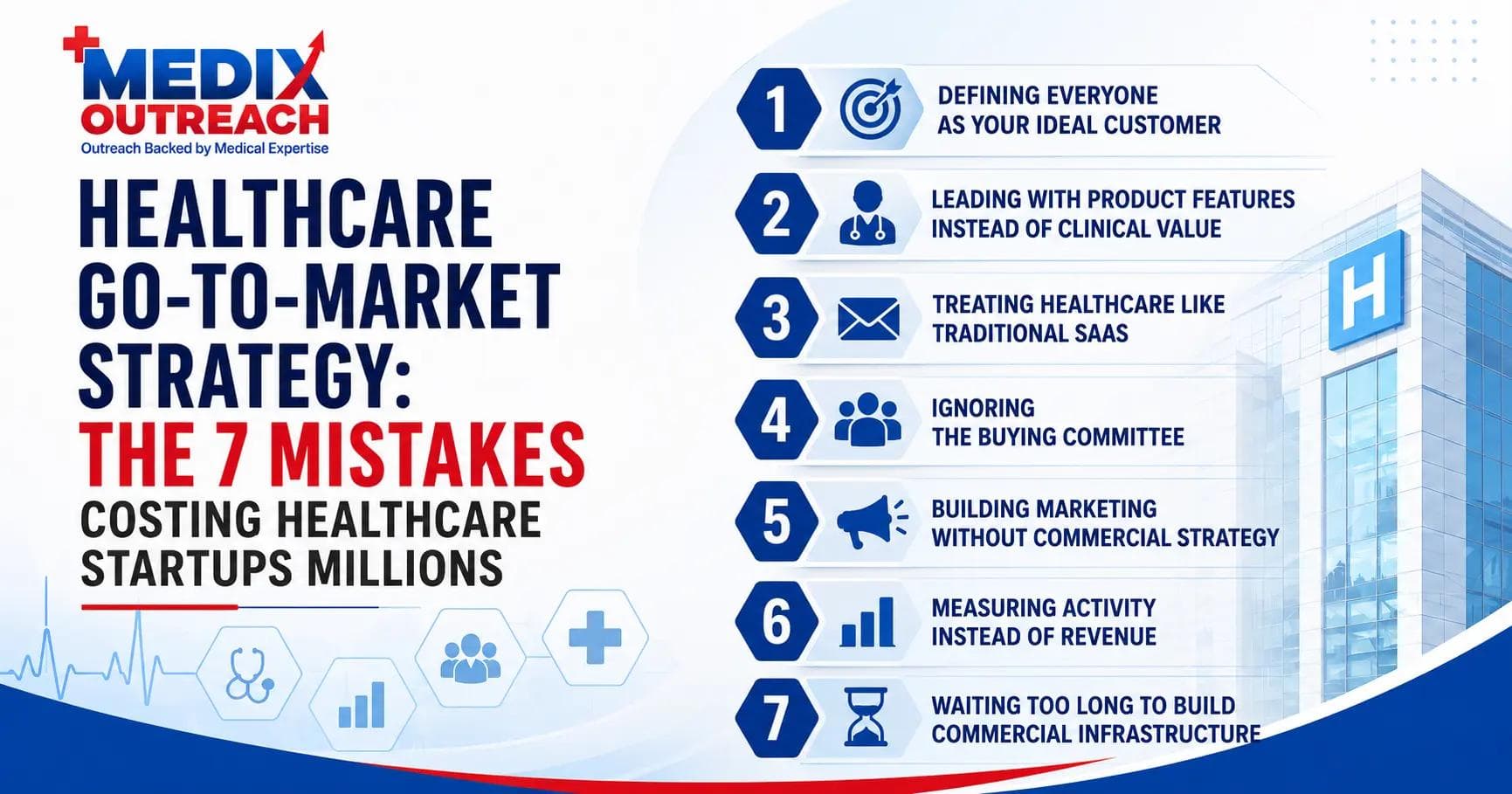
Mistake #1: Defining Everyone as Your Ideal Customer
One of the biggest mistakes healthcare startups make is trying to sell to everyone.
"We help physicians."
"We serve healthcare providers."
"We work with hospitals."
Those audiences are far too broad.
A primary care physician has different priorities than an allergist. A private specialty clinic operates differently from an academic medical center. A pharmacy evaluates products differently than a health system procurement team.
Successful healthcare market entry begins with defining an Ideal Customer Profile (ICP) based on specialty, organization type, decision-maker, patient population, reimbursement model, and workflow challenges.
Specificity creates relevance, and relevance drives engagement.
Mistake #2: Leading With Product Features Instead of Clinical Value
Healthcare startups often spend too much time explaining technology.
AI.
Automation.
Analytics.
Integrations.
Dashboards.
Healthcare buyers aren't purchasing software because it has impressive features.
They're investing in outcomes.
Instead of talking about what your platform does, explain how it:
- Reduces administrative burden
- Improves patient outcomes
- Saves provider time
- Supports reimbursement opportunities
- Fits into existing workflows
- Improves operational efficiency
Clinical relevance always outperforms technical complexity.
Mistake #3: Treating Healthcare Like Traditional SaaS
Many founders copy go-to-market strategies from successful SaaS companies.
Mass email campaigns.
Automated LinkedIn sequences.
High-volume cold outreach.
Healthcare simply doesn't respond the same way.
Healthcare outreach requires:
- Provider-specific messaging
- Clinical credibility
- Thoughtful timing
- Relationship building
- Multi-channel engagement
Healthcare prospecting is about precision, not volume.
The organizations winning provider attention aren't sending more emails. They're sending better ones.
Mistake #4: Ignoring the Buying Committee
Healthcare purchases rarely depend on a single decision-maker.
A physician may love your solution.
Operations may worry about implementation.
IT may question integrations.
Compliance may require additional review.
Finance may challenge the investment.
Your healthcare business development strategy should address every stakeholder from the very first conversation.
Companies that only sell to clinical champions often watch deals stall once additional decision-makers become involved.
Mid-article CTA
Need help building your healthcare growth engine?
Medix helps healthcare startups, clinics, pharma companies, and provider-focused platforms build scalable commercial pipelines.
Book a Strategy CallMistake #5: Building Marketing Without Commercial Strategy
Healthcare startup marketing and healthcare commercialization are not the same.
Generating website traffic or running paid campaigns doesn't automatically create revenue.
Before investing in demand generation, every startup should answer four questions:
- Who are we selling to?
- Why would they change their current workflow?
- What commercial problem are we solving?
- What makes us different from every competitor?
Without clear positioning, marketing simply amplifies confusion.
A successful healthcare go-to-market strategy aligns positioning, messaging, provider outreach, healthcare content marketing, and healthcare sales into one commercial growth system.
Mistake #6: Measuring Activity Instead of Revenue
Many startups celebrate metrics that don't predict business growth.
Open rates.
Clicks.
Followers.
Email volume.
Meetings booked.
While these metrics matter, they don't answer the only question investors and founders ultimately care about:
Is the commercial strategy generating predictable revenue?
Successful healthcare business development measures:
- Qualified opportunities
- Sales pipeline growth
- Provider engagement
- Partnership development
- Conversion rates
- Customer acquisition
- Revenue generation
Growth isn't measured by activity.
It's measured by outcomes.
Mistake #7: Waiting Too Long to Build Commercial Infrastructure
Many healthcare startups delay commercialization until after product development is complete.
By then, competitors may already own the market.
Commercial strategy should begin alongside product development, not after it.
Healthcare startups that build provider relationships early gain invaluable insights into workflow challenges, purchasing barriers, and clinical priorities before launch.
Early commercial validation reduces risk and accelerates healthcare market expansion.
What a Successful Healthcare Go-to-Market Strategy Looks Like
An effective healthcare commercialization strategy combines several interconnected components:
Market Positioning
Clearly communicate why your solution matters to healthcare buyers.
Healthcare Business Development
Develop relationships with providers, health systems, pharmacies, and industry stakeholders.
Provider Outreach
Execute targeted, personalized outreach that reflects clinical understanding.
Healthcare Demand Generation
Create awareness through educational content and thought leadership rather than promotional messaging alone.
Healthcare Sales Outsourcing
Extend internal sales capabilities with healthcare professionals who understand clinical markets.
Commercial Partnerships
Build relationships with pharmaceutical companies, distributors, healthcare organizations, and strategic partners that accelerate growth.
When these elements work together, healthcare startups create predictable, scalable commercial growth.
Why Commercialization Is Becoming the Competitive Advantage
Healthcare innovation is accelerating.
New AI platforms, diagnostics, medical devices, and digital health solutions enter the market every month.
Innovation alone is no longer enough.
The companies that succeed will be those that understand healthcare commercialization, provider engagement, and strategic business development better than their competitors.
Winning healthcare companies don't simply build better products.
They build better go-to-market strategies.
Conclusion
A successful healthcare startup isn't built solely on innovation.
It's built on commercialization.
Healthcare companies that invest early in healthcare go-to-market strategy, provider outreach, healthcare business development, and commercial partnerships consistently shorten sales cycles, build stronger provider relationships, and create sustainable revenue growth.
The future belongs to organizations that combine clinical expertise with commercial execution.
At Medix Outreach, we partner with healthcare startups, healthcare SaaS companies, pharmaceutical organizations, biotech innovators, medical device manufacturers, and clinical diagnostics companies to build healthcare go-to-market strategies that generate measurable commercial growth.
From provider outreach and healthcare sales outsourcing to healthcare business development and end-to-end commercialization, we help innovative healthcare companies turn great products into lasting market success.