
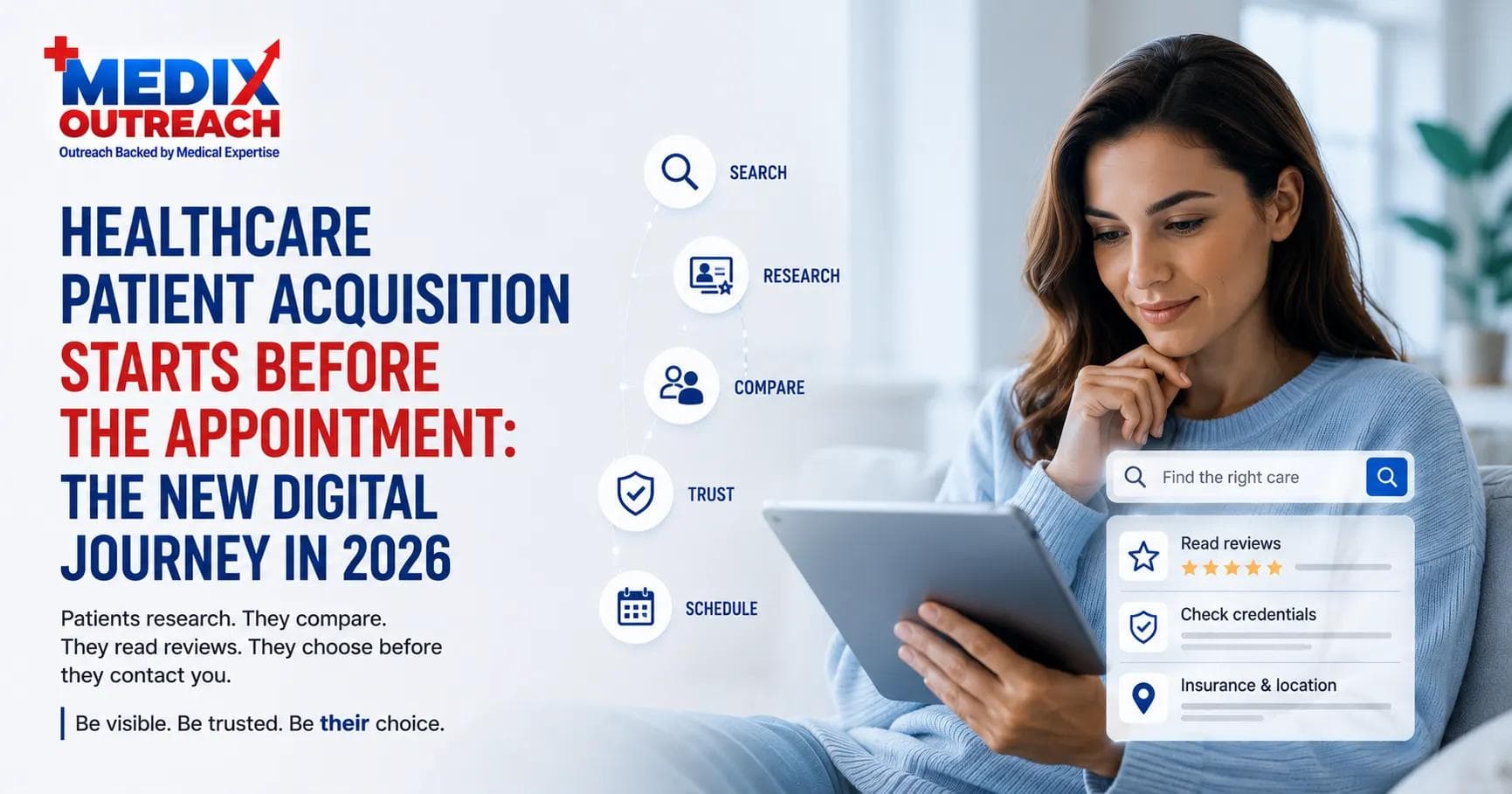
Healthcare patient acquisition has changed.
The patient journey no longer begins when someone calls a medical practice or visits a hospital website.
It begins much earlier.
Patients search for symptoms.
They compare physicians.
They read reviews.
They check insurance information.
They evaluate credentials.
They explore treatment options.
Increasingly, they also use AI tools to research healthcare providers.
Healthgrades reported in July 2026 that patient acquisition begins long before an appointment is scheduled and that patients evaluate physicians, quality signals, and trusted health information during the decision process. Its research also found that 92% of patients use online reviews at least occasionally when researching a new healthcare professional.
The digital front door is becoming the first stage of healthcare acquisition.
The New Patient Journey
A modern patient journey can look like this:
Search → Research → Compare → Validate → Contact → Schedule → Receive care.
The healthcare organization that appears only at the final stage has already missed several opportunities to influence the decision.
This changes how medical practice marketing and healthcare provider marketing should work.
AI Search Is Adding Another Layer
Traditional healthcare SEO focused on ranking in Google.
Now healthcare organizations also need to consider how their information appears in conversational AI.
Research published in 2026 indicates that patients are increasingly using AI tools to find healthcare providers. TechTarget reported that AI provider search is already influencing provider selection, with some patients saying they trust AI-assisted provider discovery more than traditional search.
This creates a new challenge.
Healthcare organizations need accurate, authoritative information across the digital ecosystem.
Your Website Is No Longer the Only Source of Truth
Patients may encounter a healthcare organization through:
- AI search
- Provider directories
- Review platforms
- Social media
- Health system websites
- Insurance directories
- Third-party healthcare platforms
If provider information differs across these sources, trust can decline.
Incorrect office hours.
Outdated physician information.
Missing specialties.
Incorrect insurance details.
Inconsistent addresses.
These details can affect whether a patient chooses to contact a provider.
Reviews Are Becoming a Commercial Asset
Clinical reputation has always mattered.
Digital reputation makes that reputation visible before the first interaction.
Patients use reviews to evaluate physicians and healthcare organizations before making decisions. Healthgrades reported that 92% of patients in its research use online reviews at least occasionally when researching a new healthcare professional.
That makes reputation management part of patient acquisition.
A strong healthcare marketing strategy should therefore consider:
- Reviews
- Provider profiles
- Credentials
- Clinical content
- Patient education
- Local search visibility
- Accurate healthcare information
Mid-article CTA
Need help building your healthcare growth engine?
Medix helps healthcare startups, clinics, pharma companies, and provider-focused platforms build scalable commercial pipelines.
Book a Strategy CallHealthcare SEO Is Becoming More Complex
Healthcare SEO is no longer simply about ranking for keywords.
Modern healthcare SEO strategy needs to support discovery across multiple environments.
That includes:
- Traditional search
- Local search
- AI search
- Provider directories
- Healthcare platforms
Healthcare content should answer real patient questions while demonstrating expertise and credibility.
Instead of publishing generic articles, organizations should create content around actual patient decision points.
Examples include:
"Which cardiologist should I see for chest pain?"
"What should I expect from a sleep study?"
"When should I see an allergist?"
"How do I choose a specialist?"
These topics connect search intent with healthcare decisions.
Conversion Happens After Discovery
Visibility alone doesn't create patient growth.
Once a patient finds a provider, the next question is:
"Can I easily take action?"
The patient should be able to understand:
- What the provider treats
- Where they are located
- Whether they accept the patient's insurance
- Whether they're accepting new patients
- How to schedule
- What to expect
A complicated booking experience can waste the demand created by excellent SEO.
This Creates a Bigger Opportunity for Medical Practice Growth
Healthcare organizations should stop thinking about marketing as traffic generation.
The goal is patient acquisition.
That means connecting:
SEO → content → reputation → provider discovery → website experience → appointment conversion.
Each stage influences the next.
How Medix Outreach Fits Into the New Patient Journey
Medix Outreach helps healthcare organizations build stronger commercial and growth strategies around healthcare audiences.
Our approach combines healthcare marketing, provider relationships, healthcare business development, healthcare content strategy, healthcare commercialization, and growth execution.
For medical practices, healthcare providers, healthcare technology companies, and organizations expanding their U.S. healthcare presence, the opportunity is to understand where patients and decision-makers discover information and build visibility there.
Conclusion
The healthcare buyer journey is becoming increasingly digital.
Patients are researching providers before they contact them.
They are reading reviews.
They are comparing credentials.
They are using search engines and AI tools.
Healthcare organizations that wait until the appointment stage to think about acquisition are starting too late.
In 2026, patient acquisition begins before the patient ever reaches your website.
The organizations that understand this new journey can build stronger visibility, improve conversion, and turn digital discovery into measurable healthcare growth.