
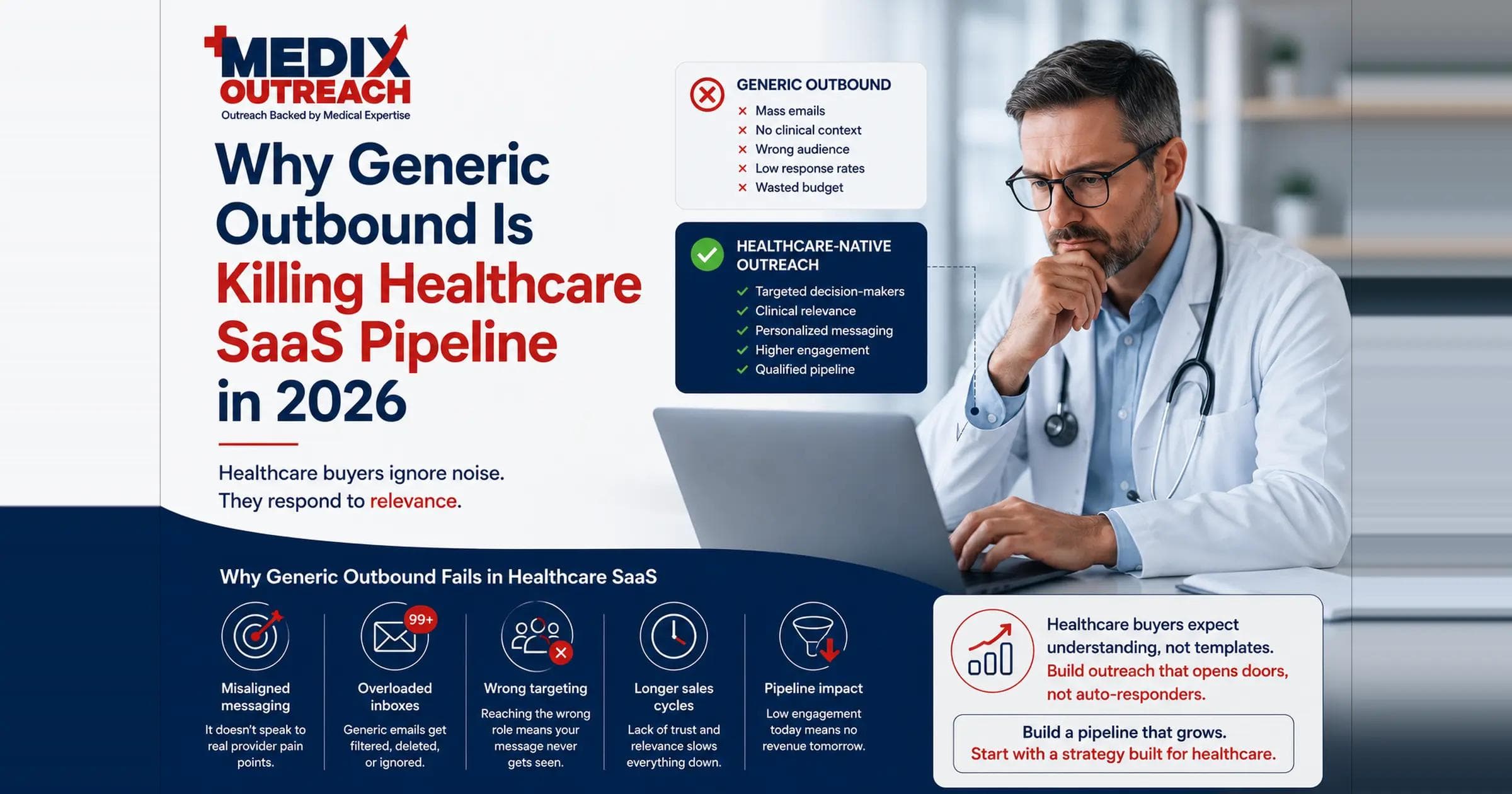
Gartner's 2025 research makes this clear: the majority of B2B buyers want to self-educate, compare options, and form opinions before engaging with sales. In healthcare, this behavior is even more pronounced. Providers, clinic operators, and pharma buyers filter outreach faster than almost any other professional category, and generic messaging is the first thing they eliminate. (Source: Taylor Scher SEO)
Yet most healthcare SaaS outbound sales programs still run the way a software company would approach any B2B vertical: volume-based sequences, feature-led messaging, and urgency tactics built for shorter sales cycles. The result is poor reply rates, wasted pipeline investment, and the persistent belief that the product is the problem when the real issue is the outreach architecture.
Why healthcare buyers filter so aggressively
Healthcare professionals operate under a level of accountability that most B2B buyers do not. Every vendor they bring into their clinical or operational environment introduces a new variable into a system where errors carry real consequences. Before they evaluate what a product does, they are unconsciously evaluating whether the company selling it understands their world well enough to be trusted.
Generic outbound answers that question immediately, and not in the vendor's favor. A pitch that could have been sent to any business regardless of industry signals that the sender has not done the work to understand clinical workflows, regulatory exposure, or the specific pressures facing that type of practice or organization.
The same convenience that patients now expect is also expected by B2B healthcare buyers. If your outreach process leads to a 48-hour response wait or a call that wastes their time, the deal is already lost. (Source: DemandWorks Media)
The volume trap
High-volume outbound sequences create the appearance of activity without producing qualified healthcare pipeline. In healthcare, the problem compounds because a poorly executed sequence does not just fail to convert. It actively damages future access to the same account.
Healthcare is a relationship-driven market where reputation travels fast within specialty networks, hospital systems, and regional clinic clusters. A provider who receives tone-deaf outreach from a vendor does not forget it, and neither do the colleagues they mention it to. We have written before about why cold outreach fails in healthcare, and the pattern is consistent: the failure is almost always upstream of the send button.
Account-based marketing has evolved from a pilot strategy to a performance imperative in B2B healthcare. With long sales cycles, multiple decision-makers, and highly specialized offerings, mass marketing does not work. Marketers are investing in precision outreach focused on specific organizations, personas, and buying committees. (Source: DBS Interactive)
Mid-article CTA
Need help building your healthcare growth engine?
Medix helps healthcare startups, clinics, pharma companies, and provider-focused platforms build scalable commercial pipelines.
Book a Strategy CallWhat actually replaces volume-based outreach
The shift is not from outbound to inbound. It is from generic outbound to healthcare-native provider outreach, built around clinical language, workflow-level specificity, and a genuine understanding of how each type of provider or buyer evaluates decisions.
That means:
- Messaging that reflects the operational reality of the specific practice type or organization being targeted.
- Language that maps to clinical priorities, not product features.
- Outreach timing that respects budget and credentialing cycles.
- Follow-up sequences designed for months-long decision timelines, not two-week close windows.
- Warm access through provider networks wherever possible, because trust is the real conversion event in healthcare B2B.
(Source: Slabtown Marketing)
For teams that prefer a done-for-you approach to outbound, Danish Lead Co provides B2B lead generation and personalized outreach support.
Channel mechanics still matter. Deliverability, list hygiene, and sequence structure decide whether a message is seen at all, and we cover that layer in our guide to healthcare email that reaches the inbox. But those are execution details downstream of relevance. No amount of sending discipline rescues a message that was never written for a clinical reader.
The compounding return on precision
Companies that shift from volume to precision in healthcare outreach see a pattern that does not show up in standard B2B conversion data. Early-stage meetings are shorter but higher quality. Internal champions are better positioned to sell upward within their organizations. Deals that enter the pipeline are significantly more likely to close.
We have seen this directly. When we repositioned a provider platform around trust rather than price, clinic adoption moved because the message finally matched how providers actually make decisions.
Organizations that adopt a data-driven, targeted approach have reported a 74% decrease in acquisition costs in departments that implemented advanced attribution practices. Doing less, more precisely, is not a conservative strategy in healthcare. It is the higher-return one. (Source: Outcomes Rocket)
Generic outbound is not a volume problem that can be solved with better tools or faster sequences. It is a language and positioning problem, and fixing it takes genuine clinical expertise and an outbound system built for healthcare buyers.