
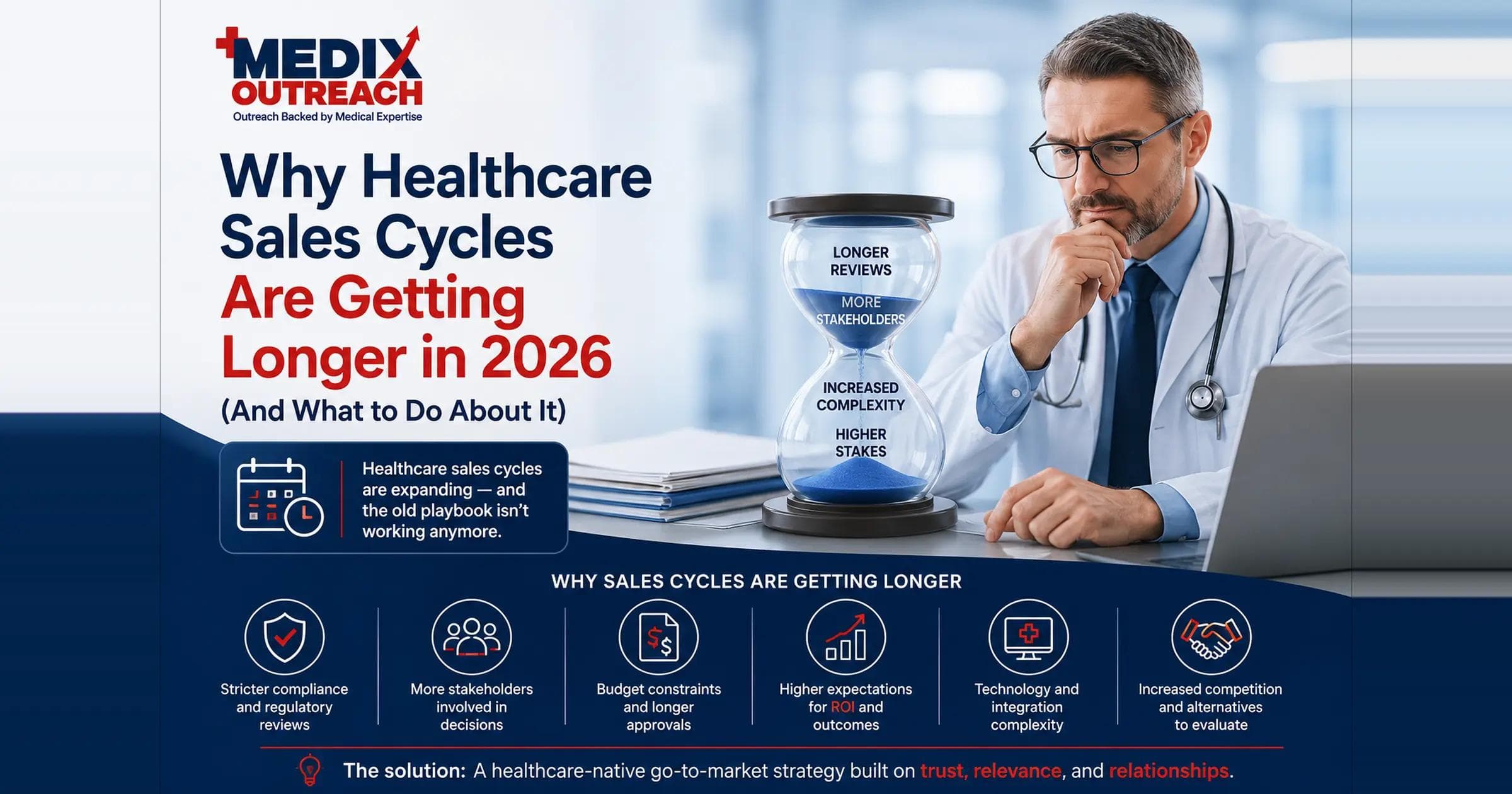
The average B2B healthcare deal now involves more than 20 decision-makers. That number was already high five years ago. In 2026, it has climbed further, and the downstream effect on revenue timelines is significant for any company trying to sell into clinical or pharma environments.
This is not a temporary friction point. Healthcare sales cycles have grown longer because the buying decisions themselves have gotten heavier:
- Larger buying committees, with more functions holding effective veto power.
- More decision gates, including security reviews and procurement cycles.
- Higher scrutiny around ROI, interoperability, data privacy, and AI risk.
Companies that entered the healthcare market expecting typical B2B conversion timelines are now recalibrating entire go-to-market strategies. (Source: Sagefrog)
Understanding why this is happening, and how to work with it rather than against it, is what separates healthcare companies that grow steadily from those that stall despite strong products.
The buying committee problem
Healthcare purchasing decisions rarely move cleanly from awareness to consideration to conversion. Multiple stakeholders enter the process at different points, with different questions and concerns. Clinical leaders may engage early. Compliance or IT may appear late and send the deal backward. (Source: Sagefrog)
This means that a single enthusiastic champion inside a target organization is rarely enough to carry a deal through. The clinical lead who loves your product still needs to align with an operations director who is worried about implementation, a compliance function that needs to review data handling, and a financial decision-maker who needs to justify the budget against competing priorities.
Outreach and messaging that only speaks to one of these stakeholders will stall the moment the conversation expands internally, which it always does. This is why a structured B2B healthcare sales funnel does more for deal velocity than any single strong conversation.
Mid-article CTA
Need help building your healthcare growth engine?
Medix helps healthcare startups, clinics, pharma companies, and provider-focused platforms build scalable commercial pipelines.
Book a Strategy CallWhat accelerates deals in this environment
Long sales cycles demand tighter alignment between marketing and sales to maintain momentum across buying committees. When stakeholders fall out of alignment, deals stall around 68% of the time. (Source: Sagefrog)
The companies closing faster in 2026 are not finding shortcuts through the process. They are building infrastructure that supports every stakeholder through every stage. That means role-specific messaging, content that helps internal champions sell the solution upward, and follow-up systems that maintain presence without pressure across timelines measured in months, not weeks.
Healthcare sales cycles often run 6 to 12 months. Even a one-month reduction in time at each stage improves cash flow and overall ROI. Small improvements in how deals are nurtured compound significantly at scale. (Source: Martal Group)
Pharma business development runs on these timelines by default, and long multi-stakeholder cycles are still winnable. Our licensing outreach for an international pharma expansion ran on exactly that kind of timeline, across regions and partner committees, and closed.
Clinical credibility as a deal accelerator
One structural advantage that consistently shortens healthcare sales cycles is clinical credibility on the vendor side. Clinician-to-clinician communication builds trust faster than any whitepaper. Seeing a peer explain a product's integration into a real-world workflow reduces the skepticism barrier common in healthcare procurement. (Source: DemandWorks Media)
This is why pharmacist-led sales teams and clinician-informed business development outperform generic sales outreach in healthcare. It is not just a positioning preference. It directly affects how quickly trust forms, and trust is the variable that moves healthcare deals forward.
The measurement shift
Measurement in healthcare B2B marketing must evolve. MQL volume and last-touch attribution matter less, while account-level engagement, multi-stakeholder content consumption, influence on sales velocity, deal size, and win rates matter more. (Source: Sagefrog)
Companies still measuring success by lead volume are not seeing an accurate picture of their pipeline health. The real metric is how quickly and consistently deals move through stages, and whether marketing activity is genuinely supporting that movement or just generating surface-level activity.
Healthcare sales cycles are longer in 2026 because the decisions are heavier, not because buyers are less interested. Companies that build their go-to-market infrastructure around that reality, with clinical credibility, multi-stakeholder messaging, and long-cycle nurture systems, are the ones converting healthcare pipeline into revenue.
If your healthcare or pharma company is seeing strong initial interest but slow close rates, the issue is almost never the product. It is the system around the product, which is exactly what our clinical business development team is built to fix through healthcare go-to-market services.