

Marketing to doctors is not the same as generic B2B marketing, and it has nothing to do with helping a practice attract more patients. This guide is a practical take on how to market to doctors the B2B way, so healthcare, pharma, medical device, healthtech, and provider-facing companies can reach physicians as buyers, partners, referral sources, and clinical adopters.
Doctors are busy, skeptical, and clinically focused. They see a lot of vendor outreach, and most of it gets ignored in the first few seconds. The messages that break through are specific, respectful of time, and clearly written by someone who understands how care actually works.
If your company needs providers to adopt a product, sign a partnership, or send referrals, this B2B healthcare marketing playbook covers who to target, what to say, and how to earn the conversation.
Why marketing to doctors is different
Before you build a campaign, it helps to accept a few things about how physicians work and how selling to physicians actually plays out.
- Doctors are time-constrained. Between patients, charting, and admin, attention is the scarcest resource. Long or vague outreach loses instantly.
- They filter out generic vendor language. "Revolutionary," "seamless," and "best-in-class" are noise. They signal that you have not done your homework.
- Clinical credibility matters. Physicians trust people who understand evidence, safety, and the realities of practice, not just a sales script.
- Workflow relevance matters. If your message does not connect to how they actually see patients, refer, prescribe, or document, it will not land.
- Trust comes before conversion. Most physician relationships start with credibility and a small, low-risk step, not a demo request.
- The doctor is not always the only buyer. Depending on the setting, the real decision may involve a practice manager, clinic owner, department leader, or referral partner.
None of this means doctors are unreachable. It means the bar for relevance is high, and companies that clear it stand out precisely because so many competitors do not.
First, understand which doctor you are trying to reach
"Doctors" is not a target. It is a dozen very different roles with different incentives, budgets, and decision power. Every doctor outreach strategy starts here, because provider outreach only works when you define exactly who you are trying to reach and what they can actually say yes to.
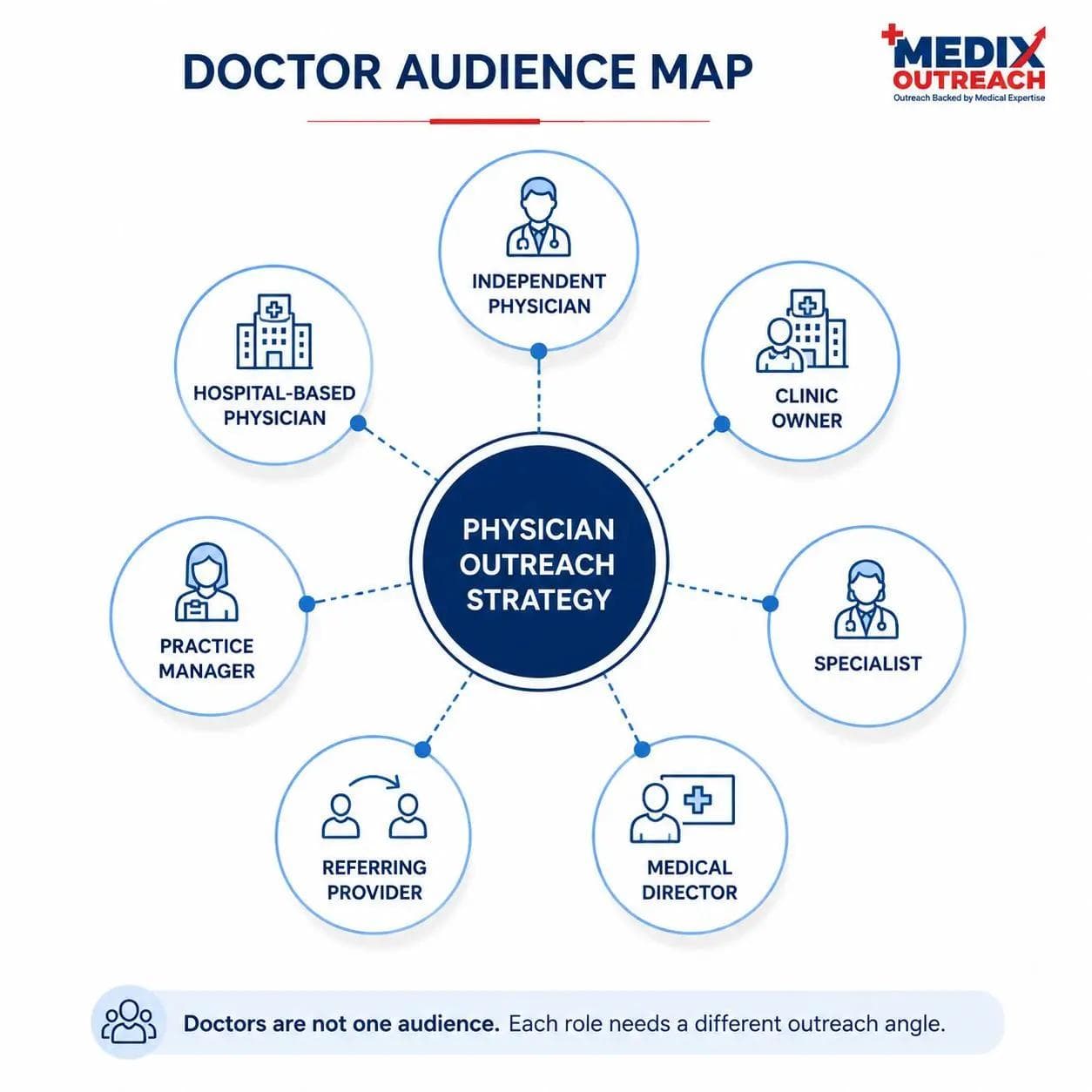
- Independent physician - often owns the decision but has little time and no procurement team.
- Clinic owner - thinks about revenue, staffing, and operations as much as clinical value.
- Specialist - cares about specialty-specific outcomes, protocols, and peer credibility.
- Medical director - balances clinical quality with organizational goals and standardization.
- Hospital-based physician - influential but usually inside a larger committee-driven process.
- Referring provider - not a buyer at all, but a source of referrals you may want to earn.
- Key opinion leader or advisor - shapes peer opinion and can open doors, but expects substance.
- Practice manager - frequently the gatekeeper who screens vendor outreach before it ever reaches the doctor.
Doctors are not one audience
A primary care physician, a psychiatrist, an aesthetic clinic owner, a hospital pharmacist, and a cardiologist do not respond to the same message. Their patients, pressures, and vocabulary are different.
The aesthetic clinic owner thinks about growth and patient experience. For the psychiatrist, physician referral marketing and continuity of care matter more than a cold pitch. The hospital specialist thinks about evidence and committee approval. One "doctor" campaign written for all of them reaches none of them. Segment first, then write.
Build a message doctors will not ignore
Once you know who you are reaching, the message has one job: prove relevance fast enough to earn a reply. Good healthcare provider marketing is not about louder promotion. It is about showing the right provider that you understand their workflow, risk, and priorities. A few principles do most of the work.
- Lead with the clinical or business problem. Open with something they recognize from their own week, not with your company.
- Avoid vague claims. Replace adjectives with specifics they can verify.
- Show relevance fast. Name their specialty, setting, or workflow in the first line or two.
- Use simple language. Clear beats clever. Do not make a busy reader decode your pitch.
- Respect their time. Short messages signal that you value theirs.
- Make the ask small. A quick question or a short call converts far better than "book a 45-minute demo."
- Prove you understand their workflow. One accurate detail about how they practice earns more trust than a page of features.
What doctors care about before they respond
Use this as a quick reference when writing outreach and sales materials for a physician audience.
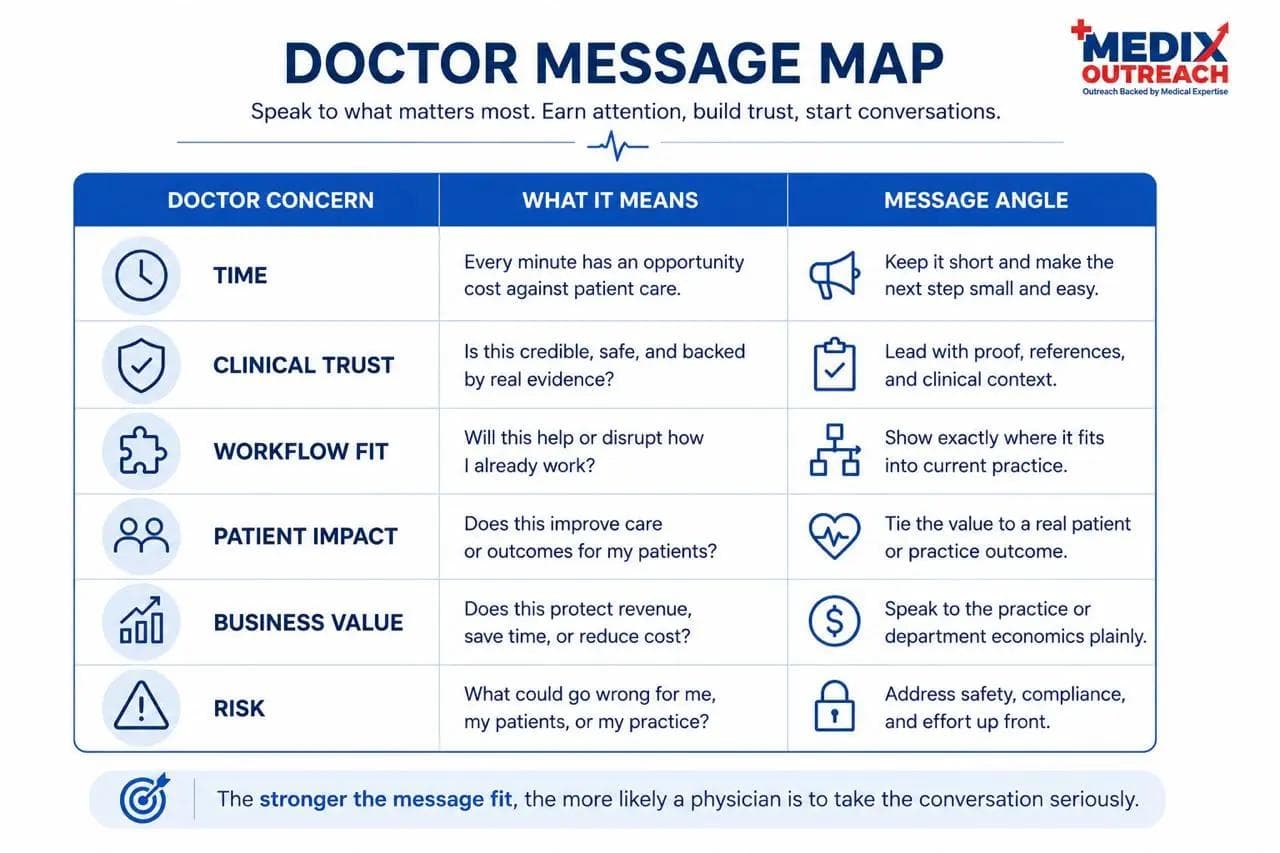
- Time - every minute has an opportunity cost against patient care. Message angle: keep it short and make the next step small and easy.
- Clinical trust - is this credible, safe, and backed by real evidence. Message angle: lead with proof, references, and clinical context, not hype.
- Workflow fit - will this help or disrupt how I already work. Message angle: show exactly where it fits into current practice.
- Patient impact - does this improve care or outcomes for my patients. Message angle: tie the value to a real patient or practice outcome.
- Business value - does this protect revenue, save time, or reduce cost. Message angle: speak to the practice or department economics plainly.
- Risk - what could go wrong for me, my patients, or my practice. Message angle: address safety, compliance, and effort up front.
Choose the right channel mix
No single channel reaches physicians reliably. The teams that get replies use a coordinated mix and repeat the message in more than one place over time. If you are trying to understand how to reach healthcare providers, start with the role, specialty, and reason they would care before choosing the channel.
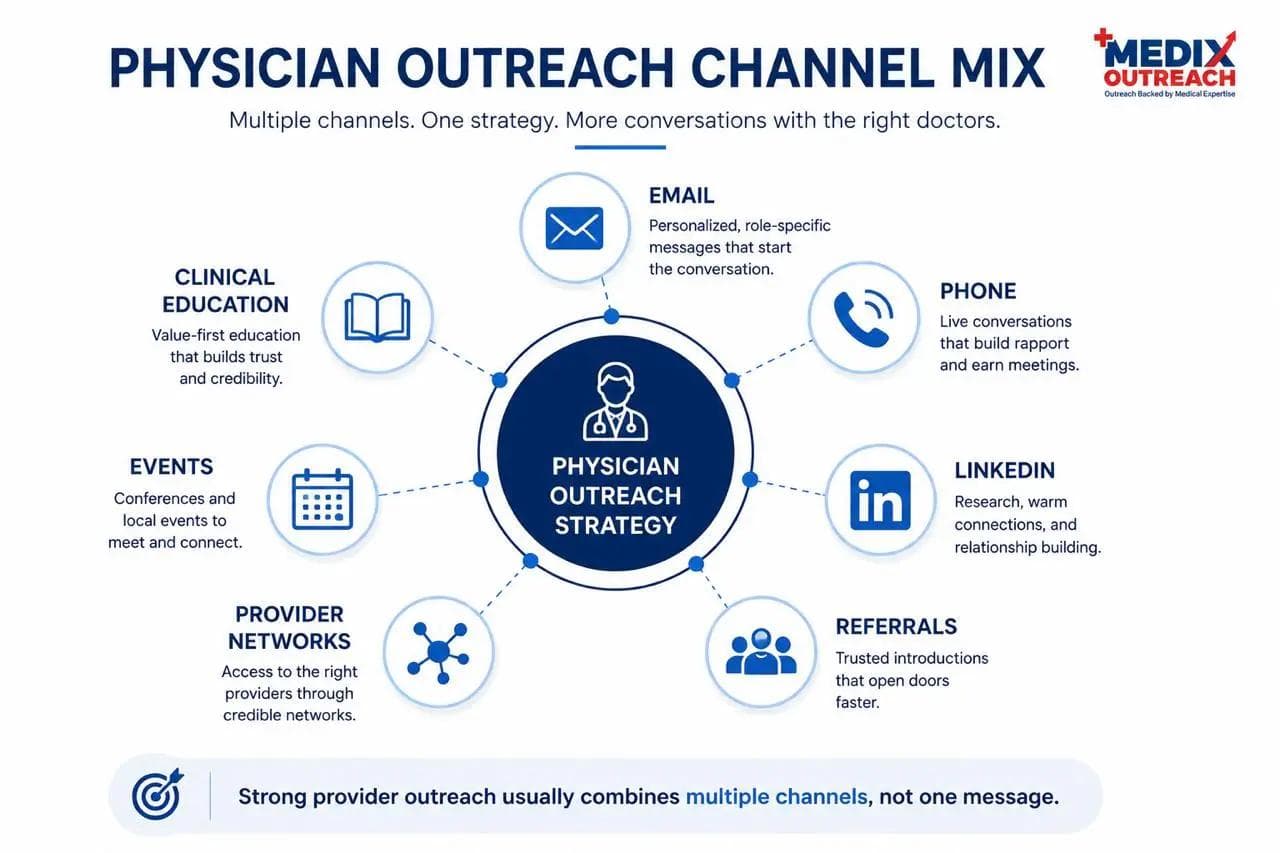
- Email - efficient for specific, problem-led messages when it is targeted rather than blasted.
- Phone - still works for reaching offices and practice managers when the call is respectful and prepared.
- LinkedIn - useful for research, warm connection, and building credibility before an ask.
- Referrals - a trusted peer introduction beats almost any cold channel.
- Local provider networks - relationships that create a credible path to the right roles.
- Events and conferences - strong for meeting specialists and understanding current priorities.
- Clinical education - lunch-and-learns, webinars, and useful content that lead with value.
- Partnerships - co-marketing with a trusted vendor or association that already has provider trust.
Channel choice is less important than execution. It is worth being honest about why so much outreach fails: much of it is generic, mistimed, or never followed up. For more on the mechanics of each channel, see how to fix healthcare cold outreach, the case for cold calling in healthcare sales, and how to do email marketing in healthcare without landing in spam.
Mid-article CTA
Need help building your healthcare growth engine?
Medix helps healthcare startups, clinics, pharma companies, and provider-focused platforms build scalable commercial pipelines.
Book a Strategy CallHow to use clinical context in physician outreach
Clinical context is the difference between outreach that sounds like a vendor and outreach that sounds like a colleague. It is also the fastest way to earn trust with a skeptical audience.
- Use specialty-specific language. Speak to the workflow of that exact specialty, not "healthcare" in general.
- Name workflow-specific pain points. Reference referrals, adoption, formulary decisions, documentation, scheduling, or clinic operations, depending on what you sell.
- Avoid patient-marketing language. You are talking to the provider as a decision-maker, not advertising to a patient. Keep the framing B2B.
- Match the ask to the setting. Adoption, referral, and formulary conversations each move differently and need different proof.
This is where a clinically native perspective pays off. A pharmacist-led sales approach, for example, reads as credible to providers because it comes from inside the care world rather than outside it. You can learn more about the healthcare-native background behind Medix on the About Medix Outreach page.
Examples of B2B doctor marketing angles
The right angle depends on what you sell and which provider you need. A few common cases show how the message shifts.
- Healthcare SaaS platform - lead with workflow and adoption. The goal is to show a clinician the software removes friction rather than adding clicks, which is the same challenge behind strong provider positioning that speeds clinic adoption.
- Medical device company - lead with clinical evidence and the economics of switching. Give the champion what they need to defend the choice internally.
- Specialty pharmacy - focus on prescriber relationships and reliable fulfillment. This is classic local provider outreach paired with demand generation.
- Psychiatry practice - build referral relationships with PCPs and local providers rather than marketing to patients, the way a provider referral engine is built.
- Aesthetic clinic platform - speak to provider growth and operations, the same lens behind aesthetic clinic adoption through sharper positioning.
- Pharma partnership or provider education - lead with credible clinical education and a clear reason for the provider to engage, not a sales pitch dressed up as content.
Common mistakes when marketing to doctors
Most physician campaigns underperform for the same handful of reasons.
- Treating doctors like generic SaaS buyers. A clinical audience needs clinical framing, not standard tech messaging.
- Sending mass emails with no specialty relevance. One generic blast to every provider signals you do not know who they are.
- Leading with features instead of workflow value. Physicians care about what changes in their day, not your spec sheet.
- Ignoring practice managers and staff. The gatekeepers often decide whether your message ever reaches the doctor.
- Asking for too much too early. A cold request for a long demo kills momentum before it starts.
- Not following up. A single touch rarely works; most replies come from a respectful, well-timed sequence.
- Not building referral or provider trust. Trust is the real currency, and it takes more than one email to earn.
- Using patient-acquisition language when the goal is B2B adoption. Marketing to a provider as a buyer is a different job than advertising to patients.
How Medix helps healthcare teams reach the right providers
Reaching doctors well is a system, not a single campaign, and building that system is where many healthcare teams get stuck. This is the work Medix Outreach focuses on.
Through its healthcare outreach, business development, and sales pipeline services, Medix helps companies:
- Clarify the ICP - define exactly which providers, roles, and settings to target first.
- Build accurate provider lists - reach the right people instead of a broad, noisy list.
- Write role-specific messaging - tailor the story to each specialty and decision-maker.
- Run healthcare outreach sequences - coordinate email, phone, and social with the right timing.
- Bring clinical context - use a healthcare-native, pharmacist-led perspective that providers take seriously.
- Build provider trust - lead with credibility so conversations start on the right footing.
- Develop the sales pipeline - turn interest into qualified meetings and a repeatable motion.
- Structure follow-up - stay in the process long enough to earn the reply.
That approach shows up across the provider-focused work at Medix, from clinic adoption to referral growth and local outreach. If reaching providers is your priority right now, you can book a strategy call to map it out.
Frequently asked questions
What is the best way to market to doctors?
Start narrow and specific. Pick one provider type, name a problem they actually feel, and lead with a short, credible message that respects their time. Broad, generic campaigns almost always lose to targeted, clinically aware outreach.
How do you reach physicians for B2B healthcare sales?
Use a coordinated mix of email, phone, LinkedIn, referrals, and provider networks rather than a single channel. Match the message to the specialty and role, keep the first ask small, and follow up on a respectful schedule.
Does email outreach work for doctors?
Yes, when it is targeted and specific. Generic mass email does not. A short, specialty-relevant message that leads with a real problem and a small ask can earn replies, especially when it is part of a wider sequence.
Should you call doctors or email them first?
It depends on the setting and the role. Email often works well for a first, low-pressure touch, while phone can be effective for reaching offices and practice managers. Most strong outreach uses both, sequenced together, rather than choosing one.
How do you build trust with physicians?
Lead with clinical credibility, be specific about their world, and make small, honest asks. Trust grows when your outreach sounds like it came from someone who understands care, and when you follow through consistently over time.
What is the difference between marketing to doctors and marketing to patients?
Marketing to patients is consumer advertising aimed at people seeking care. Marketing to doctors is B2B: you are reaching a physician as a buyer, partner, or referral source. The audience, message, and channels are different, and mixing them up is a common and costly mistake.
How can Medix help with physician or provider outreach?
Medix Outreach helps healthcare, pharma, device, and healthtech companies build the strategy, provider lists, messaging, and outreach sequences needed to reach doctors and clinical decision-makers. The approach is healthcare-native and pharmacist-led, and you can start with a free strategy call.
Final thoughts
Marketing to doctors works when the message is specific, clinically aware, respectful of time, and tied to real workflow or business value. The companies that win are not the loudest. They are the ones who sound like they understand the provider's world and earn trust one credible step at a time.
Get the audience right, speak to the concern behind the reply, and stay in the process long enough to build a relationship, and physician outreach becomes far more predictable.
If your company needs to reach doctors, clinics, providers, or healthcare decision-makers, Medix Outreach can help build the strategy, messaging, and outreach motion needed to start the right conversations.