
Selling to a hospital is not a bigger version of a normal B2B sale. It is a different game with different rules.
In most software or product sales, you find a decision-maker, show them value, handle a few objections, and close. Hospitals do not work that way. A hospital rarely buys because one person likes your product. It buys when a group of people agree that the clinical value, the economics, the risk, and the workflow all make sense at the same time.
That is why strong products with real value still stall for months inside health systems. The product was fine. The go-to-market approach was built for a simpler buyer.
This guide breaks down how to sell to hospitals, how health-system selling actually works, who is really involved, and how to build outreach that earns meetings instead of getting ignored. It is written for healthcare, pharma, medical device, healthtech, and provider-facing companies selling into the US market.
Why selling to hospitals is different
Before you plan outreach, it helps to understand what you are walking into. A few realities shape almost every hospital deal. Selling to healthcare providers inside hospitals is different from general B2B healthcare sales because the buyer is rarely one person with one priority.
- Long sales cycles. Many hospital deals take anywhere from several months to well over a year. Budget calendars, committee schedules, and pilot periods all add time.
- Multiple stakeholders. A single yes usually depends on several people across clinical, financial, and operational roles, and they do not all want the same thing.
- Clinical risk. Anything that touches patient care is evaluated for safety and outcomes first. A promising idea is not enough on its own.
- Budget pressure. Most hospitals run on thin margins. New spending has to displace something, improve a metric, or protect revenue.
- Procurement friction. Contracts, security reviews, group purchasing agreements, and vendor credentialing can slow even an approved decision.
- Evidence expectations. Buyers expect proof: clinical data, references, ROI logic, and a clear picture of what implementation looks like.
None of this means hospitals are impossible to sell to. It means the companies that win treat the process as a system to be navigated, not a wall to be pushed through.
The committee matters more than one champion
A common mistake is to find one enthusiastic contact and assume the deal is moving. That person matters, but they are one voice in a larger group. Depending on what you sell, that group can include:
- A clinical champion - the physician, nurse leader, or pharmacist who believes in the product and will advocate internally.
- An economic buyer - the department head or administrator who owns the budget and the tradeoffs.
- Procurement - the team that manages contracts, pricing, and vendor requirements.
- Pharmacy leadership - central for anything involving medications, formulary decisions, or clinical protocols.
- A value analysis committee (VAC) - the group that reviews new products for clinical value, safety, and cost, often for devices and supplies.
- A Pharmacy and Therapeutics (P&T) committee - where relevant, this group governs formulary and medication-related decisions.
Your champion opens the door. The committee decides whether you get through it. A good GTM plan gives your champion the material they need to sell on your behalf when you are not in the room. That is why a healthcare GTM strategy for hospitals has to support both the first conversation and the internal committee discussion that happens after it.
Hospitals buy risk reduction, not just products
It helps to reframe what you are actually selling. A hospital is not buying a feature list. It is buying a lower-risk path to a better result. Strong pitches speak to four kinds of value at once:
- Clinical value - better outcomes, safety, or quality metrics.
- Operational value - time saved, fewer errors, smoother workflows for busy staff.
- Financial value - cost avoided, revenue protected, or reimbursement supported.
- Implementation feasibility - a realistic, low-disruption path to going live.
If you can only speak to one of these, expect a slow decision. Committees look for the option that is easy to defend to everyone else at the table.
Understand the hospital buying committee
The exact makeup of a buying group depends on your product, but most hospital decisions involve some mix of these roles. Knowing who cares about what is the foundation of good outreach.
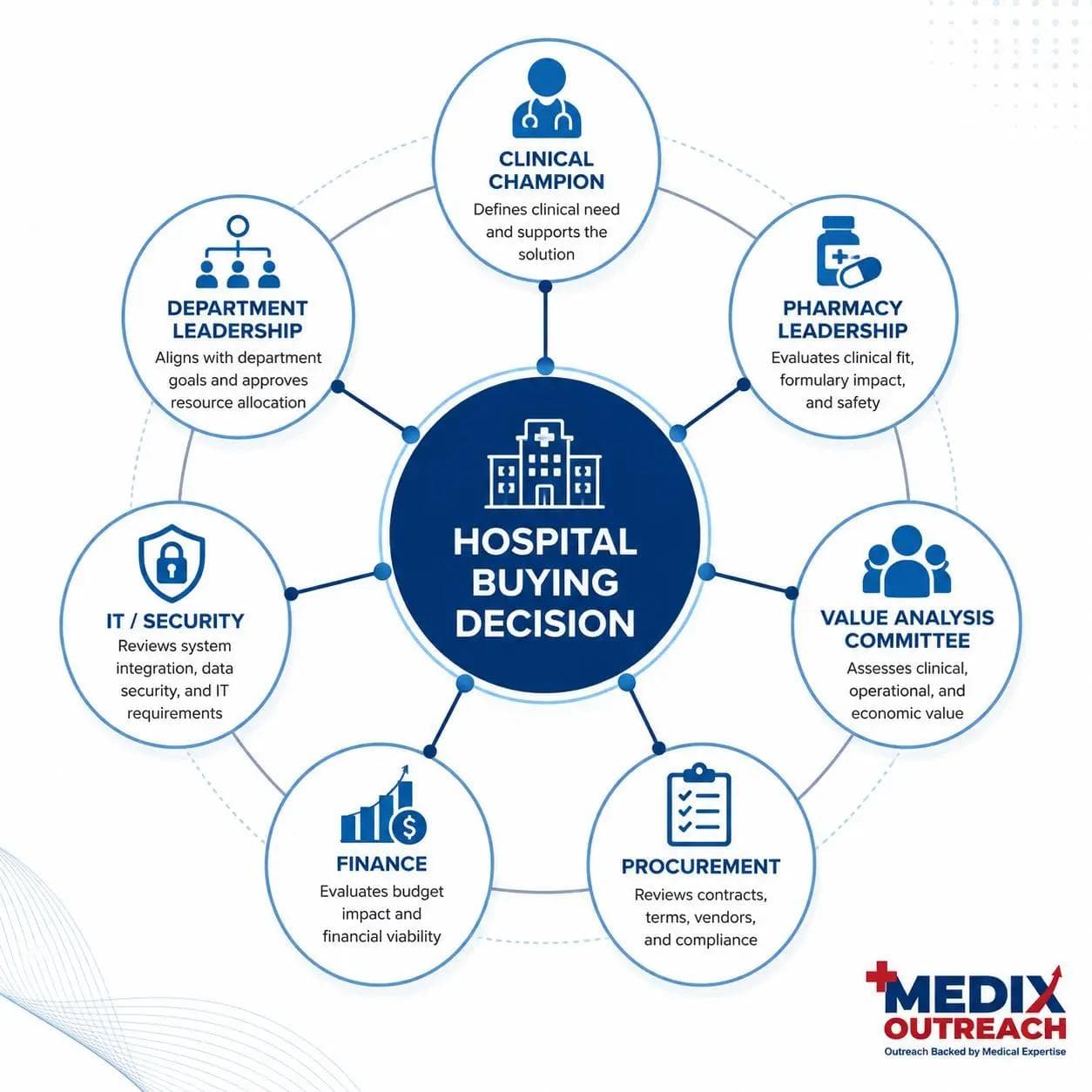
- Physicians - focused on clinical outcomes, patient safety, and whether the product fits real workflows.
- Pharmacists - central to medication-related products, formulary logic, protocols, and safety review.
- Nursing leadership - concerned with bedside workflow, staff training, and day-to-day usability.
- Department heads - own the budget and outcomes for their unit and weigh competing priorities.
- Administrators - look at strategic fit, system-wide impact, and organizational risk.
- Procurement - manages pricing, contracts, group purchasing agreements, and vendor requirements.
- Finance - evaluates total cost, payback, and budget impact.
- Compliance - checks regulatory, legal, and policy requirements.
- IT and security - essential for any software product, covering integration, data security, and EHR compatibility.
You do not need to reach all of them at once. You need to know they exist, understand the order in which they get involved, and prepare your champion for the questions each one will ask.
Build the right message before outreach
Most hospital outreach fails before anyone reads the second sentence. This is also why healthcare cold outreach fails when the message is generic, poorly timed, or sent to the wrong buyer. The message sounds like every other vendor email: generic, product-first, and clearly not written for the person receiving it.
Before you send anything, tighten the message around a few principles.
- Avoid generic sales language. Buzzwords and broad claims signal that you do not understand their world.
- Lead with the hospital problem. Open with a challenge they recognize, not with your company or your feature set.
- Use clinical and economic proof. Pair the clinical story with the financial one. Committees need both.
- Make it relevant to each role. A message to a pharmacy director should not read the same as one to a CFO.
- Explain why it matters now. Tie the value to a current pressure: a quality metric, a cost target, a staffing strain, or a regulatory change.
The goal of outreach is not to close. It is to earn a first real conversation with someone who has a reason to care.
What each stakeholder cares about
Use this as a quick reference when tailoring outreach and sales materials.
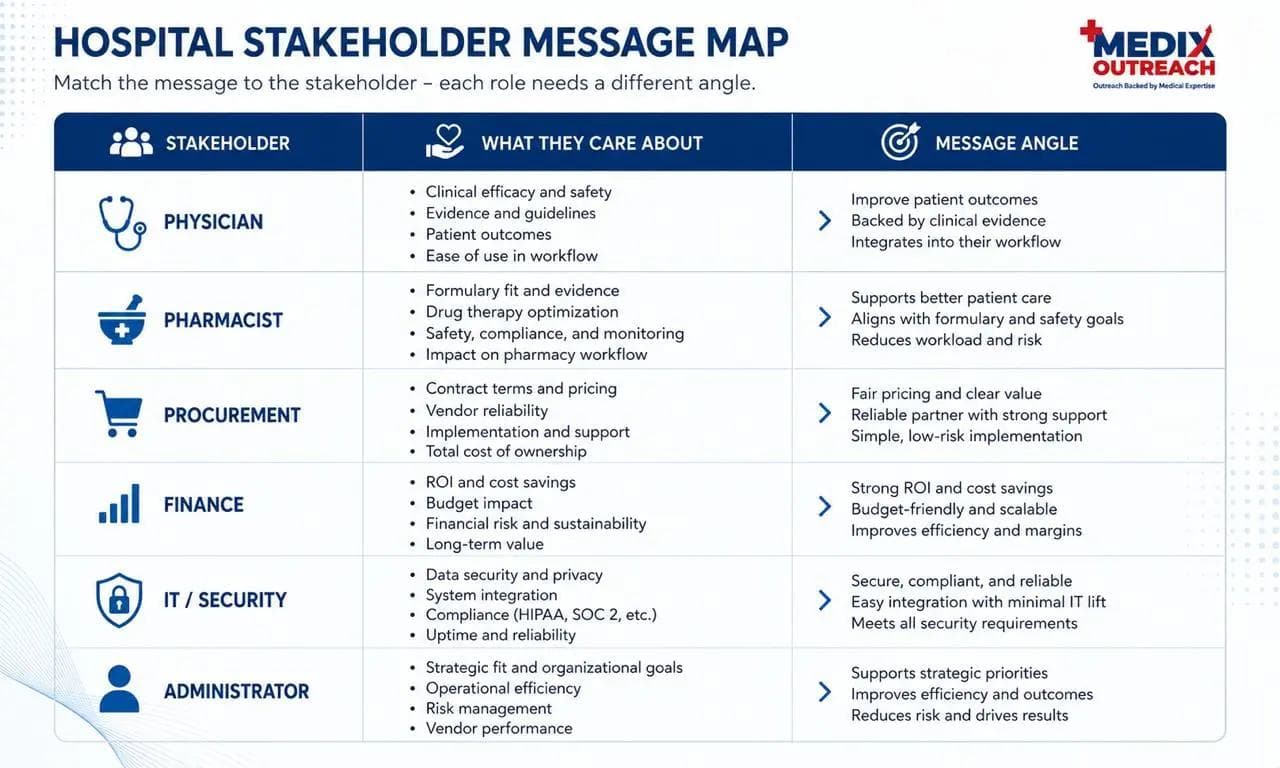
- Physician - cares about patient outcomes, safety, clinical evidence, and workflow fit. Message angle: show the clinical benefit and how it fits the way they already practice.
- Pharmacist - cares about medication safety, formulary and protocol impact, and clinical logic. Message angle: speak to formulary fit, safety, and how it supports the care team.
- Nursing leadership - cares about bedside workflow, training burden, and day-to-day usability. Message angle: emphasize ease of use and minimal disruption to staff.
- Procurement - cares about pricing, contracts, group purchasing agreements, and vendor terms. Message angle: be clear on pricing, contract path, and any existing agreements.
- Finance - cares about total cost, payback, budget impact, and reimbursement. Message angle: present a simple, credible ROI and budget story.
- IT and security - cares about integration, data security, and EHR compatibility. Message angle: address security, integration effort, and implementation clearly.
- Administrator - cares about strategic fit, system-wide impact, and organizational risk. Message angle: connect the product to a larger goal and lower perceived risk.
Mid-article CTA
Need help building your healthcare growth engine?
Medix helps healthcare startups, clinics, pharma companies, and provider-focused platforms build scalable commercial pipelines.
Book a Strategy CallHow to reach hospital buyers
There is no single channel that works for hospital outreach. The teams that break through use several, in a coordinated way, over time. If you are trying to understand how to reach healthcare providers, the channel matters less than the relevance of the message and the quality of the target list.
- Email - useful for role-specific, problem-led messages, not mass blasts. Email marketing in healthcare works best when the list, timing, and message are built around the buyer's role.
- Phone - still effective for reaching busy clinical and administrative staff when done respectfully.
- LinkedIn - strong for research, warm connection, and credibility building.
- Referrals - a trusted internal introduction can move faster than any cold channel.
- Conferences and events - valuable for meeting champions and understanding current priorities.
- Warm introductions - through advisors, investors, or existing customers who know the system.
- Provider networks - relationships that give you a credible path to the right roles.
One message is rarely enough. Hospital outreach works through sequencing, timing, and role-specific messaging. A physician, a pharmacy director, and a procurement lead should hear a version of your story that speaks to their part of the decision, delivered across more than one touch.
How the hospital sales cycle usually works
Every deal is different, but most hospital sales move through a recognizable path. Understanding the hospital sales cycle helps you plan resources, follow-up, and expectations before you start outreach. If your team is still building the full commercial motion, start with a clear first B2B healthcare sales funnel before trying to scale outreach.
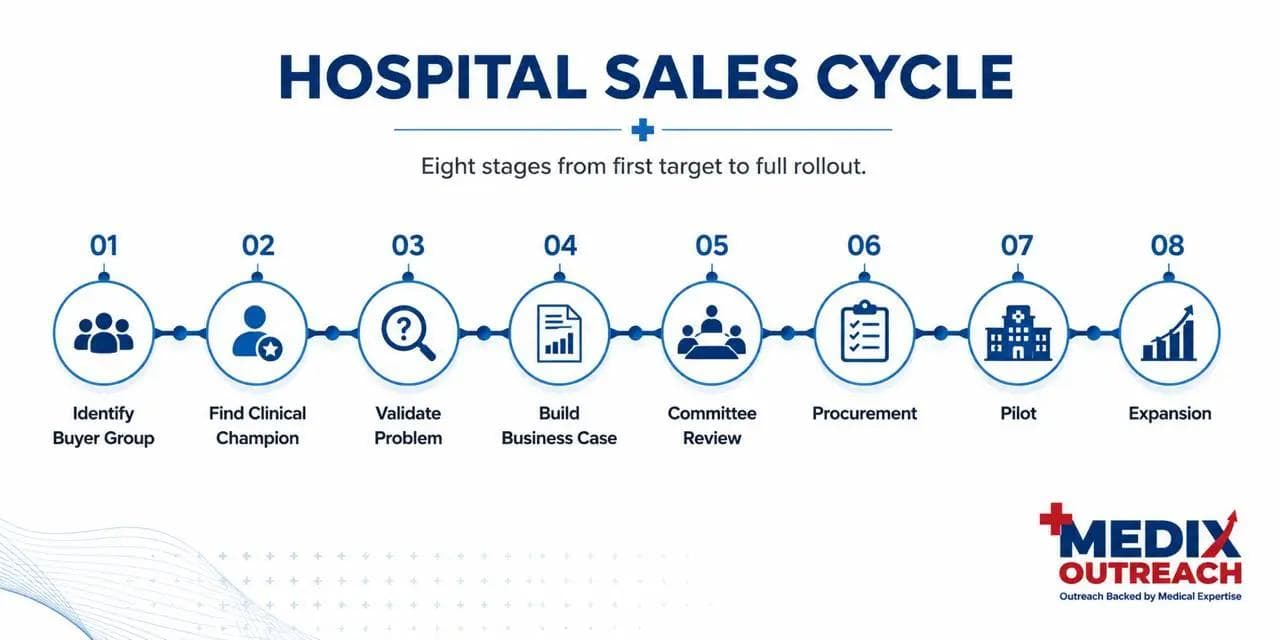
- Identify the right department or buyer group. Get specific about who owns the problem you solve.
- Find a clinical champion. Secure an internal advocate who will carry the story forward.
- Validate the problem. Confirm the pain is real, measurable, and worth solving now.
- Build the business case. Assemble the clinical, operational, and financial argument together.
- Navigate committee review. Support your champion through value analysis, pharmacy, or P&T review as needed.
- Handle procurement and vendor onboarding. Work through pricing, contracts, security, and credentialing.
- Run a pilot or limited rollout. Prove the value in a contained setting with clear success measures.
- Expand if results are proven. Use pilot results to grow into more departments or sites.
The biggest planning mistake is treating this as a two-month process. Build your pipeline and cash flow expectations around the real timeline, not the one you wish were true.
Common mistakes vendors make when selling to hospitals
Most stalled hospital deals trace back to a handful of avoidable errors.
- Pitching too early. Leading with the product before understanding the buyer's problem.
- Targeting the wrong person. Spending weeks on someone with interest but no authority or budget.
- Ignoring pharmacy or value analysis. Missing the committees that can quietly block a deal.
- Using generic SaaS messaging. Talking like a general software vendor to a clinical audience.
- Not preparing evidence. Showing up without the clinical and financial proof committees expect.
- Underestimating the sales cycle. Running out of patience or budget right before the decision.
- Treating hospitals like small clinics. Applying an owner-operator sales motion to a committee-driven system.
Where a pharmacist-led approach helps
This is the part most outside sales teams get wrong, and it is where a clinical perspective changes the outcome.
Hospitals are clinical organizations. The people who evaluate your product speak a specific language and weigh specific tradeoffs. A pharmacist-led approach to outreach helps because pharmacists work inside that world every day. They understand:
- Formulary logic and how medication decisions actually get made.
- Clinical workflows and where a product either fits or creates friction.
- Provider concerns about safety, evidence, and patient impact.
- Medication access and the practical realities of getting something used.
- Care team language, so outreach reads as credible rather than salesy.
- The commercial and clinical tradeoffs a committee is weighing.
- How healthcare buyers evaluate risk before they evaluate features.
This is the approach Medix Outreach is built around. As a pharmacist-led healthcare outreach, business development, and growth partner, Medix helps companies translate a good product into a message and a motion that healthcare buyers take seriously. The point is not to sound clinical for its own sake. It is to make your outreach relevant to the people who actually decide.
Example: turning provider access into a real GTM motion
Consider a common scenario. A healthcare company has a genuinely useful product, but the team is stuck. They are not sure which provider roles to target, how to explain the value in the buyer's terms, or how to build outreach that earns meetings instead of silence.
This is a positioning and go-to-market problem, not a product problem. The work is to clarify the ideal customer profile, define which roles to reach first, shape a message that speaks to clinical and economic value, identify the right targets, and build a repeatable outreach motion that can be measured and improved.
That is the type of engagement Medix focuses on: helping healthcare, pharma, device, and healthtech teams turn provider access into a structured GTM motion rather than a series of one-off attempts. For related examples of provider-focused outreach work, see the Medix case studies.
Frequently asked questions
How long does it take to sell to hospitals?
It varies widely by product and buyer, but many hospital deals take several months to more than a year. Anything that touches patient care, requires committee review, or needs procurement and security approval tends to sit at the longer end. Plan your pipeline and budget around a realistic timeline rather than a best case.
Who should I contact first when selling to a hospital?
Start with the person closest to the problem you solve, usually a clinical champion or department leader who feels the pain directly. Their advocacy is what earns you access to the broader buying group. Reaching a senior administrator too early, before you have an internal story, often leads nowhere.
Do I need a GPO contract to sell to hospitals?
Not always, but it depends on the product category and the health system. Many hospitals buy through group purchasing organizations or integrated delivery networks, and being on the right agreement can remove friction. In other cases you can start with a pilot or a single site and pursue broader contracts once value is proven.
How do startups sell to hospitals without existing health-system logos?
Lead with evidence and a focused champion rather than brand recognition. A well-run pilot at one site, credible clinical or economic data, and support from a respected clinician can carry more weight than a long customer list. Narrow your target, prove value in a contained setting, and use that result to open the next door.
What is the difference between selling to hospitals and selling to clinics?
Clinics often have a shorter path to a decision, sometimes an owner-operator or a small group who can say yes quickly. Hospitals decide through committees, longer cycles, formal procurement, and more integration and compliance review. The message and the patience required are different, even when the underlying product is the same.
What is the best way to sell medical products to hospitals?
The best way to sell medical products to hospitals is to start with the clinical problem, identify the right champion, prepare evidence for the hospital buying committee, and build a business case before procurement starts. A product pitch alone is rarely enough.
How can Medix help with hospital or provider outreach?
Medix Outreach helps healthcare, pharma, device, and healthtech companies build the strategy, messaging, and outreach motion needed to reach hospitals, health systems, and providers. That includes clarifying the ideal customer profile, mapping the right roles, shaping role-specific messaging, and building a repeatable outreach process. You can start with a free growth strategy session.
Final thoughts
Selling to hospitals and selling to health systems both reward trust, evidence, role-specific messaging, and patience. The companies that win are not always the loudest or the best funded. They are the ones that understand how the healthcare buying process really works and build a go-to-market motion around it.
If you get the buyer map right, speak to clinical and economic value at the same time, and stay in the process long enough to earn a pilot, hospital selling becomes far more predictable.
If your team is trying to reach hospitals, health systems, providers, or healthcare decision-makers, Medix Outreach can help build the outreach strategy, messaging, and sales pipeline needed to start the right conversations.
Explore Medix Outreach services to see how we support healthcare outreach, business development, and sales pipeline growth.