For many healthcare companies, hospitals represent the ultimate growth opportunity.
Whether you're selling healthcare SaaS, medical devices, clinical diagnostics, pharmaceutical solutions, remote patient monitoring platforms, or operational services, landing a hospital partnership can transform your business.
Yet many companies spend months on cold outreach with little to show for it.
Why?
Because hospitals don't buy the way most B2B organizations do.
Generic sales sequences, mass email campaigns, and high-volume prospecting rarely work in healthcare. Hospital purchasing is built around trust, clinical relevance, operational impact, and stakeholder alignment.
If you're wondering how to sell to hospitals more effectively, the answer isn't sending more emails. It's building a healthcare business development strategy that reflects how hospitals actually evaluate vendors.
Why Hospital Sales Cycles Are Different
Hospitals are among the most complex buyers in healthcare.
Unlike traditional B2B organizations, purchasing decisions often involve multiple departments, clinical leaders, IT teams, procurement, finance, legal, compliance, and executive leadership.
A physician may recognize the value of your solution, but they're rarely the only decision-maker.
Before a hospital invests in a new product or service, they want to understand:
- Does it improve patient care?
- Will it integrate into existing workflows?
- Is implementation realistic?
- Does it reduce operational burden?
- Is there measurable financial value?
- Can we trust this vendor?
Understanding these priorities is the first step toward successful healthcare provider outreach.
Mistake #1: Treating Every Hospital the Same
Not every hospital operates the same way.
A community hospital has different priorities than a large academic medical center. Rural facilities face different challenges than integrated health systems.
Successful healthcare market entry begins with segmentation.
Instead of targeting "hospitals," define:
- Hospital size
- Ownership model
- Geographic region
- Clinical specialties
- Existing technology ecosystem
- Organizational priorities
A focused healthcare outreach strategy consistently outperforms generic prospecting.
Mistake #2: Selling Features Instead of Operational Outcomes
Hospital executives rarely purchase technology because it has more features.
They're investing in outcomes.
Your messaging should explain how your solution helps hospitals:
- Improve patient outcomes
- Reduce clinician burnout
- Increase operational efficiency
- Lower administrative workload
- Improve reimbursement opportunities
- Support regulatory compliance
Healthcare commercialization is about solving operational challenges, not showcasing product capabilities.
Mistake #3: Relying Only on Cold Outreach
Healthcare cold email and healthcare cold calling still have a place in commercial strategy, but they shouldn't be your only approach.
Hospitals respond better to multi-channel engagement.
An effective healthcare business development strategy combines:
- Personalized email outreach
- LinkedIn engagement
- Educational content
- Industry events
- Warm introductions
- Strategic partnerships
- Provider referral marketing
The goal isn't simply getting attention.
It's building credibility before asking for a meeting.
Mid-article CTA
Need help building your healthcare growth engine?
Medix helps healthcare startups, clinics, pharma companies, and provider-focused platforms build scalable commercial pipelines.
Book a Strategy CallMistake #4: Ignoring the Buying Committee
Many companies build messaging exclusively for physicians.
Unfortunately, physicians rarely make purchasing decisions alone.
A typical hospital buying committee may include:
- Clinical leadership
- Department directors
- Operations managers
- IT teams
- Procurement
- Compliance
- Finance
- Executive leadership
Each stakeholder evaluates your solution differently.
Your healthcare go-to-market strategy should provide value to every member of the committee, not just the clinical champion.
Mistake #5: Failing to Demonstrate Clinical Credibility
Hospitals work with vendors they trust.
Clinical credibility has become one of the strongest competitive advantages in healthcare business development.
Decision-makers quickly recognize whether your outreach demonstrates an understanding of:
- Clinical workflows
- Hospital operations
- Regulatory requirements
- Patient care challenges
- Healthcare economics
Organizations that combine healthcare expertise with commercial strategy consistently generate stronger engagement than companies relying on generic B2B messaging.
What Successful Hospital Outreach Looks Like
Selling to hospitals requires more than persistence.
It requires preparation.
Successful healthcare provider outreach includes:
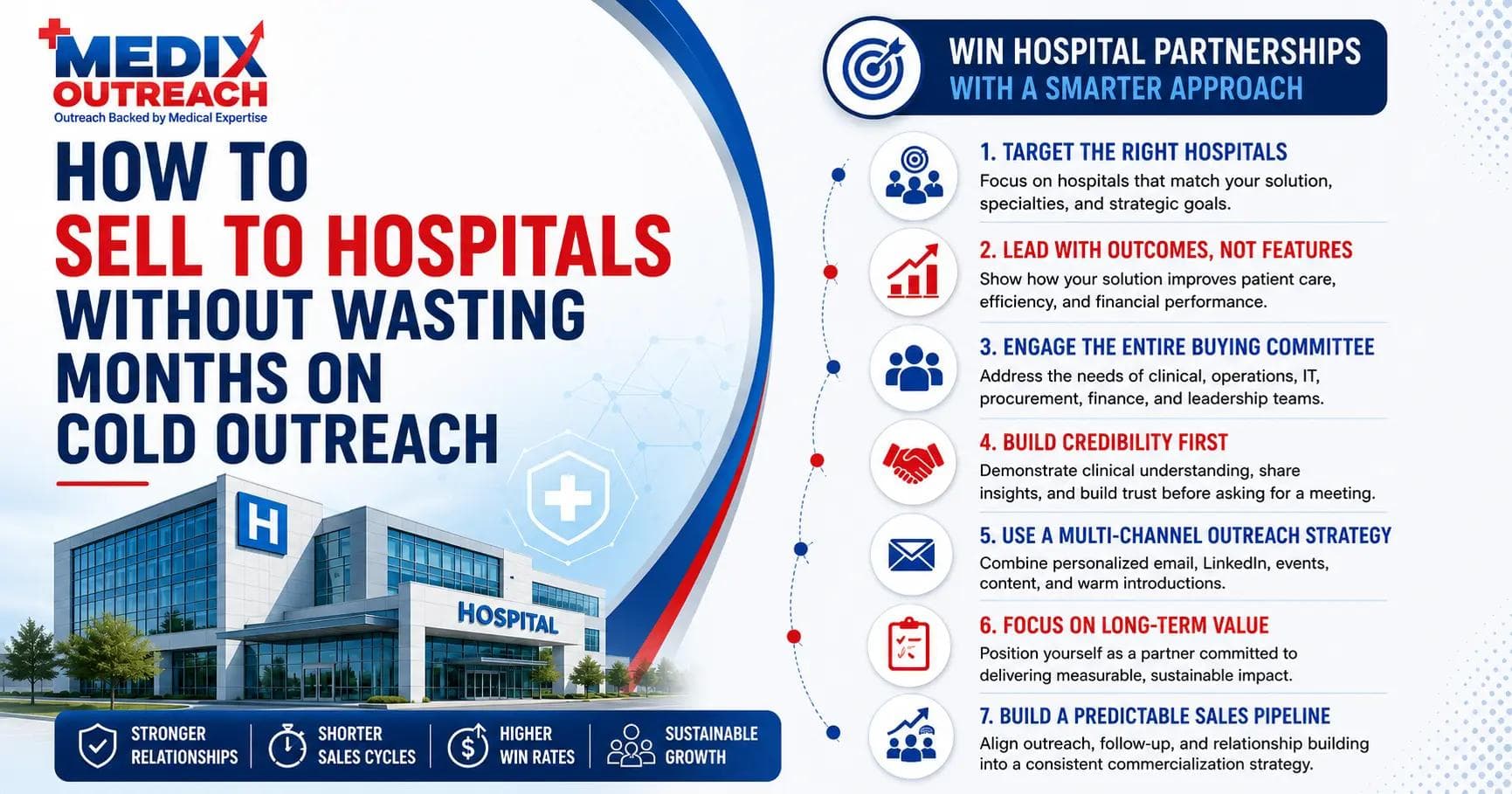
Define Your Ideal Hospital Profile
Identify the organizations most likely to benefit from your solution instead of targeting every hospital.
Build Stakeholder-Specific Messaging
Customize communication for physicians, executives, operations leaders, IT teams, and procurement.
Focus on Business Outcomes
Lead with measurable operational improvements rather than technical specifications.
Establish Credibility Before Selling
Share educational insights, industry expertise, and relevant healthcare content before requesting a meeting.
Build Relationships Across Multiple Channels
Healthcare email marketing, LinkedIn, strategic networking, conferences, and referral relationships should work together as one commercial strategy.
Commercialization Is Bigger Than Lead Generation
Many healthcare companies measure success by meetings booked.
Hospitals measure vendors by long-term value.
That's why commercialization extends far beyond healthcare lead generation.
It includes:
- Healthcare sales outsourcing
- Healthcare demand generation
- Provider outreach
- Healthcare prospecting
- Healthcare sales pipeline development
- Strategic partnerships
- Healthcare market expansion
Organizations that align these activities create sustainable commercial growth instead of inconsistent sales activity.
How Medix Outreach Helps Healthcare Companies Sell to Hospitals
At Medix Outreach, we believe selling to hospitals requires more than outbound campaigns.
It requires a healthcare commercialization strategy built around clinical credibility, stakeholder engagement, and long-term business development.
Our team combines pharmacist-led expertise with healthcare go-to-market strategy, provider outreach, healthcare sales outsourcing, pharmaceutical partnerships, and end-to-end revenue pipeline development.
Rather than functioning as another healthcare lead generation agency, we help healthcare companies build meaningful relationships with hospitals, health systems, providers, and healthcare decision-makers across the U.S. market.
Conclusion
Learning how to sell to hospitals isn't about finding the perfect cold email template.
It's about understanding how hospitals evaluate new solutions and building a commercial strategy that aligns with those realities.
Healthcare companies that invest in healthcare business development, provider outreach, healthcare demand generation, and commercialization consistently build stronger hospital relationships, shorten sales cycles, and create sustainable revenue growth.
The future belongs to organizations that combine healthcare expertise with strategic commercial execution, because hospitals don't buy from companies that shout the loudest. They buy from partners they trust.