

A clinically integrated network (CIN) is a group of independent providers that coordinate care and meet shared quality and efficiency standards; an accountable care organization (ACO) is a value-based arrangement where providers share accountability for a population's cost and quality. Both change one thing that matters enormously for referral growth: in value-based networks, referrals increasingly follow quality, cost, and coordination - not just personal relationships. This guide explains how these structures work and how to become a preferred referral partner inside them.
This shift builds on a broader trend we cover in how value-based care is redefining referral value: as networks take on financial risk, the definition of a valuable referral partner changes with it.
CIN vs. ACO: clearing up the terms
The terms overlap, which causes confusion. A CIN is about clinical integration - real coordination, shared data, and common performance standards among independent providers. Clinical integration can, where it meets legal tests, permit the network to negotiate jointly with payers. An ACO is a specific accountability arrangement for a population's total cost and quality, most visibly through the Medicare Shared Savings Program. In practice, one organization often runs a CIN and participates in one or more ACO or commercial value-based contracts.
A regulatory note that matters: forming a network and contracting jointly draws antitrust scrutiny from the federal antitrust agencies. Older agency guidance specific to ACOs has been withdrawn in recent years, and analysis is now more fact-specific, so network formation and joint contracting should always be structured with qualified counsel rather than assumed to fit a safe harbor.
How value-based incentives steer referrals
In fee-for-service, a referral is driven by relationships and habit, and it can go almost anywhere. In a value-based network, the economics change the behavior.
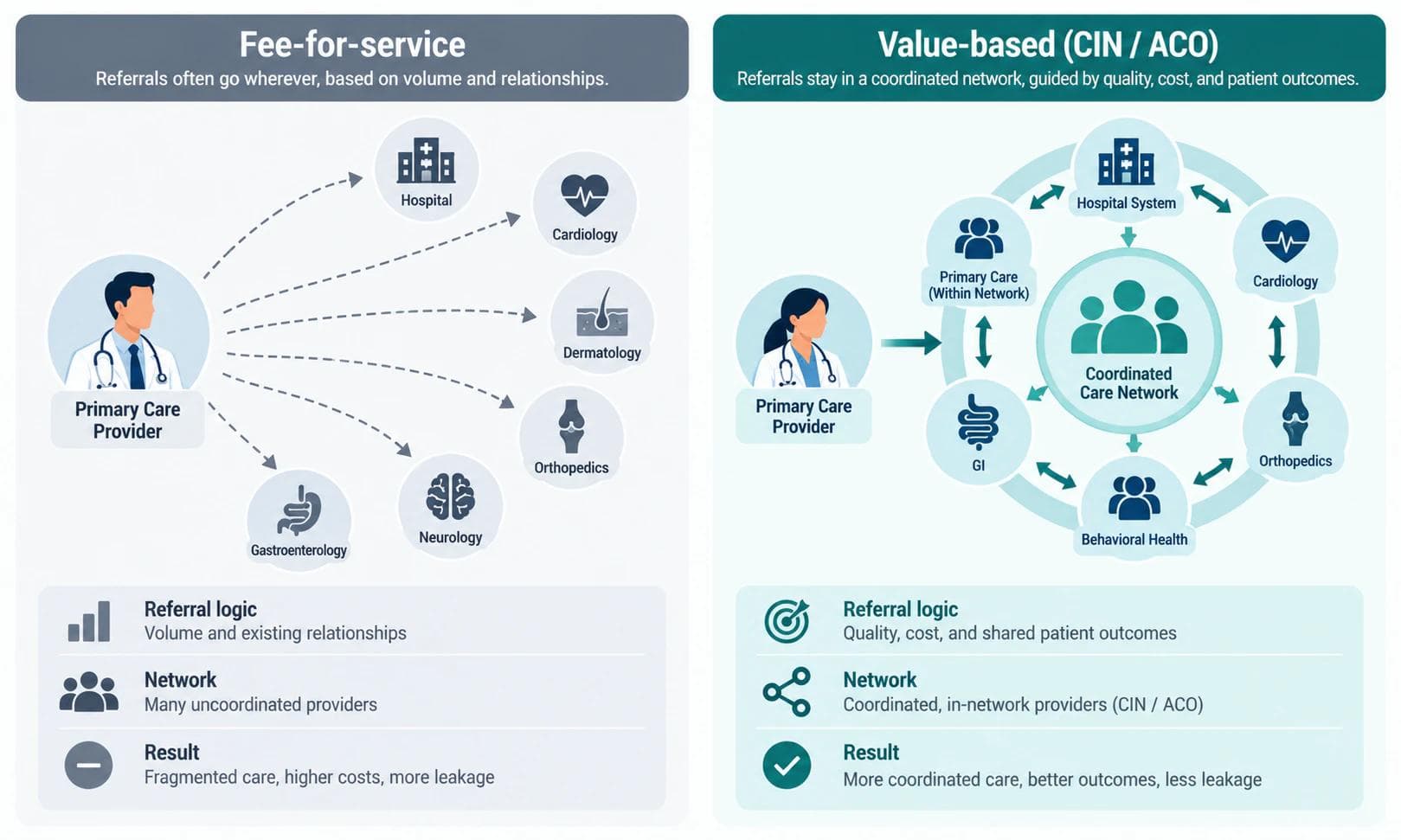
When a network is accountable for the total cost and quality of a population, every referral outside the coordinated group risks adding cost, fragmenting care, and missing quality targets that determine shared savings. So networks actively reduce out-of-network leakage and concentrate referrals with in-network providers who perform. For a specialty practice, this is both a threat and an opportunity: if you are outside the preferred set, referrals you used to receive can quietly disappear; if you are inside it, coordinated referral volume can grow.
What networks look for in a referral partner
Preferred-partner status in a CIN or ACO is earned on measurable performance, not relationships alone:
- Quality performance - outcomes and adherence to the network's clinical standards, with data to prove it.
- Cost efficiency - total cost of care for referred episodes, including avoidable utilization.
- Access - the ability to see referred patients quickly, which protects both outcomes and cost.
- Care coordination - closed-loop communication and timely notes back to the referring provider.
- Data capability - the ability to share and receive structured data so the network can measure you.
These are the same fundamentals behind strong provider network development, now with a scorecard attached. The difference in a value-based world is that your performance is measured and compared, so vague reputation is replaced by data.
How to become a preferred referral partner
- Map the networks in your market. Identify the CINs, ACOs, and value-based contracts that touch your specialty and geography, and who runs them.
- Get your data house in order. You cannot prove quality, cost, or access without clean data. This is often the first real work.
- Prove access and coordination. Show fast time-to-appointment and reliable closed-loop reporting - the operational proof networks care about most.
- Approach as a partnership, not a pitch. Networks add partners who help them hit targets. Frame the conversation around their shared-savings and quality goals, the same posture behind effective healthcare partnerships.
- Structure arrangements with counsel. Any joint contracting or formal participation needs legal and antitrust review up front.
Mid-article CTA
Need help building your healthcare growth engine?
Medix helps healthcare startups, clinics, pharma companies, and provider-focused platforms build scalable commercial pipelines.
Book a Strategy CallFor healthcare companies selling into these networks
If you sell a service or technology rather than clinical care, value-based networks are a specific buyer with specific goals: reduce leakage, improve coordination, and hit quality and cost targets. Solutions that help a network keep referrals in-network, measure partner performance, or coordinate transitions map directly to what these buyers are accountable for. Adjacent payment models like Medicare, BHI, and CoCM show how reimbursement is increasingly built around coordination - the same logic that governs CINs and ACOs.
Questions to ask before joining a network
Preferred-partner status is valuable, but participation carries obligations. Before you commit, get clear answers:
- How is performance measured, and against what benchmarks? You need to know the scorecard before you are graded on it.
- What data are you expected to share, and can your systems do it? Data capability is often the real barrier.
- What is the referral expectation - are you a preferred destination, or one of many?
- How does the economic model work - shared savings, care coordination fees, or referral access only?
- What are the exit terms if the arrangement underperforms?
- Has counsel reviewed the participation and any joint-contracting terms? Never skip this step.
Whether you are a practice seeking preferred-partner status or a company selling into value-based networks, positioning is everything. Medix's Provider Network Development and Strategic Partnerships, Licensing & Market Expansion teams help healthcare organizations navigate exactly this landscape.
Frequently Asked Questions
What is a clinically integrated network (CIN)?
A clinically integrated network is a group of otherwise independent providers that coordinate care, share data, and are held to common quality and efficiency standards. Clinical integration can allow the network to contract jointly with payers where it meets legal requirements - but the defining feature is genuine coordination, not just a contracting label.
How is a CIN different from an ACO?
An ACO (accountable care organization) is a specific value-based arrangement - often within a program like the Medicare Shared Savings Program - where providers share accountability for the cost and quality of a defined population. A CIN is a broader clinical-integration structure that may participate in ACO or commercial value-based contracts. Many organizations operate both.
Why do value-based networks steer referrals in-network?
Because the network is accountable for total cost and quality, keeping referrals with coordinated, high-performing in-network providers helps it hit shared-savings and quality targets. Out-of-network referrals can add cost and break care coordination, so networks actively work to reduce that leakage.
How does a specialty practice join or partner with a CIN or ACO?
Networks admit and retain partners based on quality performance, cost efficiency, data-sharing capability, access, and care coordination. Demonstrating those - with data - is how a practice earns and keeps preferred-referral status. Joint contracting arrangements should be structured with counsel.