

Plenty of healthcare businesses live or die on the strength of their provider network. A telehealth company needs clinicians to see patients. A specialty pharmacy needs prescribers who trust its fulfillment. A management services organization needs affiliated practices. A value based care platform needs providers who will actually use it. In every one of these models, the network is the product, and building it is a discipline in its own right.
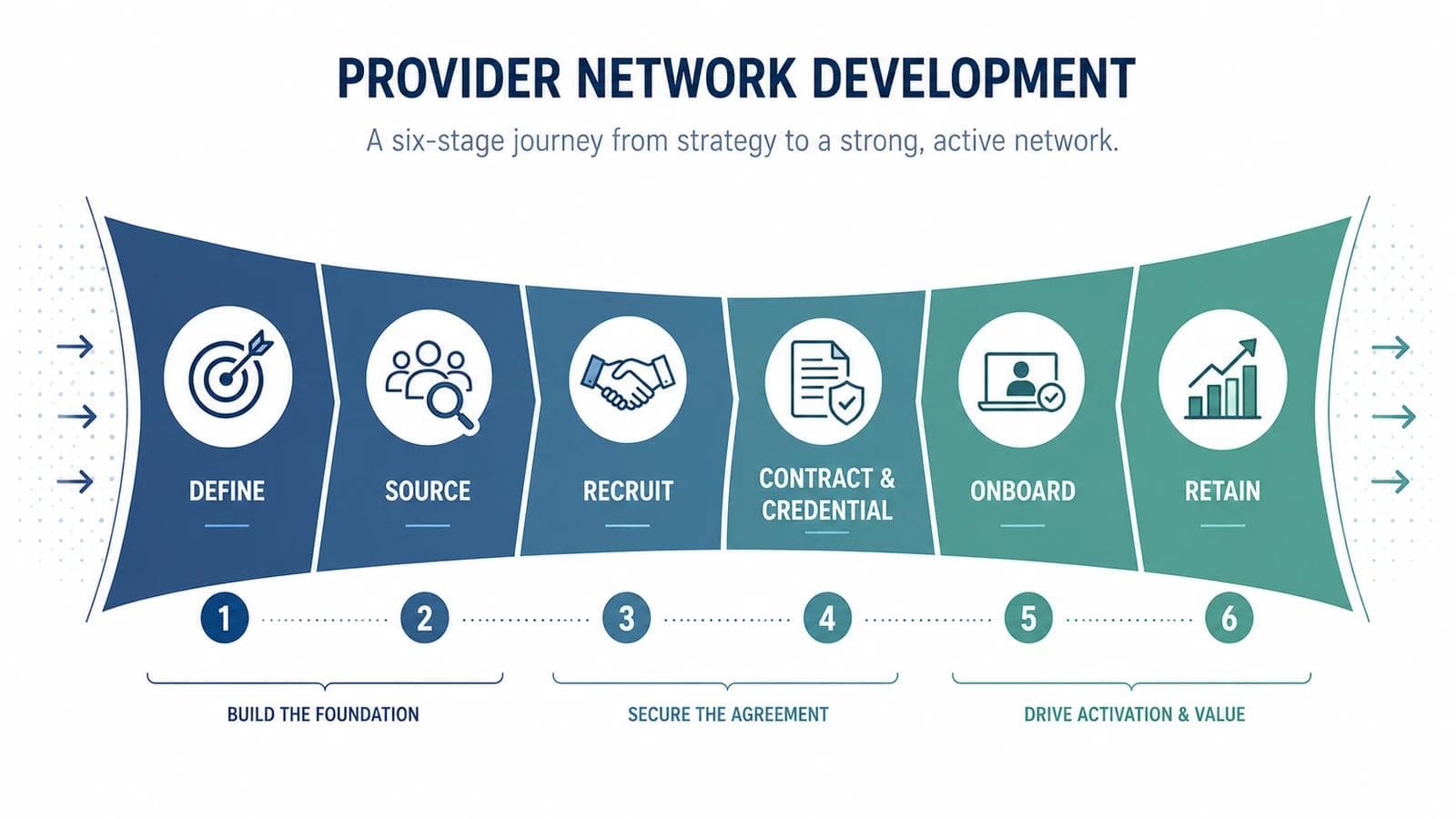
Provider network development is that discipline. It is the work of deciding which providers you need, reaching them, bringing them in cleanly, and keeping them active and engaged over time. Done well, it becomes a durable growth engine. Done casually, it produces a long list of signed up providers who never do anything, which is one of the most common and expensive failures in healthcare growth.
This guide walks through provider network development end to end, from planning the network you actually need to recruiting, contracting, onboarding, and retaining the providers who make it work.
What Provider Network Development Actually Means
Provider network development is often confused with two related but different activities, so it helps to draw clean lines.
It is not the same as marketing a product to providers. Selling a device or a software tool to a physician is a transaction where the provider is the buyer. Guidance on that motion lives in our posts on how to market to doctors and healthcare provider marketing.
It is also not the same as generating patient referrals into a single practice, which is its own playbook covered in how to get more physician referrals.
Provider network development is the supply side work of building a network of providers who deliver, prescribe, refer, or participate on behalf of your organization. The provider is not just a customer. The provider becomes part of how you deliver value to patients and payers. That difference shapes everything that follows, because you are not closing a one time sale. You are recruiting a participant into a relationship that has to keep working.
Who Needs to Build a Provider Network
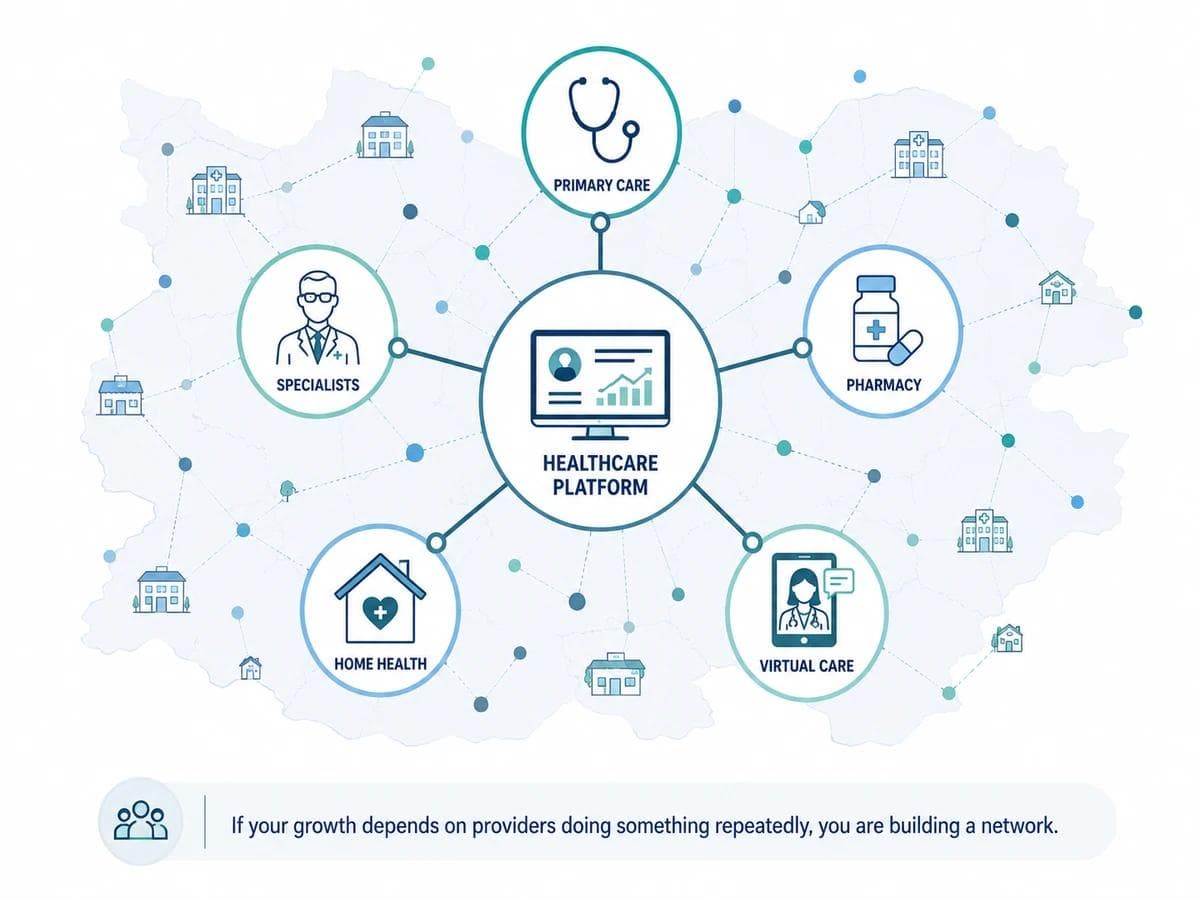
If your growth depends on providers doing something repeatedly, you are in the network development business whether you call it that or not. Common models include:
- Telehealth and virtual care platforms that need licensed clinicians across many states.
- Digital health and care management companies that need a panel of providers to prescribe, supervise, or co-manage patients.
- Management services organizations and independent practice associations that grow by affiliating practices.
- Specialty and compounding pharmacies that depend on a base of prescribing providers.
- Home health, remote monitoring, and diagnostics companies that rely on ordering and referring providers.
- Value based care organizations that need participating providers to hit quality and cost goals.
- Marketplaces and networks whose entire value proposition is the breadth and quality of their provider supply.
The details differ, but the core challenge is shared. You need the right providers, in the right places, brought in the right way, and kept active. This is the work Medix does inside its provider network development practice.
Get Clear on the Network You Need Before You Recruit
The most common mistake is recruiting before defining. Teams chase any provider who will sign, then discover the network is unbalanced, non compliant, or full of inactive names. Define the target network first.
Specialty and role mix. Which specialties and provider types do you actually need, and in what proportion? A weight management platform needs different clinicians than a cardiology focused one.
Geography and coverage. Where do you need providers, and at what density? For anything touching insurance, network adequacy standards may set minimum coverage requirements. The Centers for Medicare and Medicaid Services publishes network adequacy criteria for Medicare Advantage that illustrate how coverage is measured, and similar logic applies to many state and commercial contexts.
Quality and credentials bar. Decide the minimum standard for licensure, board certification, malpractice history, and reputation before you start, not after a problem appears.
Economics. Understand what each provider relationship costs to acquire and maintain, and what it needs to return, so the network is sustainable as it scales.
Writing this down turns recruiting from a numbers game into a targeting exercise. It also makes it obvious when you are signing providers who do not fit, which is exactly when to stop.
Build a Provider Value Proposition Worth Saying Yes To
Providers are busy, skeptical, and pitched constantly. Before you recruit, answer one question honestly. Why would a good provider want to join your network?
The strongest answers are concrete and provider centered:
- Meaningful patient volume or revenue without heavy administrative work.
- A workflow that fits how the provider already practices rather than fighting it.
- Clinical alignment with care the provider believes in.
- Simplicity and support, from clean onboarding to responsive help.
- Reputation and belonging, especially when respected peers already participate.
Provider psychology matters here as much as economics. Clinicians extend trust to organizations that clearly understand their world and treat their time with respect. Outreach that leads with your needs instead of theirs fails for the same reasons most healthcare outreach fails, a pattern we break down in why cold outreach fails in healthcare. Lead with what the provider gains and the reason it is credible.
Source and Recruit the Right Providers
With a clear target and a real value proposition, recruiting becomes systematic.
Build good source data. Start from accurate provider data segmented by specialty, location, practice type, and any signals that indicate fit. Quality of data drives quality of network.
Segment and prioritize. Not every target is equal. Identify anchor providers and respected local names whose participation makes it easier to recruit others. A few well regarded clinicians can pull a segment of a market with them.
Personalize outreach by segment. A solo practitioner, a group practice, and a health system employed physician have different incentives and constraints. Speak to each in their own terms rather than sending one generic invitation.
Make the first step small. A short, specific conversation converts better than a demand for a long commitment. Reduce friction at every early step.
Follow up with discipline. Providers are hard to reach and rarely respond the first time. Consistent, respectful follow up is what separates a growing network from a stalled one.
Credentialing, Contracting, and Compliance
Bringing a provider in is not just outreach. It is a regulated relationship, and cutting corners here creates risk that surfaces later.
Credentialing. Verify licensure, board certification, malpractice history, and any required screening to a defined standard. In insurance contexts, credentialing is often mandatory and time consuming, so build it into your timeline rather than treating it as an afterthought.
Contracting. Provider agreements should be clear about scope, expectations, payment, data use, and termination. Clean contracts prevent disputes and set the tone for a professional relationship.
Compliance. Financial relationships with providers intersect with federal fraud and abuse law. Arrangements that involve referrals or federal health program business must be structured with the Anti-Kickback Statute and physician self referral rules in mind, and the Department of Health and Human Services Office of Inspector General publishes safe harbor regulations that your counsel should review. Payments to providers may also carry transparency obligations under the Open Payments program that the Centers for Medicare and Medicaid Services administers. Involve compliance early. It is far cheaper than fixing a flawed structure later.
Mid-article CTA
Need help building your healthcare growth engine?
Medix helps healthcare startups, clinics, pharma companies, and provider-focused platforms build scalable commercial pipelines.
Book a Strategy CallOnboard for Fast Activation
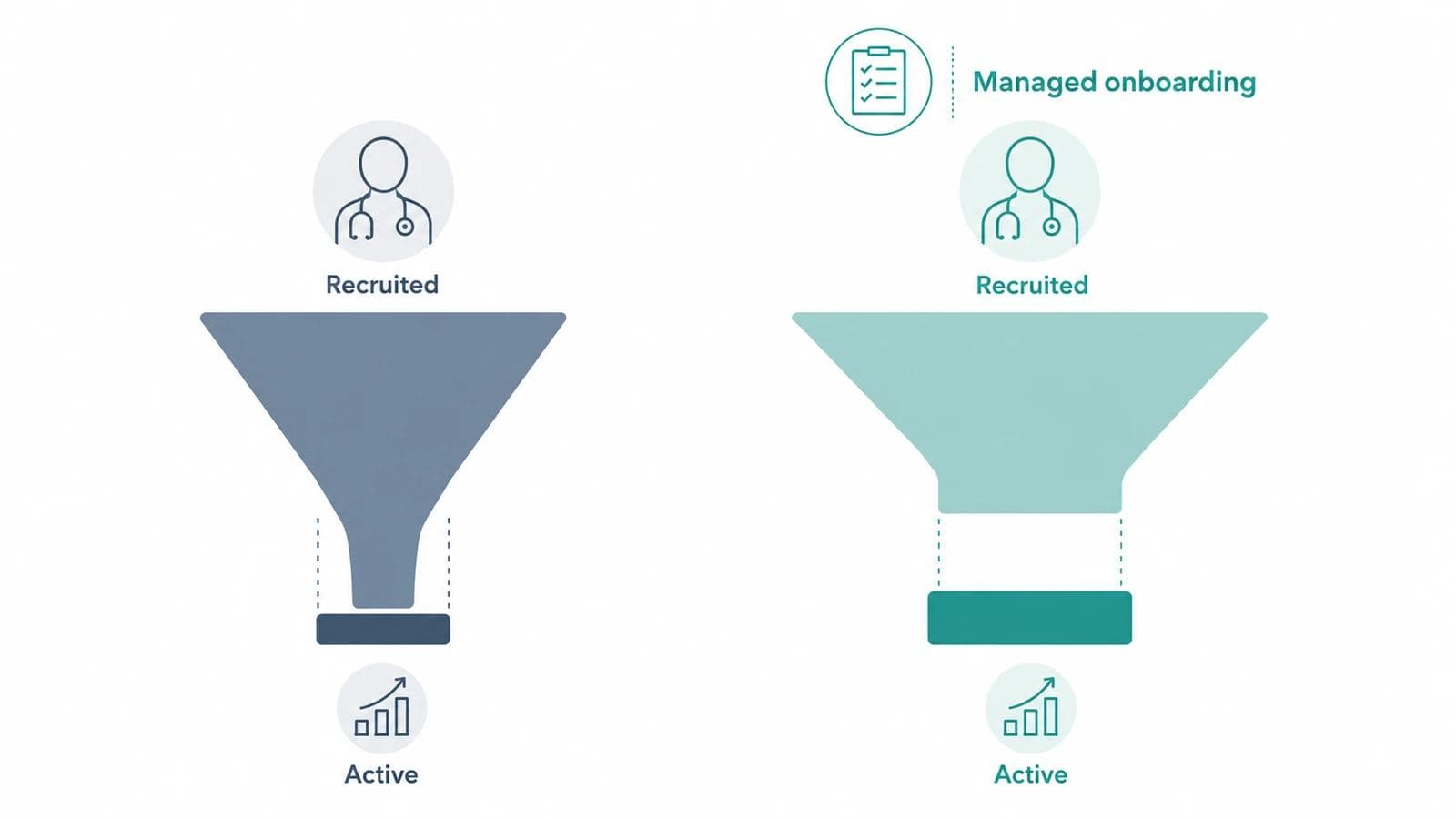
Here is the failure that quietly kills provider networks. A provider signs, and then nothing happens. The name is on the list, but the provider never sees a patient, never prescribes, never refers. Recruited is not the same as active, and the gap between them is where most network value leaks away.
Onboarding is the bridge. Treat the first thirty to sixty days as a distinct workstream with one goal, which is the provider's first real action inside your network.
- Remove every avoidable step between signing and first use.
- Give providers and their staff a clear, short path to the first patient, order, or prescription.
- Support the people around the provider. Practice managers and staff often determine whether a provider actually engages.
- Measure time to first action and treat delays as problems to solve, not as the provider's fault.
This is exactly what strong provider positioning enables. When Medix repositioned a provider platform around what clinics actually cared about, onboarding accelerated and the network expanded quickly, a story told in the provider positioning for clinic adoption case study.
Retain and Grow the Network
A network is not built once. Providers drift, priorities change, and an unattended network erodes. Retention is a continuous program, not a checkbox.
- Keep providers engaged with useful communication, education, and responsiveness rather than silence between transactions.
- Make participation easy to sustain, because friction that is tolerable at signup becomes a reason to disengage over time.
- Watch for early warning signs, such as declining activity, and reach out before a provider goes dormant.
- Grow from within. Satisfied providers refer peers, and peer referral is often the most efficient recruiting channel you have.
The pattern shows up repeatedly in real work. In one psychiatry engagement, consistent, education led provider engagement turned local relationships into a durable referral stream, described in the psychiatry provider referral engine case study. In another, pairing provider outreach with local demand created growth on both sides at once, covered in the specialty pharmacy provider outreach case study.
Metrics That Tell You the Network Is Healthy
Vanity counts like total signed providers hide more than they reveal. Track the measures that reflect a working network.
- Coverage and adequacy. Do you have the specialties and geographic density you defined as the target?
- Time to activation. How long from signature to first real action, and is it improving?
- Active provider rate. What share of recruited providers are actually doing something on a recurring basis?
- Retention and churn. Are providers staying active over time, and where are you losing them?
- Utilization per provider. Volume of patients, orders, prescriptions, or referrals per active provider.
- Peer referral rate. How many new providers come from existing ones?
If you improve activation and retention, you can often grow the network faster than by recruiting harder, because you stop losing the providers you already worked to win.
Frequently Asked Questions
What is the difference between provider network development and provider marketing?
Provider marketing sells a product to providers who act as buyers. Provider network development recruits providers into your network so they deliver, prescribe, refer, or participate on your behalf. One closes a sale. The other builds an ongoing relationship that has to keep producing.
How do you recruit providers to a new network with no track record?
Start with a specific, provider centered value proposition and recruit anchor providers whose participation lends credibility. Respected local names make it easier to recruit their peers. Keep the first step small, personalize outreach by segment, and follow up consistently.
Why do so many recruited providers stay inactive?
Usually because onboarding is neglected. Signing a provider is only the start. Without a deliberate path to the first patient, order, or prescription, and support for the staff around the provider, many recruits never activate. Treat the first sixty days as a dedicated activation workstream.
What compliance issues matter in provider network development?
Financial relationships with providers intersect with the Anti-Kickback Statute and physician self referral rules, and payments may carry Open Payments transparency obligations. Credentialing standards also apply, especially in insurance contexts. Involve compliance counsel before you structure provider arrangements.
How do you measure whether a provider network is working?
Look past total signed providers. Track coverage against your target, time to activation, the share of providers who are actively participating, retention over time, and utilization per active provider. A smaller active network usually beats a large dormant one.
Build the Network In-House or With a Partner
Once you know what network development requires, a practical question follows. Do you build the capability in-house or bring in a partner?
Building in-house makes sense when provider network development is core to your business for the long term and you have time to develop the skills. It gives you full control and keeps the relationships entirely yours. The cost is time. Hiring, training, and learning provider outreach by trial and error can take many months, and early mistakes happen on real providers you would rather not burn.
Partnering makes sense when you need to move faster than an in-house build allows, or when you lack healthcare-specific outreach experience. A partner who already understands provider psychology, credentialing, and activation can compress the learning curve and reach providers credibly from the start. That is especially valuable in the early stages, when speed and a strong first impression with providers matter most.
Many companies do both. They use a partner to build the initial network and establish the playbook, then bring the ongoing work in-house once the motion is proven. The right choice depends on how central the network is to your model, how fast you need it, and whether the expertise already exists on your team.
Build the Network Before You Need It
Provider networks are slow to build and fast to matter. The companies that win are the ones that treat network development as a real discipline rather than a recruiting sprint. They define the network they need, build a value proposition providers actually want, recruit with focus, contract cleanly, and put as much energy into activation and retention as they do into signing.
The payoff is a network that compounds. Active providers deliver, refer peers, and stay, which lowers the cost of every provider you add after them. That is the difference between a list of names and a network that grows your business.