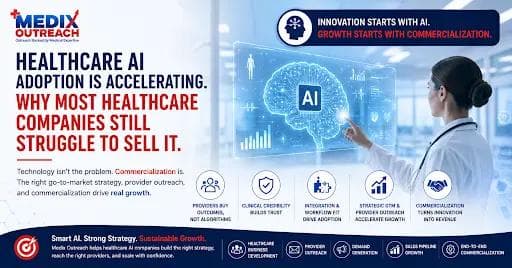
Artificial Intelligence is transforming healthcare at an unprecedented pace.
From clinical decision support and ambient documentation to revenue cycle automation, predictive analytics, remote patient monitoring, and AI-powered diagnostics, innovation is moving faster than ever.
Yet many healthcare AI companies share the same frustration:
“Our product is impressive. Why aren’t providers buying it?”
The answer is rarely the technology.
It’s commercialization.
In 2026, healthcare organizations aren’t evaluating AI based on how intelligent it is. They’re evaluating whether it solves real clinical problems without disrupting existing workflows.
Companies that understand this distinction are scaling rapidly.
Those that don’t are watching long sales cycles, stalled demos, and inconsistent revenue become the norm.
AI Innovation Doesn’t Equal Market Success
Healthcare startups often assume that better technology automatically leads to faster adoption.
Healthcare doesn’t work that way.
Hospitals, physician groups, and healthcare executives purchase solutions based on trust, workflow integration, compliance, operational impact, and measurable outcomes.
An AI platform may outperform competitors technically, but if providers can’t see how it improves patient care or fits into daily operations, adoption will remain slow.
This is why healthcare commercialization has become just as important as product development.
Providers Buy Outcomes, Not Algorithms
Healthcare professionals rarely ask:
“What AI model are you using?”
Instead, they ask:
- Will this reduce clinician burnout?
- Can this save staff time?
- Does it improve patient outcomes?
- Will it integrate with our EHR?
- Is implementation realistic?
- Can my team adopt it quickly?
Companies that lead with technical features instead of clinical value often lose opportunities before meaningful conversations begin.
Clinical Credibility Is the Competitive Advantage
AI companies entering healthcare often underestimate how important industry expertise has become.
Healthcare buyers expect vendors to understand:
- Clinical workflows
- Documentation challenges
- Reimbursement models
- Regulatory requirements
- Operational pressures
Commercial teams without healthcare expertise struggle to build trust.
Organizations that combine clinical knowledge with provider outreach create stronger relationships and healthier healthcare sales pipelines.
Mid-article CTA
Clinical Credibility Is the Competitive Advantage
Medix helps healthcare AI companies translate technical capabilities into clinical value, provider-ready messaging, and a go-to-market motion that creates qualified commercial conversations.
Explore Commercial Growth ServicesWhy Generic GTM Strategies Fail Healthcare AI Companies
Traditional SaaS playbooks rely on:
- High-volume cold email
- Automated outreach
- Product-led messaging
- Short sales cycles
Healthcare buying journeys are different.
Successful healthcare go-to-market strategies combine:
- Healthcare business development
- Provider outreach
- Educational content
- Strategic partnerships
- Healthcare demand generation
- Long-term relationship building
Healthcare AI isn’t sold through automation alone.
It’s commercialized through trust.
The Future Belongs to Healthcare Commercialization
As AI becomes more accessible, technology alone will no longer differentiate healthcare companies.
Commercial execution will.
Organizations that invest in healthcare commercialization, provider engagement, healthcare sales outsourcing, and strategic business development will build stronger partnerships and sustainable revenue growth.
The companies that win won’t necessarily have the most advanced AI.
They’ll have the strongest commercialization strategy.
How Medix Outreach Helps Healthcare AI Companies Grow
Medix Outreach helps healthcare AI companies move beyond traditional lead generation by building commercialization strategies designed specifically for healthcare.
Our team combines pharmacist-led expertise with healthcare business development, provider outreach, healthcare go-to-market strategy, healthcare sales outsourcing, strategic partnerships, and end-to-end revenue pipeline development.
Whether you’re launching an AI-powered healthcare SaaS platform, clinical decision support tool, diagnostics solution, or operational technology, we help you reach the right healthcare decision-makers and build lasting commercial relationships across the U.S. market.
Conclusion
Healthcare AI adoption is accelerating, but adoption alone doesn’t guarantee commercial success.
Healthcare companies that align innovation with clinical credibility, provider outreach, healthcare business development, and commercialization will outperform competitors focused solely on technology.
In healthcare, the companies that grow fastest aren’t always the ones building the smartest AI.
They’re the ones building the strongest commercial strategy.