
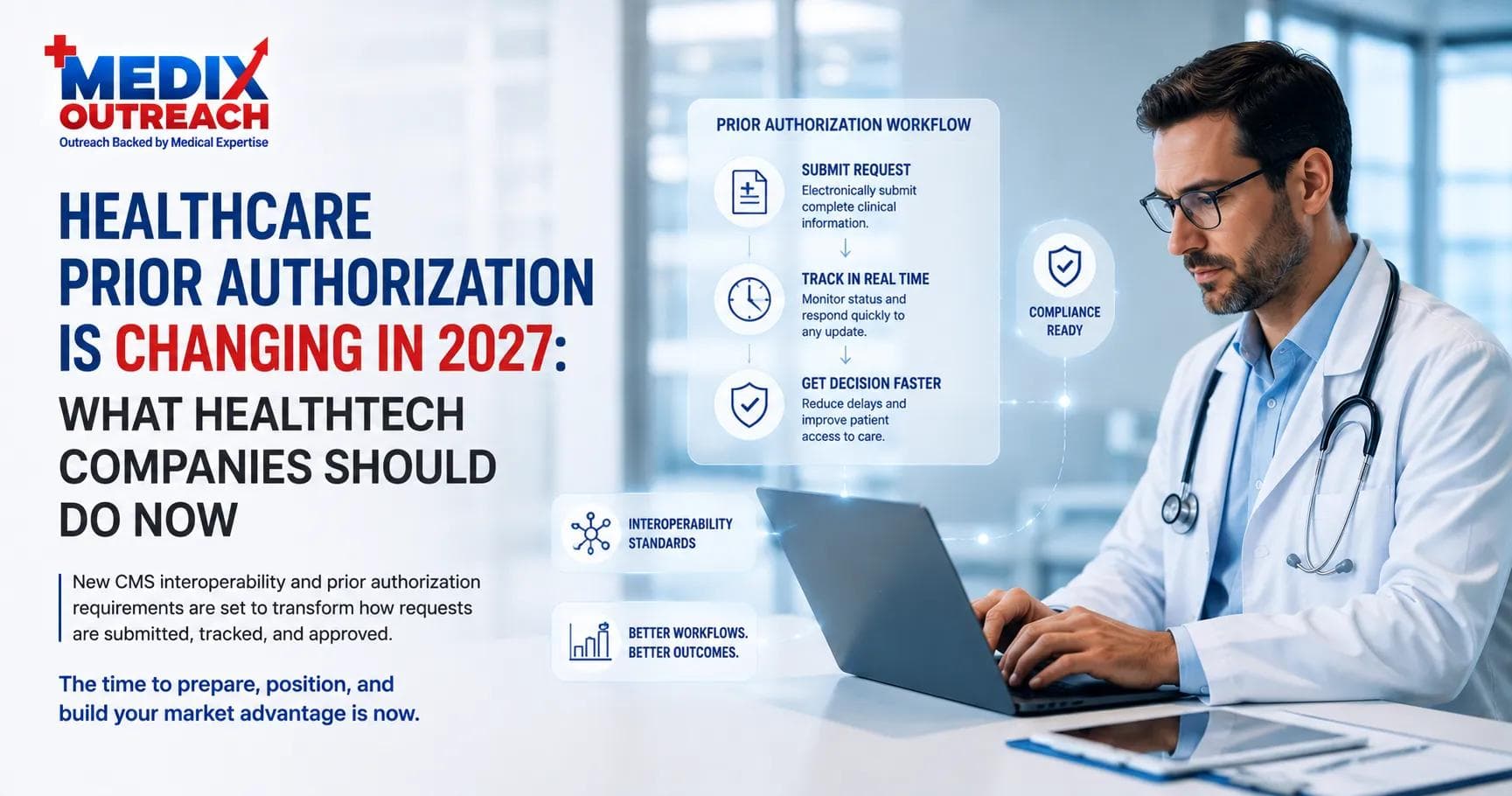
The healthcare industry is entering another major shift in how prior authorization is managed.
For years, prior authorization has been one of the biggest administrative challenges for providers, patients, and payers. Manual documentation, phone calls, portal submissions, and fragmented workflows have created delays that affect both healthcare organizations and the companies building technology for them.
Now, the market is moving toward greater automation and interoperability.
In April 2026, CMS proposed new interoperability and prior authorization requirements that would extend electronic prior authorization standards to drugs and introduce additional FHIR and NCPDP requirements. Several proposed provisions would begin October 1, 2027.
For healthcare technology companies, this isn't simply a regulatory development.
It is a market opportunity.
Why Prior Authorization Is Becoming a Technology Opportunity
The traditional prior authorization process creates friction at almost every stage.
Providers have to determine coverage requirements, gather documentation, submit requests, respond to additional information requests, and track decisions.
Patients can experience delays in receiving medications and treatments.
Payers must process large volumes of requests while maintaining compliance and transparency.
This creates demand for technology that can connect the different parties involved.
Healthtech companies developing prior authorization automation, interoperability platforms, clinical documentation tools, revenue cycle solutions, and payer-provider workflow technology are entering a market where the need is already established.
The challenge is no longer proving that the problem exists.
The challenge is commercializing the solution.
CMS Is Moving the Market Toward Electronic Workflows
CMS's 2026 proposed rule would expand electronic prior authorization requirements to certain drug-related processes and introduce additional interoperability standards.
For certain impacted payers, proposed requirements would begin in 2027, including support for electronic prior authorization for drugs covered under medical benefits. CMS also proposed requirements involving NCPDP standards for certain pharmacy-benefit workflows.
The broader direction is clear.
Healthcare is moving away from fragmented manual authorization workflows toward structured digital exchange.
That creates opportunities for companies that can help providers and payers make the transition.
The Commercial Opportunity Is Bigger Than Compliance
Healthcare companies should avoid positioning prior authorization technology simply as a compliance product.
Compliance may open the door.
Business value closes the deal.
A stronger healthcare go-to-market strategy connects the technology to outcomes such as:
- Less administrative work
- Faster submission processes
- Better documentation
- Improved visibility into authorization status
- Fewer manual interactions
- More efficient provider workflows
- Better patient access
Healthcare decision-makers want to know what changes after implementation.
Mid-article CTA
Need help building your healthcare growth engine?
Medix helps healthcare startups, clinics, pharma companies, and provider-focused platforms build scalable commercial pipelines.
Book a Strategy CallWhy Provider Outreach Matters
A technology company can have an excellent prior authorization platform and still struggle to reach healthcare organizations.
Providers already receive large volumes of technology pitches.
Generic outreach such as "Our platform automates prior authorization" is unlikely to create meaningful engagement.
Healthcare provider outreach should instead demonstrate an understanding of the specific operational problem.
For example, messaging to a specialty practice should address how authorization requirements affect its workflow, staff time, documentation, and patient access.
This is where clinical and commercial expertise become important.
The Companies That Move Early Can Build Market Position
Regulatory deadlines create urgency, but they also create crowded markets.
As 2027 approaches, more vendors will position themselves around interoperability and prior authorization automation.
Healthcare companies that start building provider relationships now can establish credibility before the market becomes saturated.
That means:
- Identifying target provider segments
- Building clinical messaging
- Developing educational content
- Establishing provider relationships
- Creating strategic partnerships
- Testing commercial positioning
- Building a qualified healthcare sales pipeline
Waiting until the compliance deadline arrives means competing with everyone else at the same time.
How Medix Outreach Can Help
Medix Outreach helps healthcare technology companies turn market opportunities into commercial growth.
Our pharmacist-led team combines healthcare business development, provider outreach, healthcare go-to-market strategy, strategic partnerships, healthcare sales outsourcing, and revenue pipeline development.
For companies operating in interoperability, prior authorization, healthcare SaaS, revenue cycle management, clinical technology, and healthcare automation, the opportunity isn't simply to build the technology.
It's to become the trusted solution healthcare organizations choose when the market changes.
Conclusion
Prior authorization is moving toward a more connected and digital model.
The companies that benefit most won't necessarily be those with the most advanced technology.
They will be the companies that understand the regulatory environment, communicate clinical and operational value, reach the right healthcare decision-makers, and build commercial relationships before demand peaks.
2027 may be the compliance milestone.
2026 is the time to build the market.