Healthcare providers have never been harder to reach.
Physicians receive hundreds of emails every week. Practice managers are overwhelmed with vendor requests. Hospital administrators face constant pressure to improve operations while controlling costs. At the same time, pharmaceutical companies, healthcare SaaS providers, medical device manufacturers, and digital health startups are all competing for the same limited attention.
Many organizations assume the solution is to send more emails or increase outbound activity.
In reality, the opposite is true.
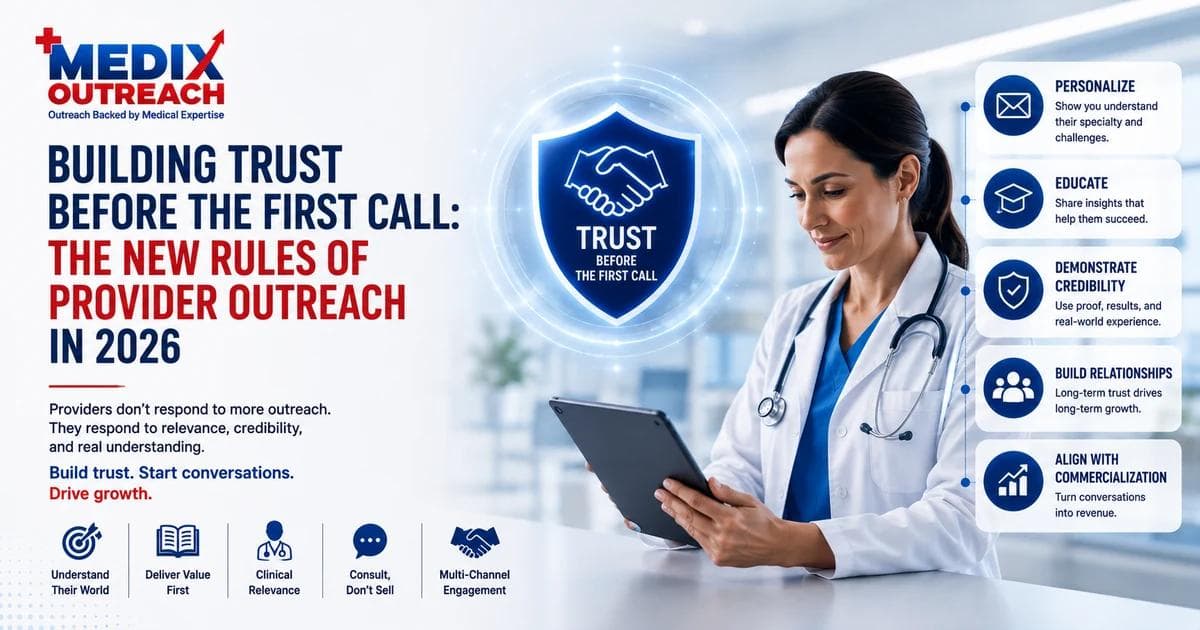
In 2026, successful provider outreach isn't about reaching more healthcare professionals. It's about building trust before the first conversation ever happens.
Healthcare companies that understand this shift are generating stronger relationships, healthier sales pipelines, and faster commercial growth.
Why Traditional Provider Outreach Is Losing Effectiveness
For years, healthcare outreach followed a predictable formula.
Purchase a list.
Launch an email sequence.
Make cold calls.
Book meetings.
Repeat.
While these tactics can still generate responses, they no longer create the commercial advantage they once did. There are clear reasons cold outreach fails in healthcare when it is not grounded in relevance.
Healthcare buyers have become more selective because they have more choices than ever before.
Every outreach message is evaluated through one simple question:
"Does this company understand my world?"
If the answer isn't immediately clear, the conversation usually ends before it begins.
Trust Is the First Buying Decision
Healthcare purchasing has always been built on trust.
Every recommendation, workflow change, software implementation, or clinical partnership has the potential to affect patient care, provider efficiency, compliance, and organizational performance.
Before providers evaluate your solution, they evaluate your credibility.
They're asking questions such as:
- Do these people understand healthcare?
- Have they worked with organizations like mine?
- Do they understand my specialty?
- Are they solving a real problem or simply selling another product?
Trust isn't created during the sales call.
It begins with the very first interaction.
Clinical Relevance Beats Generic Personalization
Many companies personalize outreach by adding a recipient's first name or company.
Healthcare providers expect much more.
Effective provider outreach demonstrates an understanding of:
- Clinical specialties
- Patient populations
- Workflow challenges
- Operational priorities
- Documentation requirements
- Healthcare regulations
An orthopedic practice has different priorities than a behavioral health clinic.
A rural hospital faces different challenges than an academic medical center.
Clinical relevance shows providers that your outreach was created specifically for them, not automatically generated for thousands of contacts. This is the same reason clinical credibility wins more business than advertising.
Educational Content Opens More Doors Than Sales Messaging
Healthcare professionals don't respond well to aggressive sales tactics.
They respond to valuable information.
Organizations building trust successfully invest in healthcare content and provider marketing that helps providers solve problems before introducing products or services.
Examples include:
- Industry insights
- Clinical trend reports
- Market research
- Educational articles
- Operational best practices
- Regulatory updates
- Provider case studies
Educational content transforms outreach from interruption into value.
Provider Outreach Is No Longer Just Email
Healthcare decision-makers engage across multiple channels.
An effective provider outreach strategy combines:
- Personalized healthcare email marketing
- LinkedIn engagement
- Educational webinars
- Industry conferences
- Professional networking
- Strategic partnerships
- Thought leadership
Each touchpoint reinforces credibility while moving providers closer to meaningful business conversations. When you are pursuing specific health systems or named accounts, this multichannel approach becomes the foundation of account-based marketing.
The objective isn't increasing outreach volume.
It's increasing familiarity and trust.
Mid-article CTA
Need help building your healthcare growth engine?
Medix helps healthcare startups, clinics, pharma companies, and provider-focused platforms build scalable commercial pipelines.
Book a Strategy CallCommercial Conversations Should Feel Consultative
Healthcare companies often enter meetings prepared to sell.
Providers expect partners who can advise.
Instead of beginning conversations with product features, successful healthcare business development teams ask questions about:
- Workflow challenges
- Staffing pressures
- Operational inefficiencies
- Patient engagement
- Growth objectives
- Technology adoption
Consultative conversations create stronger relationships because they focus on provider needs before discussing solutions.
Healthcare buyers remember organizations that understand their challenges.
Provider Outreach Must Align With Commercialization
Many organizations separate marketing, sales, and business development.
Healthcare buyers experience all three.
A provider who reads your LinkedIn content, receives an email, attends a webinar, and later speaks with your business development team should experience one consistent message.
Healthcare commercialization connects:
- Healthcare go-to-market strategy
- Provider outreach
- Healthcare business development
- Healthcare demand generation
- Healthcare sales outsourcing
- Strategic partnerships
When these functions work together, trust builds naturally throughout the buyer journey.
Technology Supports Outreach. It Doesn't Replace Relationships.
Artificial intelligence has improved prospecting, personalization, and campaign automation.
But technology cannot replace credibility.
Healthcare companies relying entirely on automation often create conversations that feel transactional.
The organizations achieving the strongest commercial growth combine technology with human expertise.
Automation helps identify opportunities.
People build relationships.
Healthcare providers continue buying from organizations they trust, not simply those with the most advanced outreach tools.
The Future of Provider Outreach
Healthcare provider outreach is becoming more relationship-driven every year.
Organizations that succeed in 2026 will:
- Prioritize trust before promotion.
- Demonstrate clinical understanding.
- Create educational content.
- Invest in strategic partnerships.
- Build long-term provider relationships.
- Align outreach with commercialization.
These companies won't necessarily send the highest number of emails.
They'll create the highest-quality conversations.
How Medix Outreach Helps Healthcare Companies Build Provider Trust
At Medix Outreach, we believe provider outreach should create relationships, not just responses.
As a Healthcare Commercialization and Business Development Partner, we combine pharmacist-led expertise with healthcare go-to-market strategy and commercial growth, provider outreach, healthcare business development, strategic partnerships, healthcare sales outsourcing, and end-to-end revenue pipeline development.
Our approach helps healthcare SaaS companies, pharmaceutical organizations, biotech firms, medical device manufacturers, diagnostics companies, and healthcare startups engage providers with clinical credibility instead of generic sales messaging. Our provider outreach and local demand generation for a specialty pharmacy shows what that looks like in practice.
Because sustainable commercial growth starts with trust.
Conclusion
The first sales call is no longer where healthcare relationships begin.
It is where trust is confirmed.
Healthcare companies that invest in provider outreach built around clinical relevance, educational value, healthcare business development, and commercialization consistently outperform organizations relying on volume-based outreach alone.
In 2026, successful provider outreach isn't measured by how many emails are sent.
It's measured by how many trusted relationships are created.
The organizations that understand this shift will build stronger provider networks, healthier sales pipelines, and sustainable long-term growth.
Frequently Asked Questions
What is a trust-first provider outreach strategy?
A trust-first provider outreach strategy focuses on building credibility before asking for a meeting or a sale. Instead of maximizing email and call volume, it leads with clinical relevance and educational value so that providers recognize your understanding of their world at the first interaction. The goal is familiarity and trust, which make later commercial conversations far more productive.
Why is sending more emails no longer effective in healthcare?
Providers receive hundreds of vendor messages and evaluate each one against a single question: does this company understand my world? High-volume, generic outreach usually fails that test and gets ignored. Adding more messages to a poorly targeted effort increases noise and burns lists rather than creating advantage. Relevance and credibility outperform volume.
How do you demonstrate clinical relevance in outreach?
Show that you understand the recipient's specialty, patient population, workflows, operational priorities, documentation requirements, and regulatory context. Reference the specific problems that organization faces rather than generic benefits. Educational content that helps providers solve real problems is one of the most effective ways to demonstrate relevance before introducing a product.
Which channels work best for modern provider outreach?
No single channel is enough. Effective provider outreach combines personalized email, LinkedIn engagement, educational webinars, conferences, professional networking, strategic partnerships, and thought leadership. Each touchpoint reinforces credibility and moves a provider closer to a meaningful conversation. The right mix depends on how a specific buyer prefers to engage.
Does automation help or hurt provider trust?
Automation helps identify opportunities, personalize at scale, and manage campaigns, but it cannot manufacture credibility. Outreach that relies entirely on automation tends to feel transactional. The strongest results come from combining technology to find and organize opportunities with clinically fluent people who build the actual relationships providers trust.
<!-- EXTERNAL REFERENCES -->
- No external regulatory citation required; this is a provider-outreach strategy analysis. Compliance-sensitive outreach should follow HIPAA standards published at https://www.hhs.gov/hipaa/for-professionals/index.html (optional supporting reference).