

Most healthcare growth teams are measured on lead volume. The accounts that actually move the number get won a different way. One health-system contract can outweigh a full quarter of small deals, and it is decided by a committee, over many months, inside a buying process that broad outreach barely touches.
Account-based marketing (ABM) turns the usual funnel around. Instead of casting wide and hoping a few good-fit buyers surface, you name the accounts worth winning first, then point your whole go-to-market effort at them. In healthcare, where the buying group is large and the cycle is long, that focus is not a luxury. It is usually the only model that matches how these organizations really buy.
This is a practical playbook for running healthcare account based marketing as an operating model rather than a one-off campaign. You will get a way to choose and tier target accounts, map the people who decide, align marketing and sales on the same short list, and measure progress by pipeline inside named accounts instead of vanity metrics.
What account-based marketing means in healthcare
Account-based marketing is a go-to-market model that treats a single account as the unit of work. The team agrees on a specific set of organizations, learns each one in depth, and coordinates marketing and sales around winning them. The idea is not new. The research firm ITSMA is credited with naming the discipline in the early 2000s, and it has since become a standard part of B2B go-to-market thinking.
In healthcare the model earns its keep. A digital health company selling into large integrated delivery networks is not chasing a market of thousands. It is trying to win maybe forty systems that fit, and perhaps ten that would change the business. Treating those forty like a mailing list wastes the one real advantage you have, which is the ability to understand each account well enough to be useful to it.
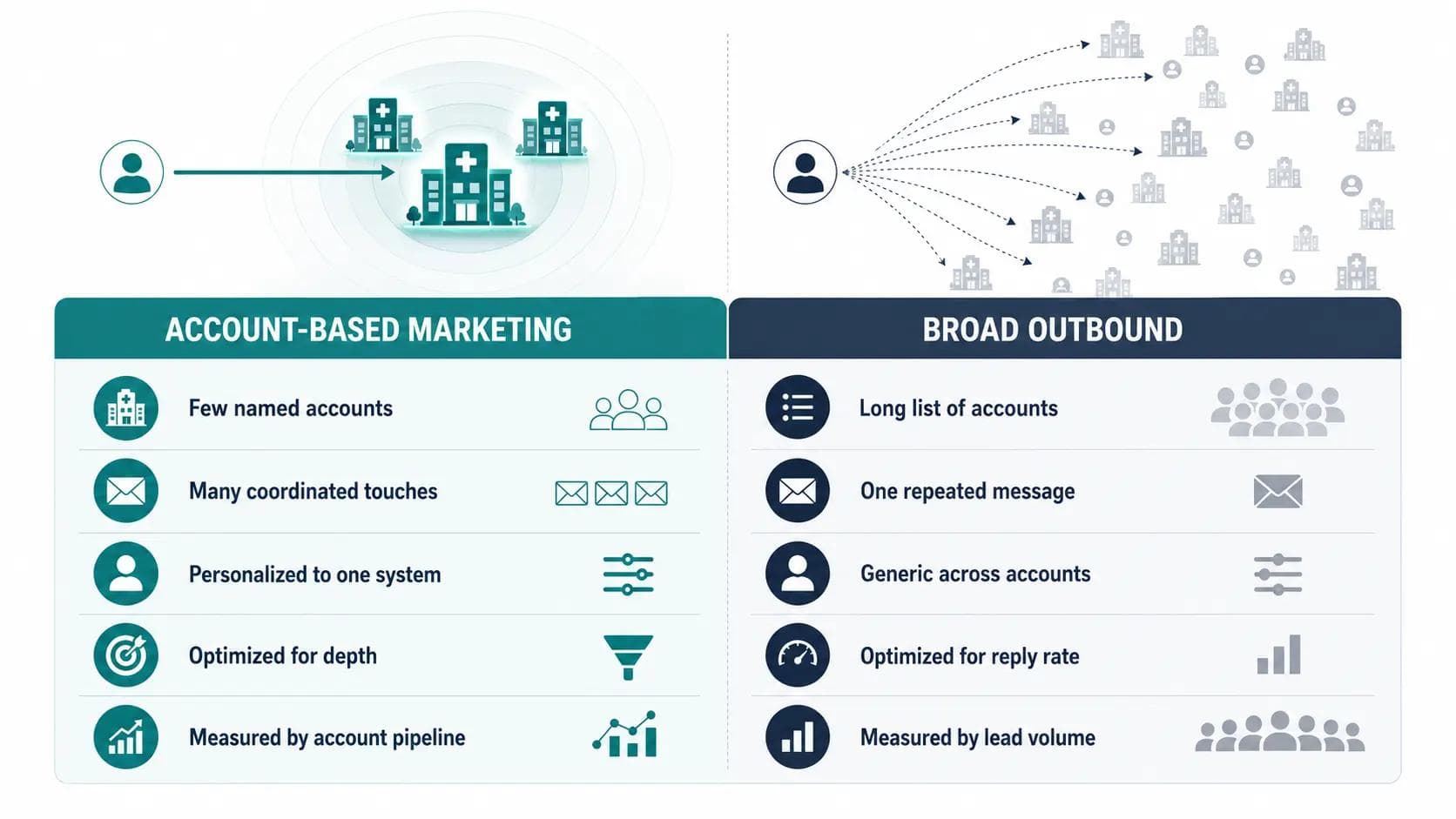
Picture a small clinical-analytics company with three good-fit health systems in its region. The broad-outbound instinct is to buy a list of 4,000 hospital contacts and start sending. The account-based instinct is to learn those three systems cold: their service lines, their public quality goals, who runs the relevant committees, and where the product actually helps. The second approach reaches fewer people and wins more deals, because the deals it is chasing were never going to close on volume.
Contrast that with spray-and-pray outbound. Broad outbound sends a similar message to a long list and optimizes for reply rate. It has a place, and we cover doing it well in healthcare SaaS outbound sales. But volume outreach and ABM answer different questions. Outbound asks, "How many good-fit buyers can we surface this month?" ABM asks, "What will it take to win this specific system, and who has to say yes?" The first fills a pipeline. The second closes the accounts that matter.
Why healthcare rewards a named-account model
Three features of healthcare buying make the named-account approach fit better here than in most industries.
First, the deals are concentrated. A small number of systems, IDNs, and large provider groups control a large share of the spend and the patient volume. Win a handful and you have a business. That concentration is exactly the condition ABM was built for, and it is why a scattershot list rarely pays off in this market.
Second, the cycle is long and gated. Hospital and health-system purchases often run many months, sometimes past a year, and pass through committees, pilots, security reviews, and budget cycles. A one-touch campaign cannot carry a deal across that distance. You need a plan that stays coherent over quarters and survives the inevitable stalls. We break the mechanics of that down in how to sell to hospitals.
Third, no single person can say yes. A clinician can love your product and still not buy it. Real approval comes from a group agreeing that the clinical value, the economics, the risk, and the workflow all hold up at the same time. ABM is one of the few models that plans for a group decision on purpose, instead of hoping a lone champion drags the deal through by force of enthusiasm.
Put those together and the math changes. If ten accounts would remake your year, spending real effort to understand ten accounts is not extravagant. It is proportionate.
Start with the list: choose and tier your target accounts
The account list is the strategy. Get it wrong and every downstream play is aimed at the wrong door. Build it deliberately, not from whoever happened to fill in a form.
Start from a clear picture of fit. Which systems have the clinical service lines, the patient mix, the technology footprint, and the strategic priorities that your product serves? A behavioral-health platform and a cardiology device do not share a target list even if both sell to hospitals. Write down the traits of an account you can genuinely help, then find the organizations that match. If your ideal-customer profile is fuzzy, tighten it before you build the list, because a shaky profile produces a shaky list. Our guide to healthcare SaaS go-to-market strategy walks through defining that profile.
Then tier the list, because not every named account deserves the same effort. A common model, described by analysts such as Gartner, splits accounts into three tiers:
- Tier 1 (one-to-one). A small group of highest-value accounts, often single digits, that get a custom plan, custom content, and named ownership from both marketing and sales. This is full ABM.
- Tier 2 (one-to-few). Clusters of similar accounts, say academic medical centers or regional systems with shared traits, that share a lightly customized program.
- Tier 3 (one-to-many). A broader set that gets programmatic, segment-level personalization and feeds the tiers above as accounts show intent.
Tiering keeps you honest about cost. One-to-one work is expensive, so you reserve it for accounts that justify it. It also gives accounts a path to move up as they engage. An account showing real buying signals in Tier 3, such as several people from the same system engaging in a short window, can graduate into a Tier 1 plan. Movement should run both ways: an account that goes quiet for two quarters can drop back down and free the effort for one that is heating up.
Keep the Tier 1 list short enough that a rep can name every account and say something specific about each one. If nobody can hold the list in their head, it is a database, not a target account plan.
Map the buying committee inside each account
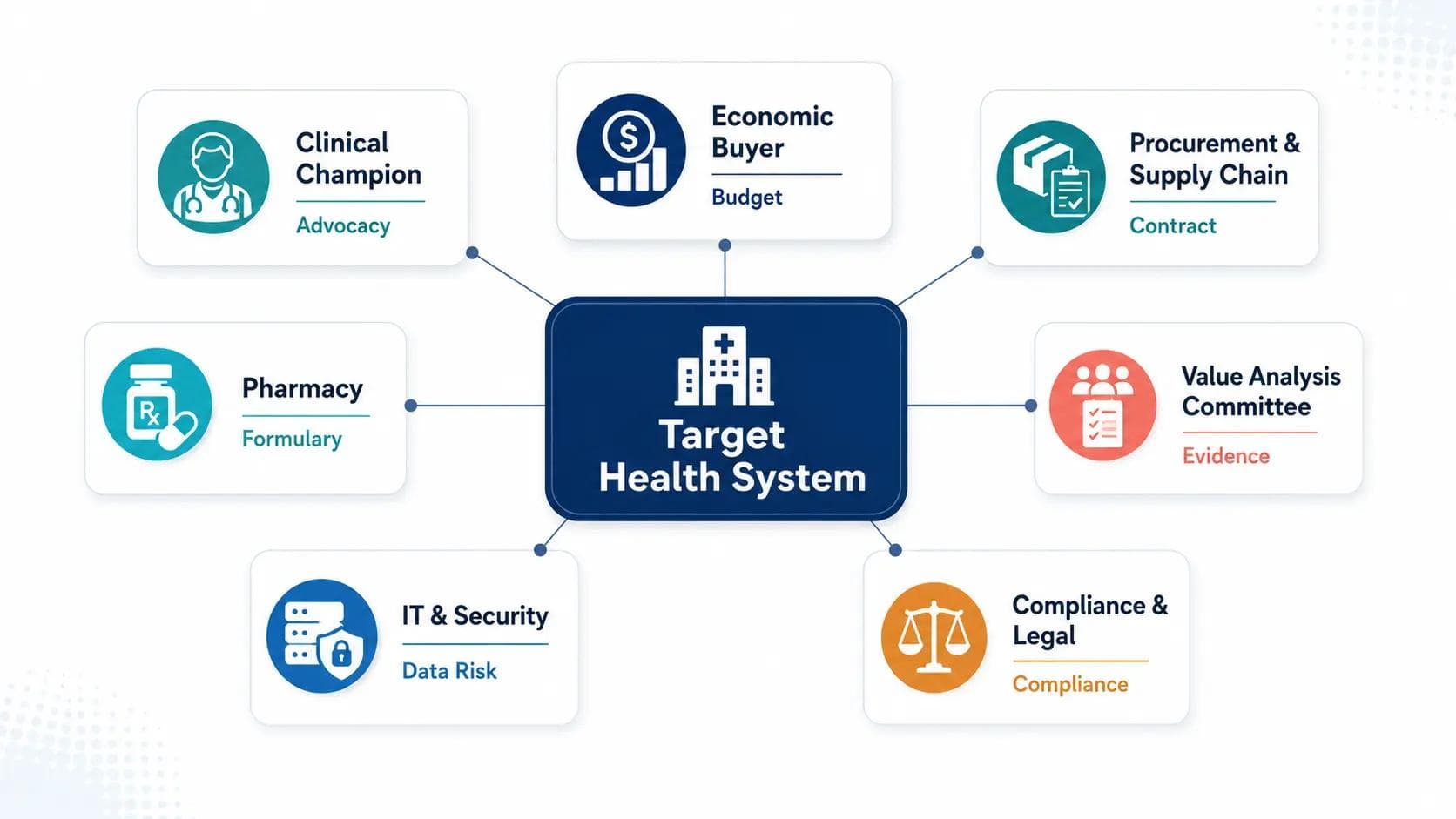
Once the accounts are set, the real work is understanding who decides inside each one. In a health system that is rarely one title. It is a committee, and every seat weighs a different kind of risk.
- Clinical champion. The physician, nurse leader, or pharmacist who feels the problem and will advocate internally. Necessary, but not sufficient.
- Economic buyer. The executive who owns the budget and the return, such as a service-line chief, a VP, or the CFO's office. Cares about total cost, payback, and risk to the P&L.
- Procurement and supply chain. Runs the contract, the pricing, and the vendor process. Can slow or accelerate everything.
- Pharmacy. For drug, formulary, or specialty-pharmacy-adjacent products, pharmacy leadership is often a decisive voice and sometimes the economic buyer.
- Value analysis committee. Many systems route new clinical products through a value analysis committee that weighs evidence, safety, cost, and workflow before anything is approved. This body is often the difference between a signed pilot and a stalled one.
- IT and security. For anything that touches data or the EHR, architecture and security review are gates you clear, not people you charm.
- Compliance and legal. HIPAA, contracting, and risk sign-off sit here.
You do not need every name on day one, but you do need the shape of the committee for each Tier 1 account: who champions, who pays, who can veto, and how a decision actually gets made in that specific organization. Two systems that look identical from the outside can have very different internal wiring. In one, pharmacy leadership effectively controls the decision; in another, an almost identical purchase runs through a service-line chief and never touches pharmacy at all. The account plan should capture that wiring, and it should be updated every time you learn something new.
Mid-article CTA
Need help building your healthcare growth engine?
Medix helps healthcare startups, clinics, pharma companies, and provider-focused platforms build scalable commercial pipelines.
Book a Strategy CallAlign marketing and sales on the same accounts
ABM breaks the moment marketing and sales work from different lists. The whole model depends on both functions aiming at the same named accounts with a shared definition of progress. Healthcare marketing and sales alignment is not a soft nicety here. It is the mechanism.
In practice that means a few concrete agreements. Marketing and sales pick the target accounts together, so nobody is surprised by the list. They agree on what a qualified account looks like and which signals count as engagement worth acting on. They share one view of each account, including the committee map, the open questions, and the last several touches, so a rep never opens a call blind to what marketing has been doing, and marketing never ships content that contradicts where the deal actually sits.
The point is one plan per account, owned jointly. Marketing warms the committee and creates account-specific material. Sales works the relationships and drives the process. Both read the same scoreboard. When that alignment is real, the account experiences you as one coordinated team rather than two departments running unrelated plays. When it is not, the failure is visible from outside: marketing emails a system about a use case sales already disqualified, or sales pitches a champion who was never told the executive economics. If you are still building the basic machine for this, our guide to building a first B2B sales funnel covers the groundwork.
Build plays personalized to one health system
Personalization in ABM is not a first-name token in an email. It is proof that you understand this specific system and can help it with something it already cares about.
Real account personalization starts from the account's own context. What service lines is this system expanding? What public priorities has its leadership committed to? Where does your product touch a problem they have already named? A message that connects to a system's stated goal, such as reducing readmissions in a particular service line, standing up a new center, or hitting a quality target, lands very differently from a generic pitch about your features.
From there, build multichannel plays that reach the committee where it pays attention. That can include tailored content for a clinical champion to share internally, executive-level material framed around economics for the buyer, advertising aimed at the account, conference and event touches, outbound that references the account's real situation, and disciplined appointment setting that books time with the committee. Cold calling still belongs in the mix for reaching busy clinical and executive buyers, done with the same account-specific context. The channels matter less than the coherence. Every touch should feel like part of one informed conversation with this system, not a set of disconnected campaigns.
This is the sharpest contrast with broad outbound. Volume outreach optimizes a single message across a big list and wins on efficiency. ABM optimizes many coordinated touches across a few accounts and the several people who decide inside each one, and it wins on depth. Neither is wrong. They are different tools, and confusing them is how good products end up with busy inboxes and empty pipelines.
Orchestrate the plays across the committee
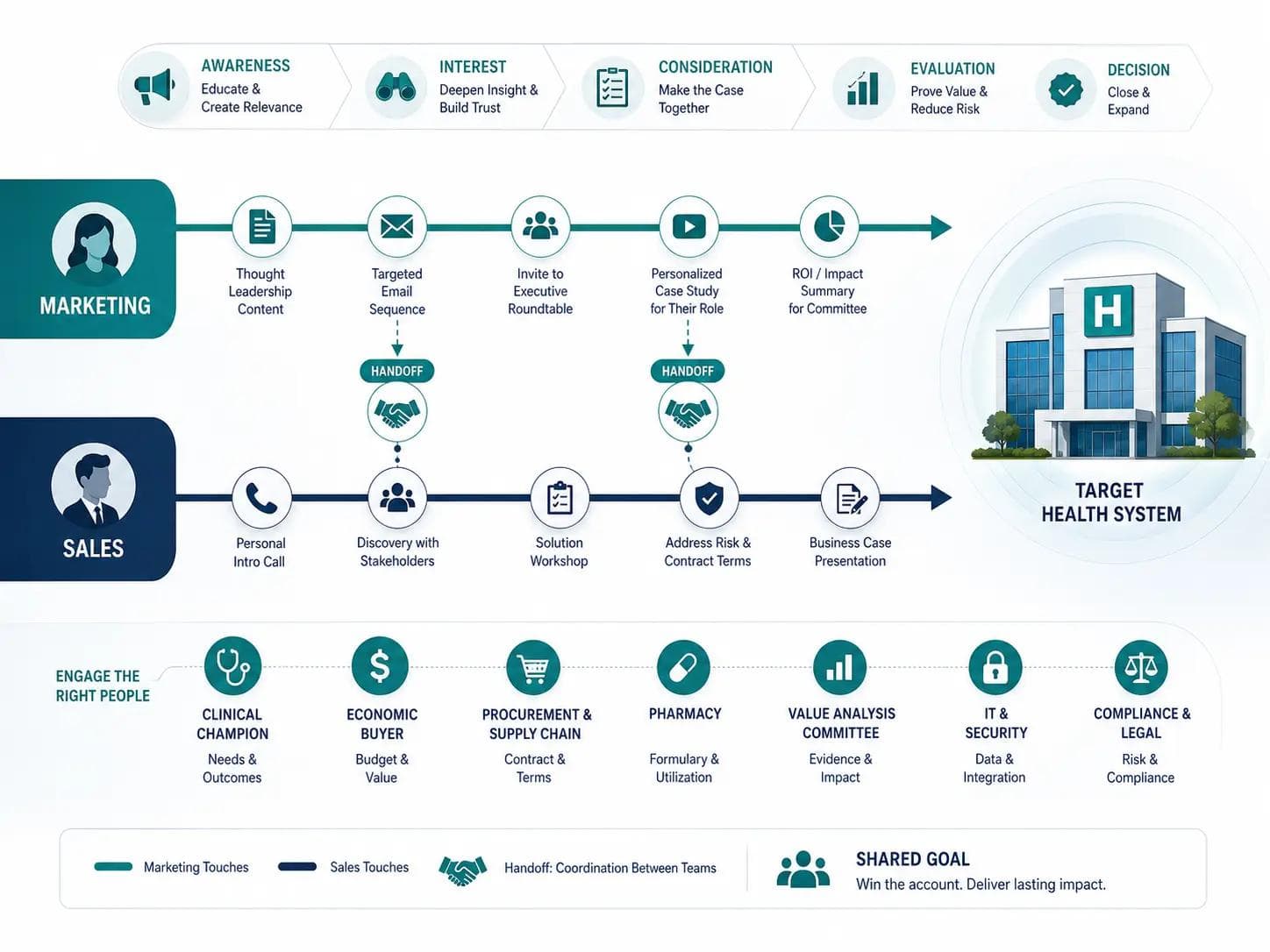
Personalized plays only work if they are sequenced. Orchestration is the discipline of deciding who gets touched, with what, in what order, and by whom, marketing or sales, so the account moves forward instead of getting hit with noise from two directions.
A simple way to think about it is to map each play to a committee role and a stage. Early on, marketing might warm the clinical champion and the economic buyer with material that frames the problem and the evidence. As interest builds, sales opens direct conversations while marketing supplies account-specific proof for the champion to circulate internally. When the deal reaches evaluation, the plays shift toward the value analysis committee, procurement, and IT, the seats that can stall a deal that is approved in principle, with the exact evidence and documentation each one needs to sign off.
Orchestration also means restraint. If three people from your company contact four people at the account in the same week with unrelated messages, the account feels pestered, not courted. One owner per account should hold the timeline and keep the touches coordinated. Good orchestration is what makes a handful of accounts feel personally handled rather than processed through a machine.
Measure pipeline in named accounts, not vanity metrics
ABM needs its own scoreboard. Lead counts and open rates tell you almost nothing about whether you are winning the accounts you chose. Judge the program by movement inside the named list.
Useful measures are account-centric. How many target accounts are engaged, meaning multiple committee members are interacting rather than one contact opening email? How many have moved from engaged to active opportunity? How are pipeline and closed revenue distributed across the tiers you set? Are new committee members entering the conversation over time, which usually signals the deal is spreading inside the account the way real health-system deals do?
This is a slower, more honest scoreboard than a lead dashboard, and it should be. A program that generated few new leads but advanced four Tier 1 systems from cold to active evaluation is winning, even if a volume dashboard would call it quiet. Our case study on building a nationwide B2B pipeline shows what concentrated, account-focused effort looks like in practice.
Set the measurement up front, before the first play ships, so marketing and sales agree on the same definition of progress from day one instead of arguing about attribution later. Target account selling in healthcare lives or dies on that shared definition, because the cycle is too long to wait until the end to find out you were counting the wrong things.
Where to start
You do not need a large team or a new platform to begin. You need a short, honest list and the discipline to work it as a unit.
Pick five to ten accounts that would genuinely change your year. For each one, draft the committee map as best you know it and mark the gaps. Agree, in writing, on who owns the account and what "engaged" means. Then build one coherent, personalized plan per account and run it patiently, measuring by how far each account moves rather than how many emails went out. Start narrow, learn the accounts deeply, and widen only once the model is working.
Healthcare ABM rewards teams that trade reach for depth on the accounts that matter. If you want senior, pharmacist-led operators to help you choose the right targets, map the committee, and build the plays that earn trust with clinical and economic buyers, that is the core of our healthcare commercial growth and GTM work. Explore the full range of healthcare growth solutions, or book a free growth strategy session and we will help you build the named-account plan for your top targets.
Frequently Asked Questions
What is account-based marketing in healthcare?
It is a go-to-market model that treats each target organization, such as a health system or large provider group, as its own market. Instead of chasing lead volume, the team names the accounts worth winning and coordinates marketing and sales around winning them.
How is healthcare ABM different from lead generation?
Lead generation optimizes for the number of good-fit buyers you can surface. ABM optimizes for winning specific named accounts. Lead generation fills the top of the funnel, while ABM works a short list of accounts deeply across a long buying cycle.
Which accounts should a healthcare company target with ABM?
Start from fit: the systems, IDNs, or provider groups whose service lines, patient mix, technology, and priorities match what your product does well. Tier them so your highest-value accounts get one-to-one attention and the rest get lighter, scaled programs.
How do you measure healthcare ABM success?
By movement inside the named accounts rather than vanity metrics. Track how many target accounts have multiple committee members engaged, how many became active opportunities, and how pipeline and revenue are distributed across your tiers.
Is ABM worth it for a small healthtech company?
Often yes, because healthcare spend is concentrated in a small number of accounts. If ten systems would change your year, focusing real effort on those ten is usually a better use of resources than broad outreach to thousands.