
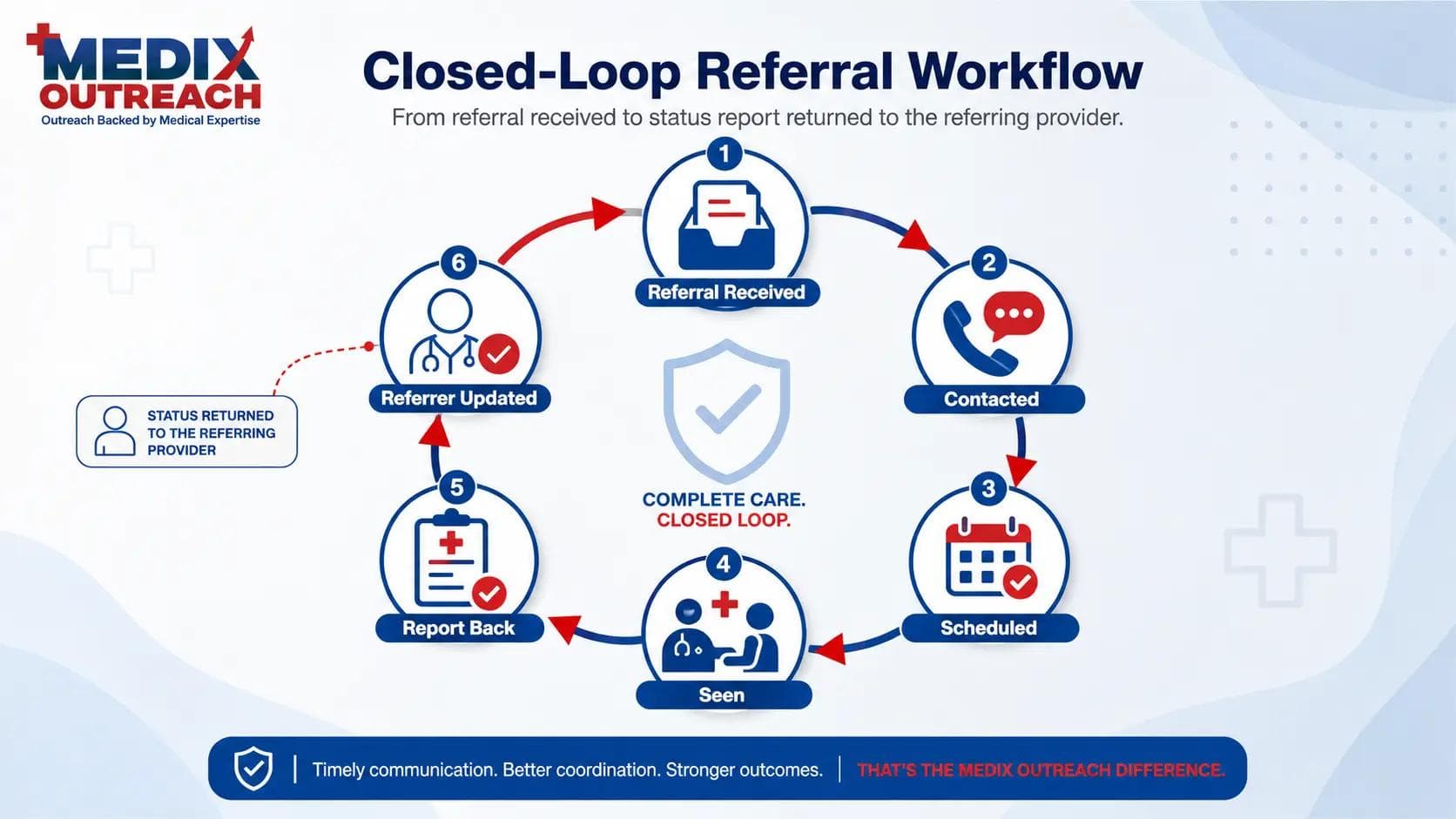
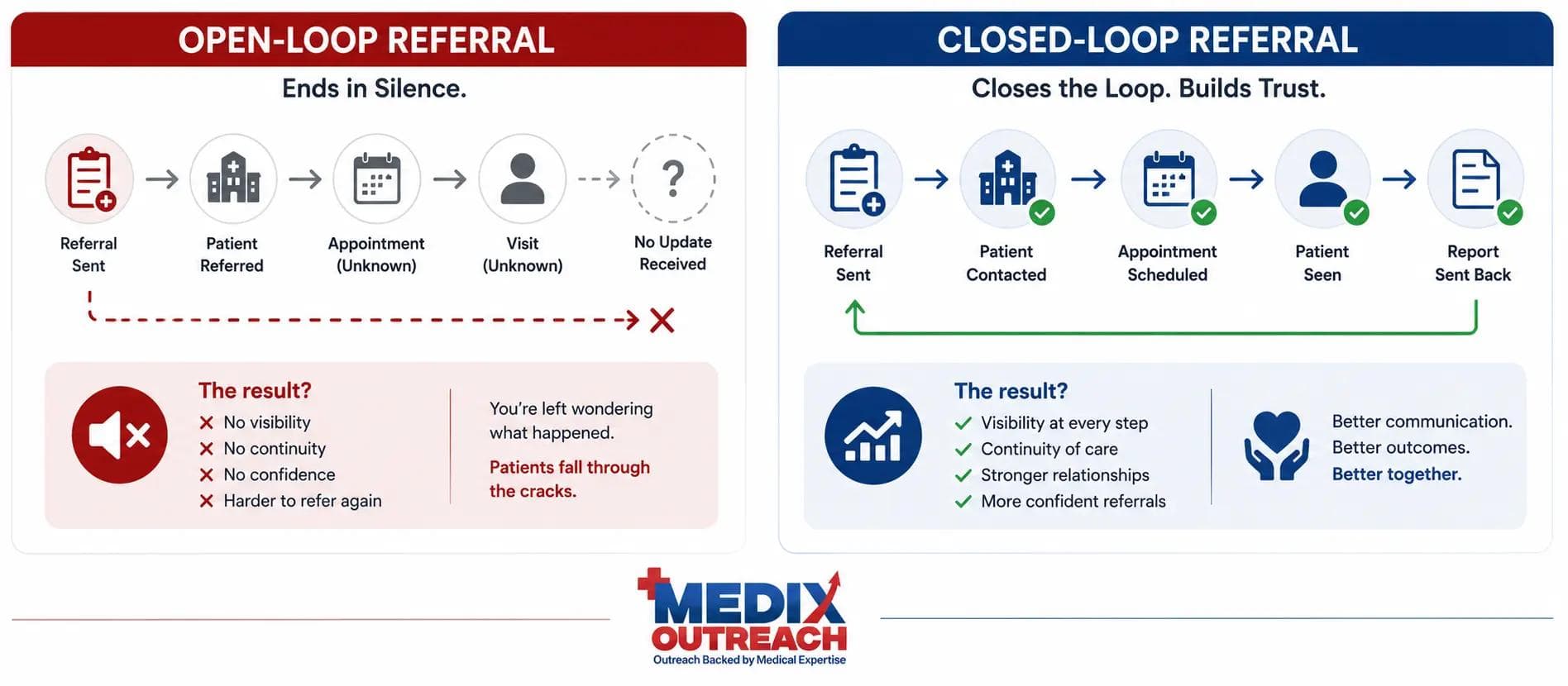
A closed-loop referral in behavioral health is a referral that is tracked all the way through — received, patient contacted, scheduled, seen, and then reported back to the referring provider — so the referrer knows what happened to the patient they sent. An open-loop referral stops at "we faxed it over." The difference is the single biggest reason a PCP either keeps referring to a psychiatry practice or quietly stops. Closing the loop is not a courtesy layered on top of good care. From the referrer's side, it is the product.
The workflow, stated simply: referral received → patient contacted → scheduled → seen → report/status returned to the referring provider. Every step that is owned, timed, and confirmed makes the next referral more likely. Every step that is silent makes the referrer wonder whether their patient fell into a void — and a referring clinician who wonders that once refers less, and twice, not at all.
Why do open-loop referrals fail?
Open-loop referrals fail because the risk in a behavioral health referral is asymmetric and it lands on the referrer. When a PCP refers a patient with depression and hears nothing back, three bad things are indistinguishable to them: the patient was never contacted, the patient no-showed, or the patient was seen and is fine. The PCP has to assume the worst, because their patient's safety and their own reputation are exposed during the silence. Silence is not neutral; it reads as failure. Meanwhile the patient may have leaked out of the pathway entirely — referral leakage — and no one finds out until the next primary care visit.
This is why the federal quality program treats loop closure as a measured behavior, not a nicety. The CMS "Closing the Referral Loop: Receipt of Specialist Report" measure (CMS50) scores the percentage of referrals for which the referring clinician receives a report back from the clinician they referred to. The measure exists precisely because the report-back so often does not happen.
What should go back to the referring clinician?
Closing the loop does not mean sending your entire chart. It means sending the referrer what they need to keep managing the patient, written to be read in under a minute:
- Confirmation of contact & scheduling (or a "could not reach" flag) - Tells them the handoff landed, or that they need to re-engage the patient
- Assessment and plan, concise - Lets them reinforce the plan at the next primary care visit
- Medications started/changed - Prevents interactions and duplicate prescribing
- Clear division of responsibility - States what you are managing versus what stays with them
- A heads-up when something changes materially - Keeps them from being blindsided by a patient they still co-own
The two moments that matter most are the earliest and the most actionable: the confirmation that the patient was contacted and scheduled, and the note after the first visit. Those two touches carry most of the trust.
Referral status tracking
You cannot close a loop you cannot see. Status tracking means every referral has a state — received, contacted, scheduled, seen, reported, or a terminal "unreachable / declined / out of scope" — and someone owns moving it forward. A referral without an owner in the first 24 hours is a referral at risk. The practices that close loops reliably are almost always the ones that made referral status visible and assigned, whether in the EHR, a referral module, or a disciplined manual tracker.
Mid-article CTA
Need help building your healthcare growth engine?
Medix helps healthcare startups, clinics, pharma companies, and provider-focused platforms build scalable commercial pipelines.
Book a Strategy CallEHR, secure messaging, fax, and interoperability realities
The honest operational picture: no single technology closes the loop for every practice. Referrals and reports still move across a mix of channels — EHR-to-EHR directed exchange, secure messaging, health information exchange (HIE), patient portals, and yes, still fax. ONC's health information exchange framework distinguishes directed exchange (sending a referral or summary straight to another provider) from query-based exchange, and its interoperability standards for care-coordination referrals describe how a transition of care or referral can be supported electronically. But interoperability is uneven, and many referring offices are not on a compatible system. The workflow — not the tool — is what has to be reliable. Do not claim that one EHR workflow is mandatory or sufficient for every organization; design the loop to close across whatever channels your referrers actually use.
Care coordination: why closing the loop strengthens the relationship
Loop closure is the operational core of care coordination. AHRQ frames care coordination around exactly these mechanics — managing referrals, supporting transitions, and making sure information follows the patient. When a psychiatry practice closes the loop, it is not just being polite; it is doing the coordination work that keeps the patient safe and the referrer informed. That reliability compounds: a PCP who has had five patients handled and reported cleanly stops evaluating the practice and starts defaulting to it. Closed-loop communication is part of the referral product, and it is the reason relationships in PCP-to-psychiatry referrals endure.
How a psychiatry practice operationalizes the workflow
- Assign an owner for every inbound referral within 24 hours.
- Give each referral a status and a next action; never let one sit unstated.
- Standardize two report-backs — a scheduling confirmation and a first-visit note — as templates, so closing the loop is a default, not an act of heroism.
- Track loop-closure rate as a real metric, reviewed monthly, the same way you track referral volume.
- Match the channel to the referrer — portal, secure message, or fax — rather than forcing one path.
This workflow is one of the load-bearing components of a psychiatry referral network. Get it right and the rest of the network holds; get it wrong and even a well-mapped set of referrers erodes.
Frequently asked questions
What is a closed-loop referral in behavioral health?
A referral that is tracked from receipt through the patient being seen, with a status and report returned to the referring provider — so the referrer knows the patient was contacted, scheduled, evaluated, and what the plan is.
What information should a psychiatry practice send back to the referring provider?
Confirmation of contact and scheduling, a concise assessment and plan, any medications started or changed, a clear division of ongoing responsibility, and a heads-up when something changes materially.
Do you need a specific EHR to close the referral loop?
No. Referrals and reports move across EHR directed exchange, secure messaging, HIE, portals, and fax. Interoperability is uneven, so the workflow must be reliable across whatever channels your referrers use. No single technology is mandatory for every organization.