
PCP psychiatry referrals are won by making the referral clinically appropriate and operationally easy — not by advertising clinical quality. From a primary care physician's chair, the value of a psychiatry partner is not "we deliver great psychiatric care." Competence is assumed. The value is that the psychiatry practice takes a hard problem off the PCP's desk cleanly: fast access, a clear scope of what it treats, a low-friction intake, a warm handoff, and a note back that tells the PCP what happened. This article is written from the PCP's perspective, because that is the only perspective that actually decides where referrals go.
Primary care carries an enormous share of behavioral health. PCPs manage a large volume of depression and anxiety themselves, and the reason they refer out is specific: diagnostic complexity, medication management beyond their comfort, treatment resistance, or a patient who needs more than a fifteen-minute visit can hold. When a PCP refers to psychiatry, they are handing over their patient and part of their reputation — and they route that trust to whichever practice makes it easiest.
Why do PCPs refer to psychiatry in the first place?
Understanding the trigger tells you how to position the partnership. The common reasons primary care needs psychiatry support:
- Diagnostic complexity (bipolar spectrum, comorbidity) - A clear evaluation and a diagnosis they can trust
- Medication management beyond comfort - Someone to own the psychopharmacology and report the plan
- Treatment-resistant depression/anxiety - Escalation without losing the patient from their panel
- Safety concerns / risk - Rapid, appropriate access — not a ten-week wait
- Time and scope limits of a primary care visit - A partner who absorbs the complexity and keeps them informed
Note what is not on this list: a slick brochure. Every trigger is operational. This is the same lesson that runs through how to get more physician referrals — referrers reward the practice that reduces their risk and workload.
What makes a psychiatry practice easy to refer to?
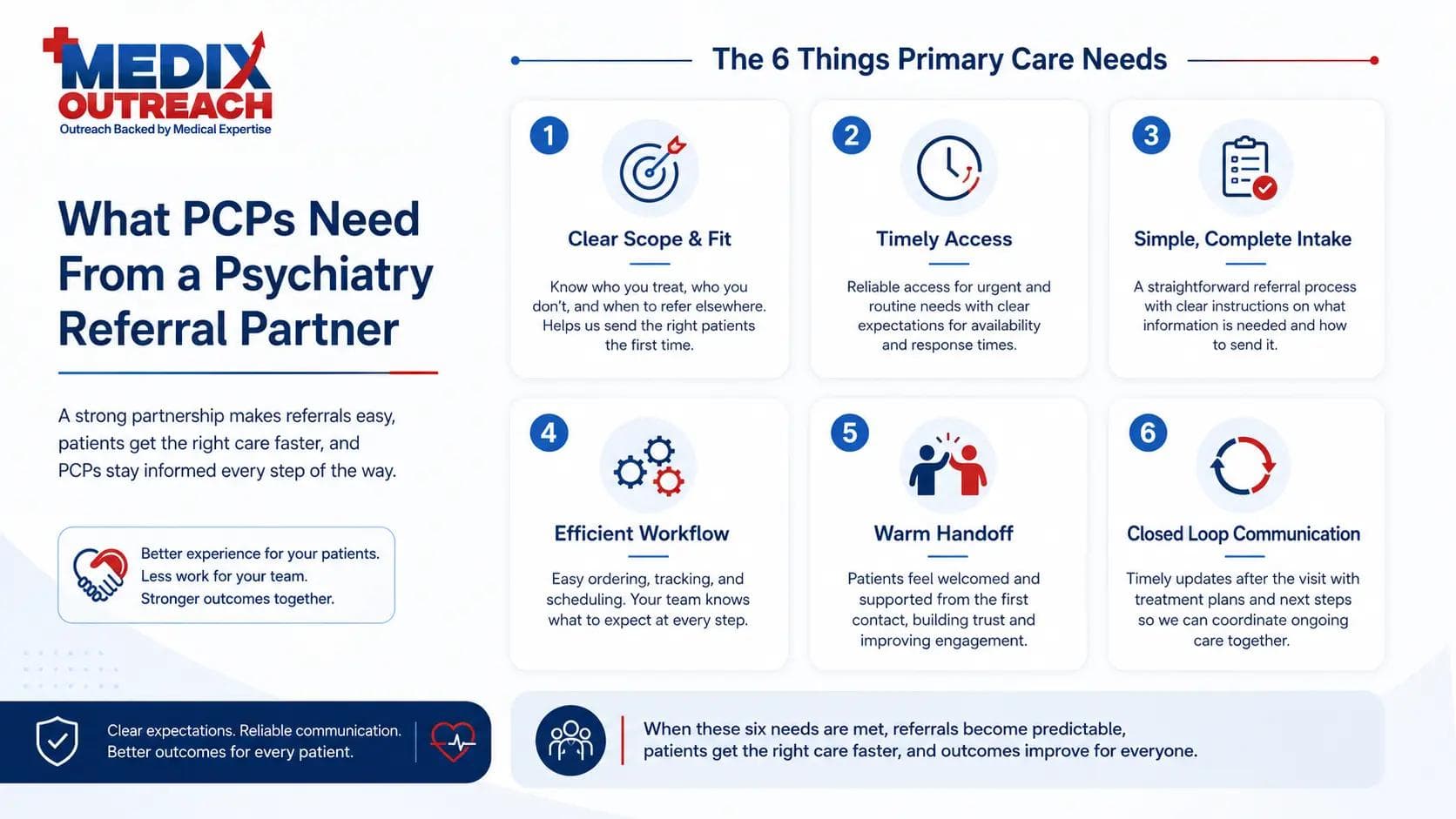
If you strip PCP referral behavior down to its drivers, six things determine whether a psychiatry practice becomes the default:
1. A clear service scope
PCPs need to know, in one sentence, what you treat and who you take — adult versus child/adolescent, conditions in scope, and what is out of scope. Ambiguity produces inappropriate referrals, which produce rejected referrals, which train the PCP to stop trying. A defined scope is a courtesy to the referrer and a filter for your intake.
2. New-patient availability
Access is the decisive variable. A PCP will not send a symptomatic patient into a two-month wait when a faster option exists. Protected new-patient slots for referred patients are the single most persuasive thing you can offer primary care.
3. Low-friction intake
The referral should reach you one known way, and the patient should be contacted quickly. Every extra required field, every callback the patient has to initiate, is a leak. The detail of what to ask for — and what not to make mandatory — is covered in psychiatry referral forms.
4. A defined referral workflow
A referral needs a clear owner in the first 24 hours and a confirmation that it was received. PCPs remember the practice that confirmed receipt as much as the one that delivered care.
5. A warm handoff
For higher-acuity or safety-sensitive referrals, a warm handoff — direct contact between offices rather than "here's a number, good luck" — is what a PCP trusts with a fragile patient.
6. Communication back to the PCP (closing the loop)
This is where relationships are made or lost. The PCP needs confirmation the patient was scheduled, a concise note with the assessment and plan, and a clear statement of what you are managing versus what stays with them. The federal quality program measures exactly this — the CMS "Closing the Referral Loop" measure scores whether the referring clinician receives a report back. The full mechanics are in closed-loop referrals in behavioral health.
Mid-article CTA
Need help building your healthcare growth engine?
Medix helps healthcare startups, clinics, pharma companies, and provider-focused platforms build scalable commercial pipelines.
Book a Strategy CallThe PCP-to-psychiatry referral pathway
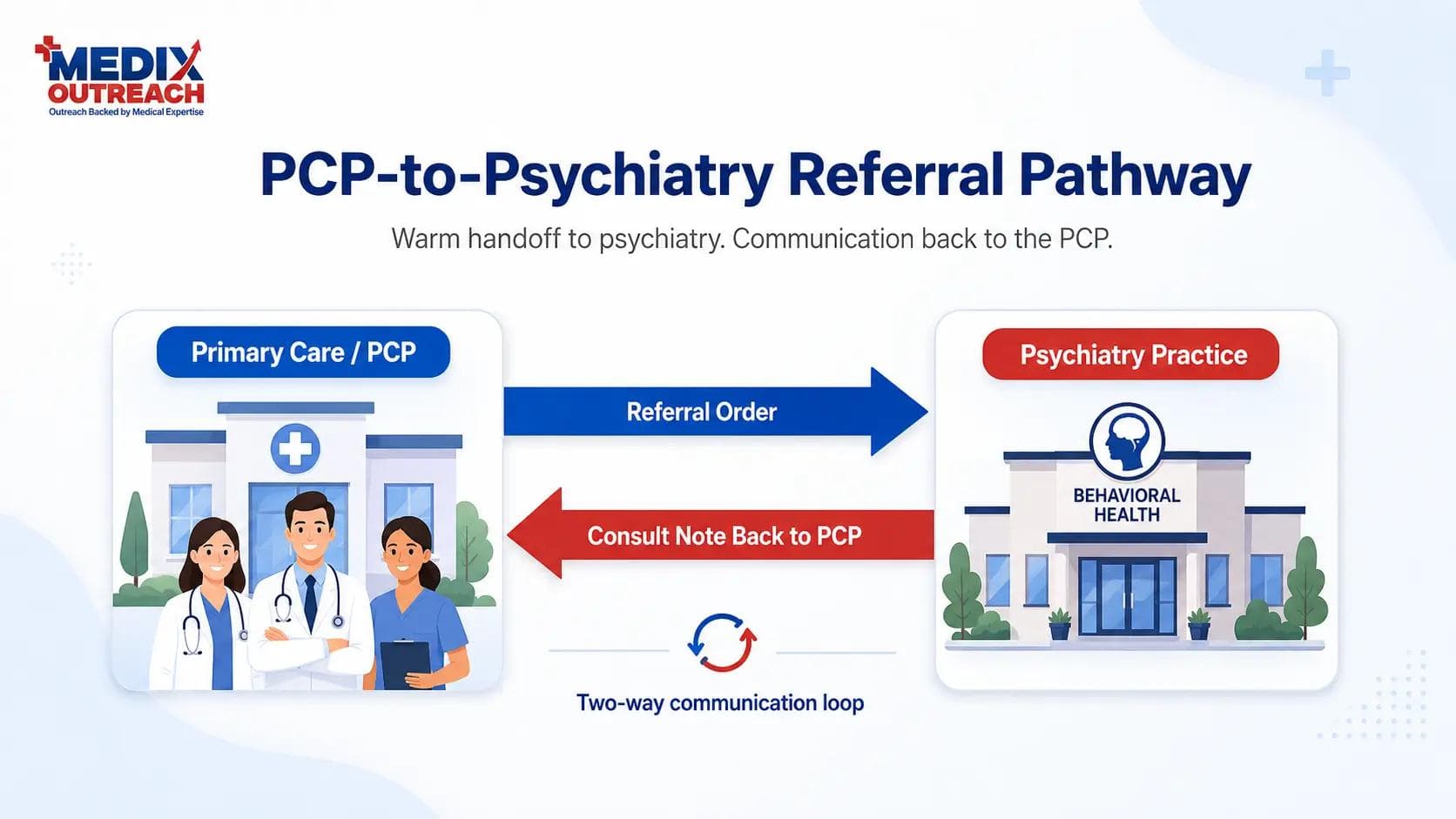
A clean pathway looks like this:
PCP identifies need → referral order sent one known way → intake confirms receipt within 24 hours → patient contacted and triaged → scheduled into a protected slot → evaluation/consult → concise note and plan returned to the PCP → ongoing status when something changes.
A useful complement to referral is integration. Many primary care practices now run behavioral health integration and the Collaborative Care Model, where a consulting psychiatrist supports the PCP's own panel. The American Psychiatric Association's Collaborative Care Model and Medicare's Behavioral Health Integration services are the formal versions of this relationship. A psychiatry practice that understands both direct referral and collaborative-care support can meet a PCP wherever they are — without claiming that referral is universally required, which it is not; requirements vary by plan and arrangement.
How Medix identifies and develops PCP referral relationships
Medix approaches PCP relationships as network development, not advertising. The sequence:
- Map the panel of PCPs by clinical overlap and geography, starting with practices already sending patients and obvious gaps nearby.
- Fix access and intake first so the promise made to a PCP is a promise the practice can keep.
- Lead with clinical education — case-based lunch-and-learns and short clinical touchpoints — rather than a sales pitch.
- Instrument the relationship so you can see which PCPs are referring, converting, and being closed-loop-served.
This is the same model behind provider network development, and it is what produced measurable referral growth in a psychiatry practice referral-engine build. It sits under the broader cluster hub, the psychiatry referral network.
Frequently asked questions
Why do PCPs refer patients to psychiatry?
For diagnostic complexity, medication management beyond their comfort, treatment resistance, safety concerns, or when a patient needs more than a primary care visit can provide. The referral goes to whichever psychiatry practice is fastest to access and easiest to hand off to.
What do primary care practices need from a psychiatry partner?
A clear service scope, new-patient availability, a low-friction intake, a defined workflow, a warm handoff for higher-acuity cases, and communication back after the patient is seen.
Are PCP referrals required to see a psychiatrist?
Not universally. Whether a referral is required depends on the patient's insurance and plan type — some plans require it, many do not. Do not assume a referral is mandatory across all arrangements.