
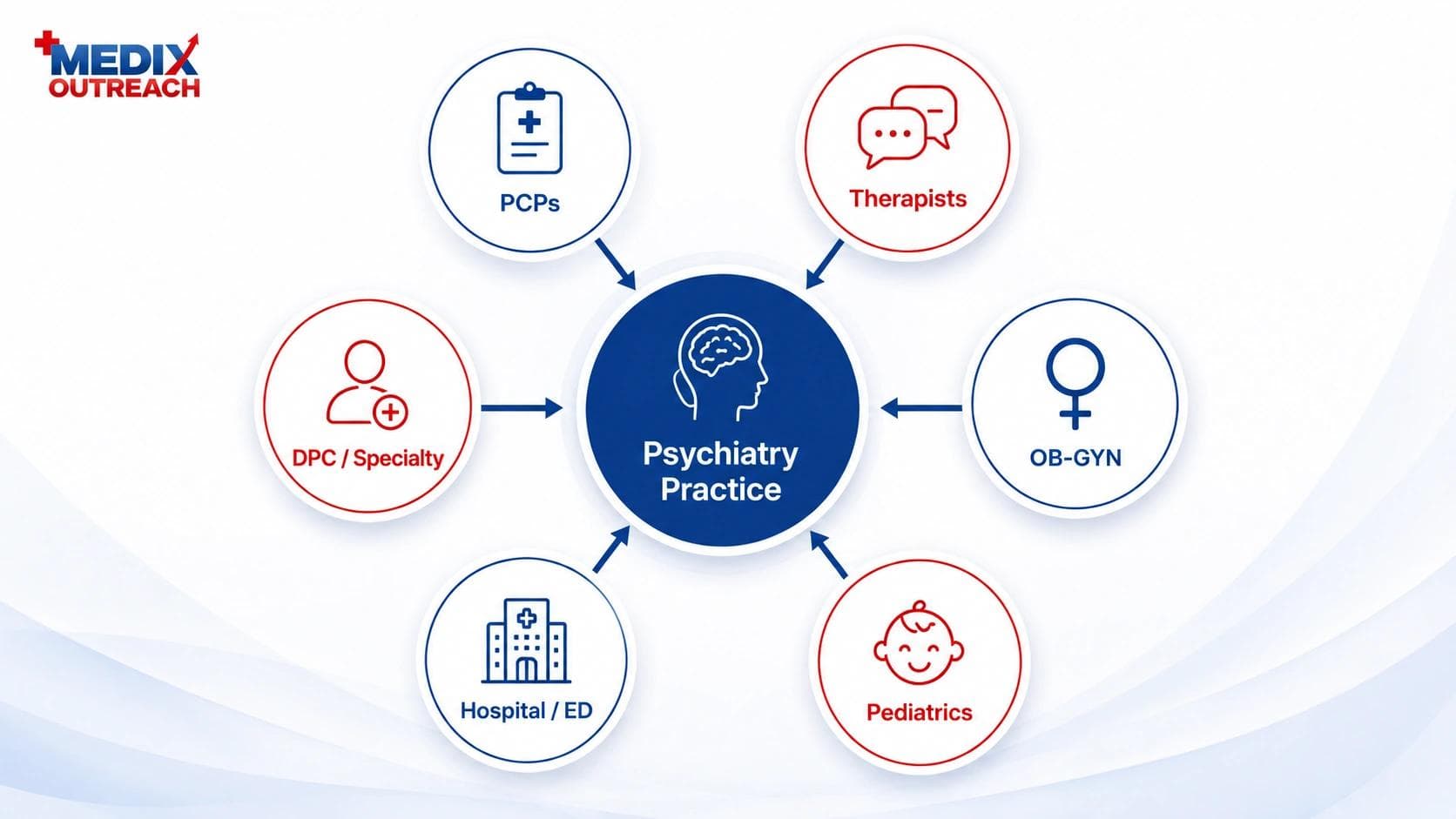
A psychiatry referral network is the structured set of provider relationships, access commitments, and closed-loop communication workflows that lead primary care physicians, therapists, hospitals, and specialty practices to send patients to a specific psychiatry practice — and to keep sending them. It is not lead generation, paid search, or a directory listing. It is a clinical trust system: referring clinicians route their patients to the practice that is easiest to reach, fastest to schedule, and most reliable about reporting back. This guide covers what belongs in a psychiatry referral network, why providers refer where they refer, how to measure network growth, and a 90-day framework for building a referral engine that keeps producing after the introductions are made.
Most psychiatry practices that want more referrals treat the problem as a marketing problem. They redesign the website, buy a directory listing, or run ads. Referrals barely move. The reason is structural: a referral is one clinician handing another clinician their patient and a piece of their reputation. That transfer runs on trust and operational reliability, not on impressions.
What is a psychiatry referral network?
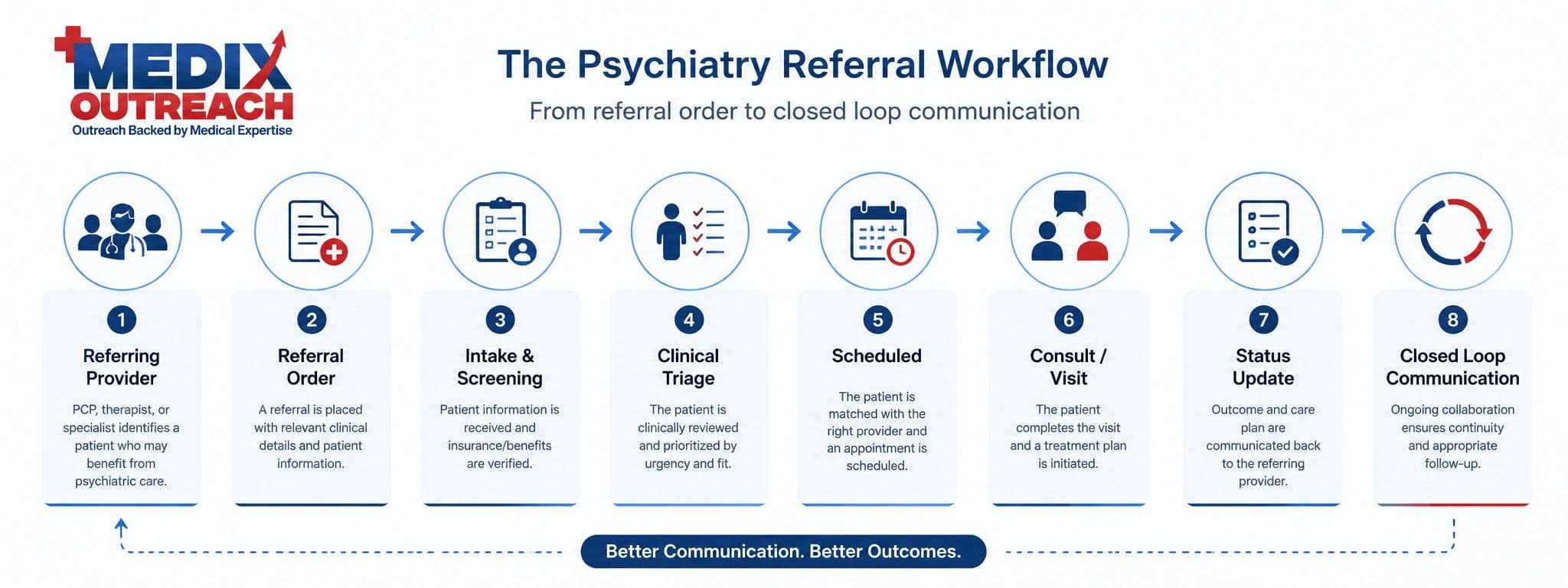
A psychiatry referral network is the collection of referral sources — and the workflow connecting them to your intake — that produces a repeatable stream of appropriate new patients. The entity relationship is consistent across every referral:
Referring provider → referral order → psychiatry intake → clinical triage → scheduled appointment → evaluation/consult → status update back to the referrer → closed referral loop.
When that chain is intact and fast, referrals compound. When any link breaks — the referral sits for four days, the patient is never contacted, the referring office never hears what happened — the network quietly stops sending. The Medix point of view is that referral growth is built through trust, access, operational reliability, provider relationships, and closed-loop communication. Marketing sits on top of that foundation; it cannot replace it.
This distinction is why a referral network is different from the broader work of how to get more physician referrals in general medicine. Behavioral health carries added friction — stigma, access scarcity, therapist-continuity concerns, and consent sensitivities — that a psychiatry-specific network has to design around.
Who belongs in a psychiatry referral network?
A referral network is not "every physician within driving distance." It is a curated set of sources segmented by clinical overlap and referral likelihood. The core sources for most outpatient psychiatry practices:
- Primary care physicians (PCPs) - Why they refer to psychiatry: Diagnostic complexity, medication management beyond their comfort, patients who need more than a PCP visit can hold; What they need from you: Fast access, a clear scope of what you treat, a note back they can read in under a minute.
- Therapists, psychologists, LCSWs - Why they refer to psychiatry: Patients who need psychiatric evaluation or medication management alongside therapy; What they need from you: Collaboration without patient capture — medication support that returns the patient to their therapist.
- OB-GYN & women's health - Why they refer to psychiatry: Perinatal and postpartum mental health needs surfaced at screening; What they need from you: Perinatal expertise, rapid access, coordination back to the OB team.
- Pediatricians - Why they refer to psychiatry: Child and adolescent needs beyond primary care; What they need from you: Age-appropriate scope, waitlist transparency, family-friendly intake.
- Hospitals, EDs, discharge planners - Why they refer to psychiatry: Behavioral-health follow-up after an acute episode; What they need from you: Rapid-access follow-up slots and reliable loop closure to the discharging team.
- Specialty practices & DPC - Why they refer to psychiatry: Comorbid mental health in chronic-disease and membership-model panels; What they need from you: Direct communication and a low-friction pathway that fits their model.
Each of these referral sources has its own operational article in this cluster, but they share one rule: the practice that makes the referral clinically appropriate and administratively effortless earns a disproportionate share of the volume. That is the theme of what primary care practices need from a psychiatry partner.
Why do providers repeatedly refer to certain psychiatry practices?
Ask a PCP why they favor one psychiatry practice over another and the answer is rarely "clinical quality" — they assume competence. What separates practices is the referral experience:
Access and new-patient availability
Time-to-first-appointment is the single most decisive factor in a psychiatry referral relationship. A referring provider will not send a patient into a ten-week wait if a two-week option exists, because the patient's risk and the referrer's reputation are on the line during that gap. New-patient availability is the product you are actually selling to the network. If access is the constraint, no amount of outreach fixes it — operational readiness comes before relationship-building.
Closed-loop communication
This is where most referral relationships die, and it is almost always fixable. The referring clinician needs three things: confirmation the patient was contacted and scheduled (or a flag that they were not reachable), a concise note with the assessment and plan, and a clear statement of what you are managing versus what stays with them. This is not a courtesy. The federal quality program treats it as a measure — the CMS "Closing the Referral Loop: Receipt of Specialist Report" measure (CMS50) scores the percentage of referrals for which the referring clinician actually receives a report back. Practices that close the loop keep the referrer; practices that treat referrals as a one-way transfer lose them. The mechanics are covered in closed-loop referrals in behavioral health.
Operational reliability
Reliability is the compounding factor. A referrer who has had five patients handled cleanly stops evaluating you and starts defaulting to you. That default is the asset a referral network is built to produce.
How should a psychiatry practice measure referral network growth?
"More referrals" is not a metric. A referral network is managed with a small, honest scorecard:
- Referrals received by source - Which relationships are actually producing, and which are dormant
- Referral-to-scheduled conversion - Whether intake is converting referrals or leaking them
- Time-to-first-appointment - Your access reality — the number referrers care about most
- Loop-closure rate - Share of referrals where a status/report went back to the referrer
- New active referrers per quarter - Whether the network is expanding or concentrating
- Referrer retention / reactivation - Whether producing referrers keep sending — the truest health signal
Ten PCP relationships that each send two appropriate patients a month beat a hundred introductions that never convert. Depth beats reach.
Mid-article CTA
Need help building your healthcare growth engine?
Medix helps healthcare startups, clinics, pharma companies, and provider-focused platforms build scalable commercial pipelines.
Book a Strategy CallThe components of a predictable referral engine
- A mapped source list — segmented by clinical overlap and referral likelihood, starting with existing referrers and obvious gaps.
- A defined referral workflow — a single known way in, with clear ownership in the first 24 hours.
- Real access — new-patient availability that matches what outreach promises.
- Closed-loop communication — a standard status update and report back to every referrer.
- Clinical education — lunch-and-learns and case-based touchpoints that keep the relationship warm.
- Measurement — the scorecard above, reviewed monthly.
This is the same architecture Medix uses in provider network development engagements, and it is what turned local PCP relationships into a measurable, repeatable stream in a psychiatry practice referral-engine build.
A practical 90-day framework
Days 0–30: Fix the pathway and map the sources
Audit how a referral actually reaches you today, who owns it, and whether anyone confirms receipt. Fix the pathway before investing in relationships — building referral volume into a broken intake just accelerates leakage. Map your existing referrers and the clear gaps.
Days 31–60: Close the access and communication gaps
Create protected new-patient slots for referred patients, define your triage and disposition rules, and stand up a standard closed-loop note. Confirm every referral within 24 hours.
Days 61–90: Run education-led outreach and measure
Now — and only now — begin structured outreach: clinical education, warm introductions, and case-based follow-up with your highest-overlap sources. Start the scorecard and review it monthly.
When do healthcare marketplaces belong in the channel mix?
Psychiatry directories and marketplaces can supplement a referral network — they capture self-referring patients and fill schedule gaps — but they are not a substitute for provider relationships. Marketplace patients arrive without a referring clinician's context and without the trust that makes a referral relationship durable. Treat marketplaces as a supplementary channel layered on top of a working provider network, not as the core. A dedicated marketplace cluster will cover channel strategy in depth; for now, the sequence is provider network first, marketplace second.
A note on compliance
Build referral relationships on access, communication, and clinical education — never on financial incentives for referrals or guarantees of referral volume. Offering anything of value in exchange for referrals raises federal Anti-Kickback and Stark considerations, and no honest referral program promises a number. The goal is to be the easiest, most reliable practice to refer to, which earns referrals without ever paying for them.
Frequently asked questions
What is a psychiatry referral network?
It is the structured set of referring providers — PCPs, therapists, OB-GYNs, pediatricians, hospitals, and specialty practices — plus the intake and communication workflow that produces a repeatable stream of appropriate new patients for a psychiatry practice.
How do psychiatry practices get more PCP referrals?
By making referral clinically appropriate and operationally easy: fast new-patient access, a clear scope of what you treat, a low-friction intake, and a closed-loop note back to the PCP after the patient is seen.
How long does it take to build a psychiatry referral network?
Foundational workflow and access fixes take about 90 days; durable referrer relationships build over two to three quarters of consistent access and reliable loop closure. There is no guaranteed volume — only a system that makes referrals more likely.
Is a referral network the same as a psychiatry marketplace or directory?
No. A marketplace captures self-referring patients; a referral network is built on trusted provider relationships. Marketplaces supplement a referral network but do not replace it.