
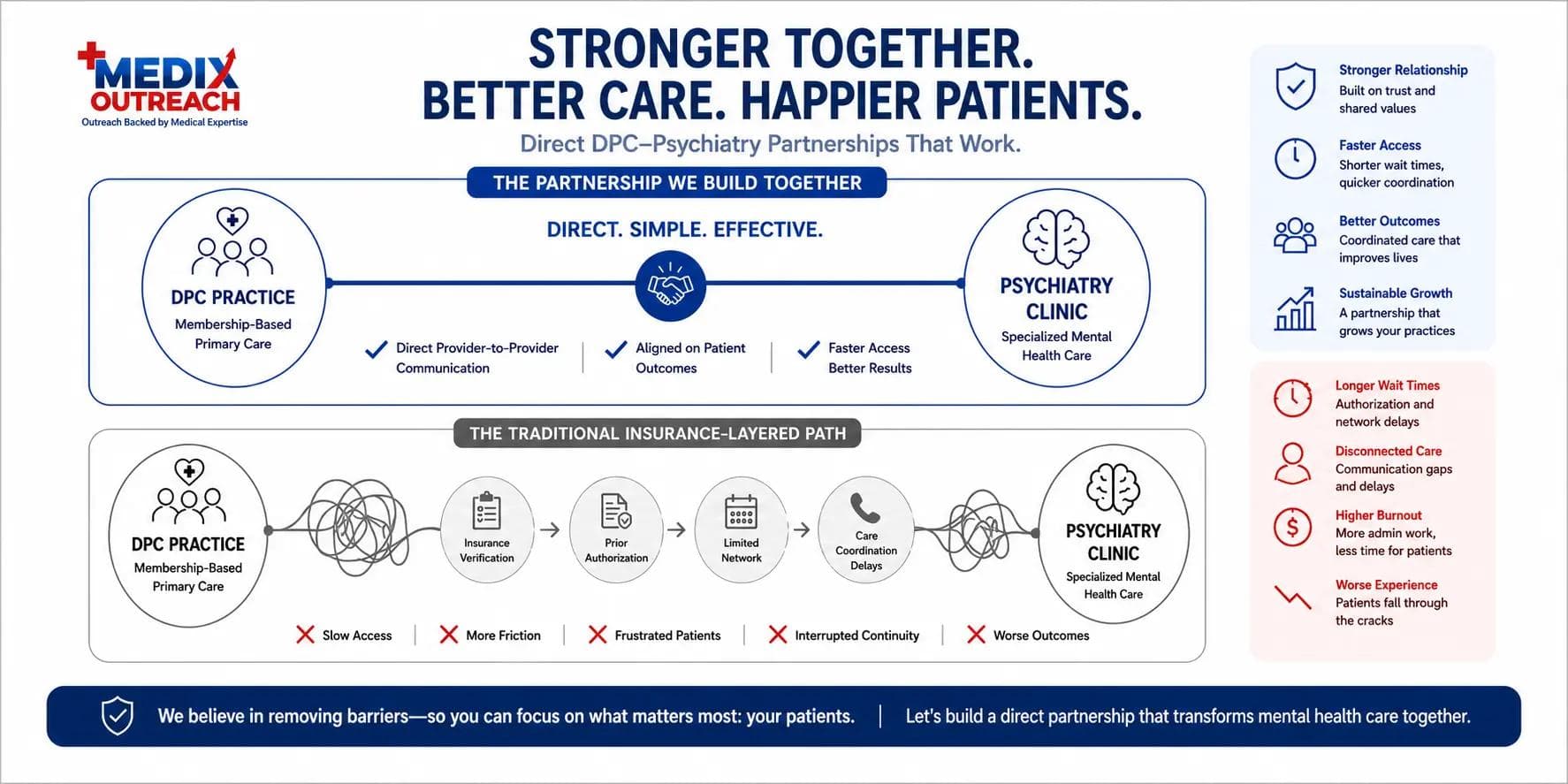
A DPC mental health referral is a referral that flows from a Direct Primary Care practice to a psychiatry clinic — and for a psychiatry practice building a referral network, DPC practices are an underrated, high-value source. Direct Primary Care physicians keep small panels, spend more time per patient, and communicate directly with the specialists they trust. That combination surfaces behavioral health needs earlier and makes the referral relationship unusually clean. The catch: you cannot approach a DPC practice with the generic insurance-and-billing pitch that works on a fee-for-service clinic, because the DPC model is built to avoid exactly that machinery.
This article explains what Direct Primary Care is, why DPC practices can make strong psychiatry referral partners, and how a psychiatry clinic should build the relationship without misreading the model.
What is Direct Primary Care?
Direct Primary Care is a primary care model in which patients pay the practice a periodic membership fee — monthly, quarterly, or annual — that covers primary care services, and the practice does not bill third-party insurers on a fee-for-service basis. The American Academy of Family Physicians describes DPC as charging patients a recurring fee for a defined set of primary care services while eliminating traditional insurance billing; patients typically pair a DPC membership with separate coverage for care outside primary care. AAFP distinguishes DPC from concierge medicine — DPC generally charges lower fees and does not bill insurance for its services.
How does DPC differ from traditional fee-for-service primary care?
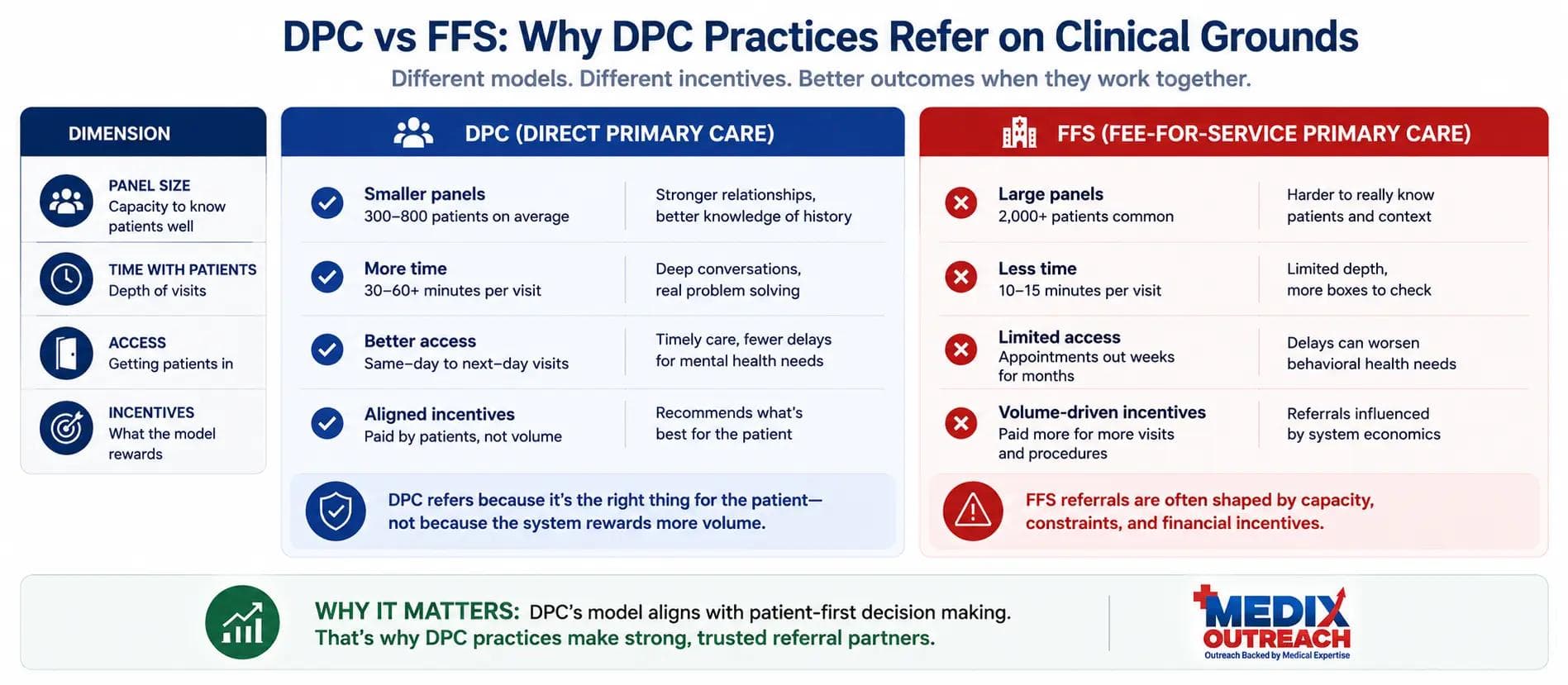
- Revenue - Traditional FFS primary care: Per-visit billing to insurers; Direct Primary Care: Recurring membership fee.
- Panel size - Traditional FFS primary care: Large; Direct Primary Care: Smaller by design.
- Time per visit - Traditional FFS primary care: Compressed; Direct Primary Care: Longer, longitudinal.
- Access to the physician - Traditional FFS primary care: Gated, scheduled; Direct Primary Care: Direct — often text/call/email.
- Coordination style - Traditional FFS primary care: Volume-constrained; Direct Primary Care: Relationship-driven.
Every one of these differences changes how — and why — a DPC physician refers to psychiatry.
Why do DPC practices make strong psychiatry referral partners?
Four structural features of the DPC model align with what a psychiatry referral relationship needs:
Access and time
Longer visits and smaller panels mean a DPC physician notices behavioral health needs their high-volume peers might miss, and has the time to have the referral conversation with the patient properly.
Longitudinal relationships
DPC is built on continuity. The physician knows the patient over time, which makes their referral question sharper and the psychiatry evaluation more efficient.
Care coordination and direct communication
DPC physicians are accustomed to communicating directly with specialists rather than through layers of staff. That is a gift to closed-loop communication — a warm handoff and a direct note back are the DPC physician's native mode, not an imposition.
Aligned incentives
Because DPC revenue is not per-visit, the physician is not optimizing for throughput. They refer when the patient needs it, on clinical grounds — the cleanest possible basis for a referral relationship.
Mid-article CTA
Need help building your healthcare growth engine?
Medix helps healthcare startups, clinics, pharma companies, and provider-focused platforms build scalable commercial pipelines.
Book a Strategy CallWhat psychiatry needs do DPC practices refer out?
DPC physicians manage a fair amount of mild-to-moderate mental health themselves, given their time and continuity. They refer out for the same clinical reasons any primary care physician does — diagnostic complexity, medication management beyond their comfort, treatment resistance, and safety concerns — the pattern covered in what primary care practices need from a psychiatry partner. Because DPC patients pay out of pocket for care outside their membership, a psychiatry practice should be transparent about cost and cash-pay options rather than assuming an insurance pathway.
Employer-linked DPC opportunities
A growing share of DPC is purchased by employers as a benefit for their workforce. For a psychiatry practice, an employer-linked DPC relationship can represent a concentrated, steady stream of behavioral health referrals — but it should be approached as a clinical partnership with the DPC practice, not as a benefits-brokering play. The referral relationship still runs physician-to-physician; the employer connection simply widens the panel behind it.
How should a psychiatry practice build relationships with DPC practices?
- Speak the model's language. Do not lead with insurance networks, prior auth, or billing. Lead with access, direct communication, and clinical fit — the things a DPC physician actually values.
- Offer what DPC prizes: fast access and a direct line. A named contact and a rapid new-patient path matter more here than anywhere.
- Be transparent about cash-pay. Many DPC patients will weigh out-of-pocket cost; clarity earns trust.
- Communicate directly and close the loop the way DPC physicians already do — it is the norm they expect.
- Lead with clinical education, not a sales pitch, consistent with how Medix approaches provider network development.
The Medix point of view: DPC practices are a high-fit, low-friction addition to a psychiatry referral network — but only if you approach them on their terms. Do not overgeneralize DPC laws, payment models, or insurance arrangements; they vary by state and by practice, and a psychiatry partner that gets the model wrong loses credibility fast.
Frequently asked questions
What is a DPC mental health referral?
It is a behavioral health referral from a Direct Primary Care practice — one that operates on membership fees rather than fee-for-service insurance billing — to a psychiatry clinic.
Why are DPC practices good psychiatry referral partners?
Smaller panels and longer visits surface behavioral health needs earlier, longitudinal relationships sharpen the referral question, and DPC physicians communicate directly with specialists — which makes closed-loop coordination natural.
How should a psychiatry practice approach a DPC clinic?
Lead with access, direct communication, and clinical fit — not insurance and billing language that does not fit the DPC model — and be transparent about cash-pay options.