Healthcare AI has entered a new phase.
The first wave focused heavily on generative AI assistants that could summarize information, generate documentation, answer questions, and support clinicians.
Now the conversation is shifting toward AI agents.
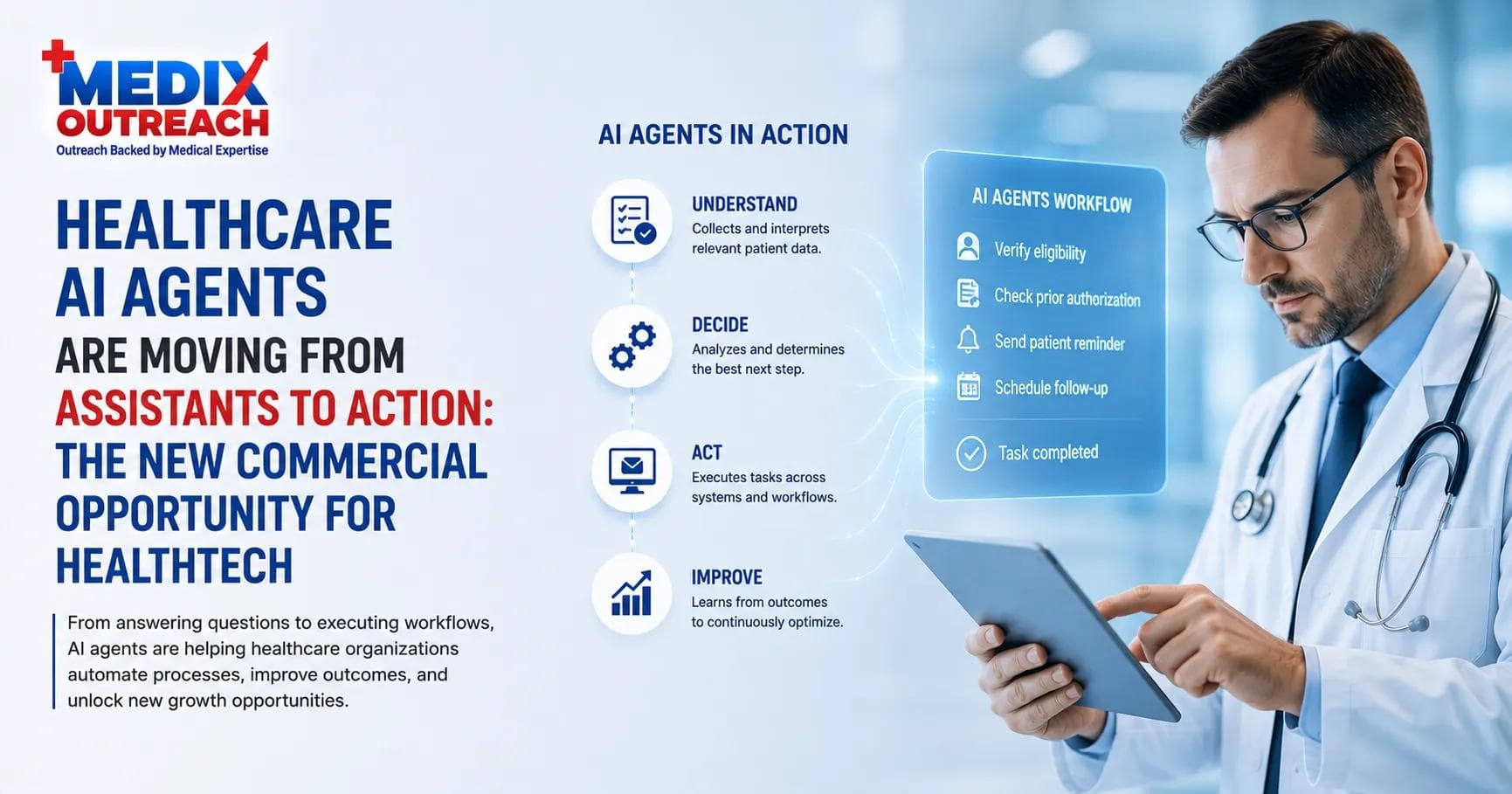
Instead of simply generating an answer, an AI agent can perform a sequence of tasks, interact with systems, and help execute workflows.
That distinction is commercially significant.
In 2026, healthcare organizations are increasingly moving from asking what AI can generate to asking what AI can actually accomplish.
Google Cloud identifies agents for workflows, customers, security, and scale as major healthcare and life sciences trends for 2026.
McKinsey similarly reports that healthcare organizations are moving toward agentic AI, with integration, ROI, and workflow transformation becoming increasingly important.
What Makes AI Agents Different?
A traditional AI assistant responds to a request.
An agent can potentially manage a process.
For example, an agentic healthcare workflow could:
- Identify an incomplete authorization
- Retrieve relevant information
- Determine what documentation is missing
- Prepare the required materials
- Route the task to the appropriate person
- Track the next step
The value isn't the AI response.
The value is the workflow execution.
Healthcare Is Particularly Suited to Agentic Workflows
Healthcare contains thousands of repetitive administrative processes.
Scheduling.
Eligibility verification.
Revenue cycle management.
Prior authorization.
Patient communication.
Documentation.
Claims processing.
Referral coordination.
Many of these processes contain structured steps that can potentially be supported by agentic systems.
McKinsey has highlighted revenue cycle management as an early opportunity because many back-end workflows are administrative and relatively structured, creating an environment where agentic AI can be tested and refined.
But Healthcare AI Has a Commercialization Problem
The technology is moving quickly.
The buying process isn't.
Healthcare organizations still need to evaluate:
- Security
- Integration
- Governance
- Clinical risk
- Data quality
- Workflow impact
- ROI
McKinsey's 2026 research found that healthcare leaders increasingly see integration challenges alongside AI risk and safety concerns as major barriers to scaling AI.
That means healthcare AI companies need more than technical differentiation.
They need a commercialization strategy.
Mid-article CTA
Need help building your healthcare growth engine?
Medix helps healthcare startups, clinics, pharma companies, and provider-focused platforms build scalable commercial pipelines.
Book a Strategy CallStop Selling the Agent. Sell the Workflow.
One of the biggest mistakes healthcare AI companies can make is leading with technical language.
"Autonomous AI agent."
"Multi-agent architecture."
"Advanced reasoning."
These terms may attract technology buyers.
They don't necessarily persuade healthcare executives.
A stronger commercial message explains what the agent changes.
For example:
Instead of:
"Our AI agent automates revenue cycle workflows."
Consider:
"Reduce manual follow-up across claims and authorization workflows while giving your revenue team more time to manage complex cases."
The second message connects technology to operational value.
Integration Will Separate Winners From Pilots
AI agents cannot create meaningful value if they operate outside the systems healthcare organizations already use.
The commercial question becomes:
"Where does the agent fit?"
Successful healthcare AI companies will need to demonstrate how their solutions interact with existing workflows, data, and systems.
Integration isn't just a technical requirement.
It is part of the sales proposition.
Trust Becomes Even More Important When AI Takes Action
An AI system that generates a summary is one thing.
An AI system that initiates an action is another.
As autonomy increases, healthcare organizations need stronger governance and controls.
McKinsey's 2026 AI Trust Maturity Survey found that responsible AI maturity is improving, but strategy, governance, and agentic AI controls continue to lag.
This creates another commercial opportunity.
AI companies that can explain their governance, safeguards, human oversight, and accountability clearly will have an advantage in enterprise healthcare sales.
The New Healthcare AI GTM Model
Healthcare AI companies should build their go-to-market strategy around five questions:
- What workflow are we changing?
- What measurable outcome improves?
- Where does the technology integrate?
- What safeguards exist?
- Who needs to approve adoption?
This approach creates a commercial narrative that works across clinical, operational, IT, and executive stakeholders.
How Medix Outreach Supports Healthcare AI Growth
Medix Outreach combines pharmacist-led healthcare expertise with business development, provider outreach, strategic partnerships, healthcare sales outsourcing, and healthcare commercialization.
For healthcare AI companies, this means moving beyond generic technology outreach and building conversations around clinical relevance, workflow value, and measurable commercial outcomes.
The next generation of healthcare AI won't be won by companies that simply build better models.
It will be won by companies that successfully connect those models to real healthcare workflows.
Conclusion
Healthcare AI is moving from assistance toward action.
That shift creates one of the biggest commercial opportunities in healthtech, but it also raises the standard for selling into healthcare.
Technology companies need to demonstrate workflow value, integration, governance, and measurable ROI.
The question is no longer whether healthcare organizations want AI.
The question is which AI solutions they can trust to actually work inside healthcare.