
A healthcare business development agency is an outside firm that helps healthcare, pharma, medtech, and digital health companies build revenue by finding the right buyers, opening qualified conversations, and turning them into partnerships and signed contracts. Unlike a marketing agency that produces awareness or a lead-generation shop that hands over lists, a business development agency owns the commercial motion itself: strategy, positioning, provider and partner outreach, and pipeline development through to deals. The strongest ones bring healthcare-specific judgment about how clinicians buy, how payers reimburse, and how procurement actually works, so you are not paying a generalist to learn your market on your budget.
If you are reading this, you are probably weighing whether to hire one. This guide covers what these agencies do, how they differ from adjacent vendors, the signs you actually need one, how engagements are typically priced, and a concrete framework for choosing well.
What a healthcare business development agency actually does
Business development in healthcare is the work of creating and advancing revenue relationships: identifying which accounts to pursue, reaching the right decision-makers, establishing clinical and commercial credibility, and moving qualified opportunities toward a contract. A healthcare business development agency does that work on your behalf, or alongside a small internal team, as an extension of your company.
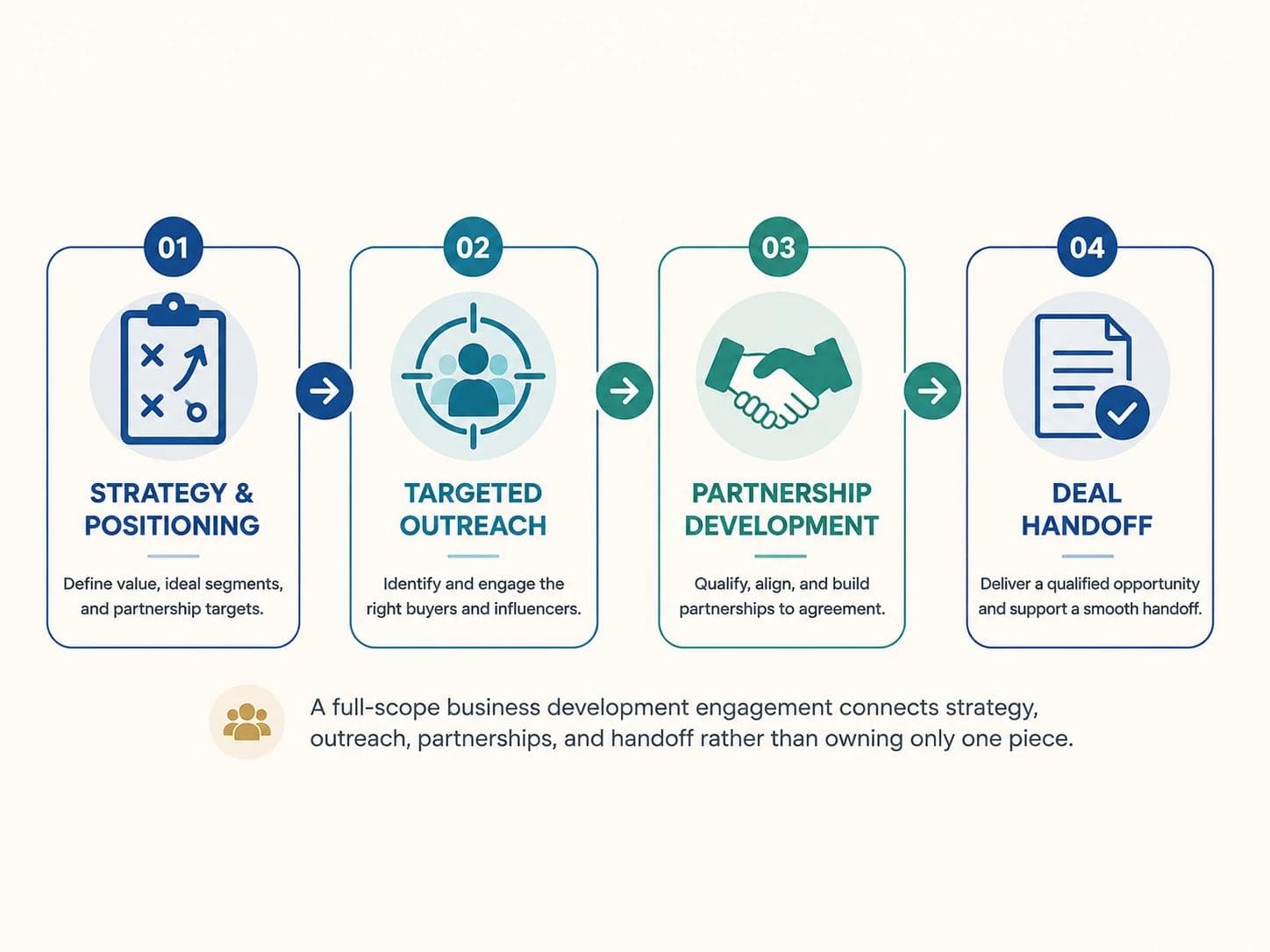
In practice, a full-scope engagement usually spans four connected areas:
- Commercial strategy and positioning. Deciding which segments to target, sharpening the value story for clinical and economic buyers, and mapping the buying process before anyone sends an email. This is the foundation, and it is closely tied to a company's broader healthcare business development strategy.
- Targeted outreach and pipeline creation. Building the account list, running provider and partner outreach, and booking qualified meetings with people who can actually buy or refer. For many clients this looks like outsourced healthcare SDR and appointment setting attached to a real strategy rather than a volume dialing operation.
- Partnership and channel development. Sourcing and structuring relationships with health systems, group practices, distributors, licensees, and other channels that multiply reach. Partnerships are often the fastest path to durable revenue, and a good agency knows how to originate and manage them.
- Deal support and handoff. Keeping opportunities warm, preparing materials for procurement and clinical review, and handing qualified deals to your closers with context intact.
The line that separates a business development agency from other vendors is ownership of the motion. A marketing firm hands you content and impressions. A lead vendor hands you contacts. A business development agency is accountable for whether real, qualified conversations happen and progress. That is a different mandate, and it requires people who understand the clinical sale, not just the funnel.
How a BD agency differs from lead-gen, marketing, and staffing firms
Buyers often use these categories interchangeably, then feel misled when the results do not match the expectation. The distinctions are real and worth getting right before you sign anything.
| Vendor type | What they own | What you get | Best when | | --- | --- | --- | --- | | Business development agency | The commercial motion: strategy, outreach, partnerships, qualified pipeline | Named, qualified opportunities advanced toward a deal | You need revenue relationships, not just activity | | Lead-generation agency | Volume of contacts or meetings against a list | Leads, MQLs, sometimes booked calls | You have a defined offer and a team ready to close | | Marketing agency | Awareness, brand, content, demand programs | Traffic, content, campaigns, sometimes inbound leads | You need visibility and a demand engine over time | | Staffing or recruiting firm | Placing a person on your payroll | A hire you then manage and ramp | You want to build the function in-house |
A lead-generation agency and a business development agency can look similar from the outside because both send outreach. The difference is what they are accountable for. Lead gen optimizes for the top of the funnel and often measures success in meetings booked, regardless of whether those meetings were with the right people or went anywhere. Business development is measured on qualified pipeline and progression. If you want the longer version of this distinction, we wrote a dedicated piece on healthcare sales outsourcing versus lead generation.
A marketing agency operates even further upstream. Marketing builds the conditions for demand: positioning, content, search visibility, and campaigns. That work matters, but a well-run ad campaign does not sit across the table from a hospital's value analysis committee or negotiate a licensing term sheet. Marketing fills the top; business development works the middle and hands off the bottom.
A staffing or recruiting firm solves a different problem entirely. It finds you a person to hire. That can be the right move when you are ready to build a permanent commercial team, but it leaves you responsible for strategy, management, tooling, and ramp. Hiring one experienced healthcare business development lead can take many months, and that person still needs a system around them to be productive.
Signs you actually need a healthcare business development agency
Not every company should hire one. These are the situations where an agency tends to earn its keep:
- Your product is sound but revenue has stalled, and you suspect the problem is commercial execution rather than the offering itself.
- You are entering the U.S. market or a new segment where you have no relationships, no reference accounts, and no local commercial team.
- Your founders or clinical team are carrying sales on top of their real jobs, and pipeline moves only when they personally push it.
- You tried generic outbound or a lead-gen vendor and got meetings that went nowhere because the outreach had no clinical credibility.
- You need partnerships, licensing, or channel relationships that require sourcing, structuring, and patient relationship management, not a campaign.
- Your sales cycle is long and multi-stakeholder, and deals keep stalling after the first demo because no one is actively advancing them.
If several of those describe you, the gap is usually not more leads. It is a commercial motion that someone owns end to end. Building that motion in-house is a legitimate choice, but it is slower and carries fixed cost. That build-versus-buy decision deserves its own analysis, and it is a distinct question from which agency to choose.
What a strong healthcare BD agency delivers
The category is uneven. Some firms are rebranded lead vendors; others are genuine commercial partners. A strong healthcare business development agency should deliver most of the following, and be able to show you how.
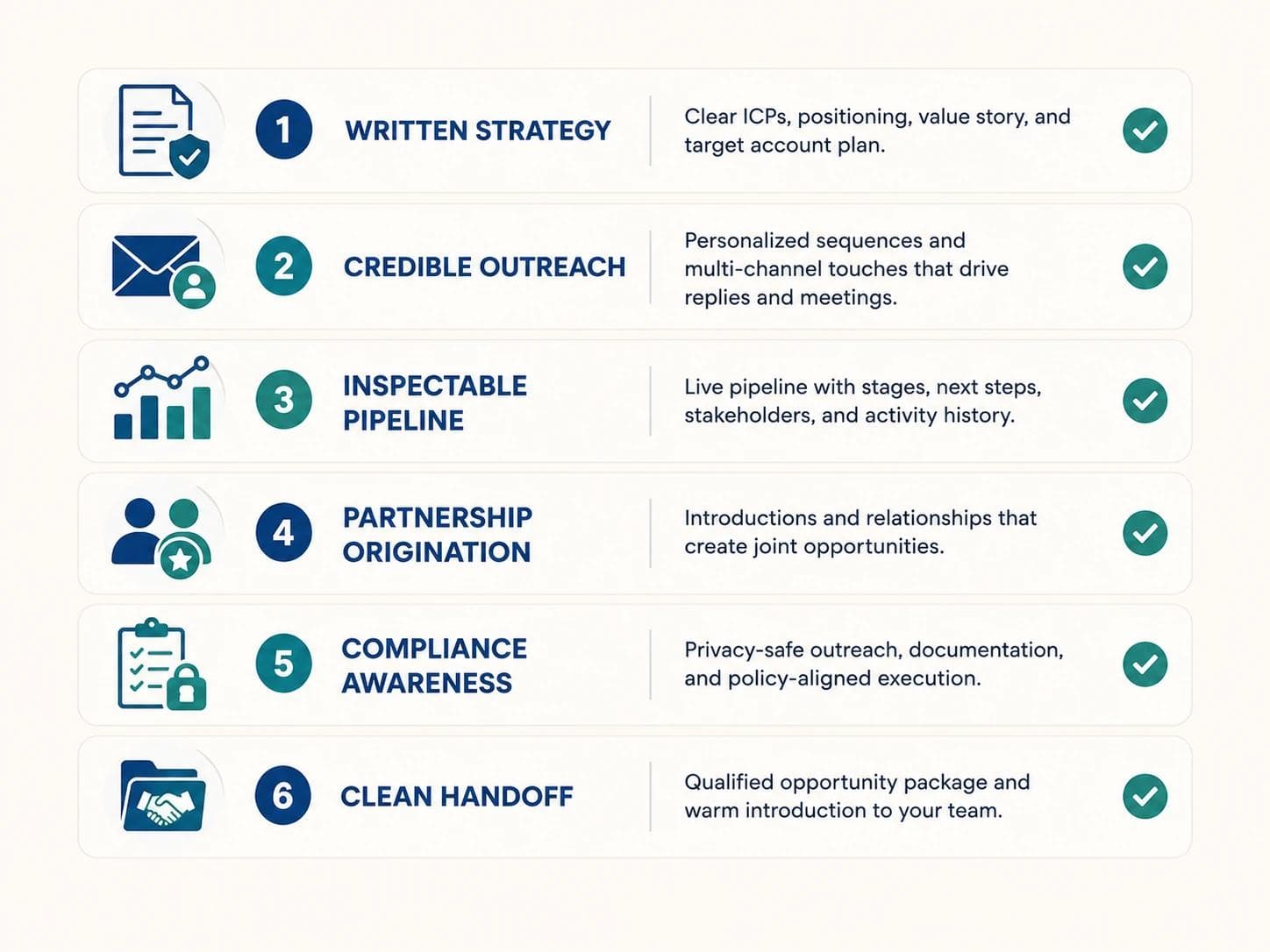
- A written commercial strategy. Segment priorities, buyer maps, positioning for clinical and economic stakeholders, and a target account list you can see and challenge. If the plan lives only in the agency's head, that is a warning sign.
- Credible, healthcare-specific outreach. Messaging that reflects how clinicians and administrators actually evaluate a product, informed by people who have sat in those rooms. Credibility is now a commercial asset in itself, and outreach that lacks it rarely converts no matter how many messages go out.
- Qualified pipeline you can inspect. Named accounts, real stage definitions, and honest reporting on what is progressing versus what is stuck. Vanity metrics like raw meeting counts are not enough.
- Partnership origination when it fits. The ability to source and advance strategic relationships, distribution, or licensing deals, which often move faster than one-at-a-time selling.
- Compliance awareness. Anyone contacting providers or touching patient data on your behalf should understand HIPAA obligations and the mechanics of a Business Associate Agreement where protected health information is involved. The U.S. Department of Health and Human Services is clear that business associates are directly accountable under the rules (HHS.gov).
- A clean handoff. Documentation, context, and warm introductions so your team can take deals across the line without starting cold.
You can see this shape in real engagements. In one example, a licensing outreach program built qualified international conversations for a pharma company by leading with clinical and regulatory credibility rather than volume, which you can read in this pharma licensing outreach case study. The pattern that separates strong agencies is consistent: strategy first, credible outreach second, pipeline and partnerships as the output.
Mid-article CTA
Need help building your healthcare growth engine?
Medix helps healthcare startups, clinics, pharma companies, and provider-focused platforms build scalable commercial pipelines.
Book a Strategy CallHow healthcare business development agencies price engagements
Pricing varies widely, and any agency quoting a single number before understanding your goals is guessing. At a high level, most engagements use one of three models, and many blend them.
- Retainer. A recurring monthly fee for an ongoing scope of strategy, outreach, and pipeline work. This is the most common model for sustained business development because the work is continuous and relationships compound over time. Retainers align well when you need a durable motion rather than a one-off push.
- Project or fixed scope. A defined deliverable with a set fee, such as a market-entry strategy, a target account map, or a time-boxed outreach sprint into a new segment. Useful when you have a specific, bounded need or want to test an agency before a larger commitment.
- Performance or hybrid. Some compensation tied to outcomes such as qualified meetings, sourced opportunities, or closed deals, usually layered on top of a base retainer. Pure pay-per-deal arrangements are rare in healthcare because sales cycles are long and multi-stakeholder, so hybrids are more realistic.
Two cautions on pricing. First, be skeptical of pure pay-per-lead pricing in healthcare, because it pushes a vendor toward volume over fit, which is exactly the failure mode you are trying to avoid. Second, compare total cost against the fully loaded expense of building the same capability in-house, including recruiting, salary, tooling, management time, and ramp. The right comparison is not agency fee versus zero. It is agency fee versus the real cost and time of doing it yourself.
A framework for choosing the right agency
Once you know you want outside help, the question becomes how to pick well. Use a consistent set of criteria rather than reacting to whichever pitch was most polished. The matrix below organizes the evaluation into the dimensions that actually predict fit.
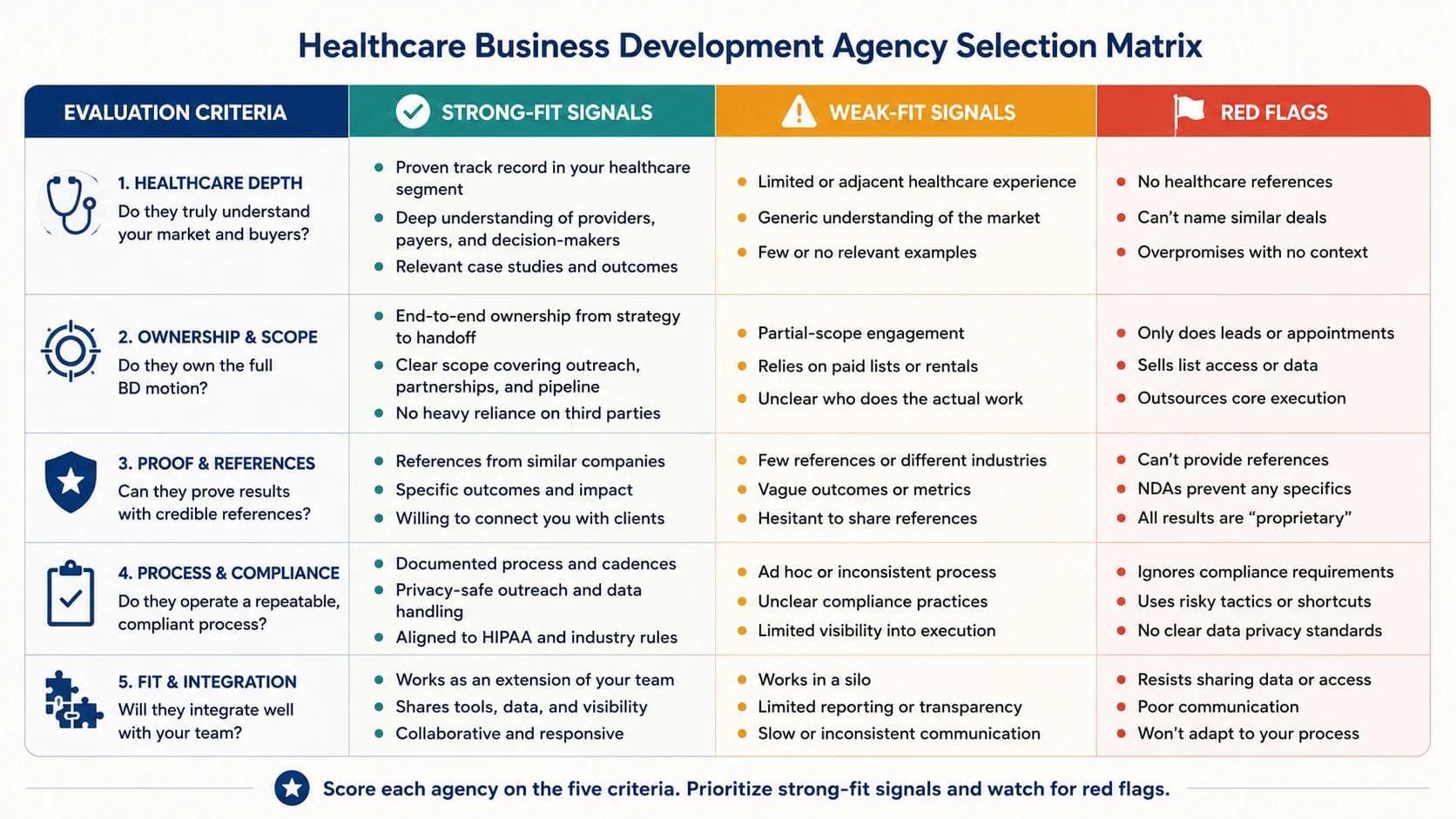
Work through these five areas for every agency on your shortlist.
1. Healthcare depth, verified. "Healthcare-specific" should mean something concrete. Ask who on the team has actually sold to or worked inside your buyer's world: pharmacists, clinicians, hospital or payer veterans, regulatory or market-access experience. A generalist agency with a healthcare landing page is not the same as a team that has sat across from a value analysis committee. Medix is a pharmacist-led firm precisely because that clinical vantage point changes how buyers respond, a point we make in the case for pharmacist-led sales teams.
2. Ownership and scope. Get specific about what the agency owns versus what stays on you. Do they build the strategy, or execute yours? Do they source and progress deals, or only book first meetings? A clear scope prevents the most common disappointment, which is paying for business development and receiving lead generation.
3. Proof and references. Ask for relevant examples and outcomes, and talk to a reference in a comparable segment. You are looking for evidence of qualified pipeline and progressed relationships, not a screenshot of meeting counts. Review an agency's published examples and full range of services to confirm they operate where you need them.
4. Process, reporting, and compliance. Understand how they build target lists, how they write outreach, how they report, and how they handle provider contact and any protected health information. If they cannot explain their process or their compliance posture in plain language, assume there is not much underneath.
5. Fit and integration. Judge how they will work with your team. Will you have a named lead? How will handoffs work? Do they push back and add strategic thinking, or just take orders? The best engagements feel like a commercial team you did not have to hire.
Alongside the criteria, watch for red flags:
- Guaranteed results, specific revenue promises, or guaranteed rankings. Credible partners describe how they work, not outcomes they cannot control.
- Pay-per-lead pricing with no qualification standard.
- No named healthcare experience on the actual delivery team.
- Reporting built on vanity metrics with no view into qualified pipeline.
- Vague scope that blurs strategy, execution, and accountability.
- Reluctance to discuss compliance or to sign a Business Associate Agreement when patient data is involved.
Agency versus in-house at a glance
Choosing an agency is related to, but not the same as, deciding whether to build the commercial function internally. Here is the quick contrast to frame that larger decision.
| Dimension | Healthcare BD agency | In-house team | | --- | --- | --- | | Time to activity | Weeks | Many months to hire and ramp | | Cost structure | Variable, scope-based | Fixed salary, benefits, tooling, management | | Healthcare expertise | Available on day one if you choose well | Depends entirely on who you can hire | | Flexibility | Scale scope up or down | Harder to adjust once hired | | Institutional knowledge | Lives partly with the agency | Stays fully in-house | | Best for | Speed, market entry, testing a motion | A permanent, owned function at scale |
The honest answer for many companies is a blend: an agency builds and proves the motion, then hands a working system to an internal hire once the model is validated. The deeper build-versus-buy analysis, including how outsourced commercial teams are structured, is a separate topic worth its own read. For now, treat the agency decision as its own question, evaluated on the framework above.
Where this leaves you
A healthcare business development agency is worth hiring when your constraint is commercial execution rather than the product, and when the work needs someone accountable for real pipeline and partnerships rather than activity. Choose one the way you would evaluate a hire: verify healthcare depth, pin down what they own, demand proof, inspect their process and compliance, and judge how they will integrate with your team. Do that, and you avoid the two common outcomes, which are paying for leads dressed up as business development, or paying a generalist to learn your market on your dime.
Medix Outreach was built for exactly this profile. We are a pharmacist-led healthcare business development firm focused on the U.S. market, combining commercial strategy, credible provider and partner outreach, and pipeline development into a single owned motion. If you want to understand how we would approach your growth, start with our healthcare commercial growth and go-to-market work or learn more about the team and how we operate. Tell us where the commercial motion is stuck, and we will show you how we would build it.
Frequently Asked Questions
What does a healthcare business development agency do?
A healthcare business development agency helps healthcare, pharma, medtech, and digital health companies build revenue by owning the commercial motion end to end. That includes setting commercial strategy and positioning, running credible outreach to providers and partners, sourcing and structuring partnerships, and advancing qualified opportunities toward signed contracts. The defining feature is accountability for real, qualified pipeline and relationships, not just awareness or a list of contacts.
How is a healthcare business development agency different from a lead-generation agency?
A lead-generation agency is accountable for the top of the funnel, usually measured in contacts or meetings booked against a list. A business development agency is accountable for the qualified pipeline and how it progresses, which means it cares whether outreach reaches the right clinical and economic buyers and whether opportunities move toward a deal. In healthcare, the distinction matters because meetings with the wrong stakeholders, or outreach with no clinical credibility, rarely convert regardless of volume.
How much does a healthcare business development agency cost?
Costs depend on scope and model rather than a single list price, and any firm quoting a number before understanding your goals is guessing. Most engagements use a monthly retainer for ongoing strategy and pipeline work, a fixed fee for a defined project such as a market-entry plan, or a hybrid that layers some outcome-based compensation on a base. Pure pay-per-lead pricing is worth avoiding in healthcare because it rewards volume over fit. The right comparison is the agency fee against the fully loaded cost of building the same capability in-house.
How do I know if I need a healthcare BD agency or should hire in-house?
Consider an agency when you need speed, are entering a new market or segment without relationships, or want to prove a commercial motion before committing to fixed headcount. Consider building in-house when you are ready to own a permanent commercial function at scale and can recruit people with genuine healthcare selling experience, which often takes many months. Many companies do both in sequence: an agency builds and validates the motion, then hands a working system to internal hires. The agency-selection decision and the build-versus-buy decision are related but separate questions.
What makes an agency genuinely healthcare-specific rather than a generalist?
Genuine healthcare depth shows up in the people doing the work, not the website. Ask who on the delivery team has actually sold to or worked inside your buyer's world, whether that is pharmacists, clinicians, hospital or payer veterans, or people with regulatory and market-access experience. A healthcare-specific agency understands how clinicians evaluate products, how payers reimburse, and how procurement and compliance function, including HIPAA obligations when patient data is involved. A generalist with a healthcare landing page will learn those things slowly, on your budget.