Healthcare companies have never had more opportunities to grow. From digital health platforms and healthcare SaaS to pharmaceutical manufacturers, medical device companies, clinical diagnostics, and specialty providers, innovation is transforming the industry at an unprecedented pace.
Yet despite launching exceptional products and investing heavily in healthcare marketing, many organizations struggle to generate consistent commercial growth.
The problem usually isn't the product.
It's the lack of a structured healthcare business development strategy.
Unlike traditional B2B markets, healthcare purchasing decisions are influenced by clinical priorities, regulatory requirements, operational workflows, reimbursement models, and multiple decision-makers. Companies that rely on generic sales tactics often spend months chasing opportunities that never convert.
A successful healthcare business development strategy aligns commercial planning, provider outreach, healthcare demand generation, strategic partnerships, and revenue execution into one scalable growth system.
What Is Healthcare Business Development?
Healthcare business development is the process of creating long-term commercial growth by building relationships, expanding market presence, generating qualified opportunities, and developing strategic partnerships across the healthcare ecosystem.
It extends far beyond healthcare lead generation.
An effective strategy includes:
- Healthcare go-to-market strategy
- Provider outreach
- Healthcare sales outsourcing
- Healthcare demand generation
- Partnership development
- Healthcare market expansion
- Revenue pipeline management
- Commercialization planning
The goal isn't simply to generate meetings. It's to build a predictable engine that drives sustainable revenue.
Why Traditional Business Development Doesn't Work in Healthcare
Healthcare is built on trust.
Every purchasing decision has the potential to affect patient care, operational efficiency, regulatory compliance, and financial performance.
As a result, healthcare buyers evaluate vendors differently than buyers in most industries.
Before purchasing a solution, they want to know:
- Does this improve patient outcomes?
- Will it fit our existing workflows?
- Can our teams adopt it easily?
- Is the vendor credible?
- Does the investment justify the operational impact?
Companies that ignore these realities often experience long sales cycles, stalled opportunities, and low conversion rates.
Healthcare business development requires clinical understanding alongside commercial expertise.
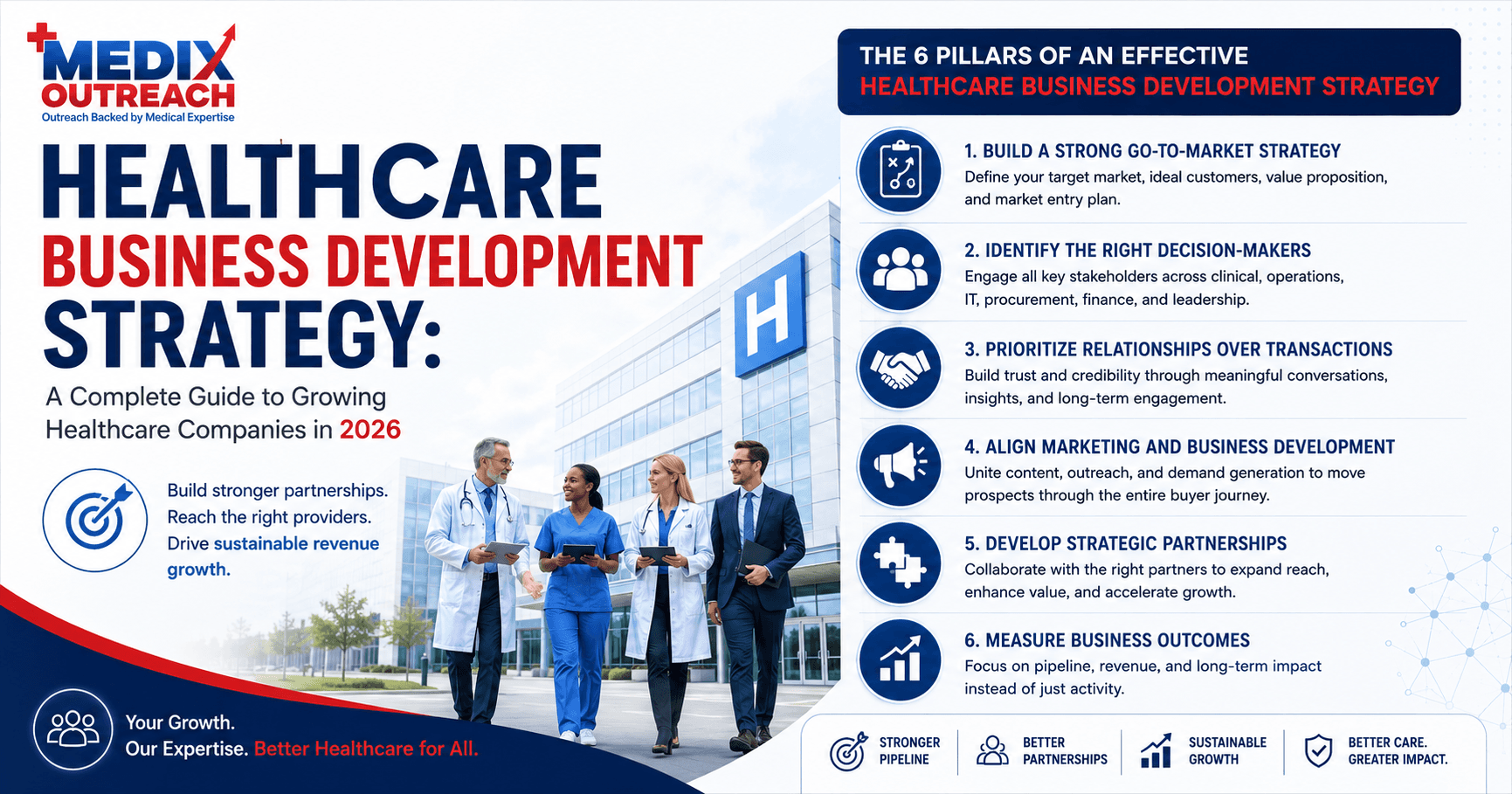
The Six Pillars of an Effective Healthcare Business Development Strategy
1. Build a Healthcare-Specific Go-to-Market Strategy
Many organizations begin with outreach before defining their commercial strategy.
That approach creates inconsistent messaging and weak positioning.
A healthcare go-to-market strategy should define:
- Target market
- Ideal customer profile
- Clinical value proposition
- Competitive positioning
- Buyer journey
- Market entry plan
Without a clear strategy, even the best outreach campaigns struggle to generate qualified opportunities.
2. Identify the Right Decision-Makers
Healthcare purchases rarely depend on one individual.
A successful provider outreach strategy considers every stakeholder involved in the buying process.
This often includes:
- Physicians
- Department leaders
- Practice managers
- Operations teams
- IT departments
- Procurement
- Finance
- Executive leadership
Each stakeholder evaluates your solution differently.
Your messaging should reflect those different priorities instead of relying on one generic sales pitch.
3. Prioritize Relationships Over Transactions
Healthcare is one of the most relationship-driven industries in the world.
Organizations don't buy from vendors they barely know.
They buy from trusted partners who demonstrate long-term commitment.
Healthcare outreach should focus on:
- Educational conversations
- Industry insights
- Clinical relevance
- Thought leadership
- Provider engagement
- Strategic networking
Companies that build credibility before asking for a meeting consistently outperform competitors relying solely on healthcare cold email or healthcare cold calling.
4. Align Marketing and Business Development
Healthcare marketing and healthcare business development should never operate independently.
Healthcare content marketing, healthcare email marketing, LinkedIn outreach, webinars, conferences, and provider engagement should all support one commercial objective.
This creates a stronger healthcare sales funnel by moving prospects from awareness to meaningful business conversations.
Instead of measuring success by website traffic or email opens alone, organizations should evaluate how marketing contributes to pipeline growth and revenue generation.
5. Develop Strategic Partnerships
Some of the fastest-growing healthcare companies don't rely solely on direct sales.
They accelerate growth through strategic partnerships.
Examples include:
- Pharmaceutical collaborations
- Referral partnerships
- Distribution agreements
- Healthcare organizations
- Industry associations
- Technology integrations
These relationships expand market reach while strengthening commercial credibility.
For many organizations, partnership development becomes one of the highest-performing channels for healthcare market expansion.
6. Measure Business Outcomes
Successful healthcare business development isn't measured by activity.
It's measured by commercial impact.
Instead of tracking only:
- Emails sent
- Calls completed
- Meetings booked
Focus on metrics that predict long-term growth:
- Qualified opportunities
- Provider engagement
- Partnership growth
- Sales pipeline health
- Revenue generated
- Customer acquisition cost
- Lifetime customer value
Growth should always be measured by business outcomes rather than sales activity.
Mid-article CTA
Need help building your healthcare growth engine?
Medix helps healthcare startups, clinics, pharma companies, and provider-focused platforms build scalable commercial pipelines.
Book a Strategy CallCommon Mistakes That Limit Healthcare Growth
Even experienced organizations make mistakes that slow commercial growth.
The most common include:
- Targeting every healthcare organization instead of ideal customers
- Leading with product features instead of clinical value
- Treating healthcare like traditional B2B sales
- Relying exclusively on healthcare lead generation
- Ignoring provider relationships
- Failing to align marketing with commercial strategy
- Measuring activity instead of revenue
Avoiding these mistakes allows organizations to create stronger pipelines while shortening sales cycles.
Why Healthcare Commercialization Is the Future
Business development no longer ends with booking a meeting.
Today's healthcare organizations need complete commercialization strategies that connect marketing, sales, partnerships, and provider engagement.
Healthcare commercialization combines:
- Healthcare business development
- Healthcare sales outsourcing
- Provider outreach
- Healthcare demand generation
- Strategic partnerships
- Revenue pipeline execution
This integrated approach creates sustainable growth instead of isolated sales wins.
How Medix Outreach Helps Healthcare Companies Grow
At Medix Outreach, we believe healthcare companies need more than lead generation.
They need a commercialization partner.
Our team combines pharmacist-led expertise with healthcare business development, healthcare go-to-market strategy, provider outreach, strategic partnerships, healthcare sales outsourcing, and end-to-end revenue pipeline development.
We work with healthcare SaaS companies, pharmaceutical organizations, biotech innovators, medical device manufacturers, clinical diagnostics companies, specialty clinics, and healthcare startups to accelerate commercial growth across the U.S. healthcare market.
Rather than simply generating leads, we help organizations build scalable commercialization systems that create lasting business impact.
Conclusion
Healthcare companies don't grow because they generate more leads.
They grow because they build stronger commercial strategies.
A modern healthcare business development strategy combines provider outreach, healthcare demand generation, commercialization, healthcare market expansion, and strategic partnerships into one unified approach.
Organizations that invest in these capabilities consistently outperform competitors still relying on traditional lead generation alone.
As healthcare becomes more competitive in 2026 and beyond, the companies that succeed will be those that combine clinical expertise with commercial execution and focus on building trusted relationships that drive long-term growth.