
Healthcare marketers get stuck on HIPAA in two opposite ways. Some freeze. They assume every email, call, and ad in healthcare is a legal minefield, so they water down their outreach or avoid whole channels. Others do the reverse. They treat patient data casually because a campaign got results, and they only learn the rules after a complaint or an audit.
Both mistakes come from the same gap. Most people in healthcare sales and marketing have never been told what HIPAA actually regulates, and just as important, what it does not. The law is narrower than its reputation. A lot of healthcare B2B outreach sits completely outside it, and getting HIPAA-compliant marketing right is more about knowing where that line falls than about fearing every send.
This guide draws that line clearly. You will learn what protected health information is, when your work is genuinely covered, when you become a business associate, and which other laws - CAN-SPAM, TCPA, and a growing set of state rules - apply to your outreach even when HIPAA does not. One note before we start. This is educational, not legal advice. Regulations change and facts differ. Treat what follows as a working map, then have qualified counsel or a compliance professional review your specific program.
What HIPAA actually governs
HIPAA is the Health Insurance Portability and Accountability Act. The part everyone worries about is the Privacy Rule, and it applies to a specific set of players, not to healthcare in general.
Two groups fall under it. The first is covered entities: health plans, healthcare clearinghouses, and healthcare providers that transmit health information electronically for certain standard transactions, like billing a payer. The second is business associates: companies that create, receive, maintain, or transmit protected health information on behalf of a covered entity to do a job for them.
Everything HIPAA protects is a single category of data called protected health information, or PHI. PHI is individually identifiable health information that a covered entity or business associate holds or transmits. Think of a patient's diagnosis tied to their name, a medical record number, treatment details, or claims data. If information is not health information tied to an individual, and it is not held by one of those two groups on the other's behalf, HIPAA generally has nothing to say about it.
That last point matters more than any other in this article. HIPAA is not a general privacy law for the whole healthcare economy. It is a specific set of duties for covered entities and their business associates, centered on one type of data. Read the source directly on the HHS HIPAA pages for professionals rather than relying on secondhand summaries.
What HIPAA does not cover
Here is where many teams overcorrect. If you sell a product or service to a hospital, clinic, lab, or pharmacy, and your outreach is aimed at the people who run those organizations, you are usually not touching PHI at all.
A provider's work email address is not PHI. A practice manager's direct line is not PHI. The fact that a cardiology group exists, has ten physicians, and might need your scheduling software is business information, not patient health data. Reaching out to that group to introduce your product is standard business-to-business selling. HIPAA generally does not govern it.
This trips people up because the buyer works in healthcare. But HIPAA follows the patient data, not the industry. A cold email to a clinic's operations lead about your billing platform is no more a HIPAA matter than a cold email to a manufacturer about factory software. The context feels clinical, so it feels regulated. It usually is not.
The line only moves when patient data enters the picture. If your outreach list was built from patient records, or your campaign uses information about identifiable patients, or your product will handle PHI once the deal closes, you are in different territory. We will get to that next. For the common case, a vendor introducing a product to a provider organization, the constraint is not HIPAA. It is the marketing and communication laws that apply to any business, which we cover further down. If your cold outreach is stalling, the cause is almost always weak targeting or a weak message, not the law. We wrote about that in why cold outreach fails in healthcare.
Marketing that touches PHI versus standard B2B demand generation
The cleanest way to stay compliant is to know which side of a single line you are on. Does your outreach or campaign use protected health information, or not?
Standard B2B demand generation does not. You are targeting organizations and the professionals inside them. Your data comes from public and commercial business sources: provider directories, professional profiles, firmographic data, conference lists, your own inbound leads. You are selling to a buyer, not communicating with a patient. This is the world most healthcare sales teams live in, and it is the world our own work covers when we help companies market to doctors and provider organizations.
Marketing that touches PHI is different. A health system asks you to run a patient outreach campaign using its patient list. A digital health company wants to email its enrolled members about a new program. A specialty pharmacy wants to contact patients on a specific therapy. In each case, the campaign uses identifiable patient information held by a covered entity. Now HIPAA is directly involved, and so is its specific definition of marketing, which we cover below.
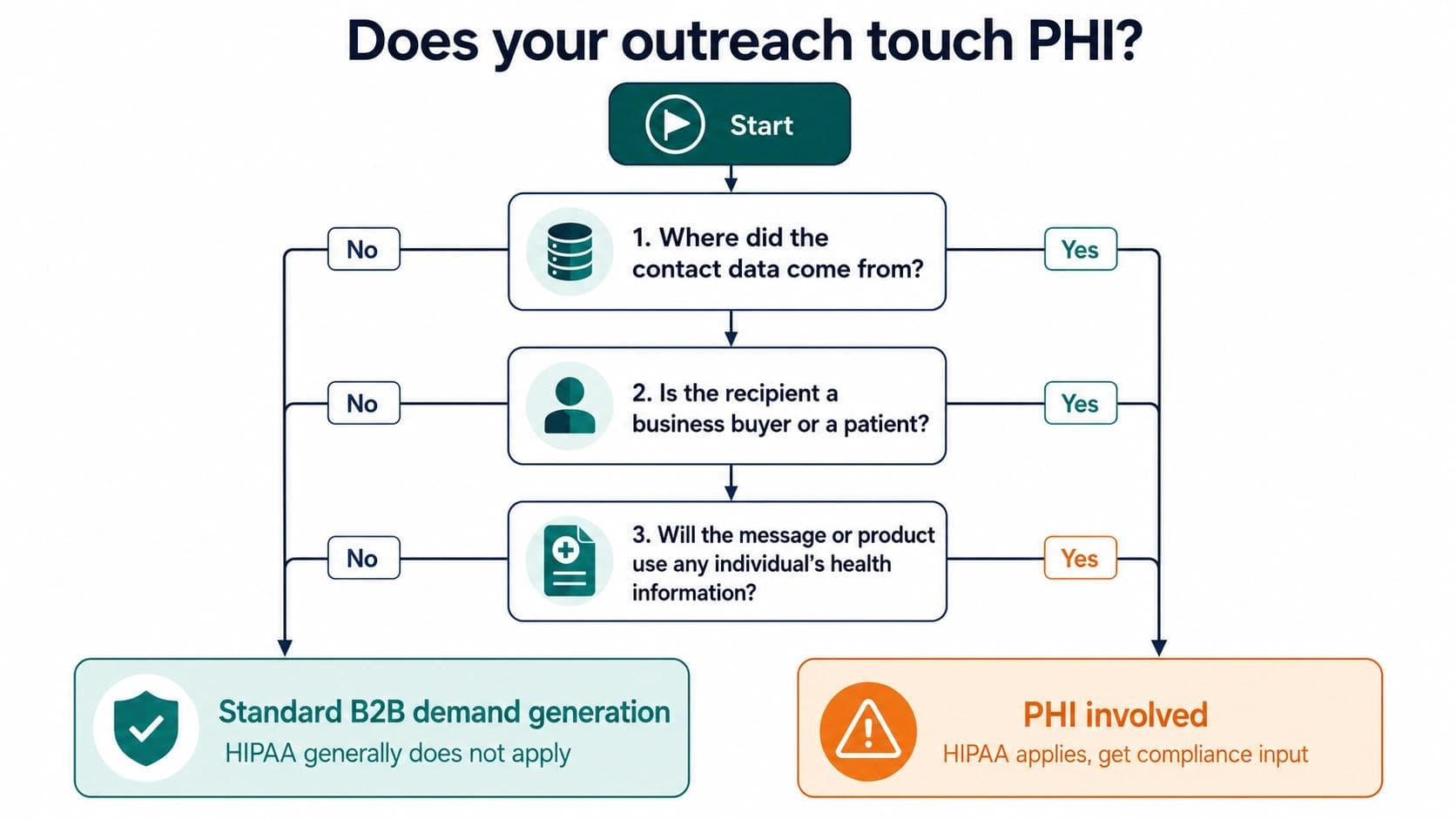
If you are ever unsure which side you are on, ask three questions. Where did the contact data come from? Is the recipient a business buyer or a patient? Will the message, or the product behind it, use any individual's health information? If the answers point to patients and their health data, slow down and get compliance input before you send anything.
When you become a business associate
There is one common path from ordinary vendor to regulated party, and every healthtech founder should know it. You become a business associate the moment you create, receive, maintain, or transmit PHI on behalf of a covered entity.
Say you sell analytics software to a hospital. During the sales process, you are just a vendor. But once the hospital signs and your platform starts processing patient records, you are handling PHI on their behalf. At that point you need a business associate agreement, or BAA - a contract that binds you to HIPAA's safeguards and spells out how you protect and use that data.
The distinction to hold onto is timing. Selling to a covered entity does not make you a business associate. Handling their PHI does. Your outreach and sales motion, the emails, calls, and demos that win the deal, typically happen before any PHI changes hands, which is a big reason so much healthcare selling sits outside HIPAA. The obligation attaches to the data relationship, not to the pitch.
If your product will eventually process PHI, build the BAA into your deal process and your security posture early. Buyers will ask about it, and being ready signals that you understand their world. The HHS Office for Civil Rights, which enforces HIPAA, publishes guidance on business associates and sample agreement language worth reviewing with counsel.
The HIPAA marketing rule, in plain terms
HIPAA has its own definition of marketing, and it is worth understanding even if it rarely applies to B2B sellers directly.
Under the Privacy Rule, marketing generally means a communication about a product or service that encourages the recipient to buy or use it. When a covered entity wants to use a patient's PHI to send that kind of communication, it usually needs the individual's written authorization first. There are limited exceptions, for example certain face-to-face communications and some treatment-related messages, but the default is that using PHI to market to patients requires their permission.
Notice who this rule constrains: the covered entity, using patient data, communicating with patients. It is not a rule about a software vendor emailing a hospital's chief medical officer. If you run campaigns on behalf of a covered entity that use patient data, this rule shapes what you can and cannot do, and authorization becomes central. If you are doing B2B outreach to providers, this specific rule is usually not your concern, though the general marketing laws still are.
The practical takeaway is that the word marketing means something precise in HIPAA. Do not assume your ordinary demand generation is what the regulation is talking about, and do not assume you are clear to run a patient-facing campaign just because a covered entity asked you to. Check the HHS marketing guidance and confirm authorization requirements before any campaign uses patient information.
The laws that still apply when HIPAA does not
Stepping outside HIPAA does not mean stepping into a rule-free zone. Several laws govern outreach for every business, healthcare included. These are the ones that actually shape most healthcare sales programs day to day, and understanding CAN-SPAM and TCPA for healthcare matters far more often than the HIPAA marketing rule does.
CAN-SPAM: commercial email
CAN-SPAM is the federal law for commercial email, enforced by the FTC, and it applies to your B2B cold email whether or not HIPAA is in play. It does not require opt-in, but it does require honesty and an exit. In practice: do not use false or misleading header information, do not write deceptive subject lines, identify the message as an ad where required, include a valid physical postal address, and give recipients a clear way to opt out that you honor promptly. You are also responsible for what vendors send on your behalf. Good email practice and good deliverability tend to move together, a theme we cover in email marketing in healthcare.
TCPA: calls and texts
The Telephone Consumer Protection Act, overseen by the FCC, governs phone calls and text messages, especially those using autodialers or prerecorded and artificial voice messages. Depending on how you call or text and whom you contact, you may need prior consent, and there are do-not-call obligations to respect. The details here are technical and they change, so treat any autodialed or texted outreach as higher risk and check the current FCC rules or ask counsel before scaling it. A human dialing a provider's business line is a very different risk profile than a mass automated text campaign.
State privacy and telemarketing laws
Beyond the federal floor, states add their own layers. Broad consumer privacy laws now exist in California and a growing list of other states, and several states have their own telemarketing and calling restrictions that can be stricter than federal rules. If you run national outreach, assume the map is uneven and design to the stricter standard rather than tracking fifty variations one call at a time.

Mid-article CTA
Need help building your healthcare growth engine?
Medix helps healthcare startups, clinics, pharma companies, and provider-focused platforms build scalable commercial pipelines.
Book a Strategy CallPractical do's and don'ts for compliant outreach
Rules are easier to follow when they are concrete. Here is how the principles above turn into daily practice.
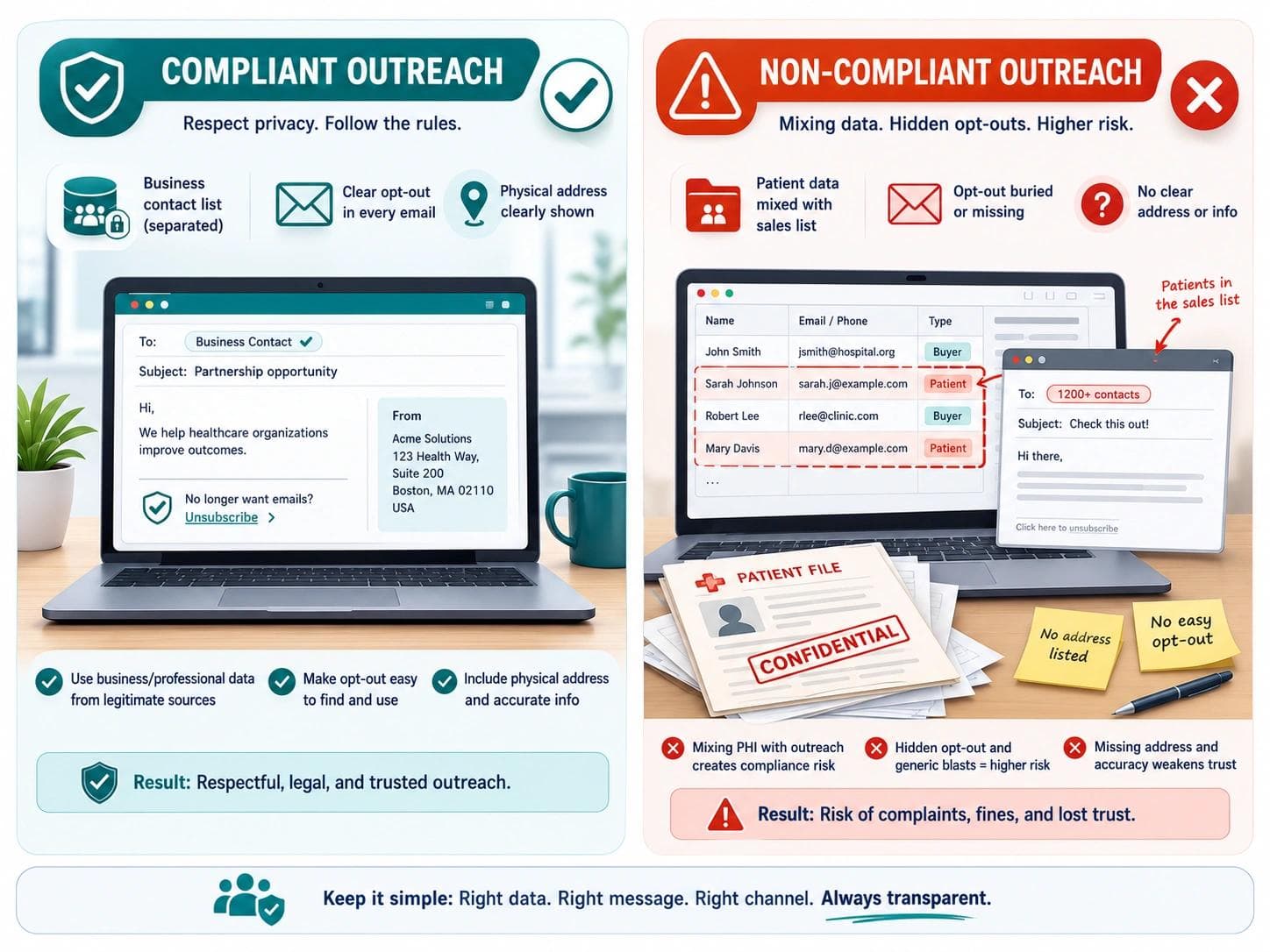
For cold email to providers, keep it clean and honest. Use accurate sender names and subject lines, include your real physical address, and make opting out easy and immediate. Source your lists from legitimate business data, not from anything derived from patient records. Keep the message about the business value to the organization, not about individual patients. And keep suppression lists current so a person who opts out never hears from you again by mistake.
For calls and voicemails, know your method. A human calling a clinic's published business number to reach an office manager is ordinary B2B selling. The risk rises sharply when you introduce automated dialing, prerecorded messages, or texts, and when you contact mobile numbers. If you are going to use those tools, get the consent and do-not-call mechanics right first. Cold calling still works in healthcare when the method and the list are right; the compliance question is about how you dial, not whether you call.
For multichannel outreach and data hygiene, treat every channel as its own set of rules and keep your data disciplined. A few habits carry most of the weight:
- Keep business contact data and any patient data strictly separate. Never let PHI leak into a sales sequence.
- Honor opt-outs across every channel, not just the one where the person unsubscribed.
- Document consent where a channel requires it, and keep those records.
- Vet any data vendor or agency, because you own the compliance outcome of what they do for you.
- When patient data is genuinely involved, stop and route the campaign through counsel or your compliance team.
The don'ts are shorter. Do not buy or use lists built from patient information. Do not disguise who you are or hide the opt-out. Do not run autodialed or texted campaigns at scale without confirming the TCPA and state requirements. Do not assume an agency's shortcuts are safe just because they are fast. Our specialty pharmacy provider outreach case study is an example of reaching providers effectively while staying firmly on the business side of the line.
Why HIPAA-compliant marketing performs better
Compliance is usually framed as a cost. In healthcare outreach it is closer to an advantage, because the same discipline that keeps you legal also makes your outreach land.
Start with deliverability. The CAN-SPAM basics, honest headers, a real address, an easy opt-out, are also what inbox providers reward. Senders who respect recipients get filtered less and reach more people. The compliant path and the high-performing path are the same path.
Then there is trust, which is the whole game in healthcare. Clinical and economic buyers are cautious by nature and by training. When your outreach is clean, respectful, and clearly about their organization's needs rather than a scraped patient list, it signals that you understand their world and can be trusted with it. That impression carries into the sales conversation and into the eventual data relationship. Buyers who see you handle the small compliance details well assume you will handle the big ones too.
There is also focus. Teams that know the line stop wasting energy on fear. They run confident B2B outreach where HIPAA does not apply, whether in-house or through outsourced appointment setting, and they slow down and get help in the narrow cases where it does. That clarity is faster than blanket caution and safer than blanket confidence. It is the posture we bring to healthcare commercial growth and go-to-market work: senior, credible outreach that respects the rules and the buyer at the same time.
Where to start
If you take one thing from this, make it the central distinction. HIPAA follows protected health information held by covered entities and business associates. Most B2B outreach to providers never touches that, so most of your day-to-day selling sits outside HIPAA. It still lives under CAN-SPAM, TCPA, and a widening set of state laws.
A simple sequence puts this to work. Map where your contact data comes from. Confirm whether any campaign uses patient information. Get a BAA process ready if your product will handle PHI. Build your email and calling practices to the honest, consent-aware standard those other laws require. Read the primary sources, HHS and its Office for Civil Rights for HIPAA, the FTC for CAN-SPAM, the FCC for TCPA, and have qualified counsel review your specific program before you scale.
Get that foundation right and outreach stops feeling risky. HIPAA-compliant marketing becomes a credible, repeatable way to build pipeline with providers who trust you. If you want a partner who runs healthcare outreach that is both compliant and effective, explore our growth services and case studies, or book time with the team.
Book Your Free Growth Strategy Session and build outreach that respects the rules and still fills your pipeline.
Frequently Asked Questions
Does HIPAA apply to B2B sales and marketing?
Usually not. HIPAA governs protected health information held by covered entities and their business associates. Ordinary B2B outreach to a clinic or hospital about your product typically does not touch patient data, so it generally sits outside HIPAA. This is educational, not legal advice.
Is cold email to doctors a HIPAA violation?
Generally no, if the message is business outreach to a provider and your list is built from legitimate business data rather than patient records. That email is still governed by CAN-SPAM, and you should confirm your specific program with qualified counsel.
What is the difference between HIPAA and CAN-SPAM?
HIPAA protects patient health information held by covered entities and business associates. CAN-SPAM is the federal law for commercial email and applies to your B2B outreach whether or not HIPAA is involved.
Do I need a BAA to sell to a hospital?
Not to sell to them. You generally need a business associate agreement once your product creates, receives, maintains, or transmits protected health information on the hospital's behalf, which usually happens after the deal closes, not during outreach.
Is HIPAA-compliant email marketing possible?
Yes. Most healthcare B2B email is compliant when it follows CAN-SPAM basics and avoids patient data. When a campaign uses patient information held by a covered entity, HIPAA's marketing rules apply and you should involve compliance and counsel.