

Most companies looking for a pharma licensing partner do not have an asset problem. They have a search-and-approach problem.
The product is real. It has a dossier, a manufacturing route, and a market somewhere. But the outreach goes to a generic business development inbox, the list came from a conference directory, and six months later the pipeline is a spreadsheet of unread emails and one polite decline.
This guide is for small and mid-size pharma, biotech, nutraceutical, and device companies with something to license or distribute. Not big pharma, which has a standing BD function and inbound deal flow.
What out-licensing actually is
Out-licensing is granting another company the rights to develop, manufacture, market, or distribute your asset in a defined territory or field of use, in exchange for some combination of upfront payment, milestones, royalties, or supply margin. You keep ownership. They bring infrastructure.
In-licensing is the same transaction seen from the other side. That matters, because the partner you approach is running an in-licensing process with its own criteria and competition for capital.
Structures vary: territory out-licensing, regional distribution where a partner registers and sells locally under your brand, private label and OEM, and field-of-use licensing limited to one indication. Which one fits needs qualified counsel.
When licensing beats building your own commercial infrastructure
Building a commercial organization in a new market means registration, a local entity, warehousing, a sales force, medical affairs, pharmacovigilance, and years of cash burn before meaningful revenue. Licensing trades a share of the economics for someone who already has it.
Licensing tends to be the stronger path when:
- The market is geographically or regulatorily distant from where your team has operated.
- Your asset is one product rather than a portfolio, so a commercial build never reaches efficient scale.
- Local relationships, tender access, or distribution reach are the real barriers, not the product.
Building can win when the asset is a platform or the market is your own. But if you would not fund the build with your own money, it is not a plan.
Why partner search fails
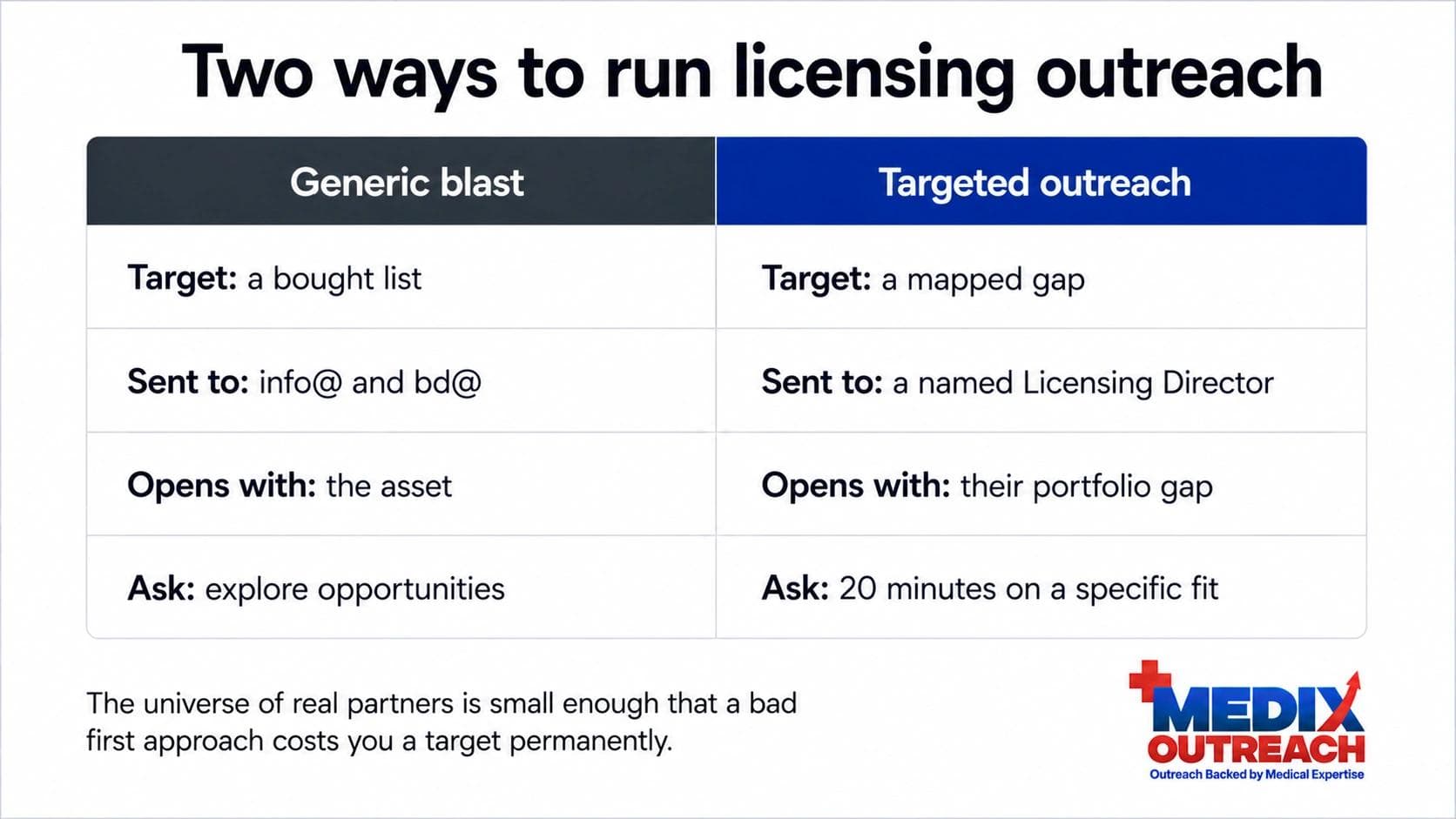
The failure mode is almost always the same. A company treats partner search as a volume exercise, scrapes a list of pharma companies in a region, and sprays a generic licensing email at info@ and bd@.
That fails for structural reasons, not because the copy was weak:
- Generic BD inboxes are triage queues. They absorb volume rather than route opportunity. Nobody's performance review depends on reading them.
- A list is not a map. Company names tell you nothing about portfolio gaps, fit, or whether the company has done a single deal in three years.
- The message is about you. Most licensing outreach describes the asset, not why this partner would want it.
This is the same dynamic covered in why cold outreach fails in healthcare. Licensing just makes it more expensive, because the universe of real partners is small and you can burn it.
Build a targeted partner map
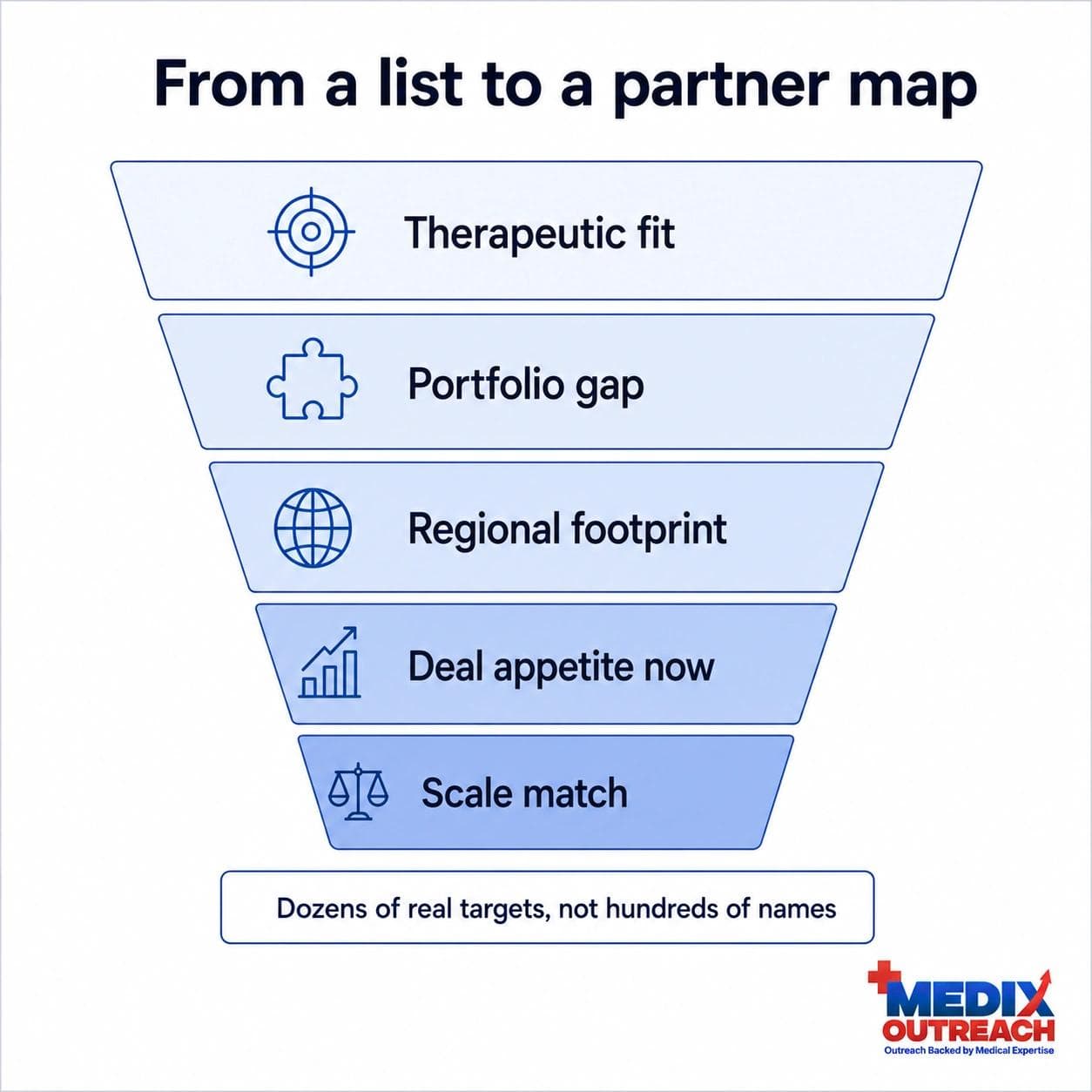
A partner map is a short, defensible list of organizations that could plausibly want your asset, with a reason attached to each. For most single-asset companies it is dozens of names, not hundreds. Five filters do most of the work:
- Therapeutic fit. Does the asset sit in a category their reps already sell? A partner with no presence there has to build the same infrastructure you were trying to avoid.
- Portfolio gap. Fit alone is not enough. The strongest targets have an adjacent gap: a missing tier in a category they sell, or a product losing exclusivity.
- Regional footprint. Registration experience, distribution reach, and tender access in your territory. Presence is not strength.
- Deal appetite, signaled by recent activity. The filter lists ignore.
- Scale match. Large enough to execute, small enough that your asset is not rounding error.
Deal appetite is about now, not history
A company that in-licensed prolifically five years ago tells you nothing about today. Strategy changes, BD teams get restructured, and capital gets reallocated without a press release. What signals appetite is recent, observable behavior: partnership announcements in the last twelve to eighteen months, new registrations filed in your territory, expansion into an adjacent segment, or a BD role hired recently. None of it guarantees interest. All of it separates a live target from a name.
Contact people, not inboxes
Licensing deals start with an individual who has a reason to care. Identify that person by name before you write anything. The roles that matter are usually:
- Head of Business Development. The most common entry point. Owns incoming opportunity and is measured on it.
- Licensing Director or In-Licensing Manager. In larger regional players, a role that exists specifically to find assets like yours.
- Chief Business Officer or Commercial Director. In mid-size companies, often the person who can say yes.
- Portfolio or Category Manager. Best-informed on whether your asset fills a real gap, and an underused route in.
Named individuals change the economics of outreach. A message to a Licensing Director referencing their category gap is a business proposition. An email to bd@ is noise.
Prepare the asset before you approach anyone
Do not start outreach until you can answer the first round of questions in a single sitting. An interested partner moves faster than you expect, and being unprepared costs you the credibility that created the interest. Have ready:
- A one-page non-confidential summary. What the asset is, what it does, where it stands, and which territories are open.
- A clear rights position. Which territories are committed and which are genuinely free. Discovering mid-conversation that a region is encumbered ends it.
- Regulatory and manufacturing status, stated accurately. Where it is approved or listed and what is required locally. Have your regulatory advisors confirm anything you put in writing.
- The data package and a supply story. Whatever supports your claim, organized for a partner's technical team, plus capacity, lead times, and cost basis. Partners diligence supply reliability hard.
- An NDA process. A template your counsel has approved and someone who can turn it around in days, not weeks.
A partner's diligence runs wider than this, into quality systems, IP position, and commercial terms. Those are conversations for your legal and regulatory advisors. Preparation just makes sure nothing obvious stalls the first two meetings.
Mid-article CTA
Need help building your healthcare growth engine?
Medix helps healthcare startups, clinics, pharma companies, and provider-focused platforms build scalable commercial pipelines.
Book a Strategy CallThe outreach is the hard part
Partner identification is a research problem, and research problems are solvable. Getting a named Licensing Director to take a first call about an asset they have never heard of is an outreach problem, and that is where most out-licensing programs die. What separates outreach that works:
- Lead with their gap, not your asset. The opening line should show you understand their portfolio and territory. The asset comes second.
- Be specific about the ask. "Exploring partnership opportunities" is not a request. "Rights are open in the GCC and we want twenty minutes to see if it fits your dermatology line" is.
- Sequence properly. A licensing conversation needs several touches before a reply. One email is not outreach.
- Speak the recipient's language. Someone who understands formulary logic and how a regional portfolio is built writes a different email.
Credibility is doing a lot of the work here. A licensing approach that reads as clinically and commercially literate gets a reply that a marketing-shaped email never will, which is the broader argument in clinical credibility as a go-to-market asset. This is exactly where Medix's licensing and market expansion work sits: partner identification, distributor identification, and the outreach that turns a target list into conversations.
Why MENA is a real regional path
Companies with a licensable asset often default to the US or Western Europe, then spend two years discovering how contested those markets are. If your goal is a first licensing deal rather than a landmark one, the Middle East and North Africa is frequently a faster route.
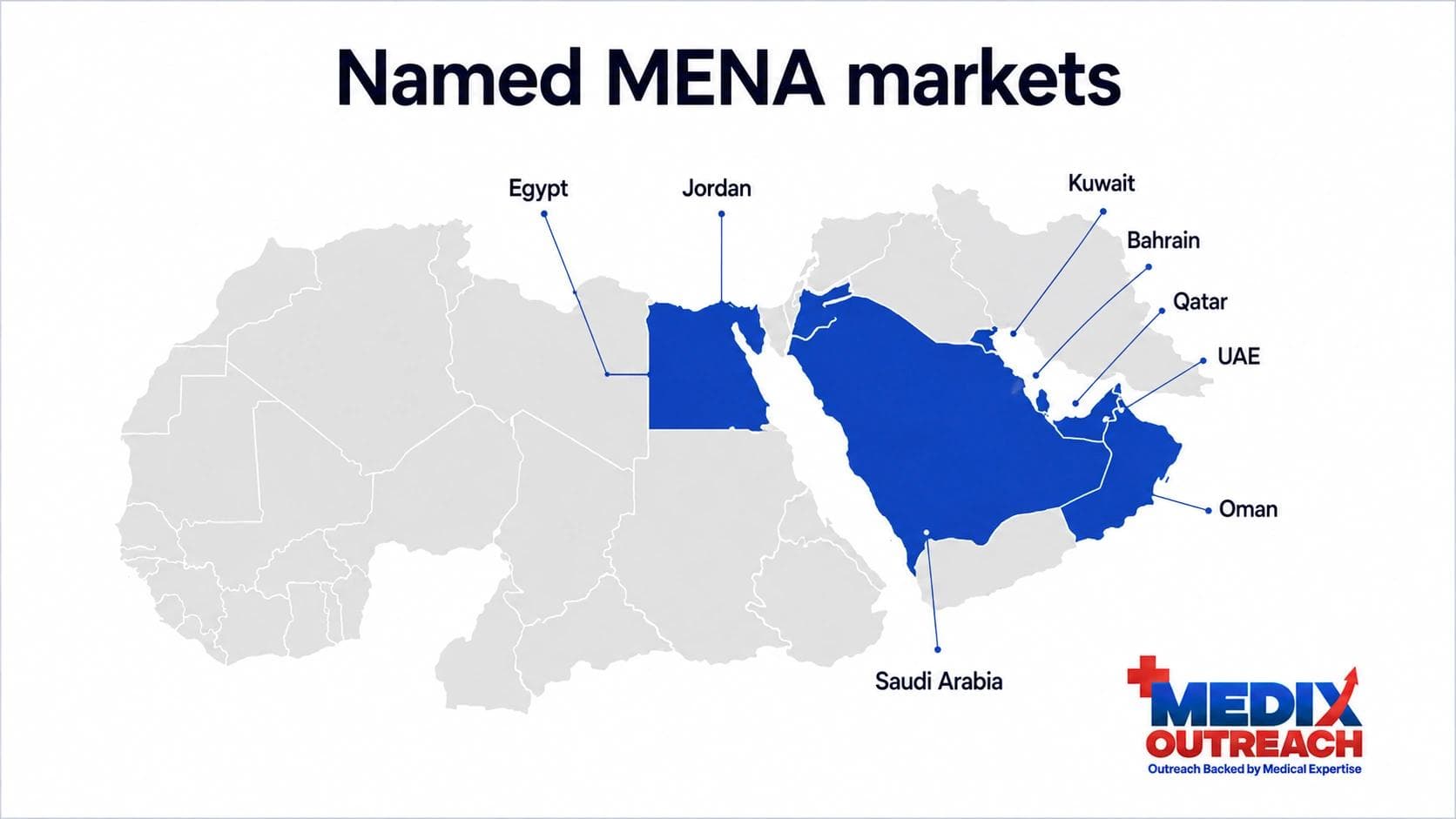
The reasons are structural. Regional pharma companies in Saudi Arabia, the UAE, Qatar, Kuwait, Bahrain, Oman, Egypt, and Jordan actively in-license to fill portfolio gaps. Distribution is concentrated, so a few well-chosen partners cover a market. And the buying side is reachable, lacking the inbound deal flow that insulates large multinationals.
Medix's own licensing outreach work for Curapep's international expansion ran this way: licensing-positioned outreach into regional pharma organizations, qualifying 25+ of them, and initiating discussions across Saudi Arabia, the UAE, and Egypt. It led to a signed licensing agreement with a major Middle East pharma player. Every asset and territory is different, so read it as an illustration of the approach rather than a projection of your outcome.
None of this makes MENA easy, and none of it replaces US strategy. If the US is your target, that is a separate problem covered in breaking into the US market.
What a first conversation should accomplish
The first call is not a pitch. It is mutual qualification, and treating it as a sales meeting is how promising conversations end politely. A good one establishes four things:
- Strategic fit. Does the asset sit in a gap they care about, or were you wrong about the map?
- Process. How they evaluate in-licensing, who else is involved, and what happens next.
- Capability. Whether they can genuinely register, launch, and sell in the territory, or are just optimistic.
- A next step with a date. An NDA, a data request, or a technical call. "Send us something" is not a next step.
What it should not accomplish is terms. Deal economics belong later, with advisors who do that work, once both sides know there is something to structure. And expect a long timeline. Licensing decisions clear multiple functions and a capital allocation discussion, the same reason healthcare sales cycles keep stretching.
Common mistakes
- Confusing a list with a partner map. Names without a reason attached are not targets.
- Approaching before the asset is ready. Interest you cannot service is worse than no interest.
- Targeting on history instead of current appetite. Last decade's dealmaker may have exited the category.
- Chasing the biggest name in the region. The best partner is the one for whom your asset matters.
- Burning a small universe. A bad first approach costs you a target permanently.
Where a pharmacist-led approach changes licensing outreach
Finding a pharma licensing partner is a business development problem wearing the costume of a database problem. The names are findable. The judgment about which names matter, and the ability to write to those people in a way that earns a reply, is what is scarce.
A pharmacist-led approach helps because it starts inside the product world. Understanding what a category gap looks like in practice, how regional portfolios get built, and what makes a licensing email credible to someone who reads twenty a month changes both the map and the message. That is the perspective Medix Outreach is built around, and why the work starts with the partner map rather than a campaign. You can read more on the About Medix Outreach page, or see the full range of healthcare business development services.
Medix does not provide regulatory, legal, or deal-term advisory work. Those belong with qualified specialists.
Frequently asked questions
What is a pharma licensing partner?
A company that takes rights to develop, register, market, or distribute your product in a defined territory or field of use, in exchange for upfront payments, milestones, royalties, or supply margin. You keep ownership; they bring commercial infrastructure.
How do I find a licensing partner for my product?
Build a partner map before you build a list. Filter on therapeutic fit, an adjacent portfolio gap, real regional footprint, deal appetite signaled by recent activity, and scale match. Then identify the person who owns in-licensing at each target and approach them directly.
Who should I contact at a potential licensing partner?
Named individuals, not generic inboxes. The usual entry points are the Head of Business Development, a Licensing Director, and the Chief Business Officer. Portfolio managers are often the best-informed and least-contacted route in.
How long does an out-licensing deal take?
Longer than most first-time licensors plan for. Identification and outreach take months, and a partner's evaluation clears commercial, technical, regulatory, and capital allocation reviews before terms are discussed.
Is MENA a realistic market for a first licensing deal?
For many small and mid-size companies, yes. Regional organizations across Saudi Arabia, the UAE, Qatar, Kuwait, Bahrain, Oman, Egypt, and Jordan actively in-license to fill portfolio gaps, distribution is concentrated, and decision makers are reachable. Registration requirements vary by country and need regulatory advice.
Can Medix help find a licensing partner?
Medix Outreach works on the commercial side of licensing: partner and distributor identification, regional targeting, licensing-positioned outreach, investor introductions, and commercial due diligence. It does not do regulatory, legal, or contract work, and does not advise on deal economics.
Final thoughts
The companies that land licensing deals are rarely the ones with the best asset in the room. They are the ones who worked out which twenty organizations could genuinely want it, found the person inside each who owns that decision, and gave them a reason to reply. That is a research discipline followed by an outreach discipline, and neither can be skipped by buying a bigger list.