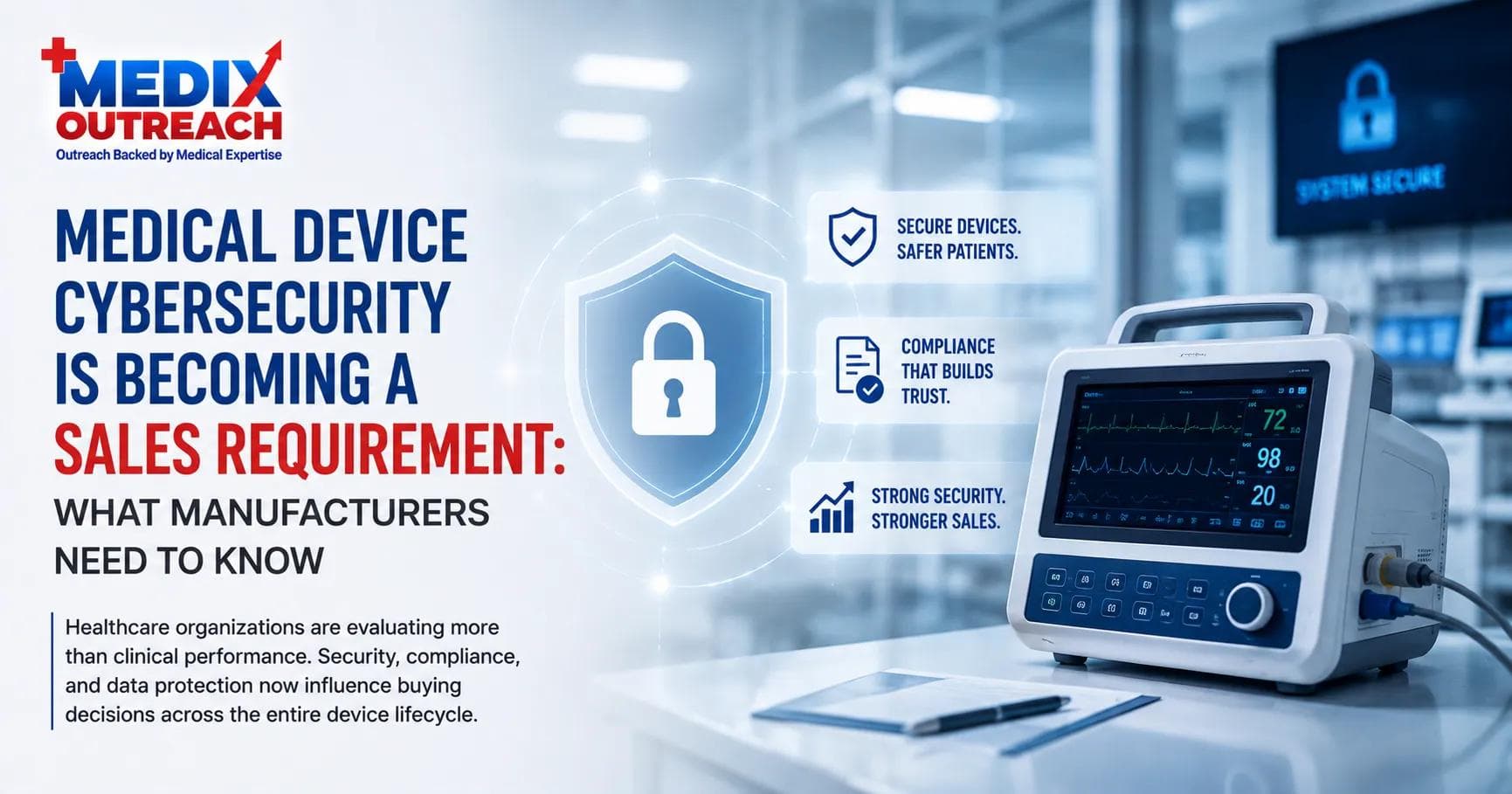
Cybersecurity used to be viewed primarily as an IT concern.
For medical device manufacturers, that is no longer enough.
Connected medical devices increasingly operate inside complex healthcare environments. They interact with hospital networks, clinical systems, cloud platforms, patient data, and other connected technologies.
That means cybersecurity can directly influence whether a healthcare organization is willing to adopt a device.
In 2026, cybersecurity is becoming part of the commercial conversation.
Medical Device Buyers Are Evaluating More Than Clinical Performance
A medical device can demonstrate strong clinical performance and still face adoption barriers if cybersecurity questions remain unanswered.
Healthcare organizations increasingly need to understand:
- How the device connects to their network
- What data it collects
- How data is protected
- How vulnerabilities are managed
- How software updates are delivered
- What happens when a security issue emerges
For manufacturers, these questions can affect procurement, implementation, and sales.
FDA Is Raising the Standard
In February 2026, FDA issued updated final guidance covering cybersecurity considerations for medical devices, including recommendations related to device design, labeling, and cybersecurity documentation in premarket submissions.
The guidance reinforces a broader industry direction:
Cybersecurity needs to be considered throughout the medical device lifecycle.
That includes product development, regulatory submissions, commercialization, deployment, and postmarket management.
Cybersecurity Can Influence Commercial Adoption
Imagine two medical devices with similar clinical capabilities.
One manufacturer can clearly explain its cybersecurity architecture, risk management process, update strategy, and vulnerability response.
The other cannot.
The first manufacturer has a commercial advantage.
This is why medical device cybersecurity should no longer be treated only as a technical requirement.
It can become a differentiator in healthcare sales.
Procurement Teams Are Asking Harder Questions
Healthcare purchasing decisions increasingly involve multiple stakeholders.
A clinical champion may care about patient outcomes.
IT may care about integration.
Security teams may care about vulnerabilities.
Compliance may care about risk.
Procurement may care about contracts and vendor requirements.
Executives may care about the overall business case.
A medical device sales strategy needs to address all of these stakeholders.
Mid-article CTA
Need help building your healthcare growth engine?
Medix helps healthcare startups, clinics, pharma companies, and provider-focused platforms build scalable commercial pipelines.
Book a Strategy CallThis Changes Medical Device Lead Generation
Traditional medical device lead generation often focuses heavily on identifying physicians and scheduling demonstrations.
That remains valuable.
But enterprise healthcare sales require more.
Manufacturers need to create commercial materials that support the entire buying committee.
That could include:
- Clinical evidence
- Security documentation
- Implementation resources
- Integration information
- ROI analysis
- Workflow explanations
- Compliance materials
The goal is to remove uncertainty at every stage of the healthcare sales funnel.
Cybersecurity Should Be Part of the Marketing Message
This does not mean turning every marketing campaign into a technical security briefing.
It means recognizing that cybersecurity is part of the product's value proposition.
For example:
Instead of saying:
"Our device connects to hospital networks."
A stronger message might communicate:
"Designed to support secure integration within complex healthcare environments."
The message should then be supported by credible technical and regulatory documentation.
Medical Device Companies Need Cross-Functional GTM
Cybersecurity creates a strong example of why healthcare go-to-market strategy cannot operate in isolation.
Marketing needs to understand the clinical value.
Sales needs to understand the security concerns.
Product teams need to support commercial conversations.
Regulatory teams need to provide accurate documentation.
Business development needs to identify organizations where the solution fits.
This is healthcare commercialization in practice.
Provider Outreach Still Matters
Even highly technical purchasing decisions often begin with a clinical problem.
A physician identifies a need.
A department evaluates the solution.
IT reviews integration.
Security assesses risk.
Procurement negotiates the agreement.
The commercial process can involve multiple stakeholders, which makes provider outreach and stakeholder mapping essential.
How Medix Outreach Helps Medical Device Companies
Medix Outreach helps medical device manufacturers build commercial strategies around the realities of healthcare purchasing.
Our pharmacist-led team combines medical device lead generation, provider outreach, healthcare business development, healthcare go-to-market strategy, healthcare sales outsourcing, and commercialization.
We help companies communicate clinical value while building the relationships and commercial infrastructure required to move from product awareness to adoption.
Conclusion
Medical device cybersecurity is becoming part of the sales conversation.
Manufacturers that treat cybersecurity only as a regulatory or technical requirement may miss an important commercial opportunity.
Those that integrate security, clinical value, workflow fit, and business outcomes into their go-to-market strategy can build stronger credibility with healthcare organizations.
In 2026, medical devices aren't being evaluated in isolation.
They're being evaluated as connected components of healthcare infrastructure.