
Most medtech teams treat FDA clearance as the summit. It is the base camp. Clearance gives you the legal right to sell a device in the United States. It does not give you a single customer, a reimbursement code, a hospital contract, or a nurse who trusts the thing enough to reach for it during a procedure. Those are separate battles, and they are usually harder than the regulatory one.
That gap is where good devices go to die. A product can be genuinely better, cleared, patented, and beautifully engineered, and still sit at a few hundred units a year because nobody built the path from clearance to routine use. The engineering problem was solved. The commercial problem was never named.
A medical device go-to-market strategy is the plan that closes that gap. It covers who you sell to first, how they actually buy, what evidence they need, how the device gets paid for, how you price and staff the commercial effort, and the order you do all of it in. This piece walks the full commercialization lifecycle for a physical device so you can plan a launch that turns clearance into adoption instead of a warehouse full of inventory.
One note before we go further. This is a practical commercialization guide, not regulatory, coding, or reimbursement advice. Confirm your regulatory pathway, coding, coverage, and payment decisions with qualified regulatory and reimbursement specialists before you act on them.
Clearance Is the Start Line, Not the Finish Line
Regulatory pathway shapes your commercial reality, so start there honestly. A 510(k) clearance means you argued substantial equivalence to a predicate device. That is useful in the market, because buyers understand the category, but it also means competitors likely have similar clearances and you cannot lean on novelty alone. A De Novo or PMA path signals a more novel or higher-risk device, which can be a stronger commercial story but also means you are educating the market from scratch.
Either way, clearance answers one question for a buyer: is this legal and is it safe enough to be sold. It does not answer the questions that actually drive a purchase. Does it work in my hands, in my workflow. Will it get paid for. Is it worth switching from what we use now. Regulatory review never touches those, and they are exactly what the rest of your go-to-market has to earn.
The day you get cleared is the day the real work starts. Budget, headcount, and patience should be planned around the commercial timeline, not the regulatory one.
Segment the Market and Pick a Beachhead
The most common mistake after clearance is trying to sell to everyone who could theoretically use the device. Broad targeting feels ambitious. It usually produces a thin, exhausting pipeline where every deal is a first-time education effort and nothing compounds.
Pick a beachhead instead. A beachhead is a narrow, winnable segment where your device solves an urgent problem for a specific clinical buyer in a specific setting. Narrow it by procedure, specialty, site of care, and buyer type. A device is not just "for hospitals." It is for interventional cardiologists at mid-size community hospitals who do a certain volume of a specific procedure and feel a specific pain your device removes. That is a segment you can name, count, and reach.
Site of care matters more than teams expect, because the buying process changes completely across settings. Selling into a large health system is a committee sale with long timelines. Selling the same device to an ambulatory surgery center or a physician-owned practice can be faster and more clinician-driven, which is why the clinic and private-practice buying process deserves its own plan. Some devices should launch in the smaller, faster setting first to build reference customers, then move up to health systems once the evidence is strong.
Score your segments on real criteria: how acute the pain is, how many sites fit the profile, how reachable the buyers are, whether a reimbursement path already exists, and how entrenched the incumbent is. The goal is not the biggest market. It is the market where you can win reference customers fast, because early adoption is what funds and de-risks everything after it.
Understand the Device Buying Journey
Selling a medical device is not a bigger version of a normal B2B sale. A hospital rarely buys because one physician likes your product. It buys when a group of people agree that the clinical value, the economics, the risk, and the workflow all make sense at the same time. That is why strong products with real value still stall for months inside health systems.
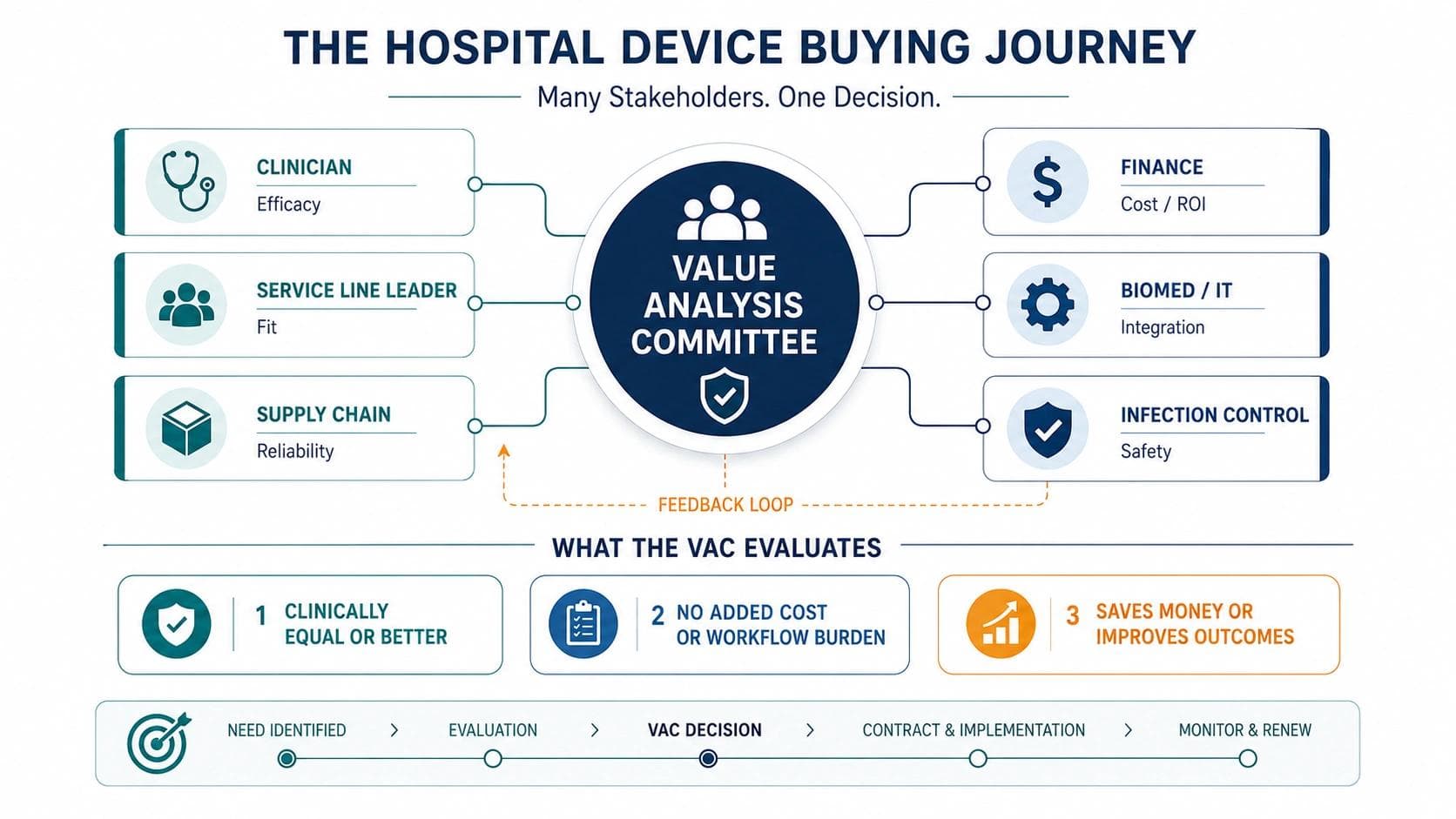
The people who touch a device decision usually include the clinician who will use it, the service line leader, supply chain, biomed or IT if the device connects to anything, finance, and often infection control. Each brings a different question, from clinical fit and workflow to price, contract, total cost, and reimbursement. Any one of them can slow or stop the deal, and none of them alone can approve it. The hospital sales motion is deep enough that it is worth studying the full hospital go-to-market playbook as its own discipline.
The Value Analysis Committee
For most hospitals and health systems, the gate is the value analysis committee, or VAC. This is a cross-functional group, usually a mix of clinical and supply chain and finance people, that evaluates new products before they can be purchased and put on contract. A clinician championing your device does not get it bought. It gets it submitted to the VAC.
The VAC wants three things: proof that the device is clinically at least as good as what they use now, proof that it does not add cost or workflow burden, and ideally proof that it saves money or improves an outcome they are measured on. They will ask about complication rates, length of stay, reprocessing, disposables, and training time. Come to a VAC with a clinician's enthusiasm and no economic story, and you will be sent away to gather more data.
Plan for the VAC from day one. Build the submission package before your reps need it: clinical evidence, a clear economic model, a workflow assessment, and answers to the objections you know are coming. Ask your clinical champion who sits on the committee and what they have rejected recently. Teams that treat the VAC as a known, preparable step instead of a surprise are the ones whose devices get on contract.

Build the Clinical and Economic Evidence Story
Evidence in medtech is two stories told to two audiences, and you need both.
The clinical story convinces the people who use the device that it is safe and effective in real practice. Your clearance data is the starting point, but buyers increasingly want more than the study that got you cleared: real-world use, peer publications, and results from clinicians who look like them. Early reference sites are worth more than almost any marketing you can buy, so treat your first accounts as evidence generators, not just revenue. Get their data, get their quotes, and let them sell the next prospect.
The economic story convinces the people who pay, and it is the part most engineering-led companies underinvest in. You need a credible model that shows what your device does to the total cost of care, not just its unit price. Does it reduce a costly complication, shorten a procedure, cut disposables, reduce readmissions the hospital is penalized for, or move a case to a lower-cost site. Build the model in the buyer's own terms and let them plug in their numbers. A device that costs more per unit but lowers total cost is an easy story once the math is on paper, and a losing one when it lives only in your head.
Do not overreach here. Overstated economic claims get caught by finance and burn credibility for the whole account, and a conservative, defensible model beats an aggressive one you cannot support.
Reimbursement and Coding: The Gate You Cannot Skip
For many devices, reimbursement is the quiet decider. A device that does not have a clear way to get paid faces a wall, no matter how good it is, because the site of care has to absorb the cost or fight for payment on every case.
The three pieces are coding, coverage, and payment. Coding is whether a code describes the procedure or device. Coverage is whether payers, including Medicare, agree to pay and under what conditions. Payment is how much. A new device may fit an existing code, the easy case, or it may need a new code and a coverage decision, which can take a long time and reshape your whole launch timeline. Either way, the gap between clinical value and a built payment path has to be planned for, not discovered mid-launch.
This is deep enough to be its own workstream, and getting it wrong can strand a good product. If reimbursement is a live question for your device, treat market access and reimbursement strategy as a parallel effort that starts early, not a box you check after launch. The short version: know the code, know who pays, know how much, and know it before your reps are in the field promising ROI.
Pricing and the Capital versus Consumable Model
Pricing a device is a strategic choice about your business model, not just a number on a quote.
Many devices sell on a capital model: equipment bought once, often for a large sum, through a budget cycle that only opens at certain times of year. Capital sales are lumpy, slow, and tied to budget approval that can add months. Others sell on a consumable or razor-and-blades model: place the equipment cheaply or for free, then earn on the disposables used with every procedure. Consumable revenue is recurring and predictable, which investors and operators both prefer, but only if the device gets used often enough to matter.
Which model you choose changes everything downstream: your sales cycle, your cash flow, your commission structure, and how a hospital budgets for you. A capital purchase runs through a capital committee and a slower approval path than a per-case disposable, which often sits in a supply budget. Some of the strongest medtech models lower the capital barrier on purpose to speed adoption, then build a durable business on consumables and service.
Whatever you choose, price to the value your economic model proves, not to your cost plus a margin. If your device saves a hospital real money per case, your price should capture a fair share of that value while leaving the buyer clearly ahead. Underpricing a genuinely valuable device is as much a mistake as overpricing a marginal one.
Mid-article CTA
Need help building your healthcare growth engine?
Medix helps healthcare startups, clinics, pharma companies, and provider-focused platforms build scalable commercial pipelines.
Book a Strategy CallChoose a Sales Model That Matches Your Device
There are three broad ways to put a device in front of buyers, and the right one depends on your device, your margins, and your market.
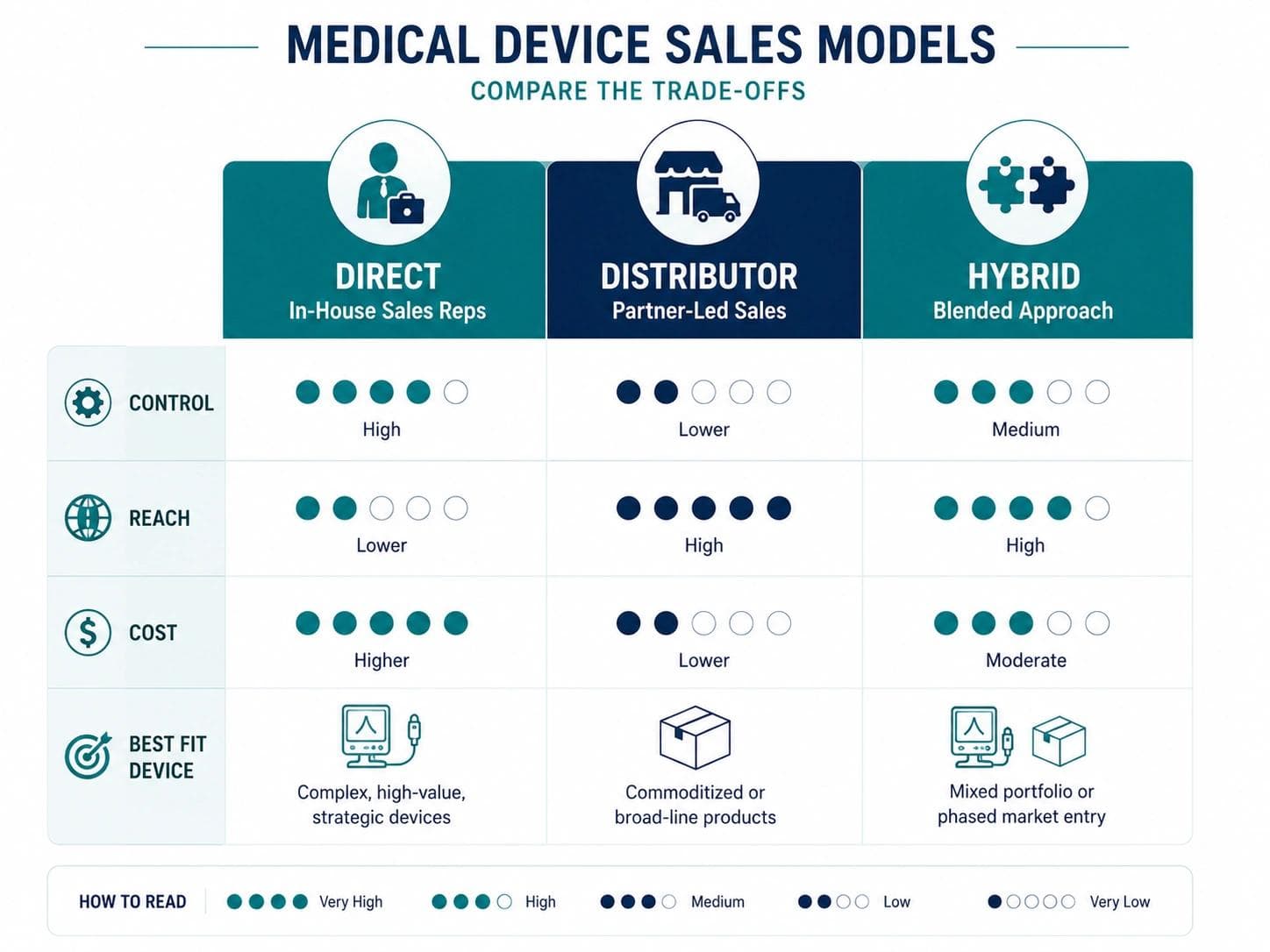
Direct sales means you hire your own reps. You get control, focus, and a team that knows the clinical story cold and owns the account. You carry the full cost and the long ramp of building a field team, and device reps are expensive and slow to hire. Direct fits higher-value devices with a complex sale and enough margin to fund the headcount.
Distributors mean you use partners who already have relationships in your target accounts. You get reach and speed without building the team, which matters when you are entering many geographies at once. You give up margin and control, and a distributor carrying dozens of lines will not tell your story as well as you would. Distributors fit lower-touch devices, broad geographies, or an early launch where you need coverage before you can afford a direct team.
Hybrid is common and often right. Run direct reps in your beachhead and most important accounts, and use distributors to extend into geographies you cannot cover yet. Many companies start distributor-led to prove the market, then bring the best territories in-house as volume justifies the cost.
Why Healthcare Sales Talent Is Hard to Hire
Whatever model you pick, the people problem is real and it is worse in healthcare than most founders expect. A strong medical device rep needs to be clinically fluent enough to hold a conversation with a surgeon, credible in an operating room or clinic, and patient enough to work a committee sale that can run many months to over a year. That combination is rare, the good ones are already employed and expensive, and a generalist B2B rep dropped into medtech usually flounders. This is one reason healthcare sales talent is so hard to find and hire, and why some teams pair a small direct effort with a partner who brings existing clinical relationships. Building the right provider network and referral relationships can do some of the work a large field team would otherwise carry, especially early when every headcount decision is expensive. Outsourced appointment setting with healthcare-literate reps can also book qualified meetings with target accounts while you build a direct team.
KOLs and Clinical Champions
Adoption in medicine is social. Clinicians watch what respected peers do, and a device that the right people use gets a hearing that cold outreach never will.
Key opinion leaders, or KOLs, are the recognized experts in a specialty, and their endorsement, publications, and podium time move a whole field. Engage them early and honestly: involve them in studies, get real feedback, and let them shape the clinical message. Do not try to buy a shallow endorsement, because clinicians can smell it and it backfires.
Clinical champions are different and just as important. A champion is the working clinician inside a target account who believes in your device and will fight for it internally. They bring you to the value analysis committee, defend the economic model, and train their colleagues. Every account you win will have one. Your job is to find them, arm them with the evidence, and make it easy for them to sell inside their own building. A champion with a strong package beats a great rep with a weak one.
Sequence the Launch and Watch for the Failure Modes
Order matters. Doing the right activities in the wrong sequence wastes the money and the momentum you cannot get back.
A sound sequence looks roughly like this. Lock the beachhead and the buyer profile. Build the clinical and economic evidence package and confirm the reimbursement path. Recruit reference accounts and KOLs. Stand up your sales model and train it deeply on the clinical and economic story, not just the product. Win, document, and publicize your first reference customers. Then expand, geography by geography, using the references you built. Each phase feeds the next, which is why skipping ahead breaks the chain.
The failure modes are predictable, which means they are avoidable.
- Great device, no adoption. The product works, but no one built the evidence, the economic model, or the VAC package, so it stalls at the committee.
- Selling everywhere at once. Thin pipeline, no reference customers, every deal starting from zero. A beachhead fixes this.
- No economic story. A clinical pitch to a financial buyer. The device gets clinical enthusiasm and no purchase order.
- Reimbursement discovered late. Reps promise ROI the payment system does not support, and deals collapse after months of work.
- Wrong sales model or wrong reps. A complex device handed to distributors who will not invest in the story, or generalist reps who cannot hold a clinical conversation.
- Underfunded launch. The regulatory budget is spent and the commercial one was never sized, so the launch runs out of runway right when it should be scaling.
Watch a device with real value stall for a year inside a health system and you will almost always find one of these, not a product flaw. The commercialization plan is what prevents them.
Where to Start
If you have a cleared device and a stalled or unbuilt launch, start with focus. Name one beachhead you can win. Build the two-part evidence story, clinical and economic, in your buyer's own terms. Confirm the reimbursement path before your reps promise ROI in the field. Prepare for the value analysis committee, choose a sales model your margins can fund, and sequence the rollout so early references power everything after them.
You can see how this plays out in practice in our work on provider positioning for clinic adoption. The pattern is consistent: clarity on the buyer, a real economic story, and a launch built in the right order.
Medix Outreach is a pharmacist-led healthcare go-to-market team. We help medtech and device companies turn clearance into commercial traction, from beachhead and messaging to commercial growth and execution with clinical buyers who can tell a real story from a rehearsed one. If your device deserves adoption it is not getting, book your free growth strategy session and we will map the path from clearance to the clinic.
Frequently Asked Questions
What is a medical device go-to-market strategy?
It is the plan for turning FDA clearance into real adoption: who you sell to first, how they buy, what evidence they need, how the device gets paid for, how you price and staff the effort, and the order you do it in.
Does FDA clearance mean I can start selling a device?
Clearance gives you the legal right to sell in the United States, but not a customer, a reimbursement path, or a hospital contract. Those are separate commercial steps, and you should confirm regulatory specifics with qualified specialists.
What is a value analysis committee?
A value analysis committee, or VAC, is a cross-functional hospital group of clinical, supply chain, and finance staff that reviews new products before they can be purchased. A clinician's support gets your device submitted to the VAC, which then decides.
Should I use direct sales reps or distributors for a medical device?
Direct reps give control and focus but cost more and take time to hire. Distributors give reach and speed but less control and margin. Many teams run a hybrid: direct in the beachhead, distributors to extend into geographies they cannot yet cover.
How long does a medical device launch take?
It varies widely by device, buyer, and reimbursement path. Health-system sales cycles often run many months to more than a year, which is why planning budget and headcount around the commercial timeline, not the regulatory one, matters.