
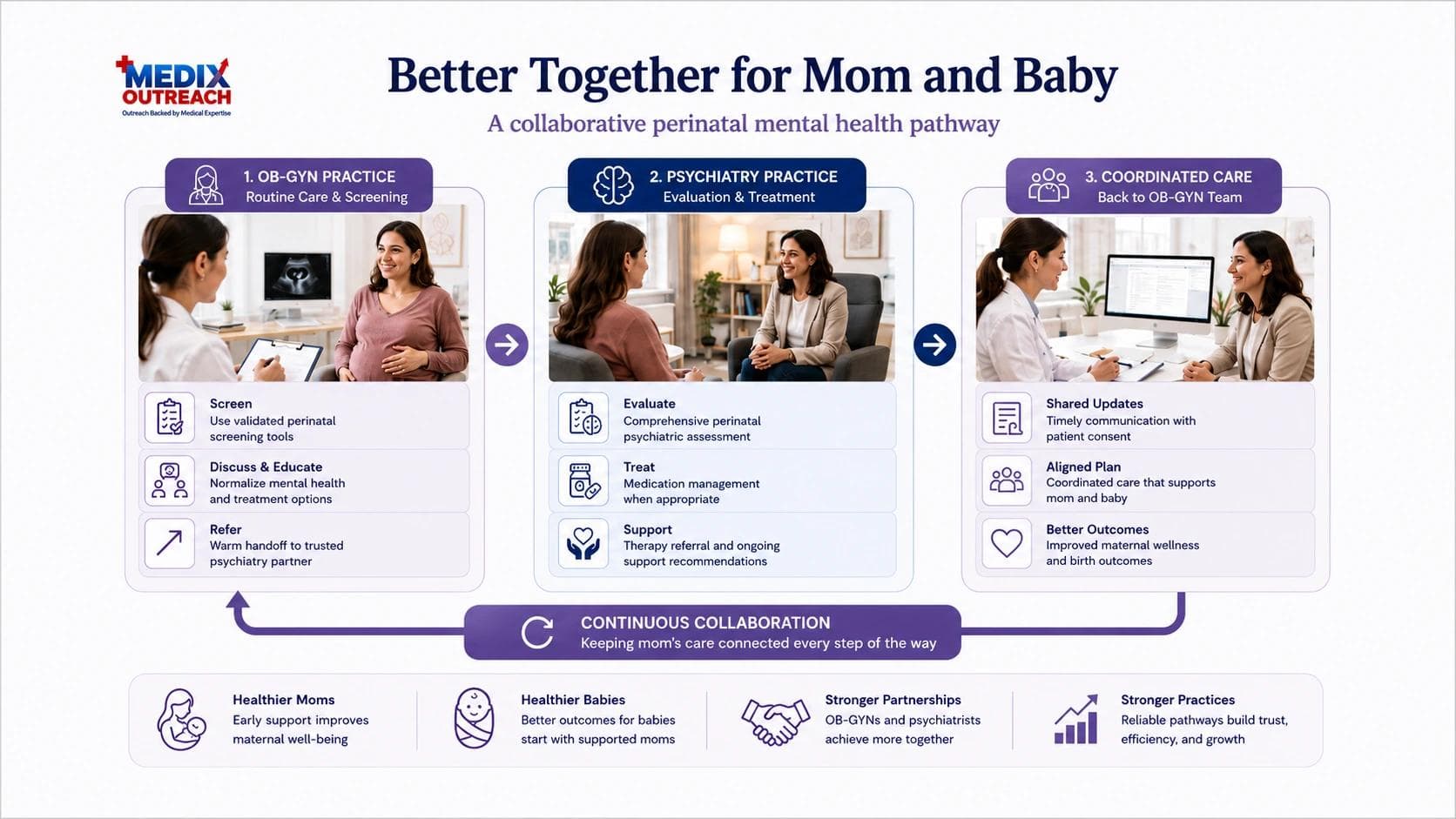
An OB-GYN psychiatry referral is a referral from an obstetrics-gynecology or women's-health practice to a psychiatry partner, most often for perinatal or postpartum mental health needs surfaced during pregnancy or after delivery. As standardized perinatal mental health screening has become routine in obstetric care, OB-GYN practices increasingly identify patients who need psychiatric evaluation or medication management — and they need a psychiatry partner with the right expertise, real access, and a habit of coordinating back to the OB team. For a psychiatry practice, women's health is a specialty-relevant, credibility-driven referral source, not a lead-generation target.
The Medix point of view: position this relationship around specialty relevance, access, and clinical credibility. An OB-GYN refers a perinatal patient to a psychiatry practice that clearly understands perinatal care and can see the patient in a timeframe that matches the clinical need — not to whoever markets hardest.
Why do OB-GYN and women's health practices encounter mental health needs?
Obstetric and gynecologic care intersects with mental health at multiple points — pregnancy, the postpartum period, and across the reproductive lifespan. Perinatal mental health conditions are among the more common complications of pregnancy and the postpartum year, which is why the field has moved toward systematic screening. The American College of Obstetricians and Gynecologists recommends screening for depression and anxiety using standardized, validated instruments at the initial prenatal visit, later in pregnancy, and at postpartum visits. Screening at scale surfaces needs at scale — and a screen is only useful if there is somewhere to refer the patients it identifies.
When does a psychiatry partner become useful to an OB practice?
OB-GYNs and women's-health clinicians manage some perinatal mental health themselves, but they refer to psychiatry when the clinical picture calls for it:
- Diagnostic complexity — a positive screen that needs psychiatric evaluation and clarification.
- Medication management in pregnancy or lactation — decisions that benefit from psychiatric expertise in the perinatal context.
- Moderate-to-severe or treatment-resistant presentations — beyond what obstetric care can hold.
- History of psychiatric illness — patients who need specialist co-management through the perinatal period.
Mid-article CTA
Need help building your healthcare growth engine?
Medix helps healthcare startups, clinics, pharma companies, and provider-focused platforms build scalable commercial pipelines.
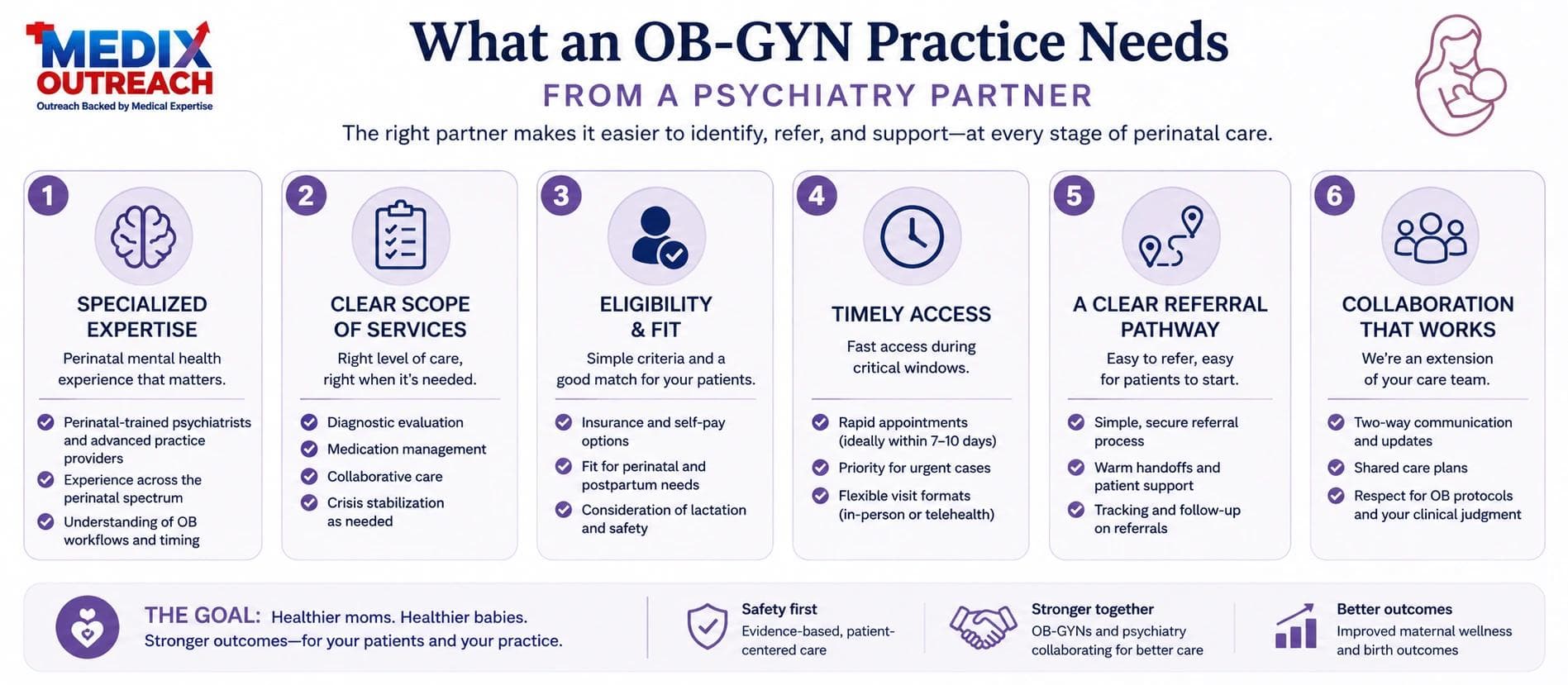
Book a Strategy CallWhat does an OB-GYN practice need from a psychiatry partner?
- Appropriate clinical expertise - Perinatal psychiatry carries specific considerations; credibility is the entry ticket
- Clear scope - The OB team needs to know what the psychiatry practice manages and for whom
- Eligibility clarity - Coverage confirmed without becoming a delay in a time-sensitive period
- Real access - Perinatal timeframes are narrow; a long wait defeats the referral
- A defined referral pathway - A known, low-friction route from a positive screen to an appointment
- Coordination back to the OB team - The OB remains central to the pregnancy; they need the loop closed
These requirements mirror the broader pattern in a psychiatry referral network, with one specialty-specific amplifier: in perinatal care, timing and expertise are non-negotiable, and coordination back to the OB is essential because the OB is managing the pregnancy alongside the psychiatric care.
Care coordination and communication back to the OB team
Perinatal psychiatric care is genuinely shared care. The OB-GYN continues to manage the pregnancy; the psychiatry practice manages the evaluation and psychiatric treatment. That makes closed-loop communication not just good manners but clinically important — the OB needs to know what was started, what to watch for, and how the plans interact. A psychiatry practice that coordinates cleanly with the OB team becomes the practice that team refers to again.
Education-led provider relationships
The most durable way into OB-GYN referral relationships is clinical education, not sales. Case-based education about perinatal mental health, screening follow-through, and co-management builds the credibility that earns referrals — the same education-led approach Medix uses across provider network development. Credibility, in this specialty, is the product; outreach that leads with clinical substance outperforms outreach that leads with a pitch.
Frequently asked questions
What is an OB-GYN psychiatry referral?
A referral from an obstetrics-gynecology or women's-health practice to a psychiatry partner, commonly for perinatal or postpartum mental health needs identified through screening or clinical evaluation.
Why are OB-GYN practices referring more to psychiatry?
Because standardized perinatal mental health screening — recommended by ACOG at prenatal and postpartum visits — surfaces more patients who need psychiatric evaluation or medication management than obstetric care alone can hold.
What does an OB team need from a psychiatry partner?
Appropriate perinatal expertise, a clear scope, eligibility clarity, real access within perinatal timeframes, a defined referral pathway, and coordination back to the OB team.