
A pharmaceutical partnership can create access to new technology, manufacturing capacity, development expertise, or commercial markets.
But the value of a partnership depends on more than the initial opportunity.
Companies need to understand what a potential partner can actually deliver.
That makes commercial due diligence an important part of pharma partnership strategy.
Why peptide partnerships require broader evaluation
Peptide programs can involve complex relationships between science, manufacturing, regulation, and commercialization.
A potential partner may have excellent scientific capabilities but limited commercial infrastructure.
Another may have strong manufacturing capacity but limited experience with a particular development stage.
The objective is to understand the complete picture.
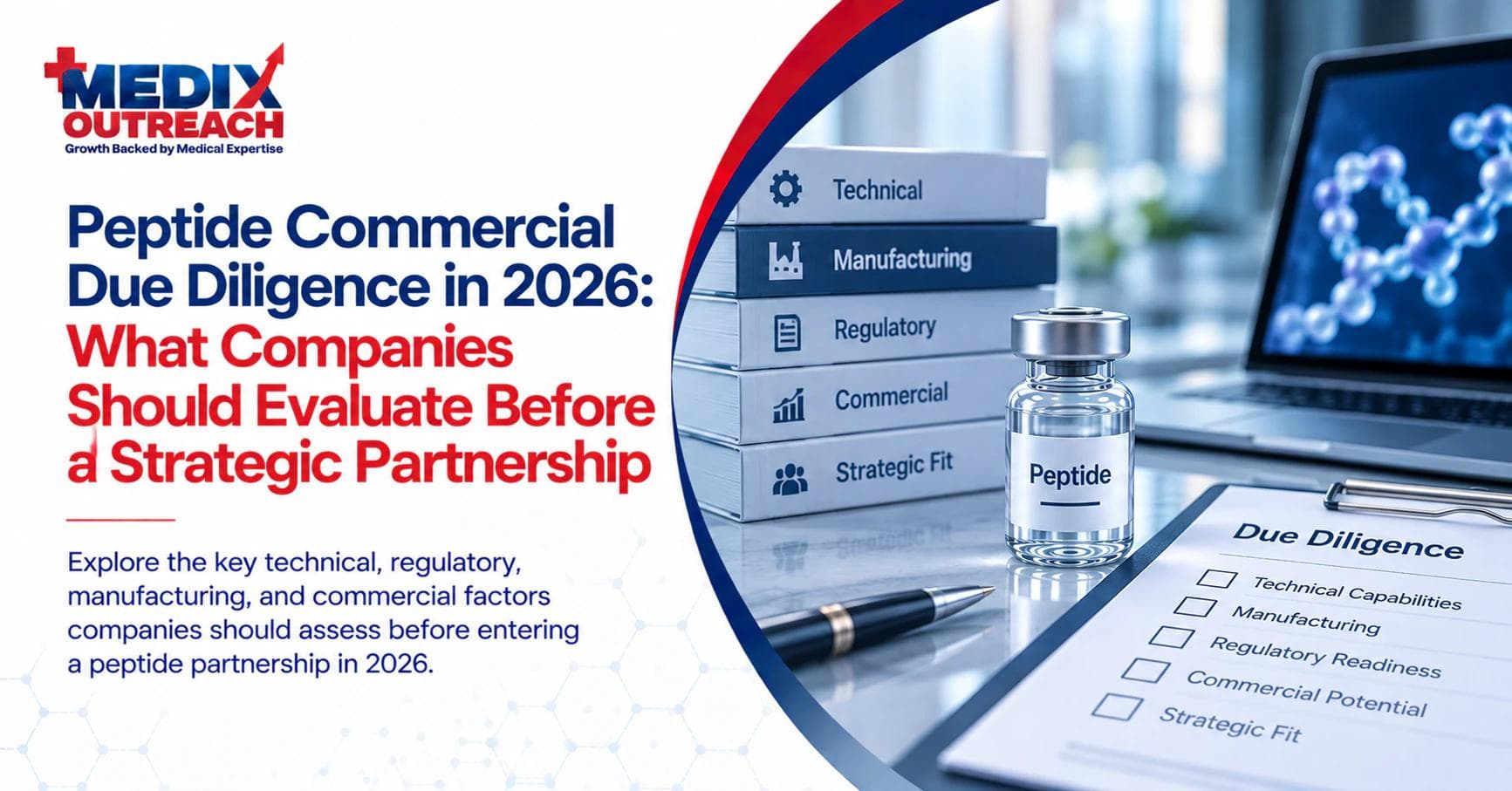
A five-part due-diligence framework
A practical framework can evaluate five areas.
1. Technical capability
Questions can include:
- What peptide technologies does the company support?
- What development stages does it cover?
- What analytical capabilities are available?
- What experience exists with similar programs?
2. Manufacturing capability
Evaluate:
- Current capacity
- Scalability
- Manufacturing locations
- Quality infrastructure
- Technology-transfer capabilities
- Commercial production readiness
The broader peptide CDMO market has been active in 2026, with capacity additions and acquisitions reflecting continued investment in peptide manufacturing.
3. Regulatory readiness
Companies should understand:
- Relevant regulatory experience
- Quality systems
- Documentation
- Development history
- Applicable regulatory pathways
This has become especially relevant as FDA updates its approach to peptide products.
4. Commercial capability
Evaluate:
- Target markets
- Geographic presence
- Existing partnerships
- Commercial infrastructure
- Market access capabilities
- Business development resources
A technically strong partner may not necessarily be the right commercial partner for every market.
5. Strategic alignment
Finally, both organizations need to understand whether their objectives align.
Questions include:
- Are the timelines compatible?
- Are the commercial objectives compatible?
- Are expectations around investment aligned?
- Is there a clear partnership model?
- Can the relationship expand over time?
Mid-article CTA
Need help vetting a peptide partner?
Medix helps healthcare and pharma companies build scalable commercial pipelines through targeted business development and provider outreach.
Book a Strategy CallWhy this matters for peptide B2B sales
Due diligence is not only something buyers conduct.
Suppliers and service providers can also use this framework when qualifying prospects.
A potential customer may look attractive based on company size, but the real opportunity depends on:
- Program relevance
- Development stage
- Technical fit
- Decision-making structure
- Timing
- Commercial potential
This makes due diligence part of effective B2B sales.
Using intelligence before outreach
Peptide marketing outreach should begin with research.
Before contacting an account, teams can examine:
- Pipeline announcements
- Clinical activity
- Manufacturing changes
- Partnerships
- Licensing
- Regulatory developments
- Executive appointments
- Geographic expansion
These signals help determine whether a conversation is commercially relevant.
Avoiding the "capability dump"
A capability deck can be useful, but it should not be the entire sales strategy.
Pharma companies want to know:
"Why should we consider this relationship?"
The answer should connect capabilities to a specific need.
That is why account research and stakeholder mapping are important.
Building a partnership scorecard without reducing the decision to a single score
Companies can evaluate prospective partners across separate dimensions:
- Technical — Can the partner support the required peptide program?
- Manufacturing — Can capacity scale with development?
- Regulatory — Does the partner understand the applicable pathway?
- Commercial — Can it support the target market?
- Strategic — Are objectives and timelines aligned?
Keeping the dimensions separate helps decision-makers see where strengths, limitations, and open questions exist rather than reducing a complex partnership to one number.
Final takeaway
Peptide partnerships can create significant commercial opportunities, but they also require disciplined evaluation.
A strong pharma partnership strategy considers technical capability, manufacturing, regulatory readiness, commercial infrastructure, and strategic alignment together.
For peptide companies, understanding these criteria can also improve B2B sales and outreach because it helps them communicate the information pharmaceutical buyers actually need.
The result is a more informed commercial conversation from the first outreach through partnership development.