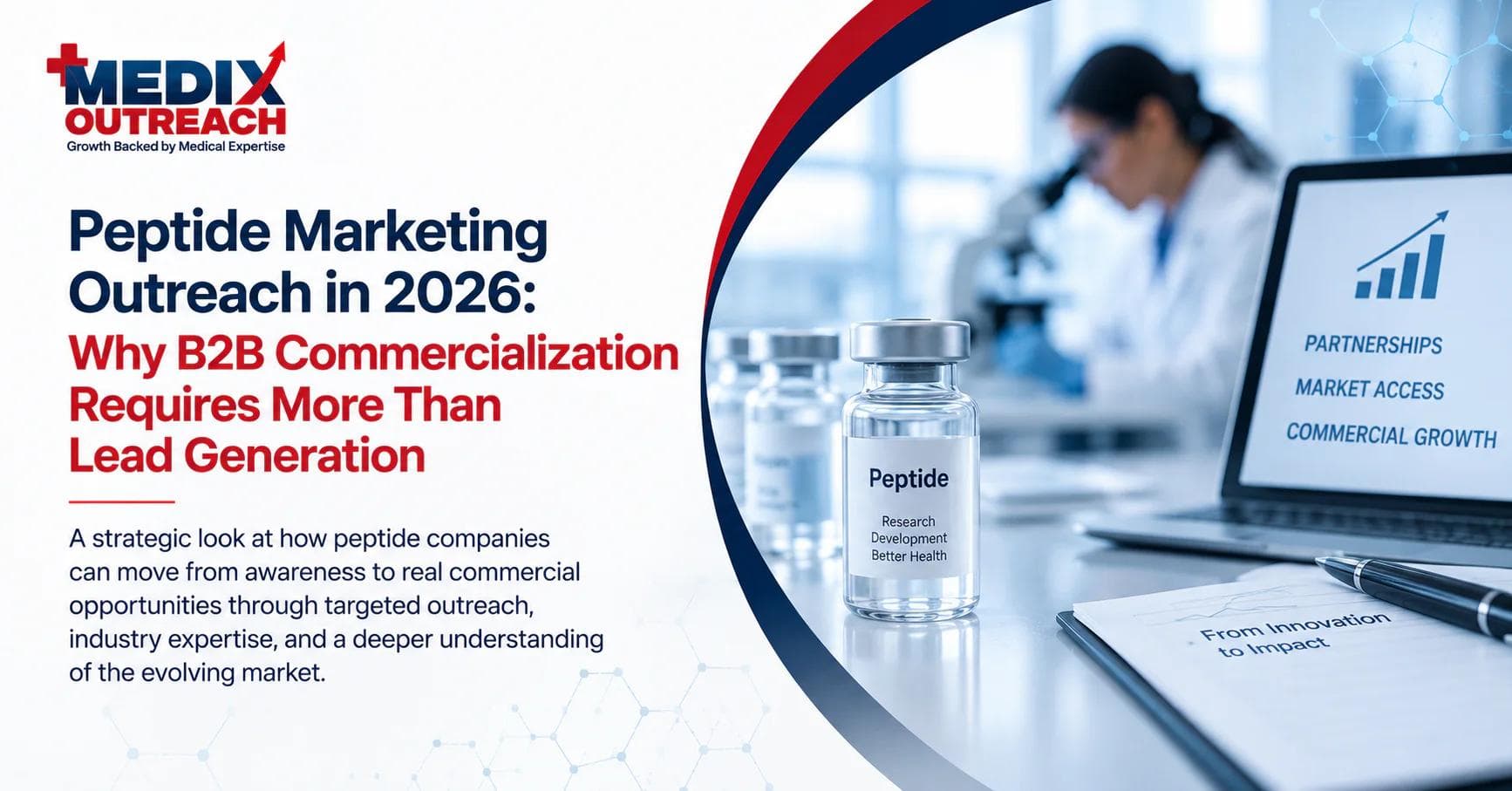
Peptide marketing outreach is becoming increasingly important as peptide-based therapeutics move deeper into mainstream pharmaceutical development.
But marketing peptides to healthcare and pharmaceutical buyers is fundamentally different from promoting a conventional consumer product.
The commercial opportunity is growing, but so is the complexity.
Companies developing peptide therapeutics, peptide APIs, manufacturing capabilities, research platforms, or pharmaceutical partnerships need to reach the right organizations with the right message.
That requires more than a large contact database and automated emails.
It requires healthcare commercialization.
Why peptide commercialization is changing
Peptide-based drug development has gained significant momentum from the success of GLP-1 therapies.
The impact is extending beyond obesity and diabetes.
Peptide development is influencing manufacturing investment, supply-chain strategy, technology partnerships, licensing discussions, and pharmaceutical business development.
Industry analysis in 2026 continues to identify GLP-1 demand as a major driver of peptide-related manufacturing investment and CDMO activity.
That creates an increasingly competitive commercial environment.
More companies are entering the peptide ecosystem.
More organizations are looking for manufacturing and development partners.
More pharmaceutical companies are evaluating new assets and technologies.
The result is simple:
Being technically capable is no longer enough.
Companies need a commercialization strategy that gets them in front of the right decision-makers.
Peptide marketing outreach is not traditional marketing
Traditional marketing often focuses on awareness.
Peptide marketing outreach needs to connect awareness with commercial intent.
A peptide company may need to reach:
- Pharmaceutical companies
- Biotechnology companies
- CDMOs
- Drug developers
- Licensing teams
- Business development executives
- Procurement teams
- Research organizations
- Strategic partners
Each audience has different priorities.
A pharmaceutical business development executive may care about pipeline fit.
A manufacturing organization may care about capacity and technical capabilities.
A licensing team may focus on intellectual property and development stage.
A procurement team may prioritize supply reliability and commercial terms.
A single generic message cannot address all of these audiences effectively.
The problem with generic peptide B2B sales
Generic peptide b2b sales typically starts with a product.
"We manufacture peptides."
"We offer peptide synthesis."
"We provide peptide APIs."
"We have advanced manufacturing capabilities."
Those statements may be accurate.
But they don't necessarily answer the buyer's question:
Why should I talk to you?
Effective B2B outreach needs to connect capability with a specific commercial problem.
For example:
A pharmaceutical company may be looking for a reliable peptide manufacturing partner as its development program advances.
A biotech company may need a partner capable of supporting a specific stage of development.
A company entering a new market may need commercial relationships rather than another vendor list.
The outreach needs to start there.
Regulatory credibility is part of the message
Peptide marketing also exists within a highly regulated environment.
This makes accuracy particularly important.
In July 2026, FDA published 17 revised draft product-specific guidances for certain generic peptide products, including semaglutide, liraglutide, glucagon, teriparatide, and others. FDA described the action as part of its evolving scientific and regulatory approach to generic peptide drug assessment.
At the same time, FDA has taken enforcement action against misleading marketing of unapproved compounded GLP-1 products. In March 2026, the agency announced warning letters to 30 telehealth companies over misleading claims concerning compounded GLP-1 products.
For peptide companies, the lesson is important:
Commercial messaging must not outrun regulatory reality.
Marketing teams need to distinguish clearly between:
- Approved products
- Investigational products
- Compounded products
- Research-use materials
- Development-stage assets
The commercial team should never make regulatory or clinical claims simply because they sound persuasive.
Mid-article CTA
Need help building your healthcare growth engine?
Medix helps healthcare startups, clinics, pharma companies, and provider-focused platforms build scalable commercial pipelines.
Book a Strategy CallWhat effective peptide marketing outreach looks like
A stronger model starts with market segmentation.
Segment 1: Pharmaceutical companies
Message around:
- Pipeline fit
- Development capabilities
- Manufacturing readiness
- Strategic partnerships
- Commercial opportunities
Segment 2: Biotechnology companies
Message around:
- Development support
- Technical capabilities
- Scale-up
- Partnership models
- Development timelines
Segment 3: CDMOs and manufacturing partners
Message around:
- Complementary capabilities
- Capacity
- Strategic collaboration
- Market expansion
Segment 4: Licensing and business development teams
Message around:
- Asset opportunity
- Technology
- Intellectual property
- Development stage
- Strategic fit
This approach transforms outreach from volume generation into commercial targeting.
Why healthcare expertise matters
The peptide market sits at the intersection of science, healthcare, pharma, regulation, manufacturing, and commercial strategy.
That makes industry understanding especially important.
A generic lead-generation agency may know how to identify executives.
A healthcare commercialization partner should understand why those executives matter.
The difference is significant.
The objective isn't simply to find someone with "Director" in their job title.
It is to identify the stakeholder who can evaluate the opportunity and determine whether the conversation is commercially relevant.
From outreach to business development
Effective peptide marketing outreach should ultimately support pharma business development.
That means creating a path from:
Target account → relevant stakeholder → qualified conversation → technical/commercial evaluation → partnership opportunity.
This is why outreach should be connected to the broader commercial strategy.
The sales team should know what constitutes a qualified opportunity.
The business development team should know which accounts matter.
The marketing team should understand which messages create credibility.
The result is a unified commercialization process.
The Medix Outreach approach
Medix Outreach approaches healthcare and pharmaceutical outreach as a commercialization problem rather than a simple lead-generation problem.
For peptide companies, that means combining healthcare expertise with targeted B2B outreach, business development, strategic relationship building, and market positioning.
The objective is not to create the largest possible prospect list.
It is to create relevant conversations with organizations capable of becoming customers, partners, licensors, manufacturers, or strategic collaborators.
Conclusion
Peptide marketing outreach is becoming more important as peptide therapeutics and related manufacturing capabilities expand.
But the opportunity comes with greater complexity.
Companies need to understand the market, segment their buyers, communicate accurately, and build outreach around actual business-development opportunities.
In 2026, the winners will not necessarily be the companies sending the most outreach.
They will be the companies that understand who they need to reach, why those organizations should care, and how to turn a first conversation into a commercial relationship.