
Peptide companies rarely have a simple sales problem.
They have a targeting problem, a positioning problem, a credibility problem, or a commercialization problem.
A company can have a strong scientific capability and still struggle to build a predictable B2B pipeline.
Why?
Because pharmaceutical buyers are not simply looking for another vendor.
They are looking for solutions that fit their development priorities, technical requirements, regulatory environment, and commercial objectives.
That is why peptide marketing outreach needs to be built differently.
The problem with volume-based peptide lead generation
A traditional lead-generation campaign might measure success through:
- Contacts generated
- Emails sent
- Meetings booked
- Response rates
Those metrics can be useful.
But they don't necessarily tell you whether the pipeline is commercially valuable.
For peptide companies, a better pipeline starts with account quality.
The question becomes:
Are we speaking to organizations that actually have a reason to engage?
Step 1: Define the ideal account
A strong peptide B2B sales strategy starts with a clear ideal customer profile.
Relevant criteria might include:
- Therapeutic focus
- Development stage
- Manufacturing needs
- Geographic market
- Partnership activity
- Technology requirements
- Commercial strategy
This narrows the market.
That is a good thing.
A smaller list of highly relevant accounts can be more useful than thousands of poorly matched contacts.
Step 2: Map the buying committee
Once target accounts are identified, determine who matters.
Potential stakeholders may include:
- Chief business development officers
- Commercial executives
- R&D leaders
- Manufacturing executives
- Procurement
- Strategic partnership teams
- Licensing teams
The right stakeholder depends on the commercial objective.
If you're seeking a licensing opportunity, the appropriate contact may differ from the person responsible for manufacturing partnerships.
Step 3: Build message-market fit
The message should reflect the buyer's problem.
A manufacturing buyer may care about capability and scalability.
A business development executive may care about strategic fit.
A licensing executive may care about asset potential.
A procurement stakeholder may care about reliability and commercial terms.
This is where a healthcare sales agency with healthcare expertise can create more value than a generic outbound provider.
Step 4: Use peptide marketing outreach to start the relationship
Outreach should be:
Relevant.
Specific.
Credible.
Concise.
A good first message doesn't need to explain everything.
It needs to establish why the conversation is worth having.
The objective is to create a commercial opening.
Step 5: Build a qualification framework
Not every response represents an opportunity.
A qualified conversation should answer:
- Is there a relevant business need?
- Is the organization a strategic fit?
- Is the stakeholder appropriate?
- Is there a potential commercial pathway?
- Is there a reasonable next step?
This prevents business development teams from wasting time on low-value opportunities.
Mid-article CTA
Need help building your healthcare growth engine?
Medix helps healthcare startups, clinics, pharma companies, and provider-focused platforms build scalable commercial pipelines.
Book a Strategy CallStep 6: Connect outreach with follow-up
One message is rarely enough.
But follow-up should add value rather than simply repeat:
"Just checking in."
A better sequence can introduce:
- Relevant market insight
- Technical context
- A specific partnership angle
- A useful resource
- A relevant question
This keeps the conversation commercially focused.
Step 7: Measure pipeline quality
A peptide marketing outreach program should eventually be evaluated through:
- Target-account engagement
- Qualified conversations
- Business development opportunities
- Partnership discussions
- Commercial pipeline
- Conversion through defined stages
Do not invent benchmarks simply to make the program look successful.
The correct performance indicators depend on the company's market, offer, sales cycle, and commercial model.
Why 2026 makes this particularly important
The peptide ecosystem is evolving quickly.
FDA's July 2026 publication of revised draft guidances for multiple generic peptide products demonstrates how the regulatory environment is developing alongside the market.
Meanwhile, continued investment in peptide manufacturing and CDMO capacity reflects the commercial importance of peptide-based therapeutics.
This means companies need commercial teams that can understand both market opportunity and healthcare complexity.
The role of a healthcare growth agency
A healthcare growth agency should do more than generate leads.
It should help connect:
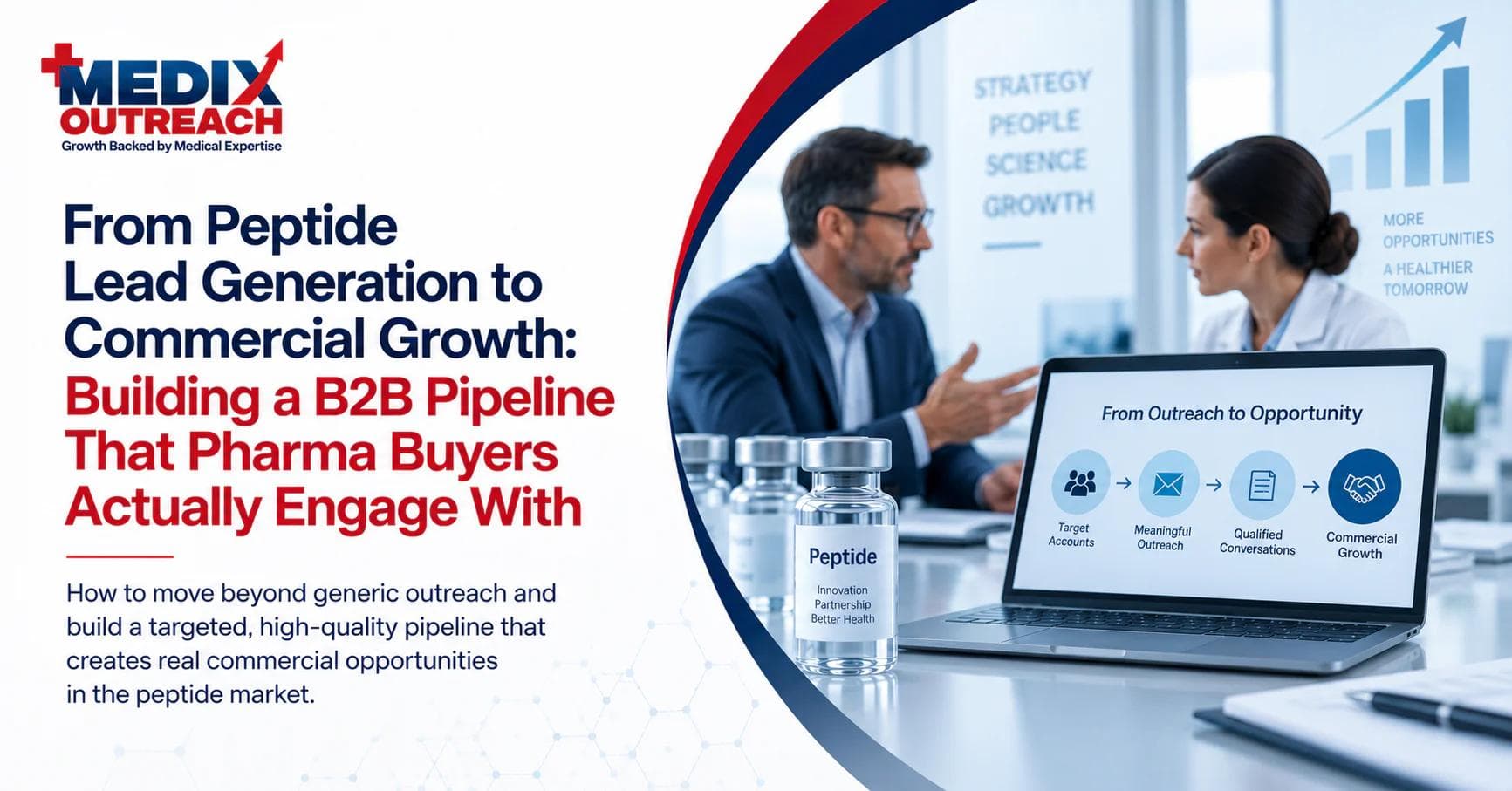
Market opportunity → target accounts → commercial messaging → outreach → business development → pipeline.
That is a different operating model.
For peptide companies, this can be particularly valuable because the market combines scientific complexity with sophisticated B2B buying processes.
Why a healthcare sales agency needs healthcare expertise
Selling into pharma and healthcare requires understanding the language of the buyer.
A generic sales representative may know how to schedule meetings.
A healthcare-focused commercial team should understand why the meeting matters.
That distinction affects:
- Targeting
- Messaging
- Qualification
- Follow-up
- Stakeholder mapping
- Commercial strategy
The goal is not merely to create meetings.
It is to create meetings that can become meaningful commercial opportunities.
The Medix Outreach model
Medix Outreach operates as a Healthcare Commercialization & Business Development Partner rather than simply a lead-generation provider.
For peptide companies, that means combining healthcare expertise with targeted commercial outreach, business development, strategic relationship development, and pipeline execution.
The focus is on creating a repeatable commercial system.
Not just filling a CRM.
Conclusion
Peptide companies have an opportunity to participate in one of the most commercially active areas of pharmaceutical development.
But scientific capability alone does not create pipeline.
The companies positioned for sustainable growth will combine strong technical offerings with:
- Clear market positioning
- Targeted peptide B2B sales
- Healthcare expertise
- Strategic outreach
- Business development
- Partnership development
- Commercial pipeline management
Peptide marketing outreach should therefore be treated as part of commercialization, not as a standalone lead-generation activity.
The objective is simple:
Reach the right organizations, engage the right decision-makers, and create commercial relationships that can grow.