
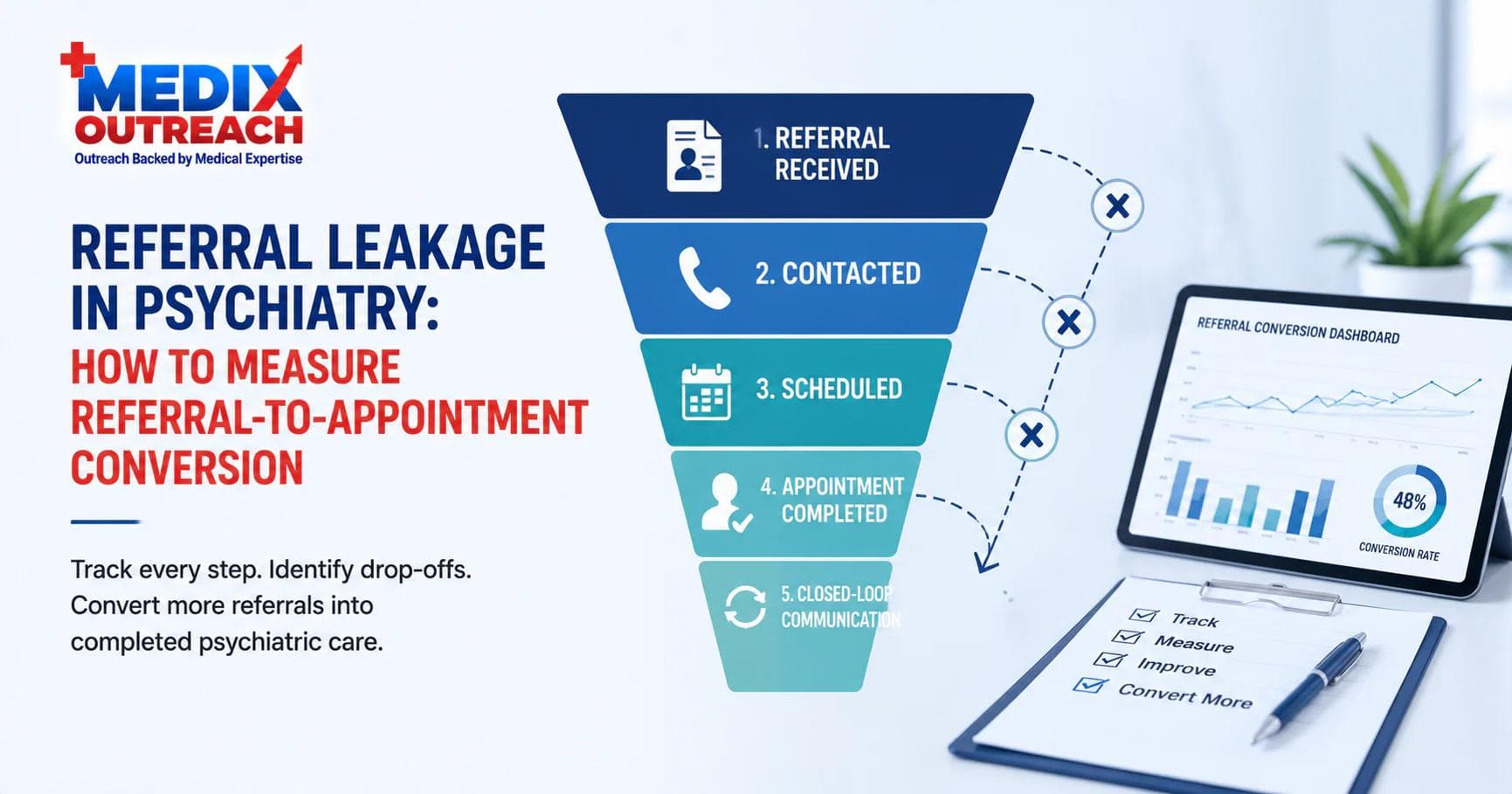
A psychiatry practice can receive a steady flow of referrals and still have a weak referral engine.
The problem may not be the number of referrals.
It may be what happens after the referral arrives.
A referral can be received but never contacted.
A patient can be contacted but never scheduled.
A patient can schedule but cancel.
An appointment can occur without the referring clinician receiving communication back.
This is psychiatry referral leakage.
The solution is not simply generating more referrals.
It is measuring what happens at every stage.
What is psychiatry referral leakage?
Psychiatry referral leakage occurs when a referral fails to become appropriate completed care or falls out of the intended pathway.
The important word is “pathway.”
A referral does not automatically equal a completed appointment.
For a psychiatry practice, the referral process may include:
Referral received → patient contacted → appointment scheduled → appointment completed → communication returned.
Every transition represents an opportunity for friction.
If a practice only measures the number of referrals received, it cannot see where patients are being lost.
The referral funnel
A practical psychiatry referral funnel should make every stage visible.
Stage 1: Referral received
Track every referral that enters the practice.
At minimum, record:
- Referral source
- Date received
- Patient eligibility
- Requested service
- Insurance information
- Referral status
This creates the baseline.
Stage 2: Referral contacted
The next question is whether the practice successfully reached the patient.
A referral sitting in an inbox is not an active patient opportunity.
Track:
- First contact attempt
- Contact outcome
- Number of attempts
- Patient response
- Reason for inability to proceed
This can reveal operational problems that have nothing to do with referral quality.
Stage 3: Scheduled
A patient who is successfully contacted may still not schedule.
This is where referral-to-appointment conversion becomes important.
The practice should define exactly what it means by conversion.
For example, one practice may define it as the percentage of referrals that result in a scheduled appointment.
Another may define it as the percentage that actually complete the first appointment.
Both can be useful, but they answer different questions.
The denominator should always be clearly defined.
Stage 4: Completed
A scheduled appointment is not necessarily completed care.
Track:
- Scheduled appointments
- Cancellations
- No-shows
- Rescheduled appointments
- Completed first appointments
This makes it possible to distinguish scheduling performance from actual access.
A referral source may appear highly productive based on bookings while producing fewer completed appointments.
That distinction matters commercially.
Stage 5: Closed-loop communication
A strong referral process does not end when the patient sees the psychiatrist.
The referring clinician should receive appropriate communication according to the clinical relationship and applicable requirements.
A closed-loop referral means the referral is tracked through completion and the referring clinician receives the specialist’s report or communication.
This matters because referral partners need confidence that patients are not disappearing into a black box.
Mid-article CTA
Need help building your healthcare growth engine?
Medix helps healthcare startups, clinics, pharma companies, and provider-focused platforms build scalable commercial pipelines.
Book a Strategy CallSource-level analytics
The next step is understanding where referrals come from.
A practice might receive referrals from:
- PCPs
- Therapists
- Hospitals
- Emergency departments
- Specialty clinics
- Other healthcare partners
The goal is not to rank referral sources based only on volume.
A source producing 50 referrals with poor completion may be less valuable operationally than a source producing 20 referrals with strong fit and completion.
Track conversion by referral source.
That allows the practice to identify active referrers and understand where operational improvements are needed.
How to distinguish a weak referral source from a weak intake operation
This is one of the most important questions in referral analytics.
Suppose a PCP sends 30 referrals.
Only 10 patients schedule.
There are at least two possible explanations.
The referrals may not be a good fit.
Or the practice’s intake process may be losing patients.
Without stage-level measurement, the practice cannot tell.
Look at the pattern.
If multiple referral sources have low conversion, the intake workflow may be the problem.
If one referral source consistently produces low-fit referrals while others perform well, the issue may be referral-source alignment.
The data should guide the response.
Capacity and wait-time effects
Referral conversion is also influenced by patient access.
If a psychiatry practice has limited appointment availability, a strong referral source can still produce disappointing conversion.
The patient may choose another option because the available appointment is too far away.
That means referral analytics should be reviewed alongside:
- Panel capacity
- New-patient availability
- Time to first appointment
- Insurance fit
- Geography
- Telehealth availability
Referral performance cannot be separated from access.
No-show and cancellation recovery
A practice should also measure what happens after scheduling.
If a patient cancels, is the appointment recovered?
If a patient does not show, is there an established follow-up process?
These operational details affect the economics of every referral channel.
The objective isn’t simply to increase scheduled appointments.
It is to convert appropriate referrals into completed care.
The monthly referral dashboard
A simple dashboard can include:
- Referrals received — What it shows: Referral volume
- Referrals contacted — What it shows: Intake responsiveness
- Referrals scheduled — What it shows: Scheduling conversion
- Appointments completed — What it shows: Actual access
- Cancellations/no-shows — What it shows: Appointment loss
- Referral-to-appointment conversion — What it shows: End-to-end performance
- Time to first appointment — What it shows: Patient access
- Referral source — What it shows: Channel performance
- Closed-loop communication — What it shows: Referral-partner experience
The exact definitions should remain consistent month to month.
That makes trends easier to identify.
What Medix Outreach looks for
Medix Outreach approaches psychiatry referral growth as a system.
Generating referrals is only one part.
The referral must be appropriate.
The practice must be able to contact the patient.
The patient needs a realistic path to scheduling.
The appointment needs to be completed.
And the referring relationship should remain informed where appropriate.
That is how referral growth becomes measurable.
Conclusion
Psychiatry referral leakage is not simply a marketing problem.
It can happen at every stage between referral and completed care.
Practices that measure only referral volume cannot see where opportunities are being lost.
A better approach tracks the full pathway:
Referred → contacted → scheduled → completed → communicated.
Once those stages are measured consistently, practices can identify whether the problem is referral-source fit, intake conversion, patient access, capacity, or follow-up.
The objective is not more referrals at any cost.
It is better referral-to-appointment conversion and a more reliable behavioral health referral pathway.