
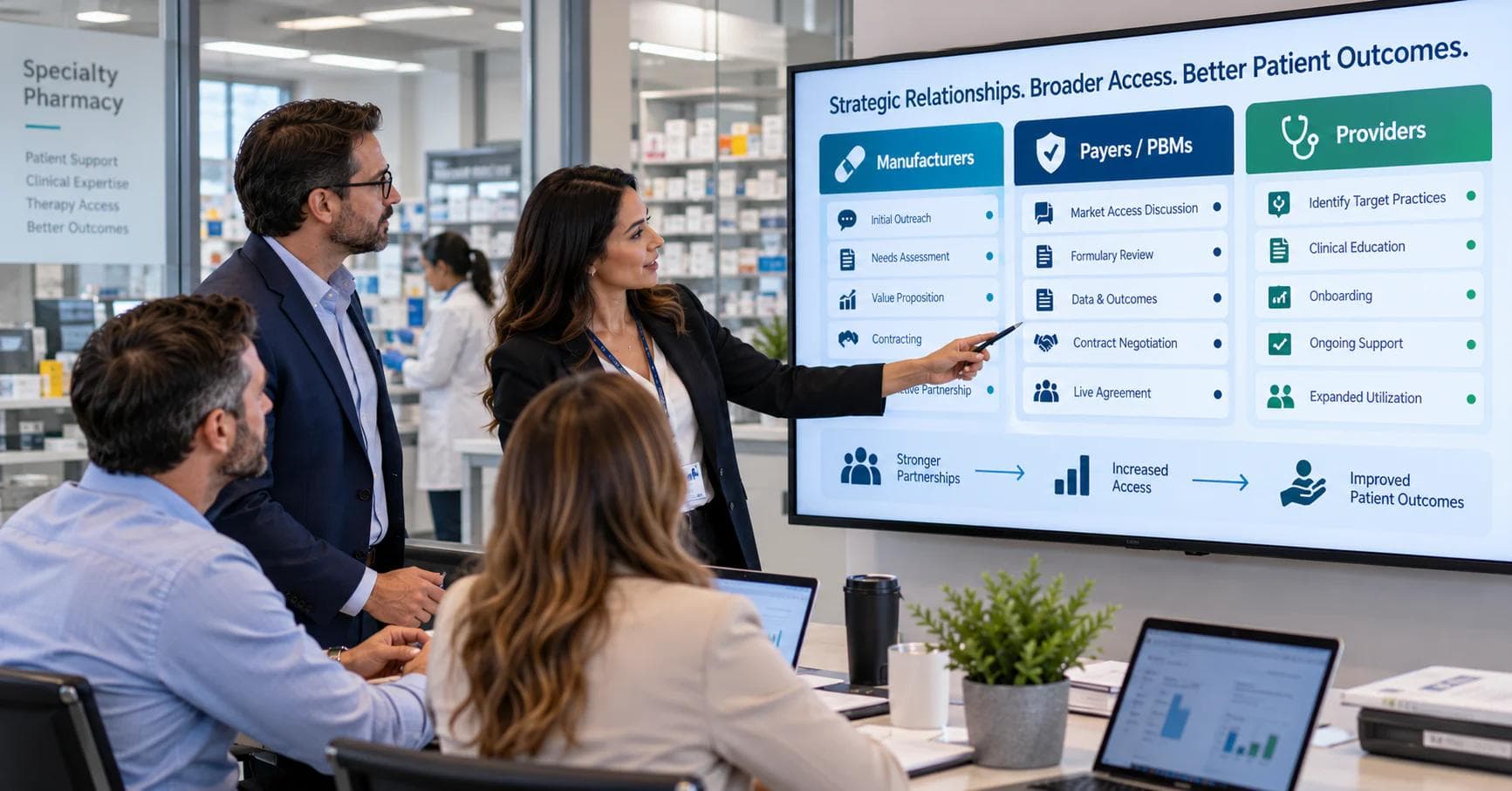
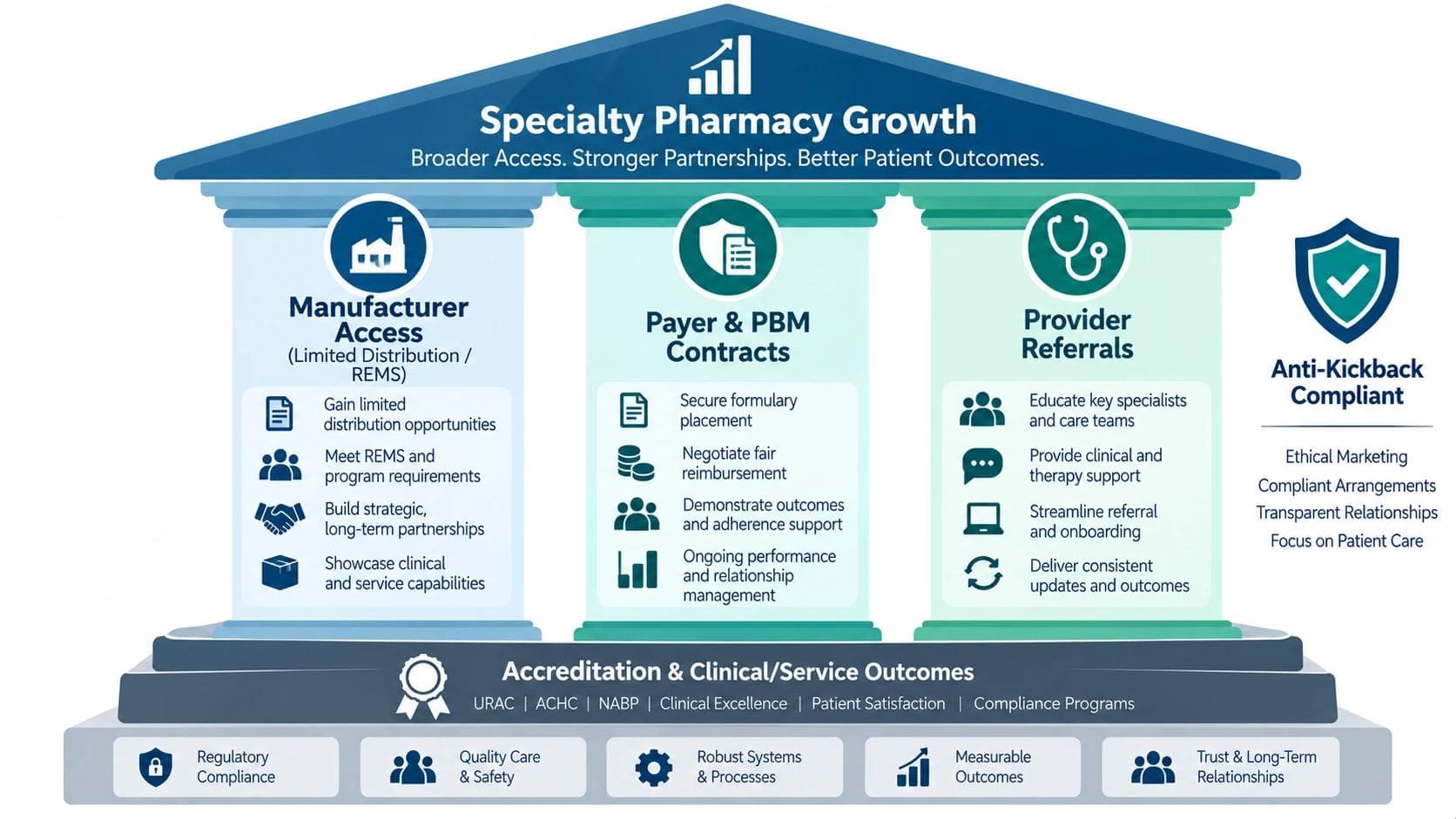
Growing a specialty pharmacy has almost nothing to do with retail-pharmacy marketing. Specialty pharmacies dispense high-cost, high-complexity therapies for conditions like oncology, autoimmune disease, and rare disorders - and they grow by winning three kinds of B2B relationships: access to the drugs (from manufacturers), inclusion in the networks that pay for them (payers and PBMs), and the referrals that send patients their way (providers). Business development across those three engines, on a foundation of accreditation and service quality, is what scales a specialty pharmacy.
This guide covers what specialty pharmacy business development really is, the three growth engines, and how to build each one compliantly.
What specialty pharmacy business development is
Specialty pharmacy sits at the intersection of manufacturers, payers, and prescribers. Unlike a retail pharmacy that competes on convenience and foot traffic, a specialty pharmacy competes on its ability to earn drug access, network contracts, and provider trust - and to prove the clinical and service performance that sustains all three. Growth, therefore, is a structured business-development function, not an advertising budget. The three engines reinforce each other: drug access makes you valuable to providers and payers; provider referrals and payer contracts make you valuable to manufacturers.
Engine 1: Manufacturer relationships and limited-distribution access
Many specialty drugs are distributed through narrow or limited-distribution networks, and some are tied to FDA-required safety programs - Risk Evaluation and Mitigation Strategies, or REMS - that constrain which pharmacies may dispense them. Getting into those networks is a business-development process: manufacturers select pharmacies on data capabilities, clinical services, patient-support programs, adherence outcomes, and reach. Winning limited-distribution access is often the single highest-value growth move a specialty pharmacy can make, because it creates a defensible, referable capability.
Engine 2: Payer and PBM network access
A specialty pharmacy can only serve the patients whose plans include it. Network inclusion with payers and PBMs depends heavily on accreditation (industry bodies such as URAC and ACHC are the recognized standards), clinical and service metrics, and contracting. Accreditation is effectively table stakes - it signals the quality and safety controls payers and manufacturers require. Business development here means achieving and maintaining accreditation, demonstrating outcomes, and negotiating network and contracting terms - the same distribution-partnership discipline that governs any healthcare channel.
Engine 3: Provider referral development
Drug access and payer contracts are wasted if prescribers do not send patients. Specialty pharmacies depend on referrals from the specialists who prescribe specialty therapies - oncologists, rheumatologists, neurologists, and others - which makes provider referral development the engine most within a pharmacy's control. This is exactly the work in Medix's specialty pharmacy provider-outreach case study: mapping high-value prescribers, earning trust through responsiveness and clinical support, and building durable referral relationships. The disciplines are the same ones behind getting more physician referrals and provider acquisition: segment prescribers, deliver value (fast turnaround, prior-authorization support, patient adherence), and close the loop.
Build specialty pharmacy growth within Anti-Kickback rules
Specialty pharmacy business development operates under intense compliance scrutiny because it touches federally reimbursed drugs and referral relationships. The Anti-Kickback Statute prohibits paying for referrals or improperly steering patients and prescriptions - see the OIG fraud and abuse laws. Build manufacturer, payer, and provider relationships on genuine value - access, clinical service, adherence, and outcomes - never inducements, and have counsel review referral programs, manufacturer service agreements, and any arrangement that could look like payment for prescriptions.
Mid-article CTA
Need help building your healthcare growth engine?
Medix helps healthcare startups, clinics, pharma companies, and provider-focused platforms build scalable commercial pipelines.
Book a Strategy CallBuild the business-development engine
- Secure the accreditation foundation. Achieve and maintain the accreditations payers and manufacturers require - the precondition for both other engines.
- Pursue limited-distribution access. Build the data, clinical-service, and patient-support capabilities manufacturers select for, and pursue the drug networks that fit your therapeutic focus.
- Win payer and PBM contracts. Demonstrate outcomes and negotiate network inclusion.
- Develop provider referrals. Run a compliant provider-outreach program targeting the specialists who prescribe your therapies.
- Measure and reinvest. Track drug access won, contracts secured, referring prescribers activated, and the outcomes that keep all three engines turning.
Frequently asked questions
How do specialty pharmacies grow? Through three business-development engines: winning manufacturer limited-distribution access, securing payer and PBM network contracts, and developing provider referrals - all on a foundation of accreditation and demonstrated clinical and service outcomes.
What is limited distribution in specialty pharmacy? Many specialty drugs are dispensed only through a narrow set of pharmacies the manufacturer selects, sometimes tied to FDA REMS safety programs. Earning a place in those networks is a key specialty pharmacy growth lever.
Why do provider referrals matter so much to specialty pharmacies? Because specialty therapies are prescribed by specialists, the pharmacy depends on those prescribers choosing to send patients. Referral development is the growth engine most within a pharmacy's own control.
What compliance rules govern specialty pharmacy business development? The Anti-Kickback Statute prohibits paying for referrals or improperly steering prescriptions. Growth must rest on genuine value - access, service, adherence, and outcomes - with counsel reviewing referral and manufacturer arrangements.
Scaling a specialty pharmacy the right way
Specialty pharmacy growth is a disciplined business-development function: accreditation as the foundation, then manufacturer access, payer contracts, and provider referrals reinforcing one another - all built on genuine value and compliance. Pharmacies that run all three engines deliberately become the ones manufacturers, payers, and prescribers choose.
Medix Outreach builds specialty pharmacy business development - manufacturer access support, payer-contracting positioning, and compliant provider-referral programs. To grow your specialty pharmacy, book a free strategy call or explore our Strategic Partnerships, Licensing & Market Expansion and Provider Network Development services.