
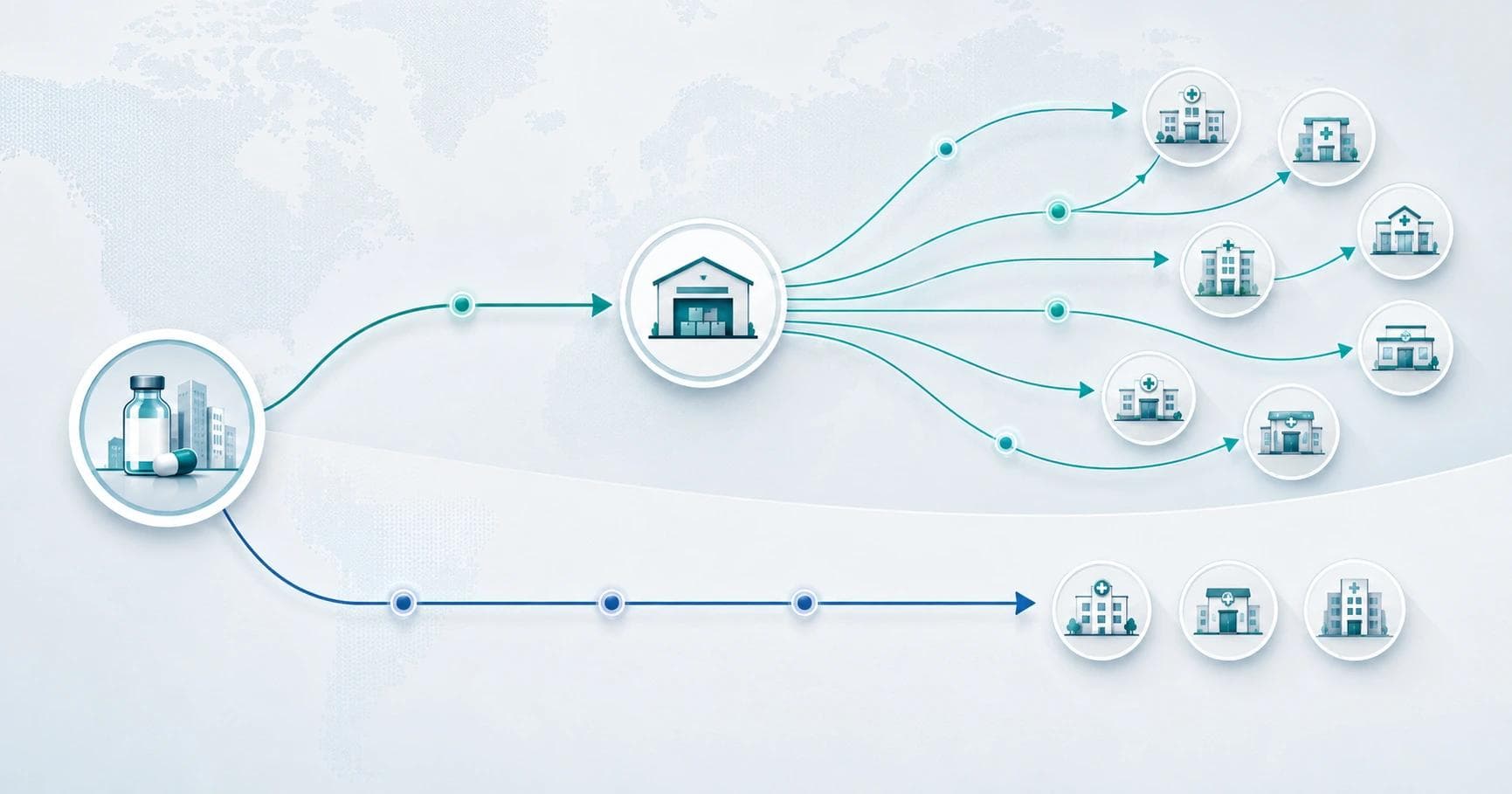
Every healthcare product company eventually hits the same wall. The product works, early accounts are happy, and now you have to reach hundreds or thousands of clinics, hospitals, or pharmacies you cannot possibly call on yourself. That is the moment the distribution question becomes urgent: do you build a direct sales force, or do you hand your product to distributors who already own the shelf space and the relationships?
There is no universally right answer, but there is a right answer for your product, your margin, and your buyer. This guide walks through how distribution actually works in healthcare, the real economics of distributor versus direct, and how to structure a partnership so it accelerates growth instead of capping it.
Short version: distributors buy you reach and speed at the cost of margin and control. Direct sales buy you margin, data, and control at the cost of time and capital. Most companies end up with a hybrid, and the ones who win are deliberate about which accounts belong in which channel and how the distributor agreement is structured.
Distribution vs. Licensing: Not the Same Deal
First, clear up a common confusion. Distribution and licensing are different arrangements, even though both involve a partner.
- Licensing transfers rights to your intellectual property or product so a partner can make, brand, or sell it, usually in exchange for royalties or milestone payments. If your question is about IP, royalties, or letting a partner commercialize under their own authorization, start with our guide to finding and approaching a pharma licensing partner.
- Distribution is a channel arrangement: you keep the product and the brand, and a partner buys, stocks, imports, or resells it to end accounts. The distributor makes money on margin, not royalties.
The two can coexist, especially internationally, where you might license a product in one region and distribute directly in another. But the decision frameworks are different, and this article is about distribution.
The Economics: Reach vs. Margin
The distributor tradeoff comes down to a single tension. A distributor gives you reach you could not build quickly on your own, and takes a margin for it. A direct model keeps the margin and the customer relationship, and makes you pay for the sales infrastructure and the time to build it.
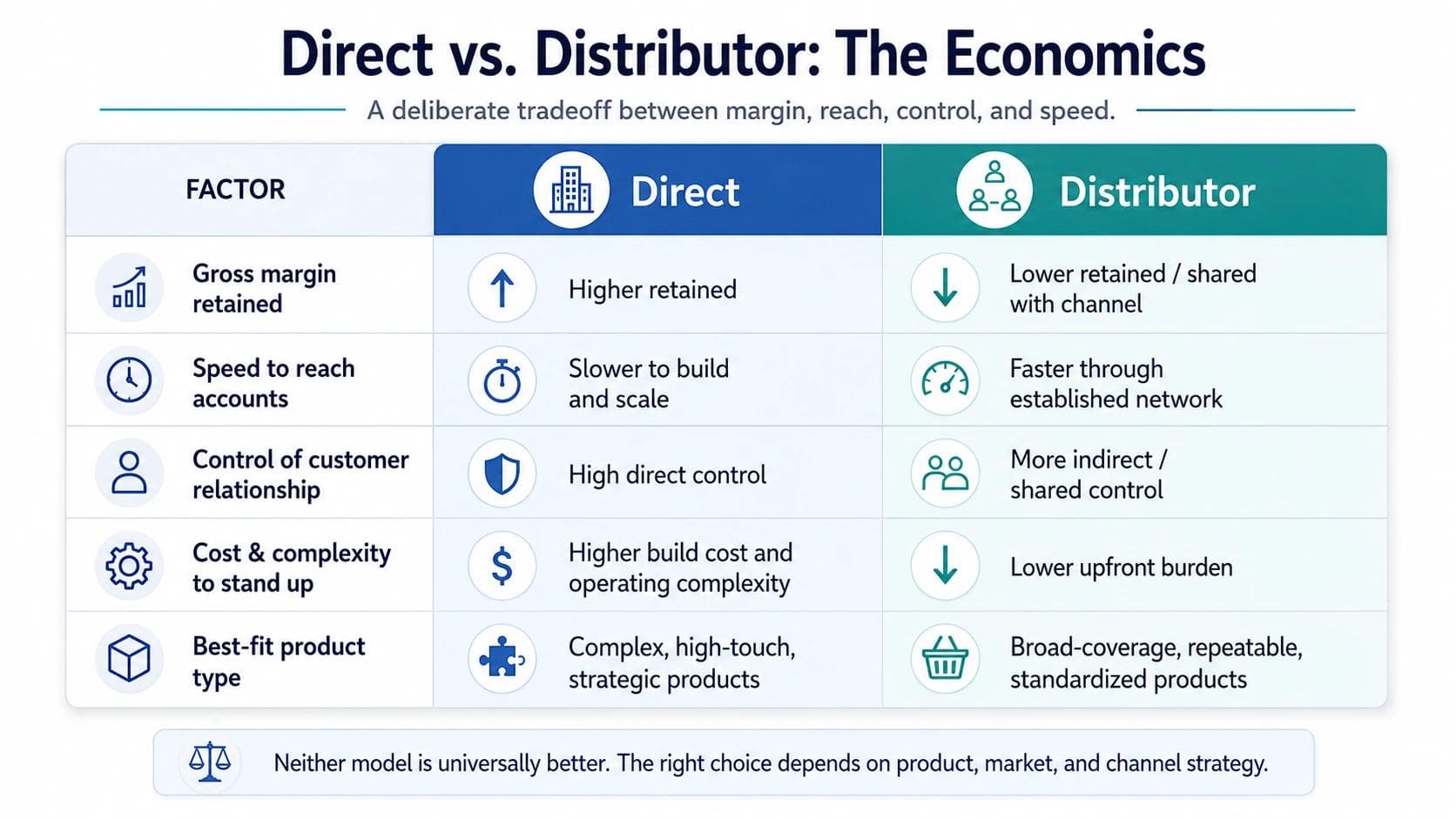
Distributors earn their cut by providing things that are expensive to replicate:
- Existing account relationships with the hospitals, clinics, pharmacies, or GPOs you want to reach.
- Logistics and inventory, including warehousing, cold chain where needed, and the working capital to hold stock.
- Regulatory and import infrastructure, which matters for physical products and even more for international markets.
- Coverage density that a small direct team cannot match across a wide geography.
What you give up is equally concrete. Margin is the obvious cost, but the quieter ones matter more over time: you lose direct visibility into who is buying and why, you lose control of how your product is positioned, and you become dependent on the distributor's incentive to prioritize your product over the dozens of others in their bag. A distributor carrying five hundred products will always push the ones that sell themselves or pay the best margin, which may not be your new-to-market device.
When a Distributor Is the Right Call
Distribution tends to win when the product and the buying process favor an intermediary:
- Commoditized or category-familiar products where buyers do not need heavy clinical education to adopt. Consumables, established device categories, and reorder-driven products move well through distributors.
- Fragmented, geographically dispersed buyers such as independent clinics and small practices, where the cost of direct coverage per account is prohibitive.
- Markets you cannot legally or practically serve alone, especially international ones. In the Gulf and much of the world, a local distributor holds the licenses and relationships you need, which we cover in expanding a U.S. healthcare company into the MENA region.
- Low-touch reorder economics where the value is in availability and fulfillment more than in a consultative sale.
Our work building a nationwide B2B peptides pipeline is an example of reaching a wide, fragmented base of clinics and wellness providers - exactly the kind of dispersed demand that a well-run channel is built for.
When Direct Sales Is the Right Call
Direct wins when the sale is complex, high-value, or relationship-driven:
- Clinically complex products that require education, workflow integration, and evidence to adopt. If your buyer needs a value analysis committee to say yes, a distributor rep juggling hundreds of SKUs will not carry that argument. This is the reality behind most medical device go-to-market strategy.
- High-margin, lower-volume products where the economics can support a dedicated team and the margin loss to a distributor is painful.
- Products where the customer relationship is the asset, such as platforms with expansion revenue, where owning the account directly compounds over time.
- Early market development where you are still learning the buyer, refining the message, and generating the reference accounts. You want that learning in-house, not filtered through a partner. Building that early motion is what our healthcare business development work is designed to accelerate.
Mid-article CTA
Need help building your healthcare growth engine?
Medix helps healthcare startups, clinics, pharma companies, and provider-focused platforms build scalable commercial pipelines.
Book a Strategy CallThe Hybrid Model Most Companies Land On
In practice, few healthcare companies are purely one or the other. The durable pattern is a segmented hybrid: sell the strategic, complex, high-value accounts directly, and use distributors for the long tail of smaller, dispersed, or hard-to-reach accounts. Enterprise health systems and marquee references stay in-house; independent practices and secondary geographies go through the channel.
The hybrid only works if you draw the lines clearly. Undefined boundaries create channel conflict, where your direct team and your distributor chase the same account and your pricing collapses in the crossfire. Define which accounts, segments, or territories belong to each channel, and put it in writing.
Structure the Agreement So It Performs
Most distribution disappointments trace back to a weak agreement signed in the early enthusiasm of finding a willing partner. The single most damaging mistake is granting broad, unconditional exclusivity to an unproven distributor. If they underperform, they have locked up your market and you cannot bring in anyone else.
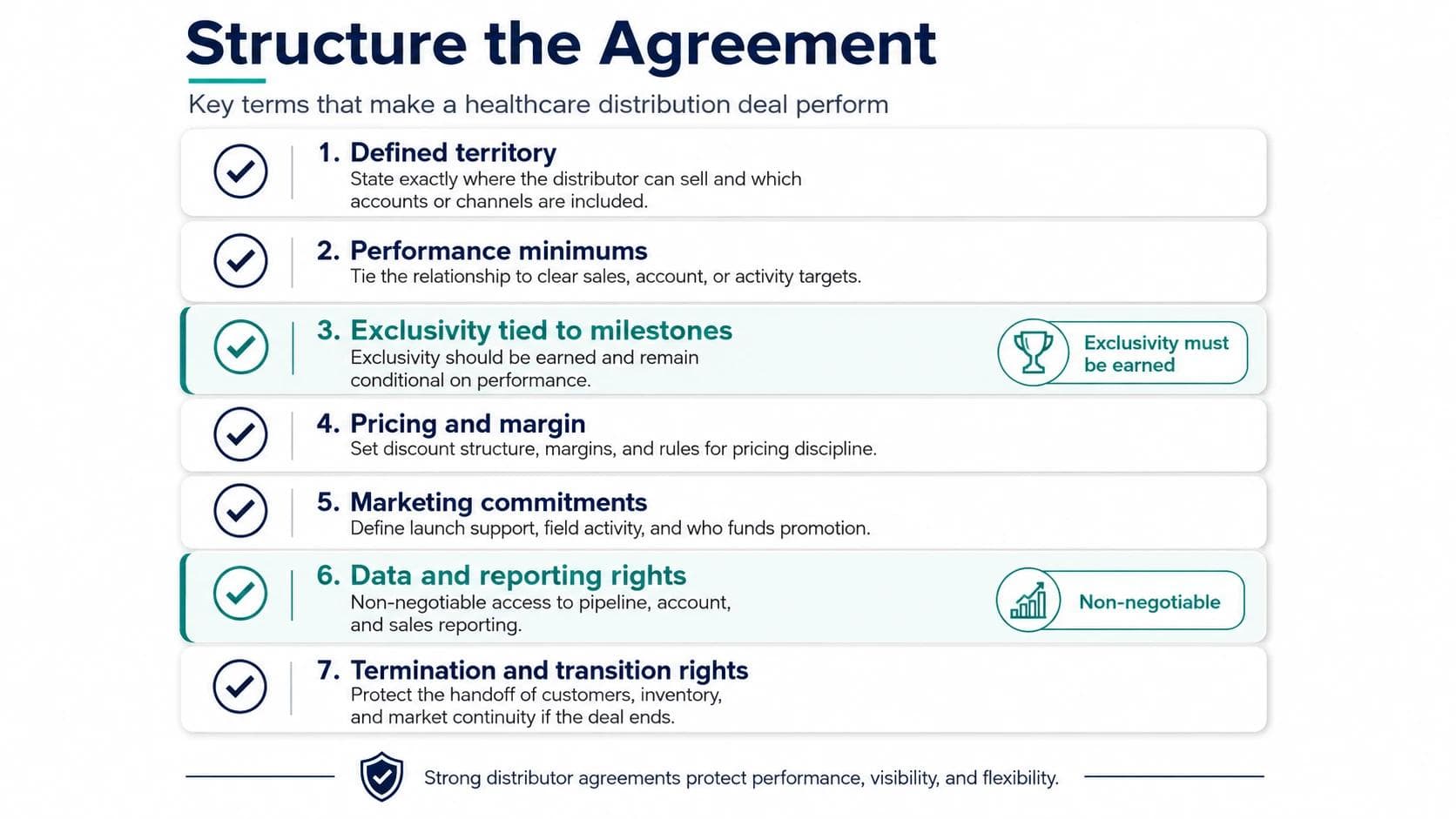
The terms that protect you are not exotic; they are just often missing:
- Defined territory and segment. Exactly which geographies and account types the distributor covers, and what stays direct.
- Performance minimums. Concrete purchase or sales targets, with consequences for missing them.
- Conditional exclusivity. If you grant exclusivity, tie it to hitting the minimums and specific milestones. Exclusivity should be earned and revocable, not a gift.
- Pricing and margin structure that leaves room for both parties and protects your floor price across channels.
- Marketing and support commitments the distributor must make, so your product gets real attention, not shelf space.
- Data and reporting rights. You must see sell-through, account-level data, and pipeline. Losing visibility into your own market is how companies go blind.
- Termination and transition rights, including who owns the customer relationships and registrations if the partnership ends. Internationally, make sure product registrations can transfer.
The diligence that goes into choosing the partner matters as much as the paper. Vet distributors on the specific buying process you need served, not just their size. The discipline is the same one we apply to strategic partnerships generally: the best-known name is not automatically the right fit, and a partner who is excellent at one buyer type can be the wrong choice for another.
A Note on Compliance
Distribution in healthcare sits inside a regulatory frame. For medical devices, importers and distributors have their own registration and listing obligations with the U.S. Food and Drug Administration, and physical products carry storage, handling, and traceability requirements. When distribution touches referrals or anything a federal program pays for, anti-kickback rules constrain how you structure incentives. None of this is a reason to avoid distribution; it is a reason to build the channel with someone who understands the constraints, so your growth engine does not create compliance exposure. For products moving into hospital systems specifically, the buying path also runs through group purchasing organizations, which we break down in how hospitals buy.
Frequently Asked Questions
What is the difference between a distributor and a direct sales model in healthcare?
A distributor buys your product and resells it to end accounts, earning a margin and providing reach, logistics, and existing relationships. A direct model means your own sales team sells straight to the buyer, keeping the full margin and the customer relationship but bearing the cost and time of building the team. Distributors optimize for reach and speed; direct optimizes for margin, data, and control.
When should a medical device company use distributors instead of direct sales?
Distributors make sense for products that are category-familiar, reorder-driven, or sold to a fragmented base of smaller accounts, and for markets you cannot practically serve alone, such as international ones. Clinically complex, high-value products that require education and committee approval usually justify a direct team, at least for strategic accounts. Many companies use both, selling complex accounts directly and the long tail through distributors.
How do you avoid getting locked in with a bad distributor?
Never grant broad, unconditional exclusivity to an unproven partner. Tie any exclusivity to performance minimums and milestones so it can be scaled back or revoked if the distributor underperforms. Define the territory and segments precisely, secure account-level sales data and reporting rights, and include clear termination and transition terms covering who keeps the customer relationships and product registrations.
What is channel conflict and how do you prevent it?
Channel conflict happens when your direct team and your distributors, or two distributors, compete for the same accounts, which erodes pricing and damages relationships. Prevent it by clearly segmenting the market in writing: define which accounts, territories, or customer types belong to each channel, and set consistent pricing rules so no channel can undercut another.
Can you use distribution and licensing together?
Yes, and companies often do, especially across regions. You might license a product to a partner in one market while distributing it directly or through a distributor in another. The arrangements are distinct: licensing transfers rights to make or sell in exchange for royalties, while distribution keeps the product yours and pays a partner a margin to move it.