
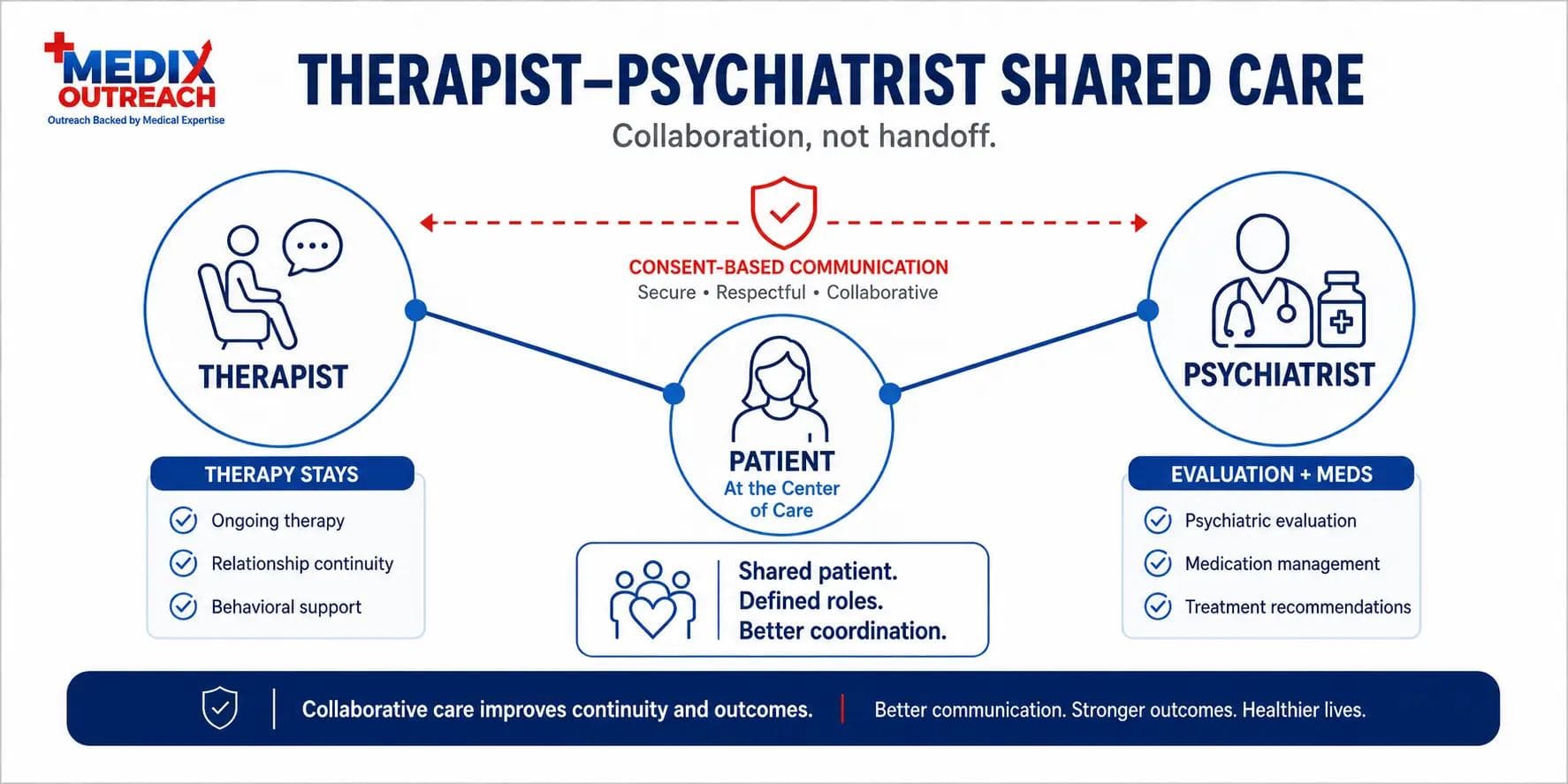
A therapist-to-psychiatrist referral works when the psychiatry practice functions as a collaborative medication-management and evaluation partner — not as a threat to the therapist's relationship with the patient. Therapists refer patients to psychiatrists for a specific reason: the patient needs a psychiatric evaluation or medication management that sits outside the therapist's scope. What the therapist is weighing, often silently, is whether they will get the patient back. A psychiatry practice that answers that question clearly — defined roles, continuity protected, communication both ways — earns a durable referral source. One that behaves like a patient-capture funnel gets one referral and never a second.
This article covers why therapists refer to psychiatrists, how psychotherapy and psychiatry collaborate around medication management, and how a psychiatry practice can build trust with therapists while protecting the continuity they care about.
Why do therapists refer patients to psychiatrists?
Therapists — psychologists, LCSWs, LPCs, LMFTs — provide psychotherapy but do not prescribe. They refer to psychiatry when a patient's care needs something medication or medical evaluation adds:
- Medication management — the patient may benefit from pharmacotherapy the therapist cannot provide.
- Psychiatric evaluation — diagnostic clarification, especially where a mood, psychotic, or bipolar-spectrum picture is in question.
- Treatment resistance — therapy alone is not moving the patient and a combined approach is indicated.
- Complexity or safety — the clinical picture has escalated beyond outpatient therapy alone.
In each case the therapist is not exiting the patient's care — they intend to keep doing the therapy. They are adding a psychiatric partner. That intent is the entire basis of the relationship.
Psychotherapy and psychiatry collaboration: defining the roles
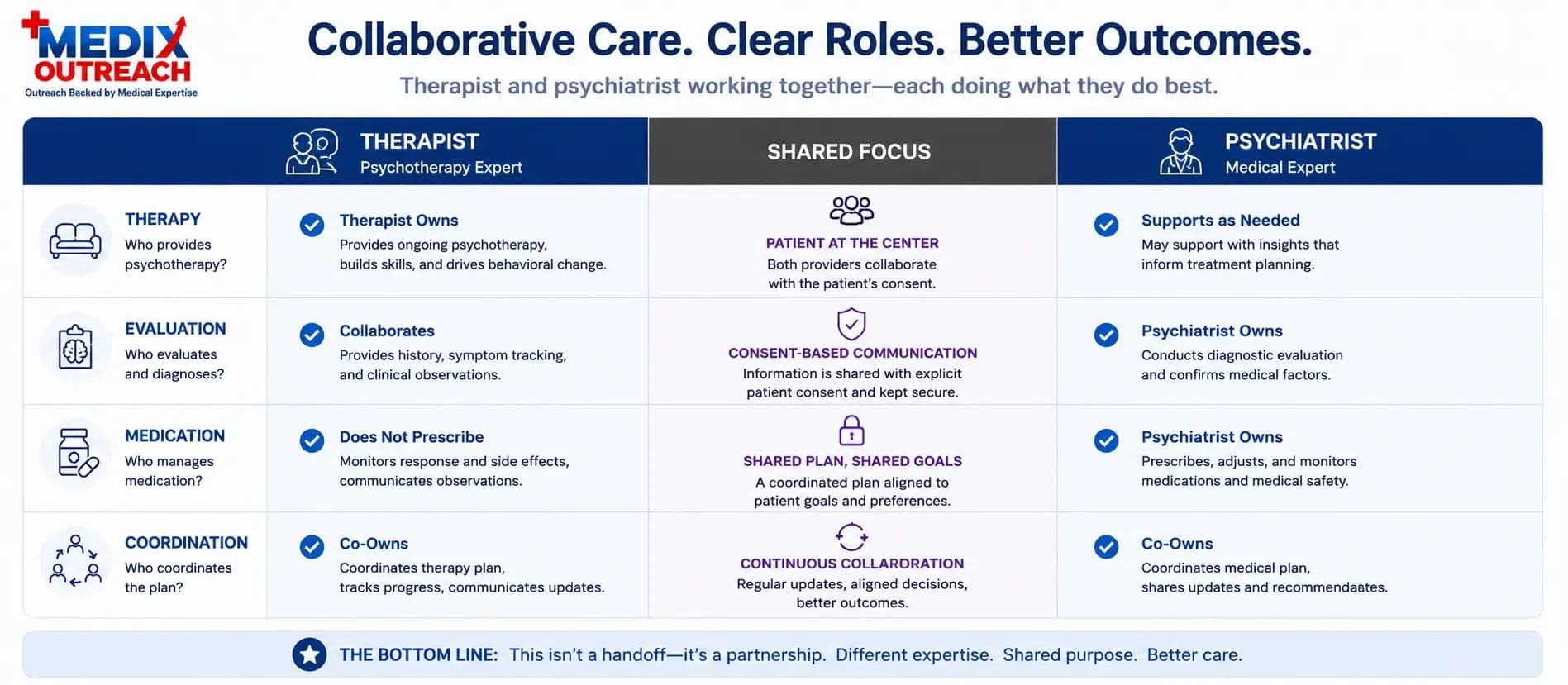
The collaboration works when roles are explicit. The cleanest arrangement:
- Psychotherapy / ongoing therapeutic relationship - Referring therapist
- Psychiatric evaluation & diagnosis - Psychiatry practice
- Medication management - Psychiatry practice
- Shared coordination & communication - Both, with consent
This division mirrors established collaborative-care thinking. The American Psychiatric Association's integrated-care model is built on exactly this principle — distinct roles, shared patient, coordinated communication — and it is the reason clearly defined clinical roles are the foundation of a therapist referral relationship rather than a nicety.
Mid-article CTA
Need help building your healthcare growth engine?
Medix helps healthcare startups, clinics, pharma companies, and provider-focused platforms build scalable commercial pipelines.
Book a Strategy CallThe real concern: continuity and patient capture
The unspoken worry behind many therapist referrals is losing the patient — that the patient will migrate entirely to the psychiatry practice, or be steered to an in-house therapist. A psychiatry practice that wants therapist referrals to continue has to defuse this deliberately:
- State the arrangement up front: "We manage the evaluation and medications; the patient continues therapy with you."
- Return the patient to their therapist rather than absorbing their psychotherapy.
- Communicate back so the therapist stays informed and central to the patient's care.
- Do not compete for the therapy relationship the referral was built on.
The Medix point of view is direct: position psychiatry as a collaborative medication-management and evaluation partner, not a patient-capture channel. Trust built this way turns a single therapist into a recurring, high-intent referral source and a node in a psychiatry referral network.
Scheduling, access, and communication
The operational requirements mirror any strong referral relationship: fast access so the therapist's patient is not left waiting, and communication that closes the loop. A therapist who refers a patient for medication management needs to know the patient was seen, what was started, and how to coordinate — the same closed-loop communication that keeps PCPs referring. For therapists, one addition matters: the note back should respect that the therapist remains the continuity owner.
Consent and privacy considerations
Coordination between a therapist and a psychiatry practice involves sharing behavioral health information, which carries heightened sensitivity. Communication should proceed with appropriate patient consent and in line with applicable privacy rules. This is an operational and compliance matter for each practice to handle with its own counsel — the point here is simply that consent-based communication is part of the collaboration, not an obstacle to it. Medicare and most payers cover psychotherapy and psychiatric services delivered by different clinicians, so a collaborative arrangement does not inherently create a coverage conflict — but verify specifics per patient and plan.
Building professional trust with therapists
- Make the collaborative arrangement explicit in your first conversation and in writing.
- Deliver fast access for their referred patients.
- Return the patient to therapy and say so.
- Close the loop with a note that keeps the therapist central.
- Never structure reciprocity as a quid pro quo — no referral fees, no guaranteed reciprocal referrals. Trust, not incentives, is what makes the relationship durable and compliant.
Frequently asked questions
Why do therapists refer patients to psychiatrists?
For medication management, psychiatric evaluation and diagnostic clarification, treatment-resistant cases, or increased complexity or safety concerns — while the therapist continues providing psychotherapy.
How can psychiatry avoid "capturing" a therapist's patient?
By defining roles up front, managing only the evaluation and medications, returning the patient to their therapist, and communicating back — rather than absorbing the therapy relationship.
Do therapist-psychiatrist referrals involve reciprocal referral fees?
No. Durable, compliant referral relationships are built on clinical trust, access, and communication — never referral fees, quid pro quo, or guaranteed reciprocal referrals.