

Urgent care marketing is the work of getting a nearby patient to choose your center at the moment they need care, and then building the review reputation and contract relationships that make that volume repeatable. It is not brand advertising. Urgent care is local, unplanned, convenience-driven, and close to loyalty-free: most patients choose the closest, highest-rated, lowest-friction option they can find in a search, and many will choose a different one next time.
That makes urgent care a different growth problem than a primary care panel or a cash-pay specialty clinic. This guide covers the three levers that actually move volume, the second revenue engine most operators under-invest in, and the metrics and compliance guardrails that keep growth profitable.
What makes urgent care marketing different
Three structural facts shape everything that works in this category:
- Demand is unplanned and local. Patients decide to seek care in minutes, not weeks, and they almost never travel far for it. Your addressable market is a tight radius, and the buying decision happens inside a search result.
- Loyalty is weak and convenience wins. Wait time, hours, online check-in, and location usually beat brand. A patient who had a fine visit will still pick a closer or faster option next time unless you make returning easy.
- There are two revenue engines, not one. Walk-in patient volume is the obvious one. The second, which many operators treat as an afterthought, is contracted occupational health and employer relationships. The marketing motions for each are completely different.
Get the framing right and the tactics follow. Chase brand awareness and you burn budget; win the local moment and build the contract book, and you compound.
Win the local search moment
Most urgent care demand resolves inside a single search for care nearby. Winning that moment is the highest-leverage work in urgent care marketing, and it is mostly operational, not creative.
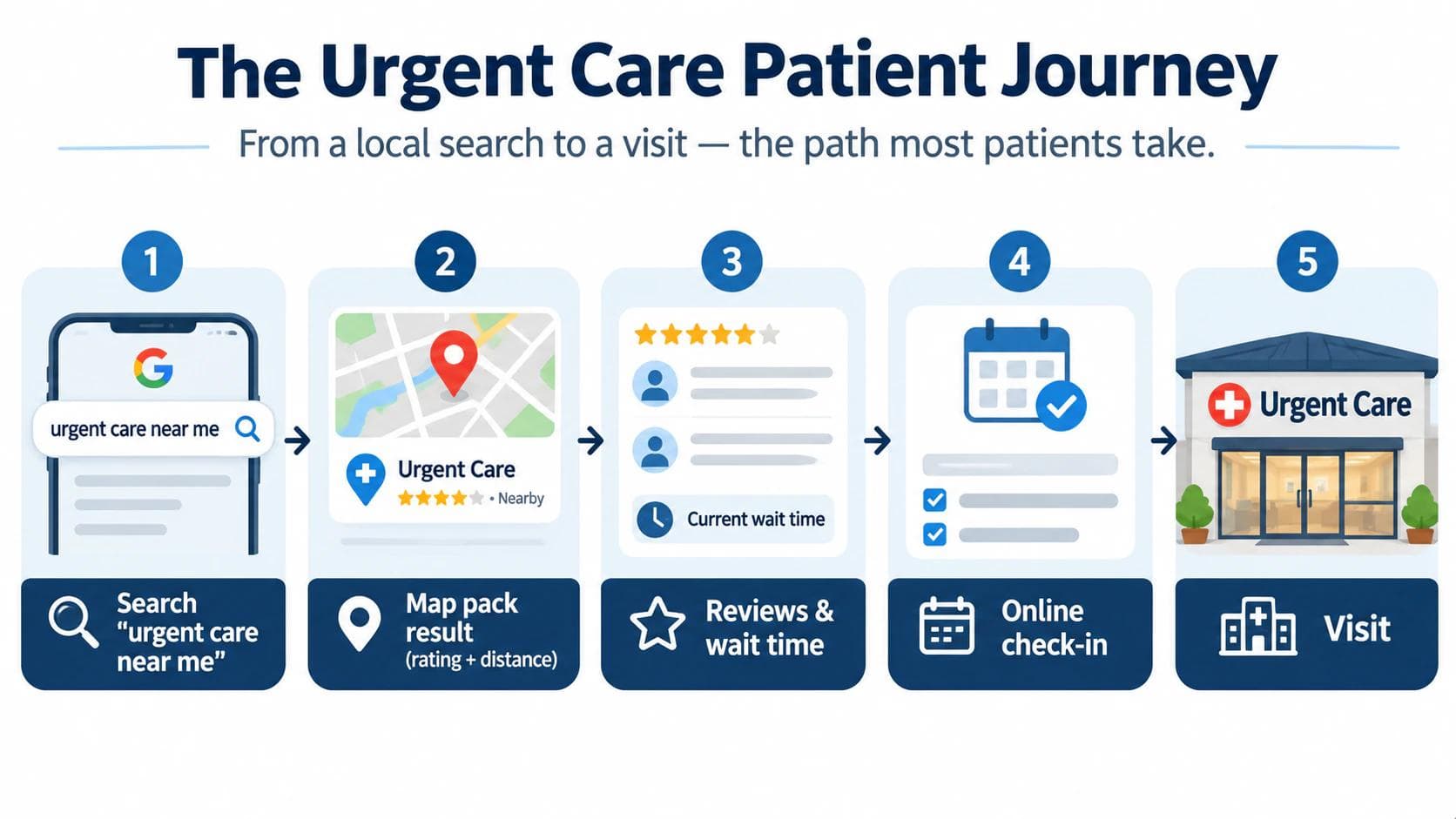
- Own your Google Business Profile for every location. Accurate hours, services, real photos, and categories drive the map results patients actually click. Google's own guidelines govern how you represent each location, and inaccurate or duplicate listings quietly cost you visits.
- Build location pages that answer the real query. One indexable page per center with services, hours, wait-time and insurance information, and directions will out-rank a single corporate page for "urgent care near me" style searches in each market.
- Remove friction at the decision point. Online check-in or reserve-a-time, visible wait times, and accepted-insurance clarity convert a searcher into a visit. Marketing that drives a click to a slow or unclear page wastes the spend.
- Treat local SEO as a system, not a campaign. The same fundamentals that help healthcare brands rank apply here: fast, useful, trustworthy pages built for people first.
Reputation is your conversion engine
In a loyalty-free category, reviews are not a vanity metric; they are the deciding factor between two map results. Star rating and review volume shape which center a searcher chooses before they ever see your website.
- Make review generation a routine, not a push. A simple, consistent post-visit request lifts volume more than any one-off campaign. Automate the ask; keep it effortless for staff and patients.
- Respond to reviews, including the hard ones. A calm, professional response to a negative review reassures the next reader more than a wall of five stars.
- Keep testimonials honest and compliant. Reviews and testimonials used in your own advertising must reflect genuine patient experience; the FTC's health-products guidance sets the bar for substantiated claims and honest endorsements.
The second revenue engine: occupational health and employer contracts
This is where most urgent care marketing leaves money on the table. Beyond walk-in patients, urgent care centers can build a durable, higher-margin book of business from employers: pre-employment screenings, drug and alcohol testing, workers' compensation injury care, physicals, and ongoing occupational-health services. This revenue is contracted, recurring, and far less price-sensitive than a single visit, and it is won through outreach, not ads.
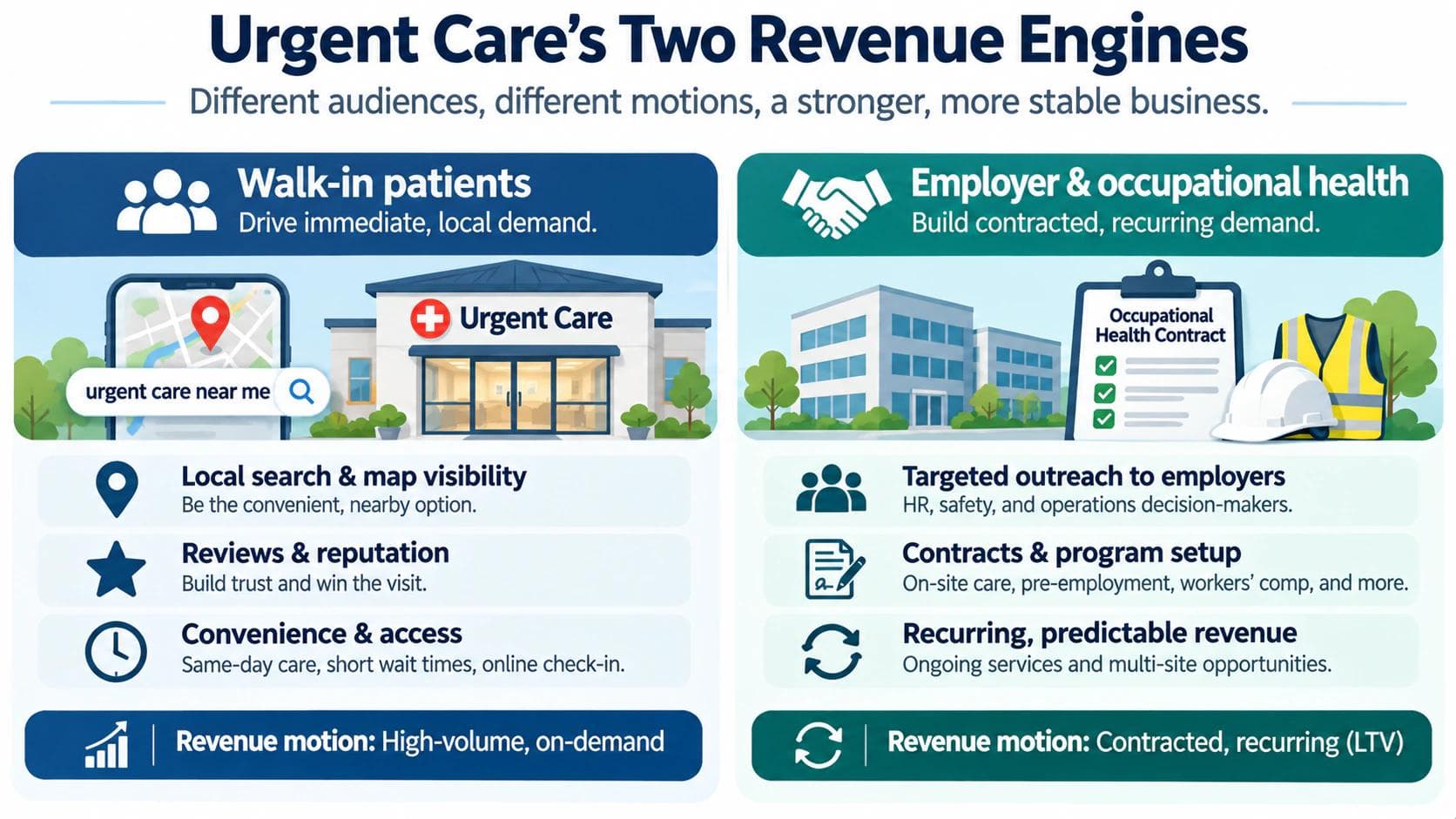
- It is a B2B sale, not a search result. You are reaching HR leaders, safety managers, and operations directors at local employers. That is targeted outreach and relationship-building, the same discipline behind any physician liaison program or provider-outreach motion.
- Lead with the employer's problem. Faster return-to-work, predictable injury care, and simple scheduling for a distributed workforce are what a safety or HR leader is buying, not your clinical brochure.
- Build a referral and partner network around it. Brokers, local business associations, and staffing firms all route occupational-health volume. Treating this like a referral network rather than a one-off pitch is what makes it compound.
Operators that build this engine stop living and dying by walk-in seasonality. It is also where an outreach partner adds the most leverage, because it is a sales motion, not a marketing campaign.
Mid-article CTA
Need help building your healthcare growth engine?
Medix helps healthcare startups, clinics, pharma companies, and provider-focused platforms build scalable commercial pipelines.
Book a Strategy CallPayer mix and the economics of a visit
Volume alone is not the goal; profitable, sustainable volume is. The payer mix behind your visits determines whether growth helps or hurts, so marketing decisions should be made with the economics in view.
- Know the value of a visit by type. A commercially insured visit, a self-pay visit, and an occupational-health service carry very different economics. Reimbursement reference points such as the CMS fee schedules anchor the public-payer side of that math.
- Market toward the mix you want. The channels you invest in, the services you feature, and the employer relationships you pursue all shift your payer mix. Marketing that only chases raw visit count can quietly erode margin.
Measure what actually matters
Urgent care marketing should be judged on economics, not traffic. Track:
- Cost per new patient visit by channel, and the payback period on paid channels.
- New vs. returning visit ratio and repeat-visit rate, the real signal of whether convenience and reputation are working.
- Occupational-health contract value and pipeline, measured like B2B revenue, not like ad clicks.
- Review velocity and average rating per location, the leading indicator for local-search share.
Compliance guardrails
Urgent care marketing operates inside real rules, and the cost of ignoring them is legal, not just reputational.
- Protect patient data in your marketing stack. Tracking pixels, retargeting, and intake forms can touch protected health information; build on HIPAA-compliant tooling and understand HHS's guidance on marketing before you deploy them.
- Keep claims and reviews honest. Health claims and patient testimonials in advertising must be truthful and substantiated under the FTC's health-products compliance guidance.
Frequently asked questions
What is the most effective urgent care marketing channel?
For walk-in volume, local search is the highest-leverage channel: an accurate Google Business Profile, strong per-location pages, and an active review reputation win the "near me" moment where most urgent-care decisions are made. For durable revenue, employer and occupational-health outreach outperforms any single consumer channel.
How do urgent care centers get more patients?
By winning local search, removing friction at the point of choice (online check-in, visible wait times, insurance clarity), generating reviews as a routine, and building occupational-health and employer relationships that produce contracted, recurring volume.
What is occupational health marketing for urgent care?
It is the B2B outreach motion that sells employer services, pre-employment screenings, drug testing, workers' compensation injury care, and physicals, to HR, safety, and operations leaders at local employers. It is relationship-driven, not search-driven, and it produces more predictable revenue than walk-ins.
Does urgent care marketing have to be HIPAA compliant?
Yes. Any marketing that touches patient data, including tracking pixels, retargeting, and intake forms, is subject to HIPAA, and patient testimonials and health claims must meet FTC standards. Build the stack and the creative with those rules in mind from the start.
Turning urgent care visits into durable growth
Urgent care growth is won in two places at once: the local search moment that captures today's walk-in, and the employer relationships that produce tomorrow's contracted volume. Operators who treat reviews and location pages as a system, and who build an occupational-health book like a real sales motion, stop competing on budget and start compounding.
Medix Outreach helps urgent care operators and multi-site groups build both engines, the patient-acquisition side that wins local demand and the employer and partner outreach that turns volume into contracts. See how we approach clinic growth in our work on accelerating clinic adoption through positioning, or read the broader medical practice marketing playbook.