

A physician liaison program is a structured field function that builds relationships with referring providers and turns them into a measurable, repeatable referral channel. Instead of hoping physicians remember to refer, a liaison systematically identifies the right referral sources, learns what they need, removes friction from the referral process, and tracks what comes back. Done well, it is one of the highest-return growth investments a specialty practice, hospital service line, or ancillary provider can make.
This guide covers what a physician liaison actually does, how the role differs from a sales rep, how to plan territories and set KPIs, the compliance guardrails that keep the program clean, and a 90-day launch plan. It builds on the fundamentals in our provider referral engine and provider network development guides.
What is a physician liaison program?
A physician liaison program pairs a dedicated person (or team) with a defined set of referring accounts and a defined outcome: more of the right referrals, converted into completed appointments. The liaison is the human interface between your organization and the front offices, care managers, and physicians who decide where patients go next.
The program has three moving parts. First, a target list of referral sources tiered by potential. Second, an outreach cadence that keeps your practice top of mind and easy to use. Third, a feedback loop that measures referrals by source and routes intelligence back to your clinical and operations teams. Without all three, you have visits without a system.
Physician liaison vs. sales rep vs. medical science liaison
These titles get used interchangeably and should not be. The distinctions matter for hiring, compensation, and compliance.
- Physician liaison (referral development): employed by a provider organization to grow and retain referrals from other providers. Success is measured in referral volume, quality, and retention.
- Medical sales representative: typically employed by a device, pharma, or supplier company to sell a product to clinicians. The relationship is transactional and product-centered.
- Medical science liaison (MSL): a scientific, non-commercial role at a manufacturer that exchanges clinical evidence with experts. If you are building a KOL and medical advisory board strategy, that is MSL-adjacent territory, not liaison work.
The confusion is expensive when it bleeds into behavior. A liaison who acts like a hard-closing sales rep damages trust with referring offices; a liaison treated as a scientific resource fails to move referral numbers. Hire and coach for the specific job.
What a physician liaison actually does
The best liaisons spend their time on a small number of high-leverage activities:
- Access management. They know your current wait times, which providers are accepting new patients, what insurance you take, and how to get an urgent patient seen. This is the single most valuable thing they carry into a referring office.
- Friction removal. They fix the reasons referrals stall: a confusing intake form, a fax line nobody answers, a portal login that never worked. A referral that is hard to place goes elsewhere.
- Relationship building. They meet the people who actually route patients - office managers, referral coordinators, and MAs - not just physicians. Much of referral behavior is decided at the front desk.
- Intelligence gathering. They report back on competitor activity, service gaps, and what referrers wish you did differently.
- Closing the loop. They make sure referring providers get timely notes and outcomes, which is the number-one driver of repeat referrals.
Notice what is not on the list: giving lavish gifts, promising volume, or paying for referrals. That is the line between relationship development and a compliance problem, covered below.
The referral development loop
A liaison should run a repeatable cycle for every account, not a series of unconnected visits. The loop is: identify the right referrers, understand their specific needs, deliver value and easier access, make referring effortless, then track results and follow up - and repeat. The follow-up is where most programs break down and where the compounding returns live.
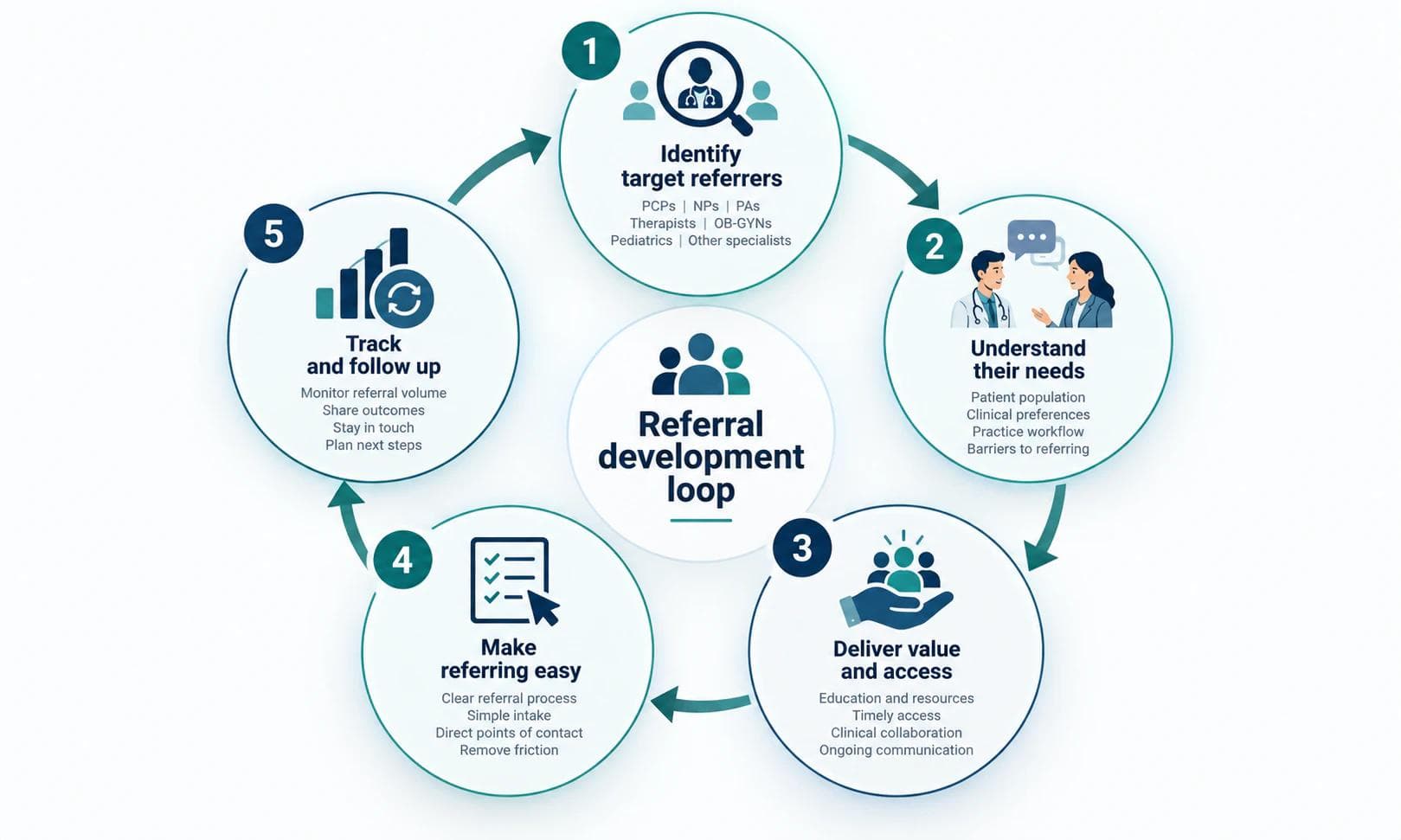
Anchoring the loop to data is what separates a professional program from friendly visits. Every touch should be logged, and every referral should be attributable to a source so you can see which relationships are actually producing.
How to build the program: a step-by-step framework
- Define the outcome and baseline. Decide what a 'good referral' is (specialty, payer mix, geography) and measure your current monthly referrals by source before you start. You cannot show ROI without a baseline.
- Build a tiered target list. Rank potential referral sources by volume potential and strategic fit. Tier A gets frequent, high-touch attention; Tier C gets light-touch nurture. Use claims data, your own referral history, and local market mapping.
- Design the value proposition. Referring providers care about access, communication, and outcomes for their patients - not your marketing. Lead with speed-to-appointment and closed-loop reporting. This is where clinical credibility does the heavy lifting.
- Set the cadence. Assign visit frequency by tier, with clear objectives per visit. Warm up new relationships the right way - our guide on how to earn trust before the first meeting applies directly to liaison outreach.
- Instrument the loop. Stand up referral tracking so every source is attributable and every stalled referral is visible. Without measurement, the program becomes unaccountable activity.
- Hire and onboard. Recruit for relationship skill, healthcare literacy, and resilience. Onboard with clinical shadowing so the liaison can speak credibly about your providers and services.
- Review and reallocate. Monthly, move effort toward the accounts and messages that produce and away from the ones that do not.
Mid-article CTA
Need help building your healthcare growth engine?
Medix helps healthcare startups, clinics, pharma companies, and provider-focused platforms build scalable commercial pipelines.
Book a Strategy CallPhysician liaison KPIs and metrics
Activity metrics tell you the program is running; outcome metrics tell you it is working. Track both, and never let activity metrics stand alone.
- New referrals by source (the headline outcome metric).
- Referral-to-appointment conversion - completed appointments, not just sent referrals.
- Referral retention / reactivation - keeping active referrers active and winning back lapsed ones.
- New referring accounts activated per quarter.
- Time-to-appointment for referred patients (a leading indicator of future referrals).
- Coverage and cadence adherence - are Tier A accounts actually getting the planned touches?
If you only measure visits, you will optimize for visits. Anchor compensation and reviews to referral outcomes and conversion, adjusted for territory difficulty.
Compliance: the guardrails that keep a liaison program clean
Referral development is legal and common. Paying for referrals is not. Because many patients are covered by federal programs, liaison activity intersects with the federal fraud and abuse laws, particularly the Anti-Kickback Statute, and with the physician self-referral (Stark) rules when designated health services are involved.
Practical guardrails: keep gifts and meals nominal and documented; never tie liaison compensation to the referral volume of specific physicians in a way that implies payment for referrals; put any space, staffing, or service arrangements with referral sources in writing at fair market value; and train liaisons on what they may and may not offer. Have counsel review the program before launch, not after an audit.
In-house vs. outsourced liaison capacity
The first 90 days
A liaison program should show signal within a quarter. A realistic launch sequence:
- Days 1-30 - baseline and build. Pull referral history, build the tiered target list, define the value proposition, and complete clinical onboarding and compliance training. Stand up referral tracking before the first visit.
- Days 31-60 - activate Tier A. Begin structured outreach to your highest-potential accounts with clear per-visit objectives. Fix the access and communication friction the liaison surfaces - these early operational wins compound.
- Days 61-90 - measure and adjust. Review referrals and conversion by source, expand to Tier B, and reallocate effort toward what is producing. By day 90 you should see new or reactivated referrers and a working cadence, not just activity.
Building an in-house liaison team makes sense when you have the volume, management bandwidth, and time to recruit and train. Many practices and emerging health services do not - or need to prove the channel before committing to headcount. In those cases, an experienced Provider Network Development partner can stand up target lists, cadences, and tracking quickly, then transition the function in-house once it is producing. Either way, the discipline is the same: a defined list, a real cadence, and a measured loop.
Frequently Asked Questions
What is a physician liaison?
A physician liaison is a field-based representative who builds and maintains relationships between a specialty practice, hospital, or ancillary service and the referring providers who send it patients. The role is relationship and access management, not clinical care and not high-pressure sales.
What is the difference between a physician liaison and a medical science liaison (MSL)?
A physician liaison focuses on referral development and provider access for a practice or facility. A medical science liaison is a scientific role at a pharmaceutical or device company that exchanges clinical and research information with key opinion leaders. They sit in different organizations and have different goals.
How many referral sources can one physician liaison manage?
It varies by geography and specialty, but a common working range is roughly 75 to 150 active accounts per liaison, tiered by referral potential. Dense urban territories skew lower because of travel; the priority is depth on high-value accounts rather than breadth.
Are physician liaison programs legal?
Yes, when structured correctly. The activity is relationship-building and access improvement, not paying for referrals. Programs must respect the federal fraud and abuse laws and physician self-referral (Stark) rules, and any gifts, meals, or arrangements should be reviewed by counsel.