
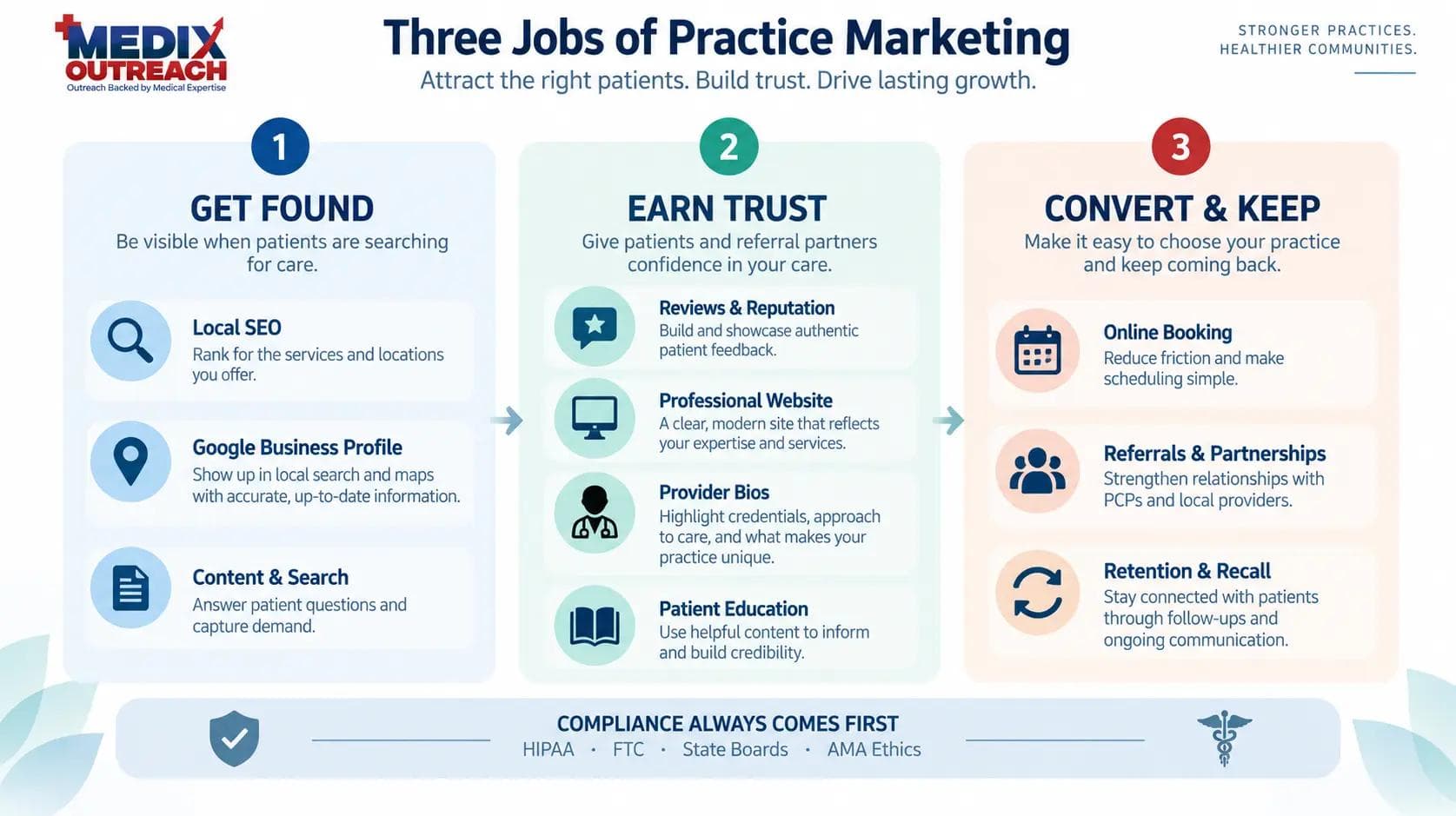
Medical practice marketing is how a practice earns a steady flow of the right patients — and keeps them. Strip away the tactics and it reduces to three jobs: get found when patients search, earn trust before they book, and convert and keep the patients you attract. Every channel below serves one of those three jobs. A practice that does all three, within the rules, builds predictable growth instead of chasing one-off campaigns.
This is a complete playbook. It also carries a constraint most marketing advice ignores: healthcare marketing operates under HIPAA, FTC, state medical-board, and professional-ethics rules that shape what you can say and how you can target. We build those in throughout, not as an afterthought. For the operational side of growth — revenue, capacity, and retention economics — pair this with growing the practice's business.
Start with positioning, not tactics
Before any channel, answer three questions in one or two sentences each: Who is your ideal patient (condition, payer mix, geography)? What do you do better or differently than the practice down the street? What should a patient feel and do after encountering you? Positioning decides which channels matter. A concierge primary-care practice, a high-volume urgent care, and a specialty surgical clinic need different marketing, and copying tactics without positioning is why most practice marketing underperforms.
Get found: local SEO and Google Business Profile
Most patient journeys start with a search, often "near me." Two things drive local discovery:
- Google Business Profile (GBP). Claim and fully complete your profile — accurate name, address, phone, hours, services, and photos — following Google's Business Profile guidelines. Inaccurate or manipulated profiles risk suspension. Keep it current, and use it to collect and respond to reviews.
- Local SEO. Optimize your site and location pages for the conditions and services you treat plus your geography, earn consistent citations (name/address/phone across directories), and build content that answers real patient questions. The full framework — including how to show up in AI-generated answers — is in our healthcare SEO strategy pillar, and the search-driven patient's digital journey piece maps how patients move from query to booking.
Your website: the conversion engine
Traffic without conversion is wasted spend. A practice website has one primary job — get the right patient to book — and a few non-negotiables:
- Online scheduling or a one-tap call, above the fold.
- Mobile-first and fast. Most healthcare searches are on phones; slow, clunky sites lose patients before they read a word.
- Clarity over cleverness. Services, conditions, insurance accepted, location, and what to expect — findable in seconds.
- Trust signals. Provider bios with real credentials, honest photos, and (where compliant) outcomes and reviews.
Reviews and reputation: the trust currency
Online reviews are, for many patients, the deciding factor. Build a simple, compliant system: ask every satisfied patient at the right moment, make leaving a review effortless, and respond to all reviews professionally. Two cautions: never pay for fake reviews (an FTC violation), and never reveal that someone is a patient or disclose any health information in a public reply — that is a HIPAA breach. Acknowledge feedback generically and move detailed conversations offline.
Content and patient education
Education builds trust and captures search demand at the same time. Answer the questions your patients actually ask — about conditions, procedures, costs, insurance, and what to expect — in clear, accurate content. This is also your best defense against misinformation and your path into AI-generated answers. The system for producing it consistently is our healthcare content marketing engine. Keep clinical claims accurate and sourced; health content is held to a higher standard.
Paid acquisition: when it makes sense
Search and social ads can accelerate growth, but only on top of the fundamentals above.
- Search ads (Google) capture high-intent patients searching for your services now — strong for elective and shoppable services.
- Social ads (Meta) build awareness and work for education-led, elective, and community-focused practices.
Two compliance points: sensitive-health targeting is restricted on major ad platforms, and any patient data used for retargeting must respect HIPAA. Track cost per acquired patient against patient lifetime value so paid spend stays profitable.
Referrals: patient and provider
Referrals are the highest-trust, lowest-cost growth channel, and they come in two forms:
- Patient referrals — a delighted patient telling a friend. Encourage them with a simple, compliant ask and an outstanding experience (incentive programs must follow anti-kickback and state rules — be careful here).
- Provider referrals — other clinicians sending you patients. For specialty and surgical practices this is the growth engine, and it is a relationship-management discipline: see our physician liaison program guide. Whatever the channel, track your referral sources so you invest in what works.
Mid-article CTA
Ready to grow your practice predictably?
Medix helps practices and clinics turn scattered tactics into a patient-acquisition system that compounds.
Book a Practice Growth CallRetention and reactivation
Acquiring a patient costs far more than keeping one, and retention compounds. Build recall and reactivation into the practice: appointment reminders, recare/recall for overdue patients, post-visit follow-up, and permission-based email or SMS with genuinely useful information. Retention is where marketing and operations meet — the economics are covered in medical practice growth, and in aesthetics specifically in our med spa lead generation and fertility clinic patient acquisition guides.
Compliance: the rules that shape all of it
Four regimes govern medical practice marketing. Know them before you launch:
- HIPAA. Using protected health information for marketing generally requires prior written authorization, per HHS guidance. This affects testimonials, review responses, retargeting, and email lists.
- FTC. Advertising claims must be truthful and substantiated, and testimonials are treated as your own claims, per the Health Products Compliance Guidance.
- State medical boards. Advertising rules vary by state and can restrict specific terms and claims. Check yours.
- Professional ethics. The AMA Code of Medical Ethics on advertising requires communications to be true and not materially misleading; claims implying unique skill or guaranteed outcomes can be deceptive.
Compliance is not a brake on marketing — it is the trust foundation the whole strategy stands on.
Measure what matters
Track a short list that ties marketing to money: new patients per channel, cost per acquired patient, patient lifetime value, no-show/cancellation rate, review volume and rating trend, and reactivation rate. If you cannot attribute a new patient to a channel, you cannot invest intelligently — which is why referral and channel tracking is non-negotiable.
A prioritized 90-day plan
- Weeks 1–2: Nail positioning and the ideal patient. Claim and fully complete Google Business Profile.
- Weeks 3–4: Fix website conversion basics — online booking, mobile speed, clear service/insurance info.
- Weeks 5–6: Launch a compliant review-generation routine and start responding to all reviews.
- Weeks 7–9: Publish the first cornerstone education content; set up local SEO on your top three services.
- Weeks 10–11: Stand up retention basics — reminders, recall, post-visit follow-up.
- Week 12: Add paid acquisition only where the funnel converts, and instrument attribution end to end.
Frequently asked questions
How much should a medical practice spend on marketing?
It varies by specialty, growth stage, and competition. Rather than a flat percentage, budget against a target cost per acquired patient measured against patient lifetime value, and shift spend toward the channels that hit it.
Can I use patient testimonials in my marketing?
Only with the patient's valid written HIPAA authorization, and the testimonial must be truthful and not misleading under FTC rules. Never disclose someone's patient status or health information without authorization.
What is the fastest way to get more patients?
Fix the fundamentals first — Google Business Profile, website conversion, and reviews — because they lift the return on every other channel. Paid ads can accelerate results but not fix a leaky funnel.
Is SEO or paid advertising better for a medical practice?
They serve different needs. SEO and Google Business Profile build durable, compounding discovery; paid ads buy immediate, high-intent visibility. Most practices need both, sequenced so ads run on a converting foundation.