
Searching for Zocdoc alternatives for psychiatrists can quickly become confusing.
Many comparison articles put every mental health platform into the same list.
That creates the wrong buying question.
Not every platform does the same thing.
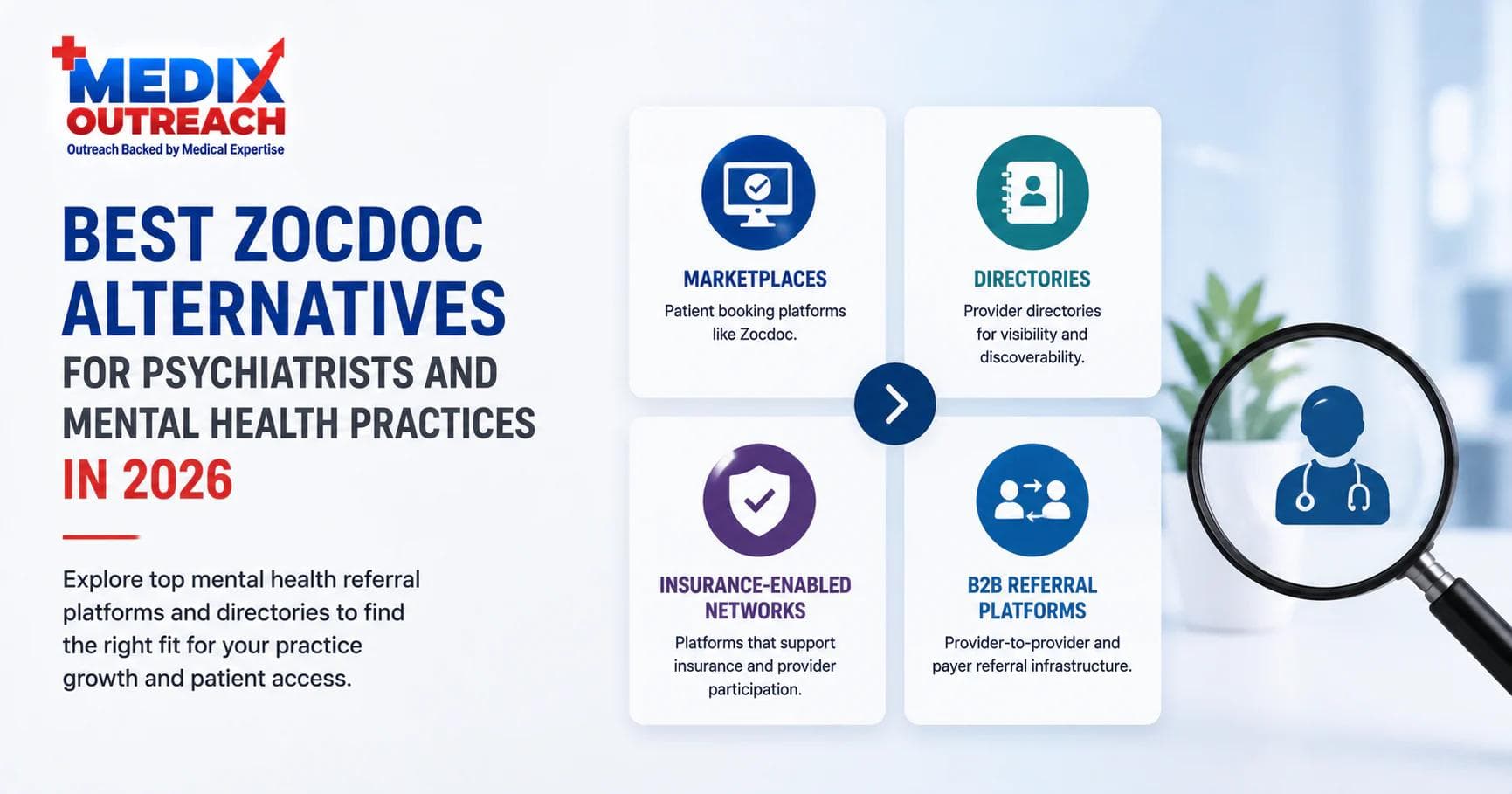
Some are consumer marketplaces.
Some are psychiatrist directories.
Some support insurance participation and provider enablement.
Others are designed around provider or payer referral infrastructure.
For a psychiatry practice, the best option depends on the problem the practice is actually trying to solve.
Do not compare unlike platforms
Before comparing platforms, define the commercial function.
Is the practice looking for:
- Consumer demand?
- Online booking?
- Directory visibility?
- Insurance participation?
- Provider matching?
- PCP referral infrastructure?
These are different needs.
A psychiatry practice should not select a platform simply because it appears on a “Zocdoc alternatives” list.
It should select the channel that solves its specific growth constraint.
Category 1: Consumer booking marketplaces
Zocdoc is the clearest example of a consumer-facing healthcare marketplace.
Patients can search by factors such as insurance, visit reason, and location, then review providers and available appointments.
The strength of this model is patient intent.
The patient is actively looking for care and can move toward booking.
For practices with appropriate availability, this can make the marketplace useful for new-patient acquisition.
The trade-off is that the practice is participating in an external marketplace rather than owning the entire discovery channel.
Category 2: Mental health directories
Psychology Today operates differently.
Its U.S. directory allows people to search for mental health professionals, including psychiatrists, and provider profiles can include clinical specialties, credentials, fees, payment options, and accepted insurance.
The directory model is primarily about discoverability.
It gives providers a profile where prospective patients can evaluate fit.
That makes it different from a marketplace built around immediate healthcare booking.
The patient journey can be more research-oriented.
Category 3: Insurance-enabled provider networks
Headway, Alma, Rula, Grow Therapy, and similar organizations need to be evaluated according to the services and eligibility they currently offer.
Their models can involve combinations of patient matching, insurance participation, credentialing, billing, or other practice-support functions.
The important point is that these platforms should not automatically be grouped together with consumer directories.
Their commercial role can be broader than simply helping a patient find a psychiatrist.
Because payer participation, geography, provider eligibility, and platform offerings change, practices should verify current details directly with each platform before deciding.
Category 4: Provider and payer referral infrastructure
Quartet Health represents another category.
The strategy playbook distinguishes B2B referral infrastructure from consumer marketplaces because provider-originated referral pathways solve a different commercial problem.
The patient is not necessarily searching a marketplace independently.
A healthcare organization can initiate a referral relationship within a broader care pathway.
That distinction matters.
A consumer marketplace and a B2B referral platform may both produce patient volume, but the underlying relationship is fundamentally different.
Mid-article CTA
Need help building your healthcare growth engine?
Medix helps healthcare startups, clinics, pharma companies, and provider-focused platforms build scalable commercial pipelines.
Book a Strategy CallComparison matrix
- Consumer marketplace — Primary function: Patient discovery and booking — Typical patient/referral journey: Patient searches → compares → books — Main strategic value: Consumer demand
- Mental health directory — Primary function: Provider discovery — Typical patient/referral journey: Patient searches → reviews profiles → contacts provider — Main strategic value: Visibility and profile discoverability
- Insurance-enabled network — Primary function: Patient matching and practice support — Typical patient/referral journey: Patient matching → insurance-enabled access — Main strategic value: Payer participation and operational support
- B2B referral infrastructure — Primary function: Provider-originated referrals — Typical patient/referral journey: Healthcare partner → referral → behavioral health care — Main strategic value: Referral relationships and coordination
The exact services offered by individual platforms should be verified before publication or implementation.
How a psychiatry clinic should choose
Start with the problem.
If the practice needs more consumer demand and has appointment availability, a marketplace may be relevant.
If the practice primarily needs online visibility, a psychiatrist directory may be more appropriate.
If insurance participation and administrative support are the constraint, an insurance-enabled network may deserve consideration.
If the strategic objective is building relationships with PCPs or other healthcare organizations, B2B referral infrastructure should be evaluated separately.
The mistake is choosing the platform first and defining the problem second.
Why direct referral relationships remain an owned asset
External platforms can create demand.
They should not be the only source of growth.
Direct referral relationships can create an entirely different kind of commercial asset.
A PCP who knows:
- Who your practice accepts
- Which patients are appropriate
- How to refer
- How quickly patients can access care
- How communication is handled
has a reason to refer again.
That relationship can become part of the psychiatry practice’s long-term referral infrastructure.
The right way to evaluate Zocdoc alternatives
A useful evaluation should consider:
- What type of platform is it?
- Who initiates the patient journey?
- Does it support online booking?
- What role does insurance play?
- Does it support provider matching?
- What control does the practice retain?
- What happens after the first appointment?
- Does it complement direct referral relationships?
This is more useful than simply asking which platform is “best.”
The Medix Outreach perspective
Medix Outreach does not view marketplaces, directories, insurance-enabled networks, and referral infrastructure as interchangeable.
They solve different commercial problems.
The right strategy depends on the psychiatry practice’s patient access, capacity, payer environment, geographic market, and growth objectives.
A strong practice may use more than one channel.
The important thing is understanding what each channel contributes.
Conclusion
The best Zocdoc alternative for psychiatrists depends on what the practice needs.
A consumer marketplace, psychiatrist directory, insurance-enabled network, and B2B referral platform may all support growth, but they do so through different mechanisms.
The most effective decision is therefore not:
“Which platform is better than Zocdoc?”
It is:
“Which type of platform solves our current growth constraint?”
That distinction can prevent psychiatry practices from investing in a channel that generates visibility without creating the right kind of patient or referral relationship.