

Concierge medicine has a very specific growth problem. The practice does not need thousands of patients; it needs a few hundred of the right ones, paying a recurring membership, who stay for years. That makes concierge marketing less about reach and more about fit. A campaign that drives a flood of price-shoppers is a failure. A campaign that fills a limited panel with aligned, high-retention members is the whole game.
This guide covers how membership, retainer, and direct-primary-care (DPC) practices attract the right patients, fill a panel without discounting the model, and build the referral and employer channels that keep it full.
Panel math changes the entire strategy
Concierge economics are the opposite of volume medicine. A physician might cap a panel at a few hundred members instead of seeing thousands of patients. Because each member is high-value and recurring, the numbers that matter are different:
- Members needed to fill the panel — a finite, knowable target.
- Member retention — the single biggest driver of practice value; losing members quietly undoes any acquisition win.
- Cost to acquire a member vs. multi-year membership value — which justifies patient, relationship-based marketing over cheap volume tactics.
Once you frame growth as "fill and hold a panel," the strategy writes itself: attract fit, convert on trust, and retain relentlessly. This is the recurring-revenue logic that also defines sustainable medical practice growth, concentrated into a membership model.
Marketing for fit, not volume
The concierge value proposition — access, time, relationship, and a premium experience — appeals to a specific patient. Your marketing should pre-qualify ruthlessly so the people who inquire already want what you offer.
- Lead with access and relationship, not features. Longer visits, same-day access, direct physician communication, and continuity are the reasons people pay. Make them the headline.
- Be transparent about the model and the fee. Price transparency filters out the mismatched and reassures the aligned. Concierge and DPC patients respect clarity.
- Speak to a defined segment. Busy professionals, families who want continuity, patients managing complex conditions, or executives through employer programs — name them and speak to their specific frustration with conventional care.
- Keep claims clean. Follow the FTC's advertising standards and, if you serve Medicare-eligible patients, structure membership offerings against Medicare rules — the AMA and AAFP's direct primary care resources outline the model and its guardrails.
The acquisition channels that actually fill a panel
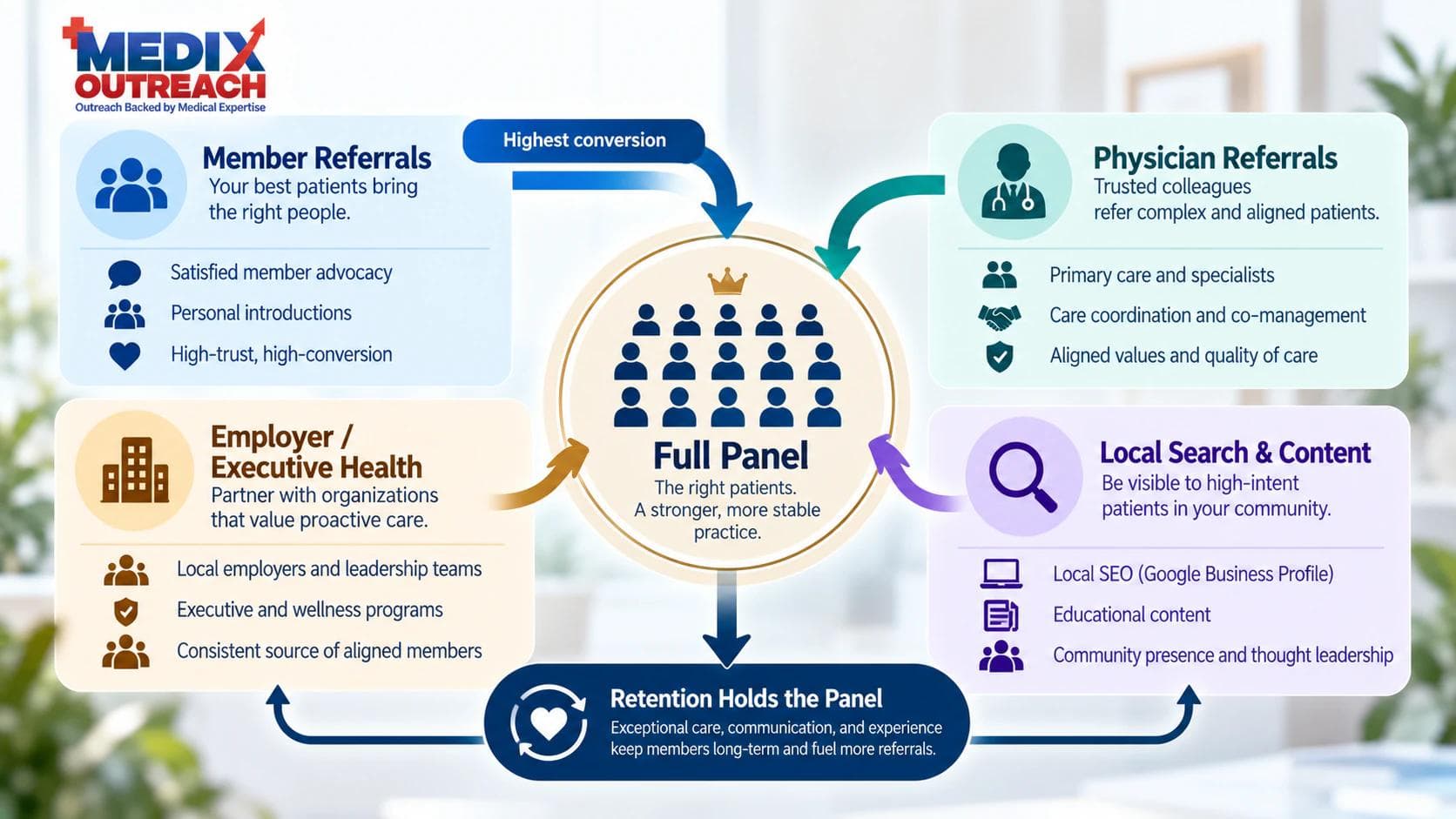
Referrals from satisfied members
In premium relationship care, member referrals are the highest-converting channel by a wide margin. A member who loves their physician and refers a friend delivers a pre-sold, high-fit prospect. Build a simple, respectful referral motion into the member experience rather than leaving it to chance, and track where new members come from with disciplined referral-source tracking.
Professional and physician referrals
Specialists, retiring physicians handing off panels, and local practices that cannot offer the access patients want can all become referral sources. This is a B2B relationship-building motion, the same discipline behind getting more physician referrals.
The employer and executive channel
Many high-value members first encounter concierge care through employer-sponsored executive health or wellness benefits. Selling into employers is a distinct, high-leverage channel that can fill a panel faster than consumer marketing — the motion Medix builds through direct-to-employer healthcare sales.
Local search and content
Prospective members research privately before reaching out. An accurate local presence, a site that clearly explains the model and fee, and content that answers "is concierge medicine worth it?" capture that research phase and feed AI search answers.
Mid-article CTA
Need help building your healthcare growth engine?
Medix helps healthcare startups, clinics, pharma companies, and provider-focused platforms build scalable commercial pipelines.
Book a Strategy CallRetention is a growth strategy
Because the panel is capped, keeping members is as important as acquiring them. Every retained member reduces the acquisition pressure and raises practice value. Retention comes from delivering the access and relationship you promised, proactive communication, and an onboarding experience that confirms the member made the right choice. The best concierge practices treat the first 90 days of membership as a marketing function in its own right.
Measure the panel, not the clicks
- Inquiries-to-members conversion rate by channel.
- Member acquisition cost vs. multi-year membership value.
- Panel fill rate and time-to-fill.
- Annual retention / churn.
- Referral share of new members — the leading indicator of a self-sustaining practice.
Frequently asked questions
How do concierge medicine practices attract patients? Primarily through member and physician referrals, an employer/executive-health channel, and local search plus clear content about the model — all aimed at attracting a defined, high-fit segment rather than maximizing volume.
What is the best marketing strategy for a concierge or DPC practice? Market for fit, not reach: lead with access and relationship, be transparent about the fee, pre-qualify aggressively, and build referral and employer channels that compound. Retention of existing members is part of the growth strategy because the panel is capped.
How is concierge medicine marketing different from regular practice marketing? Conventional practices chase volume; concierge practices fill and hold a limited, recurring-revenue panel. That makes fit, retention, and lifetime value the key metrics, and makes referrals and employer channels more valuable than mass advertising.
How long does it take to fill a concierge panel? It varies by market and channel mix, but practices that combine referral, employer, and local-search channels typically fill faster than those relying on advertising alone. Tracking time-to-fill and referral share shows whether the mix is working.
Filling a panel you can keep full
Concierge marketing succeeds when it attracts the right few hundred people and keeps them. That means marketing for fit, building referral and employer channels that compound, and treating retention as a growth engine. Do that, and the panel fills with members who stay — which is the only version of concierge growth that lasts.
Medix Outreach helps membership, concierge, and DPC practices build patient-acquisition engines and the referral and employer channels that fill a panel. To grow your practice, book a free strategy call or explore our Patient Acquisition & Practice Growth service.