

To track referral sources, capture a structured source for every new patient at intake, connect each referral to its outcome, and report volume and conversion by source every month. That is the whole game in one sentence - but each part hides a trap that makes most referral reports untrustworthy. This guide gives you the data model, the KPIs, an attribution model, and the routine that turns the numbers into growth.
Referral tracking is the measurement layer under every other referral effort. A physician liaison program cannot be held accountable, and referral management software cannot prove its value, without clean source data underneath.
Why most referral tracking is unreliable
Three failures show up again and again:
- No source is captured at intake, so 'referral source' is blank or guessed later.
- Sources are not standardized - the same practice appears five ways, so no source ever looks significant.
- Referrals are counted but outcomes are not - you know a referral came in, but not whether the patient was ever seen.
Fix these three and you are ahead of most organizations. Everything below assumes you have.
The data to capture
For every new patient, capture a small, disciplined set of fields:
- Referral source - the specific provider, organization, campaign, or channel, chosen from a controlled list, not free text.
- Source type - provider referral, self-referral, platform/directory, event, or internal.
- Date received and date of first contact.
- Insurance / payer - so you can see source quality, not just quantity.
- Referral reason / service requested - for routing and demand analysis.
- Outcome stages - scheduled, seen (completed), and whether results were returned to the referrer.
A controlled source list is the highest-leverage decision here. If staff can type anything, your report will never aggregate cleanly.
A simple referral attribution model
Think of every referral as moving through stages, and measure the drop-off between them. Received, contacted, scheduled, seen, then kept or looped back to the referrer. Attribution simply means every patient - and the visits that follow - is tied to the source that started the journey.
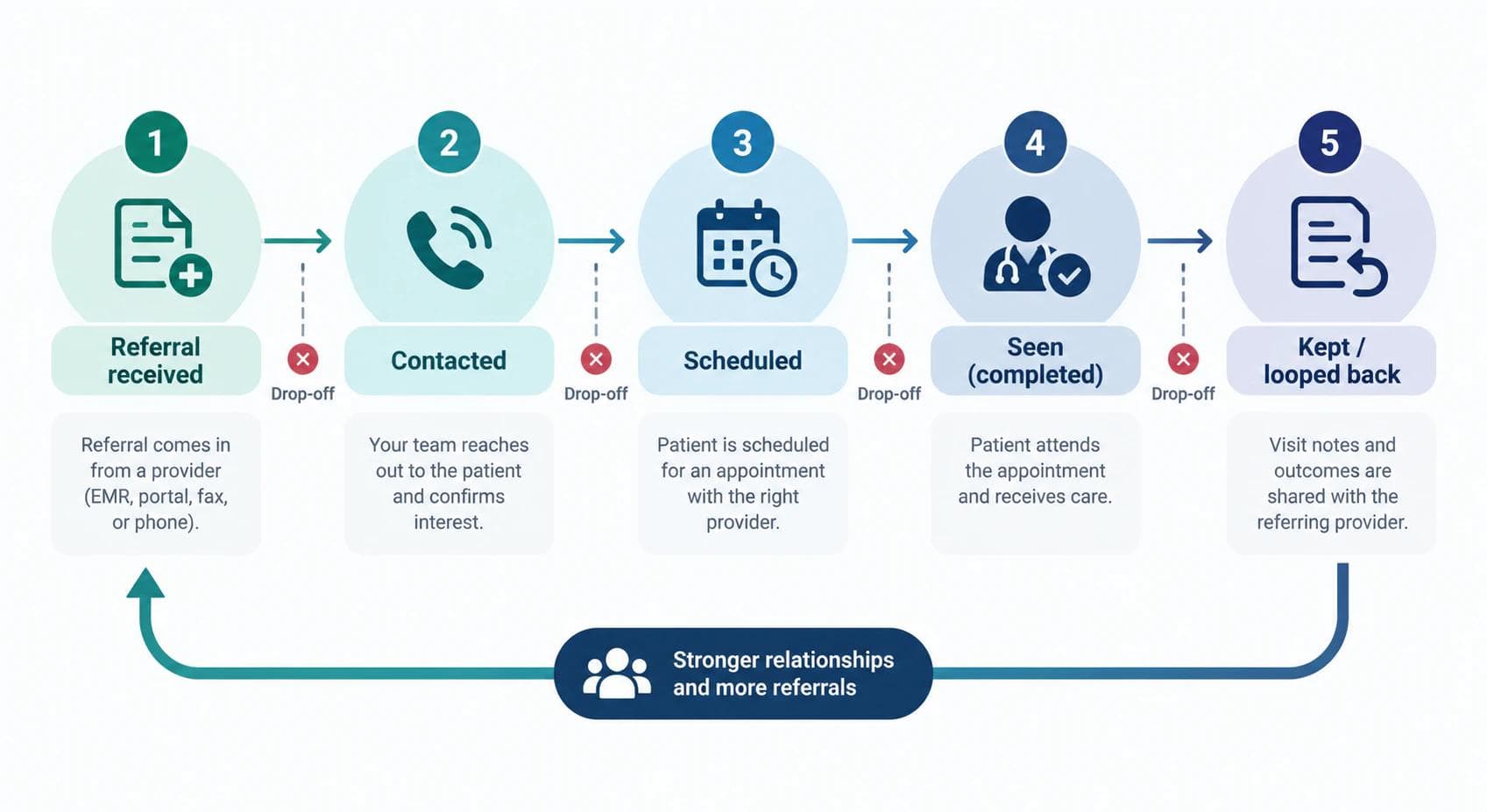
This staged view is powerful because it localizes problems. If referrals are received but not scheduled, the problem is intake capacity or speed. If they are scheduled but not seen, the problem is reminders and no-shows. This is the mechanism behind how you measure referral leakage - leakage is just drop-off between these stages.
The referral KPIs that matter
Track a short list well rather than a long list poorly:
- Referrals by source - the raw input, tiered by volume.
- Referral-to-appointment conversion by source - the single most important number; completed visits divided by referrals.
- New vs. returning referrers - are you activating new sources or just harvesting old ones?
- Active-referrer retention - what share of last quarter's referrers referred again this quarter?
- Time-to-first-contact and time-to-appointment - leading indicators; speed drives both conversion and future referrals.
- Payer mix by source - so a high-volume, low-quality source does not masquerade as your best.
- Referral concentration - what share of referrals comes from your top five sources? High concentration is a risk.
Mid-article CTA
Need help building your healthcare growth engine?
Medix helps healthcare startups, clinics, pharma companies, and provider-focused platforms build scalable commercial pipelines.
Book a Strategy CallHow to turn the report into growth
A referral report is only useful if it changes what your team does next month. Run this loop:
- Segment sources into grow, keep, and recover. Grow the high-conversion, high-quality sources; keep the steady ones; recover lapsed referrers who used to send patients.
- Diagnose drop-off. For your top sources, find the stage where referrals stall and fix the operational cause - not with more outreach, but with faster contact or easier scheduling.
- Reallocate outreach. Point your liaison or business development effort at the accounts and stages the data flags, the core of a disciplined provider referral engine.
- Close the loop with referrers. Return notes and outcomes; it is both good care coordination and the strongest driver of repeat referrals.
- Review monthly and adjust. Treat referral growth as a managed portfolio, not a set-and-forget report.
Tools: from spreadsheet to system
Common referral-tracking mistakes to avoid
- Free-text source fields - the single biggest cause of unusable data; always use a controlled list.
- Counting sent referrals as won referrals - a referral is not real until the patient is seen.
- Tracking volume but never quality - a high-volume source with poor payer mix or low conversion can cost more than it returns.
- Reviewing quarterly instead of monthly - problems compound in the gap; leakage is easier to fix early.
- Reporting without reallocating - a dashboard nobody acts on is decoration. Every review should change where effort goes.
- Ignoring lapsed referrers - a source that stopped sending is often your fastest win, and it never shows up if you only watch active accounts.
You can start in a spreadsheet with a controlled source list and a monthly pivot. As volume grows, move to a system that captures source and outcome automatically. Whatever the tool, the model is the same: clean sources, staged outcomes, and a monthly reallocation decision. Referral tracking is where healthcare business development stops being anecdote and becomes a system - and where Medix's Provider Network Development team most often starts an engagement.
Frequently Asked Questions
How do I track where my referrals come from?
Capture a structured 'referral source' field at intake for every new patient, standardize the source names, and tie each referral to its downstream outcome (scheduled, seen, kept). The combination of a clean source field plus outcome tracking is what makes a referral source report trustworthy.
What is the most important referral KPI?
Referral-to-appointment conversion by source. Total referrals can look healthy while completed appointments quietly leak. Conversion by source tells you both how much a relationship produces and where the process is failing.
What is referral attribution in healthcare?
Referral attribution is assigning each new patient (and the resulting visits or revenue) to the source that sent them - a provider, a campaign, a platform, or word of mouth. It lets you compare sources on outcomes, not just volume.
How often should I review referral source data?
Review a source-level report monthly for trends and reallocation, with a lighter weekly check on leading indicators like unscheduled referrals. Anything less frequent and problems compound before you see them.