

Direct-to-employer healthcare sales means contracting with employers - especially self-funded ones - to deliver care or solutions to their workforce, instead of reaching members only through a health plan. It is one of the fastest-growing channels in healthcare because the buyer feels the cost directly and can act without waiting for a payer. This guide explains why employers buy, who the real stakeholders are, the sales motion that works, and how to prove ROI.
The employer channel is distinct from selling to health plans. If your current motion targets payers, start with the differences - our guide on how to sell to payers and health plans pairs directly with this one.
Why self-funded employers are a distinct buyer
The critical distinction is funding. A fully insured employer buys a plan and hands risk to an insurer. A self-funded employer pays claims from its own money and hires an administrator to process them. That single fact changes everything: self-funded employers feel every avoidable ER visit and every poorly managed chronic condition on their own books, so they have both the motive and the authority to buy solutions that help.
The market is large. According to the KFF survey, most covered workers are in self-funded plans, and these plans are generally governed by ERISA governs self-funded employer plans, the federal framework for private employer-sponsored benefits. Understanding that a plan is self-funded and ERISA-governed tells you the buyer can contract directly and cares intensely about total cost of care.
What employers actually buy
Employers do not buy clinical features. They buy outcomes that map to their problems:
- Lower total cost of care - fewer avoidable claims, better-managed high-cost members.
- Better access and experience - benefits employees actually use, which supports recruiting and retention.
- Reduced absenteeism and higher productivity - health outcomes translated into workforce terms.
- Simplicity - a solution their administrator and consultant can implement without chaos.
Translate your solution into these terms. A musculoskeletal program is not 'virtual PT'; it is 'fewer avoidable surgeries and less time off work.' This translation is the heart of a strong healthcare sales strategy for the employer channel.
Who actually buys: the employer stakeholder map
The most common reason employer deals stall is pitching to one person when the decision belongs to a group. The real decision unit spans HR, finance, and outside advisors.
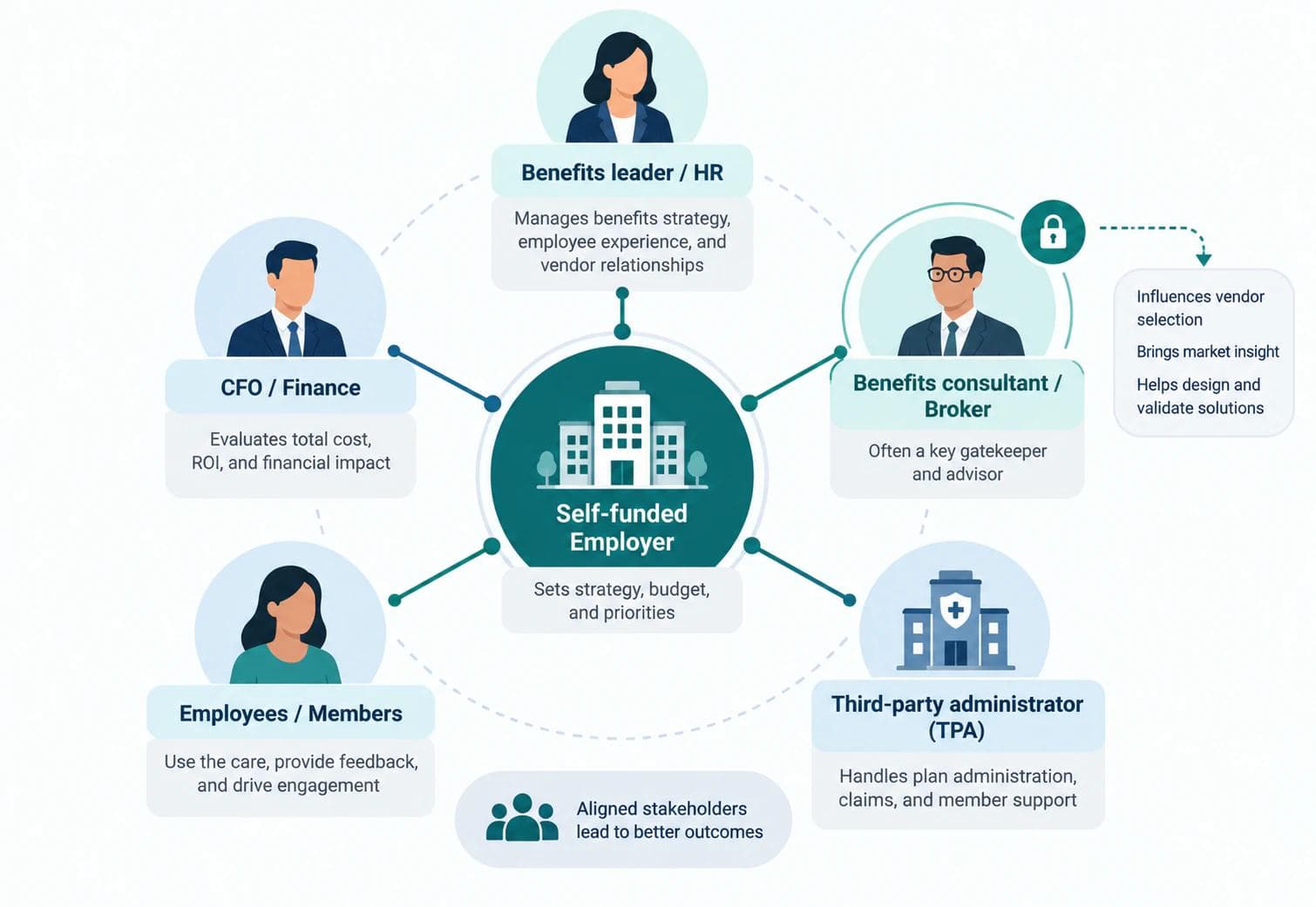
- Benefits leader / HR - usually your champion; owns employee experience and the benefits roadmap.
- CFO / finance - scrutinizes cost and ROI; a credible, conservative financial case wins or loses here.
- Benefits consultant / broker - frequently the gatekeeper. Many employers rely on their advisor to vet and shortlist vendors, so the consultant can accelerate or quietly kill a deal.
- Third-party administrator (TPA) - processes claims and handles data and integration; implementation lives or dies with them.
- Employees / members - the ultimate users; low engagement undermines renewal even after a signed contract.
Winning means mapping this unit for each target and enabling the people who control access - particularly consultants and brokers, who influence far more employer decisions than most first-time sellers expect.
Mid-article CTA
Need help building your healthcare growth engine?
Medix helps healthcare startups, clinics, pharma companies, and provider-focused platforms build scalable commercial pipelines.
Book a Strategy CallThe direct-to-employer sales motion
- Target by fundability and fit. Prioritize self-funded employers of a size that feels the problem you solve. Do not chase employers whose funding structure makes direct contracting impractical.
- Win the advisor. Build relationships with the benefits consultants and brokers who serve your target employers. Enabling them is often faster than cold-approaching employers directly - the same partnership logic behind healthcare partnerships.
- Lead with the CFO's math. Bring a defensible ROI model in employer language: total cost of care, avoided claims, and productivity - not clinical vanity metrics.
- Design for the calendar. Employer decisions cluster around benefits planning and open enrollment. Map each target's timeline and work backward; miss the window and you wait a year.
- Plan implementation and engagement up front. Show the TPA integration path and the member-engagement plan before signing. Renewals depend on utilization, not just the sale.
Proving ROI without overpromising
Employers and their consultants have seen inflated savings claims and discount them heavily. Win credibility by being conservative and transparent: define the baseline, state your assumptions, distinguish gross from net savings, and agree in advance on how success will be measured. A believable, modest ROI case beats an incredible one every time.
Is the employer channel right for you?
Common direct-to-employer mistakes
- Pitching HR only - the CFO and the benefits consultant decide as much as the benefits leader.
- Ignoring the consultant and broker - trying to go around the advisor usually stalls the deal instead of speeding it.
- Selling features, not cost of care - employers buy outcomes measured in claims, absenteeism, and retention.
- Overpromising savings - inflated ROI claims are discounted heavily by sophisticated buyers and destroy credibility.
- Missing the benefits calendar - a great pitch delivered after decisions are made waits a full year.
- Neglecting engagement - a signed contract with low member utilization does not renew.
Direct-to-employer works best when your solution has a clear cost-of-care or workforce impact, you can integrate with administrators, and you can support member engagement. It is harder if your value is diffuse or your implementation is heavy. If you are weighing this channel against payer or provider routes, that is exactly the kind of decision Medix's Healthcare Commercial Growth & Go-to-Market and Strategic Partnerships, Licensing & Market Expansion teams help healthcare companies make - grounded in healthcare business development fundamentals rather than channel hype.
Frequently Asked Questions
What does direct-to-employer healthcare mean?
Direct-to-employer (sometimes called direct contracting) means a healthcare provider or solution contracts with an employer - usually a self-funded one - to deliver care or services to that employer's workforce, rather than reaching those members only through a health plan.
Why sell to self-funded employers specifically?
Self-funded employers pay claims from their own funds, so they feel healthcare costs directly and have both the incentive and the authority to buy solutions that improve outcomes or lower spend. A majority of covered U.S. workers are in self-funded plans, which makes the market large.
Who is the real decision-maker in an employer sale?
Rarely one person. The benefits leader champions, the CFO scrutinizes cost, and the benefits consultant or broker often gates access and shapes the shortlist. Winning usually means enabling the consultant and giving the CFO a credible ROI case.
How long is a direct-to-employer sales cycle?
It is often tied to the annual benefits planning and open-enrollment calendar, so timing matters as much as the pitch. Many decisions cluster months before enrollment; missing that window can push a deal a full year.