

Selling to a payer is one of the hardest and most valuable motions in healthcare commercialization. A single national health plan can represent more covered lives than thousands of individual clinics combined. Win one enterprise contract and you have distribution most companies spend years chasing. Miss the way payers actually buy, and you spend those same years stuck in pilots that never convert.
Most teams struggle with payer sales for a simple reason. They treat a health plan like a large provider. It is not. A payer is an insurance and risk management business first, and a healthcare organization second. The people who evaluate your solution are thinking about medical cost trend, member retention, regulatory ratings, and actuarial certainty, not clinical enthusiasm alone.
This guide lays out how to sell to payers in practical terms. It covers the payer landscape, who sits on the buying committee, what payers actually pay for, how to build a business case that survives finance and actuarial review, and how to move a deal from first meeting to a signed enterprise agreement.
Why Selling to Payers Is Different From Selling to Providers
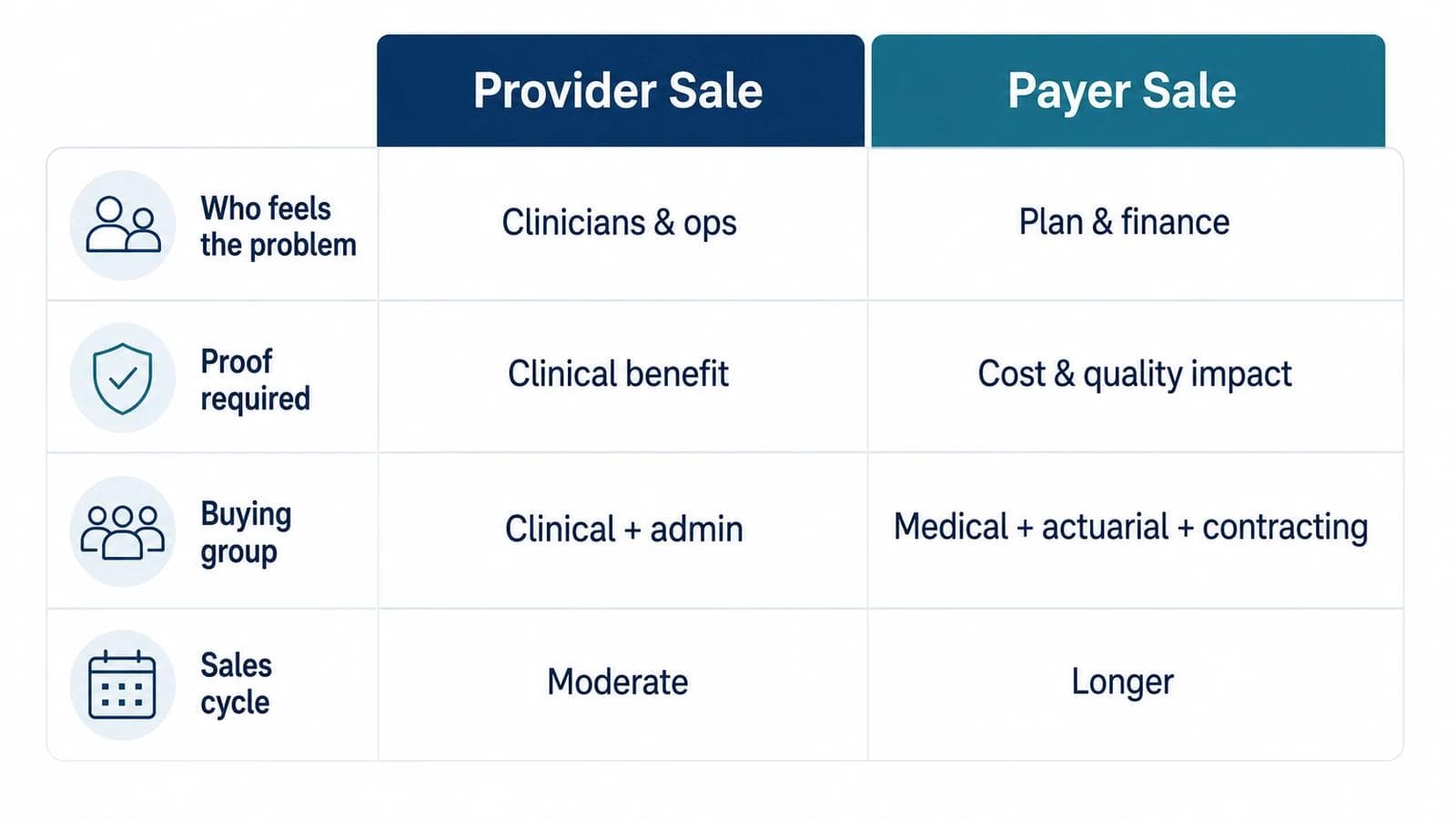
When you sell to a provider organization, the buyer usually experiences the problem directly. A practice manager feels the scheduling pain. A physician feels the documentation burden. The value story can be clinical and operational, and a motivated champion can often push a deal forward.
Payers buy differently. The health plan does not deliver care. It finances it, manages the risk around it, and answers to employers, regulators, and members. That changes the entire evaluation. A payer buyer is asking whether your solution lowers the total cost of caring for a population, improves a quality rating that affects revenue, or reduces administrative expense at scale, and whether any of those claims will hold up under scrutiny.
This is closely related to, but distinct from, reimbursement. Getting a product covered and paid is a separate discipline covered in our guide to market access and reimbursement strategy. Selling to payers, the subject here, means selling your product or service to the health plan itself as the customer.
The practical implications are worth stating plainly:
- The buying group is large, cross functional, and risk averse.
- The proof bar is quantitative. Anecdotes and clinician praise rarely close a payer deal.
- Sales cycles are long and gated by procurement, security, and legal.
- The economic buyer often cares more about medical loss ratio and member outcomes than about your feature set.
Know the Payer Landscape Before You Prospect
Payer is a broad word. The organizations behind it buy in very different ways, and targeting the wrong segment wastes months. Map the landscape first.
National commercial insurers. The largest carriers cover tens of millions of members across many product lines. They have formal innovation and vendor management functions, long procurement processes, and high expectations for security and scale. These are enterprise sales in the fullest sense.
Regional and Blue plans. Regional carriers and Blue Cross Blue Shield plans often move faster than national carriers and can be strong first customers. They still expect rigor, but a well run regional plan can become a reference account that opens national doors.
Medicaid managed care organizations. Plans that administer Medicaid benefits operate under state contracts and tight margins. They care intensely about quality measures, access, and social drivers of health for complex populations.
Medicare Advantage plans. Plans serving Medicare Advantage members are highly motivated by Star Ratings and risk adjustment, because those directly affect payment. The Centers for Medicare and Medicaid Services publishes the Star Ratings framework that drives much of this behavior, which makes anything tied to quality measures and member experience commercially relevant.
Self insured employers and their administrators. Many employers carry their own insurance risk and hire a third party administrator or an administrative services only arrangement to run the plan. Selling here can mean selling to the employer, the administrator, or a benefits consultant, and each has different incentives.
Pharmacy benefit managers. PBMs manage the drug benefit and are a distinct buyer with their own economics. If your solution touches medication, they belong on your map.
Before you build a list, decide which of these segments fits your value story, your evidence, and your ability to service a contract. A focused approach to a defined set of named accounts, the discipline described in our healthcare account based marketing playbook, beats broad outreach every time in payer markets.
Who Actually Buys Inside a Health Plan
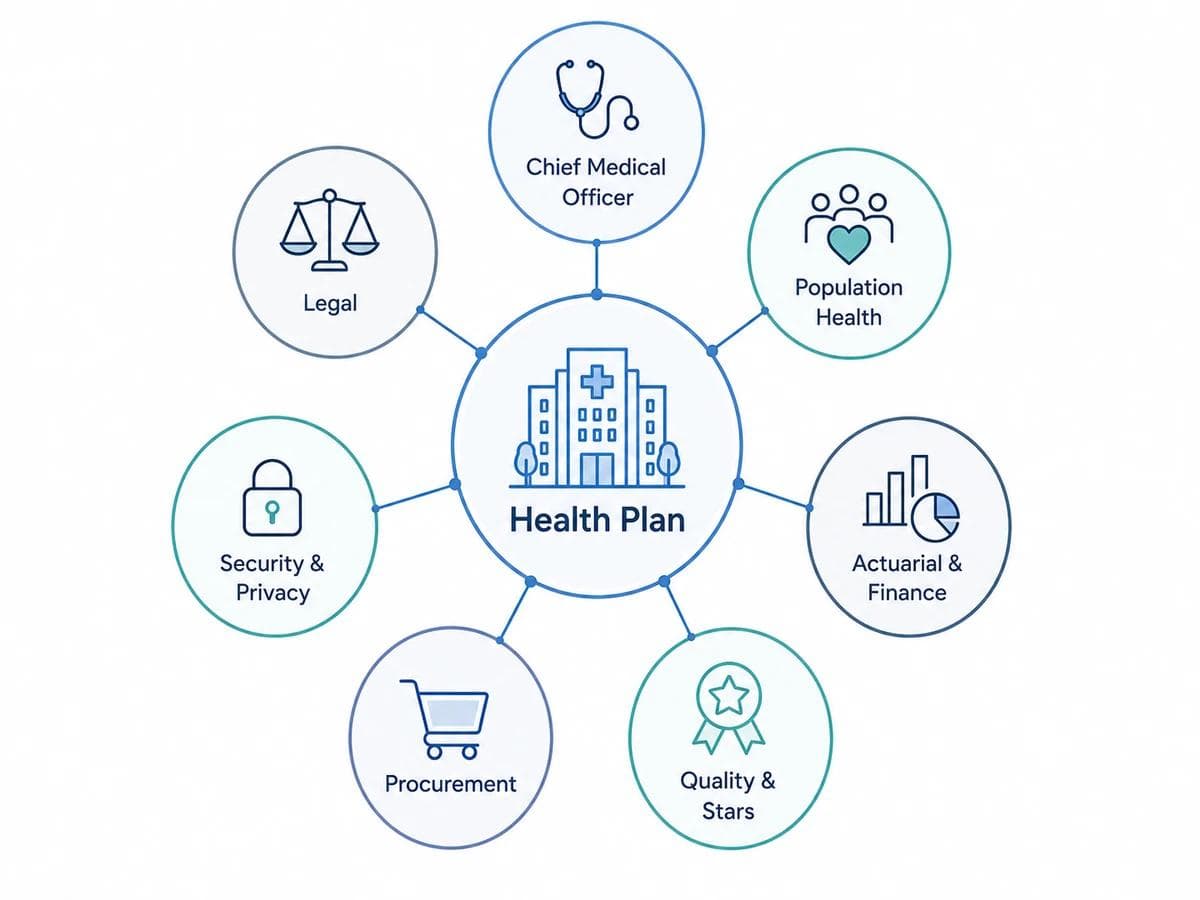
There is no single payer buyer. Enterprise payer deals move through a committee, and each member can stall the process. Identify these roles early and build a relationship map for every target account.
- Chief Medical Officer and medical directors. They own clinical credibility and outcomes. They ask whether the clinical model is sound and whether it will help or hurt members.
- VP of Population Health or Clinical Operations. Often the functional champion. They own programs like care management, quality improvement, and gaps in care, and they feel the operational problem your solution addresses.
- Actuarial and finance. The quiet gatekeepers. They pressure test every savings claim and decide whether the business case is credible. If actuarial does not believe your numbers, the deal does not advance.
- Quality and Stars teams. In Medicare Advantage and Medicaid, these teams own the measures that drive revenue and compliance. A solution that moves a measure has a natural sponsor here.
- Procurement and vendor management. They run the formal process, manage competition, and negotiate terms. They are not the champion, but they can slow or accelerate everything.
- Information security and privacy. They gate any solution that touches member data. Expect deep review of your security posture and data handling.
- Legal and compliance. They review contract structure, data use, and regulatory exposure before signature.
The pattern to remember is that your champion rarely has unilateral authority. Your job is to arm that champion to sell internally to finance, security, and leadership. That means giving them a business case, a security summary, and reference proof they can forward without editing.
What Payers Actually Buy
Payers do not buy technology for its own sake. They buy measurable movement on a short list of priorities. Anchor your positioning to one of these, and make the connection explicit.
- Lower total cost of care. Reducing avoidable admissions, readmissions, emergency visits, or high cost claims for a defined population.
- Better quality ratings. Improving HEDIS measures, Medicare Star Ratings, or state Medicaid quality metrics that affect payment and standing.
- Management of high risk, high cost members. Better identification and support for the small share of members who drive a large share of spend.
- Administrative efficiency. Reducing manual work in prior authorization, claims, appeals, or care management operations.
- Member experience and retention. Improving satisfaction and engagement, which affects ratings and the cost of member churn.
- Regulatory and network needs. Closing access gaps, meeting network adequacy, or supporting compliance obligations.
The shift toward value based care makes many of these more urgent, because plans increasingly share financial risk with providers and need tools that manage that risk. If your solution supports value based arrangements, say so directly and show how.
Build a Business Case That Survives Actuarial Review
The center of gravity in a payer deal is the business case. A clinician who loves your product cannot save a deal that finance does not believe. Build the case to a standard that actuarial and finance will accept.
Start with the unit of economics that payers use. Most payer value stories are expressed per member per month, or as an impact on medical cost trend, or as a change in a rated measure. Translate your outcomes into those units rather than into your own product metrics.
Be honest and specific about the baseline. Payers will ask how you defined the population, what the comparison group was, and how you separated your effect from everything else happening in the market. A credible, conservative claim with a clear method beats an aggressive claim with a fuzzy method.
Show the path to attributable savings. Payers are skeptical of self reported outcomes for good reason. The strongest cases offer a way to measure impact inside the plan's own data, or propose a shared savings or performance structure that ties your payment to results.
Do not fabricate precision. Ranges based on a defensible method are more persuasive than a single confident number that cannot be defended. This is also where domain fluency matters, because a partner who understands payer finance can frame your evidence in the terms the buyer already uses. That fluency is the difference our pharmacist-led approach is built to provide.
Mid-article CTA
Need help building your healthcare growth engine?
Medix helps healthcare startups, clinics, pharma companies, and provider-focused platforms build scalable commercial pipelines.
Book a Strategy CallExpect a Long Sales Cycle and Plan for It
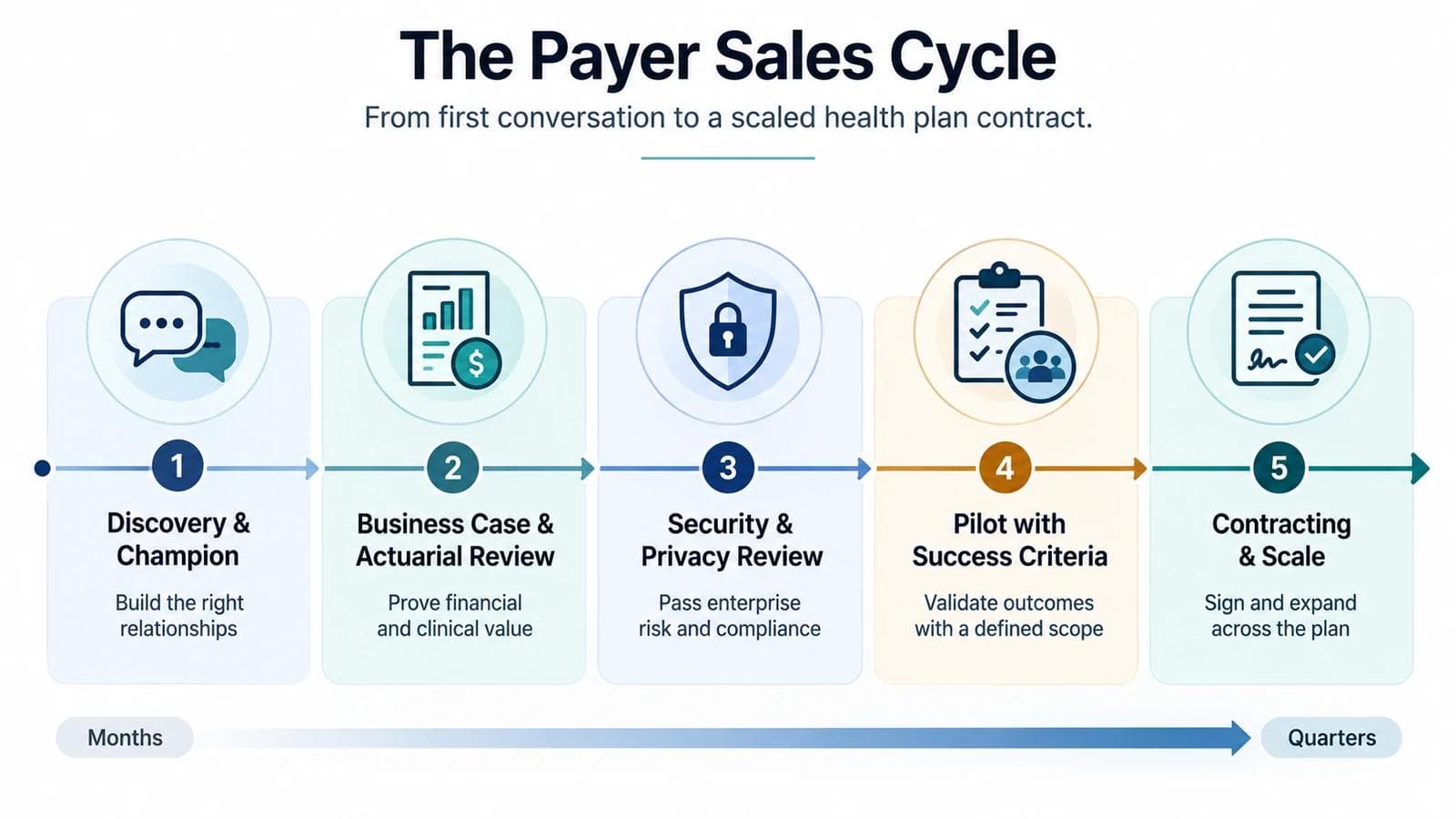
Payer deals are slow. Enterprise healthcare buying already runs long, and payers add procurement, security, actuarial, and legal gates on top. It is normal for a payer sale to take many months and sometimes more than a year from first conversation to signature. Our analysis of why healthcare sales cycles keep stretching applies with extra force here.
A typical progression looks like this:
- Discovery and champion development. Find the functional owner, understand the priority you map to, and confirm real intent.
- Business case and evaluation. Build the case with the champion, then survive finance and actuarial review.
- Security and privacy review. Complete the plan's assessment of your data handling and security posture.
- Pilot or proof of value. Run a limited engagement with clear, pre agreed success criteria.
- Contracting and scale. Negotiate terms, move from pilot to regional or enterprise rollout, and expand.
The pilot stage is where many companies get stuck. A pilot without pre agreed success criteria and a defined path to expansion becomes a permanent science project. Structure every pilot as a step toward a contract, with the expansion terms discussed before the pilot starts. Our guide on moving from pilot to contract covers how to avoid that trap.
Outreach and Positioning for Payer Buyers
Cold volume does not work well with payer executives. They are hard to reach, heavily gatekept, and unmoved by generic pitches. Payer go-to-market rewards precision and credibility.
- Lead with the priority, not the product. Open with the cost or quality problem the specific plan is likely facing, then connect your solution to it.
- Tailor by persona. A medical director, an actuary, and a Stars lead care about different things. Build distinct message threads for each within the same account.
- Use warm paths. Introductions from advisors, existing customers, and industry relationships outperform cold outreach into a health plan.
- Show up where payers are. Industry conferences and payer focused events are where these relationships often begin. Plan follow up before you go, not after.
- Bring proof, not adjectives. A one page business case and a relevant reference will do more than a polished deck full of claims.
Compliance and Contracting Realities
Selling to payers means handling protected health information and operating inside a heavily regulated environment. Get ahead of the questions you will be asked.
Data protection is table stakes. Any solution touching member data needs a compliant data architecture and the ability to sign a business associate agreement, a baseline explained in our overview of HIPAA-compliant sales and marketing. Expect detailed security review, and expect certifications to be requested.
Contract structures increasingly tie payment to performance. Payers may propose or expect shared savings, performance guarantees, or risk sharing. Understand these structures before you negotiate, because they change how you price and how you get paid.
Financial relationships in healthcare are regulated. Arrangements that involve referrals or federal health program business intersect with fraud and abuse law, and the Department of Health and Human Services Office of Inspector General maintains guidance on safe harbor regulations that your legal team should review when structuring deals. This is not a place to improvise.
Common Mistakes When Selling to Payers
- Treating the health plan like a big provider and leading with clinical excitement instead of financial and quality outcomes.
- Selling only to the champion and never equipping them to win over finance, security, and leadership.
- Bringing outcomes the actuary cannot verify, or claiming precision the method cannot support.
- Entering a pilot with no pre agreed success criteria and no discussed path to expansion.
- Underestimating security and privacy review and losing months because the assessment was not ready.
- Targeting national carriers first when a regional plan would have been a faster, more winnable first reference.
Frequently Asked Questions
How long does it take to sell to a payer?
Plan for a long cycle. Many payer deals take several months to over a year from first meeting to signature, because they pass through clinical, financial, actuarial, security, and legal review. Regional plans can move faster than national carriers, and a strong reference account shortens the next cycle.
Should we start with national or regional payers?
For most companies, a regional or Blue plan is a better first target. They can move faster, expect real rigor without national scale requirements, and can become the reference account that makes national conversations credible.
What proof do payers require before they buy?
Payers want quantitative, defensible evidence tied to cost or quality, expressed in their units such as per member per month or a specific rated measure. The strongest proof can be measured inside the plan's own data or is backed by a performance based contract structure.
Who is the most important person in a payer deal?
There is no single buyer. The functional champion, often in population health or clinical operations, drives the process, but finance and actuarial decide whether the business case is credible, and security gates anything touching member data. You need all of them.
How is selling to payers different from getting reimbursed?
Reimbursement is about getting your product covered and paid when providers or patients use it. Selling to payers means the health plan is your direct customer, buying your solution to manage cost, quality, or operations. The two are related but require different strategies.
The Payer Sale Rewards Patience and Proof
Selling to payers is a test of discipline. The organizations are complex, the buying groups are large, and the proof bar is high. None of that is a reason to avoid the market. It is the reason the market is worth entering, because the same friction that slows you down protects you once you are in.
The teams that win payer contracts do a few things consistently. They target the right segment instead of every plan. They map the buying committee and equip the champion. They build a business case that finance and actuarial accept. They structure pilots as steps toward contracts. And they treat compliance and security as early work, not last minute scrambling.
Do those things well and the payer market stops being a wall and starts being a moat.