

A healthcare sales strategy is the deliberate plan for how a company converts clinical and administrative buyers into signed contracts: who you sell to, who inside the account has to say yes, how you position the product to a risk-averse clinical audience, and how you move deals through a long, committee-driven process. It is not a list of activities or a quota. It is the operating logic that decides where you spend selling effort and why. In healthcare, that logic has to account for a buying environment where the person who wants your product rarely controls the budget, and where the wrong first conversation can quietly kill a deal you never see die.
What a healthcare sales strategy is, and why generic B2B sales strategy fails
Most B2B sales playbooks assume a fast, economically rational buyer. You find a pain, quantify the ROI, get to the decision-maker, and close. That model breaks in healthcare for structural reasons, not because the reps are weak.
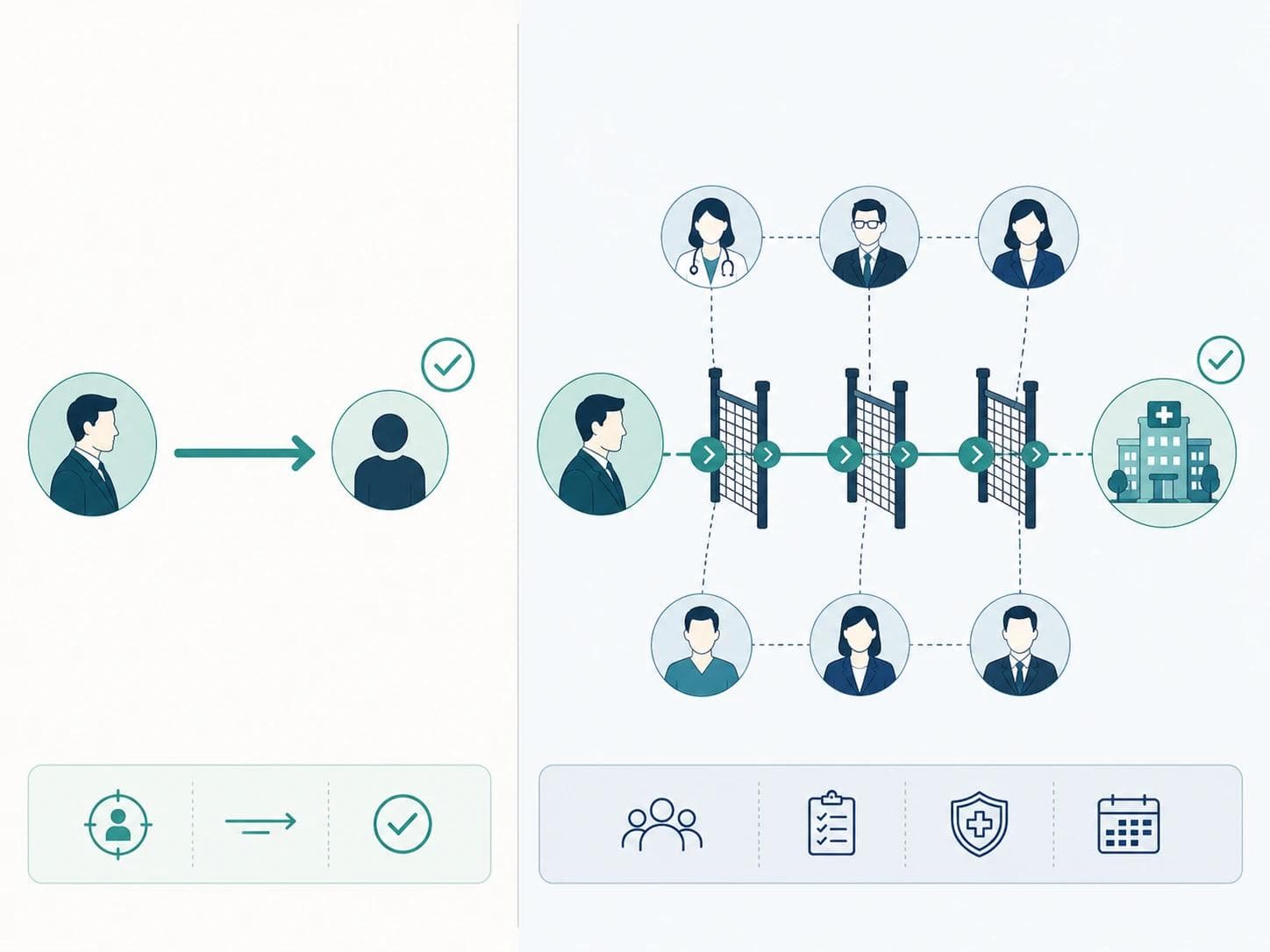
Healthcare buyers carry risk that has nothing to do with price. A hospital pharmacist evaluating a new product is thinking about patient safety, formulary precedent, workflow disruption, and their own professional exposure if something goes wrong. A generic pitch built around efficiency and cost savings reads as tone-deaf to that audience. The result is a polite meeting, no clear objection, and a deal that never advances. This is why we treat clinical credibility as a commercial asset, not a marketing nicety. For a deeper look at that idea, see how clinical credibility functions as a go-to-market asset.
Four things make healthcare selling its own discipline:
- The buyer is a committee, not a person. Clinical, financial, operational, and compliance stakeholders all shape the outcome, and they often never sit in the same room.
- The economic buyer is separated from the user. The clinician who wants the product usually cannot approve the spend, and the person who can approve it has never used it.
- Purchases route through formal gates. Value analysis committees, pharmacy and therapeutics review, procurement, and information-security review can each stop a deal cold.
- Cycles are long and non-linear. Six to eighteen months is normal for enterprise healthcare deals, and the timeline is set by committee calendars and budget cycles, not by your urgency.
A healthcare sales strategy exists to make those realities predictable instead of surprising. Everything that follows is about building a selling motion that matches how healthcare actually buys.
Start with ICP and segmentation, not activity
The most expensive mistake in healthcare sales is selling to everyone. Provider organizations, payers, and life-science buyers purchase in completely different ways, on different timelines, with different economic logic. A single motion cannot serve all of them well.
Your ideal customer profile (ICP) for the selling motion should be specific enough that a rep can look at an account and know whether it belongs in the pipeline. Define it across a few dimensions:
- Setting and size: independent clinics, group practices, ambulatory surgery centers, community hospitals, integrated delivery networks, or health plans. Each has a distinct decision structure.
- Economic trigger: what budget or mandate makes your product relevant right now. Reimbursement changes, a quality-measure gap, a staffing shortage, or a compliance deadline are stronger triggers than general interest.
- Reachable champion: whether the person who will advocate for you internally actually exists and can be reached.
- Reference fit: whether a win in this segment produces a reference that opens the next ten accounts.
Segmentation then decides how you sell, not just who you sell to. Selling into hospitals is a different sport from selling into owner-operated clinics, and both differ from selling to payers. We have written dedicated playbooks for each: how to sell to hospitals, how to sell to payers and health plans, and the differences show up in every stage of the process. Getting segmentation right is also where a focused motion beats a broad one, which is the throughline in our work on refining provider positioning to speed clinic adoption.
Treat qualified pipeline as the input to this strategy, not the strategy itself. Demand generation fills the top of the funnel, but a filled funnel with no selling logic just produces busy reps and stalled deals. The strategy is what you do with a qualified opportunity once it arrives.
Map the buying committee before you build the pitch
The single highest-leverage move in healthcare selling is mapping the buying committee early and treating each role as a distinct audience with its own question to answer. Deals do not die because one person says no. They die because one unmanaged stakeholder quietly withholds a yes.
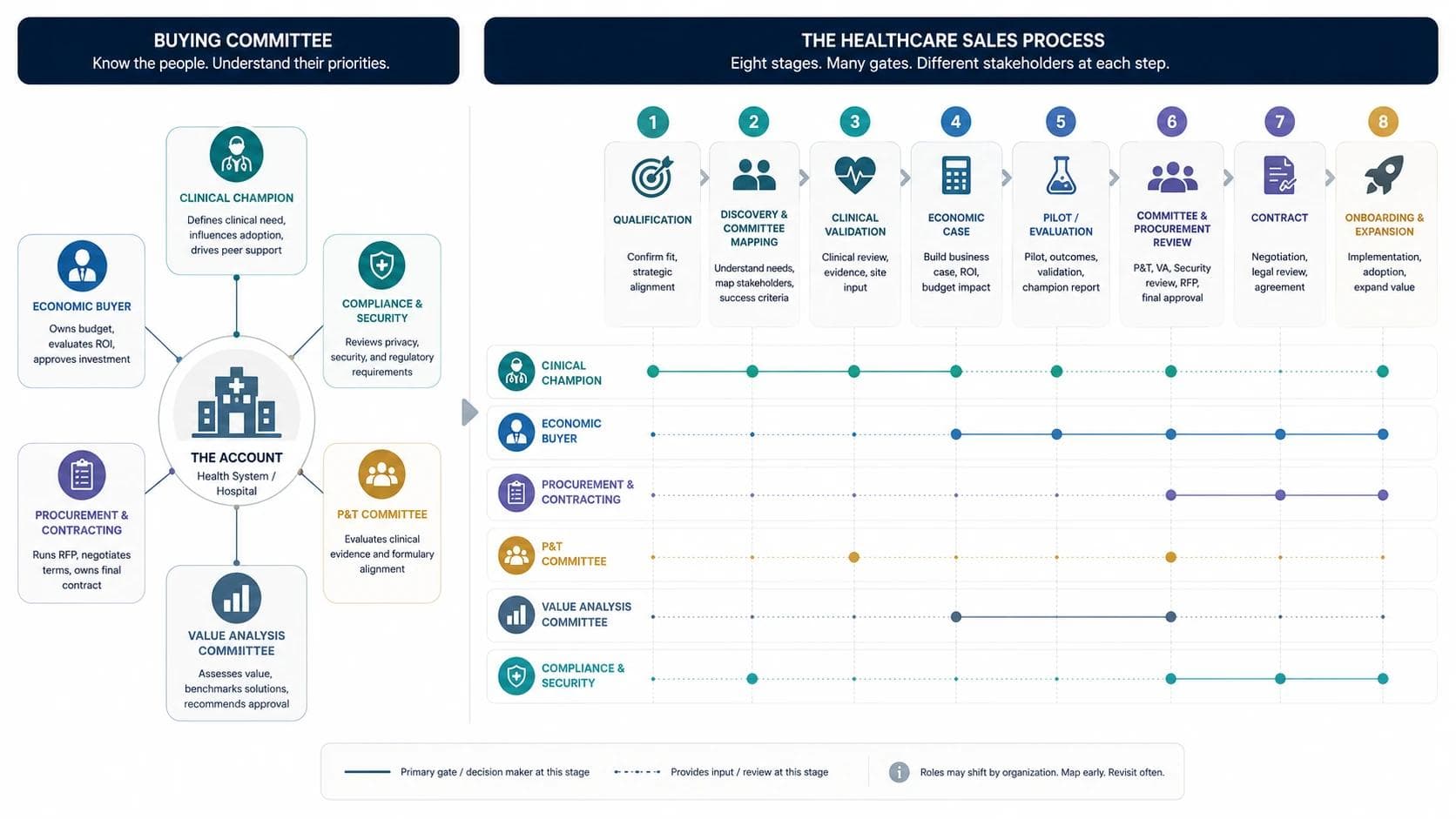
A typical healthcare buying committee includes:
- The clinical champion. Usually a physician, nurse leader, or pharmacist who wants the product and will advocate internally. This person carries the deal but rarely controls budget. Your job is to arm them to sell on your behalf when you are not in the room.
- The economic buyer. A department head, service-line leader, or finance executive who approves the spend. Their question is whether the purchase is justified against the budget and, increasingly, whether it maps to a reimbursement or cost-avoidance pathway. Coverage and payment rules published by CMS often shape whether the economic case even exists.
- Procurement and contracting. The function that runs the actual purchase, negotiates terms, and enforces process. In hospitals, this often means going through a group purchasing organization or an integrated delivery network's contracting arm. We break down how that machinery works in the guide to hospital procurement, GPOs, and IDNs.
- Pharmacy and therapeutics (P&T) committee. For drugs and many clinical products, a formal review body decides whether the product can be used at all. It meets on a fixed schedule and follows evidence standards you cannot shortcut.
- Value analysis committee. For devices, supplies, and services, this cross-functional committee evaluates clinical value, cost, and workflow impact before a purchase is approved.
- Compliance, security, and legal. For anything that touches patient data, information-security and HIPAA review can add months. A no here is absolute.
Mapping the committee means naming the real people in each role for a given account, understanding what each one needs to approve, and sequencing your engagement so no gate surprises you late. A deal is not qualified until you know who has to say yes and what each of them is measuring.
Positioning and messaging for clinical buyers
Positioning in healthcare is the discipline of making each stakeholder see themselves and their risk in your story. The same product needs a different message for the clinician, the economic buyer, and the committee, because each one is answering a different question.
For the clinical champion, lead with outcomes, evidence, and workflow. Show that the product is safe, that it fits how they already practice, and that it will not create more work. Clinical buyers trust peers and data far more than they trust vendors, so proof points, published evidence, and reference sites from comparable organizations carry more weight than any feature list.
For the economic buyer, translate clinical value into financial and operational terms: cost avoided, revenue enabled, a reimbursement pathway, a quality measure improved, staff time recovered. This is where the ROI story belongs, and it should be specific to their setting rather than a generic slide.
For procurement and committees, package the evidence in the format they require. That means clean clinical documentation, security and compliance answers ready before they are asked, and a business case that survives a spreadsheet review without you present.
The connective tissue across all three is clinical credibility. A team that speaks the buyer's clinical language earns meetings that a generic sales team never gets. This is the core reason we build pharmacist-led and clinically fluent commercial teams, and it is why messaging that respects the clinical context outperforms messaging optimized only for conversion metrics. The message is not softer in healthcare. It is more precise.
Mid-article CTA
Need help building your healthcare growth engine?
Medix helps healthcare startups, clinics, pharma companies, and provider-focused platforms build scalable commercial pipelines.
Book a Strategy CallThe healthcare sales process: stages and how to manage long cycles
A healthcare sales process needs explicit stages tied to committee milestones, not to how a rep feels about a deal. The stages below are a practical backbone you can adapt:
- Qualification. Confirm the economic trigger, the reachable champion, and segment fit before you invest selling time.
- Discovery and committee mapping. Identify every stakeholder, what each needs, and the internal path to approval.
- Clinical validation. Get the champion and clinical reviewers comfortable with safety, evidence, and workflow fit.
- Economic and business case. Build the justification the economic buyer will defend internally.
- Pilot or evaluation. Many healthcare purchases run through a trial or limited deployment before a full commitment.
- Committee and procurement review. Navigate value analysis, P&T, security, and contracting in the right sequence.
- Contract and close. Final terms, legal, and signature.
- Onboarding and expansion. The first deployment is the reference that fuels the next segment of accounts.
Long cycles are managed by controlling what happens between meetings, not by pushing for speed. Healthcare cycles are getting longer, and the reasons are structural: more stakeholders, tighter budgets, and heavier compliance review. We unpack the drivers in why healthcare sales cycles keep stretching in 2026. The practical response is mutual close plans that name each committee date, champion enablement so your advocate can advance the deal without you, and disciplined stage exit criteria so an opportunity cannot sit in "clinical validation" for four months while a rep reports it as healthy.
The pilot stage deserves special attention. A pilot with no pre-agreed success criteria and no conversion path is where healthcare deals go to die. Before any evaluation starts, agree in writing on what success means, who judges it, and what a good result triggers next. Otherwise you fund the buyer's curiosity and win nothing.
Choosing your motion mix: field, inside, and partner-led
The channel and motion mix should follow deal size, buyer setting, and cycle length, not fashion. Most healthcare companies run a blend, and getting the blend right is a strategy decision with real cost implications.
Here is how the three primary motions compare:
- Field sales. In-person, relationship-driven selling. Best for high-value enterprise deals with hospitals and health systems where committee access and clinical trust are built face to face. Highest cost per rep, longest ramp, strongest fit for six-figure and up contracts.
- Inside sales. Remote selling by phone, video, and email. Best for mid-market clinics, group practices, and clearer, faster purchases. Lower cost, faster to scale, and effective when the buying committee is small. The owner-operator segment often fits here, and we cover its dynamics in selling to clinics and private practices.
- Partner-led and channel. Selling through GPOs, distributors, integrators, or clinical societies that already hold the buyer's trust. Best when a partner shortcuts access you cannot build fast enough on your own. Slower to stand up, lower margin, but can reach segments that direct selling cannot serve economically.
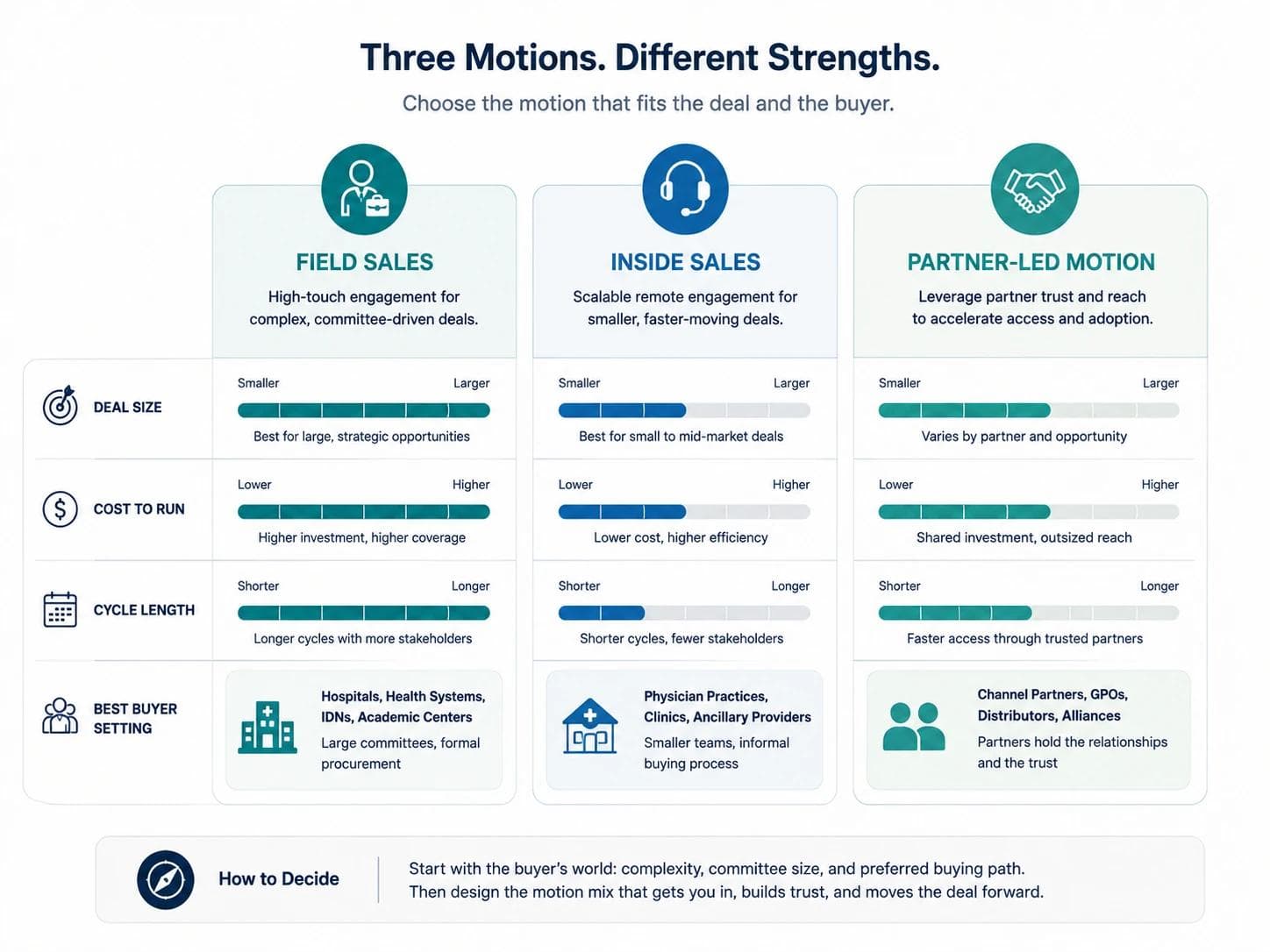
The mistake is defaulting to expensive field sales for every segment because it feels premium, or defaulting to cheap inside sales for enterprise deals that demand in-person committee work. Match the motion to how that specific buyer buys. Many companies also underestimate how much of the early motion is really pipeline creation, which is why we distinguish the selling motion from the demand engine that feeds it in our work on the healthcare sales pipeline.
Metrics, forecasting, and enablement
You cannot forecast a healthcare pipeline with the same metrics you would use for fast SaaS. Because cycles are long and committee-gated, activity metrics and raw stage counts are misleading. A pipeline can look full and still be dead.
Track a mix of leading and lagging indicators:
- Committee coverage: the percentage of active deals where every required stakeholder is identified and engaged. This is the best early predictor of whether a deal will close.
- Stage conversion rates by segment: how deals move from clinical validation to economic case to committee review, measured separately for hospitals, clinics, and payers.
- Cycle time by stage: where deals actually stall, so you can fix the specific gate rather than pushing harder everywhere.
- Champion strength: an honest read on whether your internal advocate can advance the deal without you.
- Pilot-to-contract conversion: the single number that tells you whether your evaluations are structured to win.
Forecasting improves when you weight deals by committee progress rather than by rep optimism. A deal that has cleared value analysis and is in procurement is worth far more to the forecast than a deal with an enthusiastic champion and no committee map.
Enablement is what makes the strategy repeatable across a team. At a high level, it means giving reps the clinical fluency, the stakeholder-specific messaging, the evidence assets, and the process discipline to run this motion consistently. It is the ongoing system that turns a strategy on paper into behavior in the field, not a one-time training event. We go deeper on that system in healthcare sales enablement, which pairs directly with the strategy laid out here.
How Medix builds the selling motion
Medix Outreach is a pharmacist-led healthcare commercialization and business development firm, and the selling motion is the part of commercialization we specialize in operating, not just advising on. Commercialization is broader than sales, covering pricing, market access, and partnerships. Within that, the selling motion is where clinical interest becomes signed revenue, and it is where most healthcare companies lose deals they should win.
Our approach starts with the buyer, not the pitch. We define the ICP and segmentation, map the real buying committee for target accounts, and build stakeholder-specific positioning that speaks the clinical language your buyers actually use. Then we install the process: staged qualification, mutual close plans, structured pilots, and forecasting weighted by committee progress. Because the team is clinically fluent, we earn the conversations a generic sales team never reaches. You can see how this connects to the wider commercial engine in our healthcare commercial growth and go-to-market service.
The bottom line
A healthcare sales strategy wins when it is built around how healthcare buys, not around how you would prefer to sell. That means a precise ICP, a mapped buying committee, positioning that answers each stakeholder's real question, a process staged to committee milestones, a motion mix matched to the buyer, and metrics that measure committee progress instead of activity. Companies that treat healthcare as generic B2B keep filling pipelines that never convert. Companies that respect the clinical buying environment build selling motions that close.
If you are designing or rebuilding your commercial motion and want a partner who understands how clinical buyers actually decide, Medix Outreach can help you map the committee, sharpen the message, and run the process that carries deals through long cycles to signed contracts.
Frequently Asked Questions
What is a healthcare sales strategy?
A healthcare sales strategy is the deliberate plan for converting clinical and administrative buyers into signed contracts. It defines your ideal customer profile, maps the buying committee that has to approve the purchase, sets the positioning for each stakeholder, and lays out a staged process for moving deals through long, committee-driven cycles. It differs from a generic B2B sales strategy because the buyer is a committee, the economic buyer is separated from the user, and formal review gates like value analysis and P&T committees can stop a deal that everyone seems to like.
Why does generic B2B sales strategy fail in healthcare?
Generic B2B strategy assumes a fast, economically rational buyer you can move by quantifying ROI and reaching one decision-maker. Healthcare buyers carry clinical and professional risk that has nothing to do with price, and the person who wants the product usually cannot approve the spend. Purchases route through committees, procurement, and compliance review on timelines set by institutional calendars rather than your urgency. A pitch optimized for efficiency and speed reads as tone-deaf to a clinical audience, which is why so many healthcare deals stall with no clear objection.
Who is on a healthcare buying committee?
A typical healthcare buying committee includes a clinical champion who advocates internally, an economic buyer who approves the budget, procurement or contracting that runs the purchase, and one or more review bodies. For drugs and clinical products that means a pharmacy and therapeutics committee, and for devices and services it often means a value analysis committee. Anything that touches patient data adds compliance, security, and legal review. Mapping every one of these roles for a specific account, and understanding what each needs to approve, is the most decisive move in healthcare selling.
How long is a typical healthcare sales cycle?
Enterprise healthcare sales cycles commonly run six to eighteen months, and they are non-linear because the timeline is driven by committee schedules and budget cycles rather than seller urgency. Smaller purchases into independent clinics and practices can move faster, while hospital and health-system deals sit at the long end because of the number of stakeholders and formal review gates involved. The practical way to manage a long cycle is to control what happens between meetings with mutual close plans, champion enablement, and disciplined stage exit criteria, rather than pushing for artificial speed.
Should we use field sales, inside sales, or partners in healthcare?
The right motion depends on deal size, buyer setting, and cycle length, and most healthcare companies run a blend. Field sales fits high-value hospital and health-system deals where committee access and clinical trust are built in person. Inside sales fits mid-market clinics and practices with smaller buying committees and faster decisions. Partner-led and channel motions fit segments where a group purchasing organization, distributor, or clinical society already holds the buyer's trust and can shortcut access you cannot build economically on your own. The strategic error is defaulting to one motion for every segment instead of matching the motion to how that buyer actually buys.