
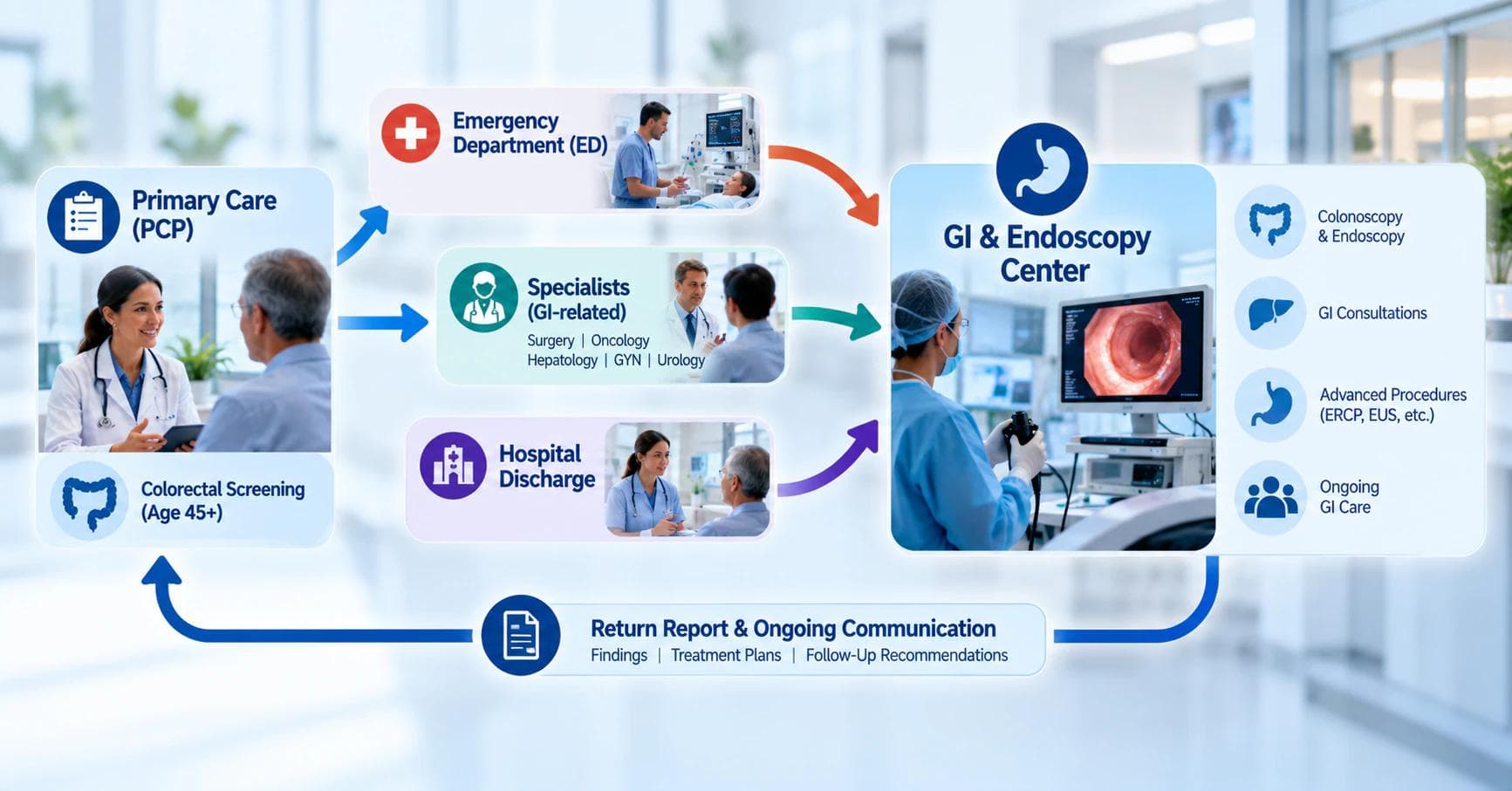
Gastroenterology has an unusual growth advantage and an unusual growth problem. The advantage is a large, recurring, guideline-driven demand stream: colorectal cancer screening. The problem is that almost all of that demand arrives through someone else's referral — a primary care physician, an urgent care, a positive stool-test result. A GI practice or endoscopy center grows by becoming the place those referrers send patients, and by making the screening pathway effortless.
This guide covers where GI referrals come from, how to capture screening demand, what referring physicians want, and how to build referral growth within the rules that govern physician referrals.
Colorectal screening is the demand engine — capture it
The single largest, most predictable source of GI and endoscopy volume is colorectal cancer screening. The U.S. Preventive Services Task Force recommends screening for colorectal cancer starting at age 45 for average-risk adults, which expanded the eligible population significantly. See the USPSTF colorectal cancer screening recommendation.
That recommendation creates a steady stream of screening-eligible patients flowing through primary care. The GI practices that grow fastest make it trivially easy for a PCP to refer a screening patient and for a positive non-invasive test to convert to a colonoscopy:
- Fast, convenient scheduling for screening colonoscopies, with minimal wait.
- A clear pathway for positive stool-based tests (for example FIT or stool DNA) to a diagnostic colonoscopy, so no at-risk patient falls through the cracks.
- Simple ordering and prep guidance that reduces PCP and patient friction.
Owning the screening pathway in your market is the highest-leverage GI referral-growth move there is.
Map GI referral sources
Beyond screening, GI referrals flow from several sources, each needing its own relationship:
- Primary care physicians — the dominant source, for screening and for symptoms (reflux, abdominal pain, IBS, abnormal labs).
- Emergency departments and hospitalists — for GI bleeds and acute presentations needing follow-up.
- Other specialists — oncology, hepatology, surgery, and primary care managing IBD and liver disease.
- Non-invasive screening programs and labs that generate positive results requiring colonoscopy.
As with any specialty, growth starts with seeing which sources send volume, which are declining, and which should refer but do not — the referral-analytics discipline behind tracking referral sources.
What referring physicians want from a GI practice
- Access. Short wait times for both screening and symptomatic referrals; delays send patients elsewhere.
- Closed-loop communication. The referrer wants timely results and a clear plan back in their workflow — especially for findings that need follow-up.
- Clinical quality and the full range of services — from screening and diagnostic endoscopy through IBD and advanced procedures.
- Frictionless referral and prep. Easy order submission, EHR-integrated results, and patient-friendly prep instructions. The professional societies — the American Gastroenterological Association and the American Society for Gastrointestinal Endoscopy — set the quality standards referrers expect.
Mid-article CTA
Need help building your healthcare growth engine?
Medix helps healthcare startups, clinics, pharma companies, and provider-focused platforms build scalable commercial pipelines.
Book a Strategy CallGrow referrals within Stark and Anti-Kickback rules
GI referral development operates inside strict federal rules.
- The Physician Self-Referral Law (Stark) restricts referrals for designated health services when a financial relationship exists, unless an exception applies — see CMS physician self-referral.
- The Anti-Kickback Statute prohibits inducements for referrals of federally reimbursed services — see the OIG fraud and abuse laws.
Grow through genuine value — access, the screening pathway, service, and quality — not inducements, and have counsel review any referral program or co-marketing arrangement.
Build a GI referral-development program
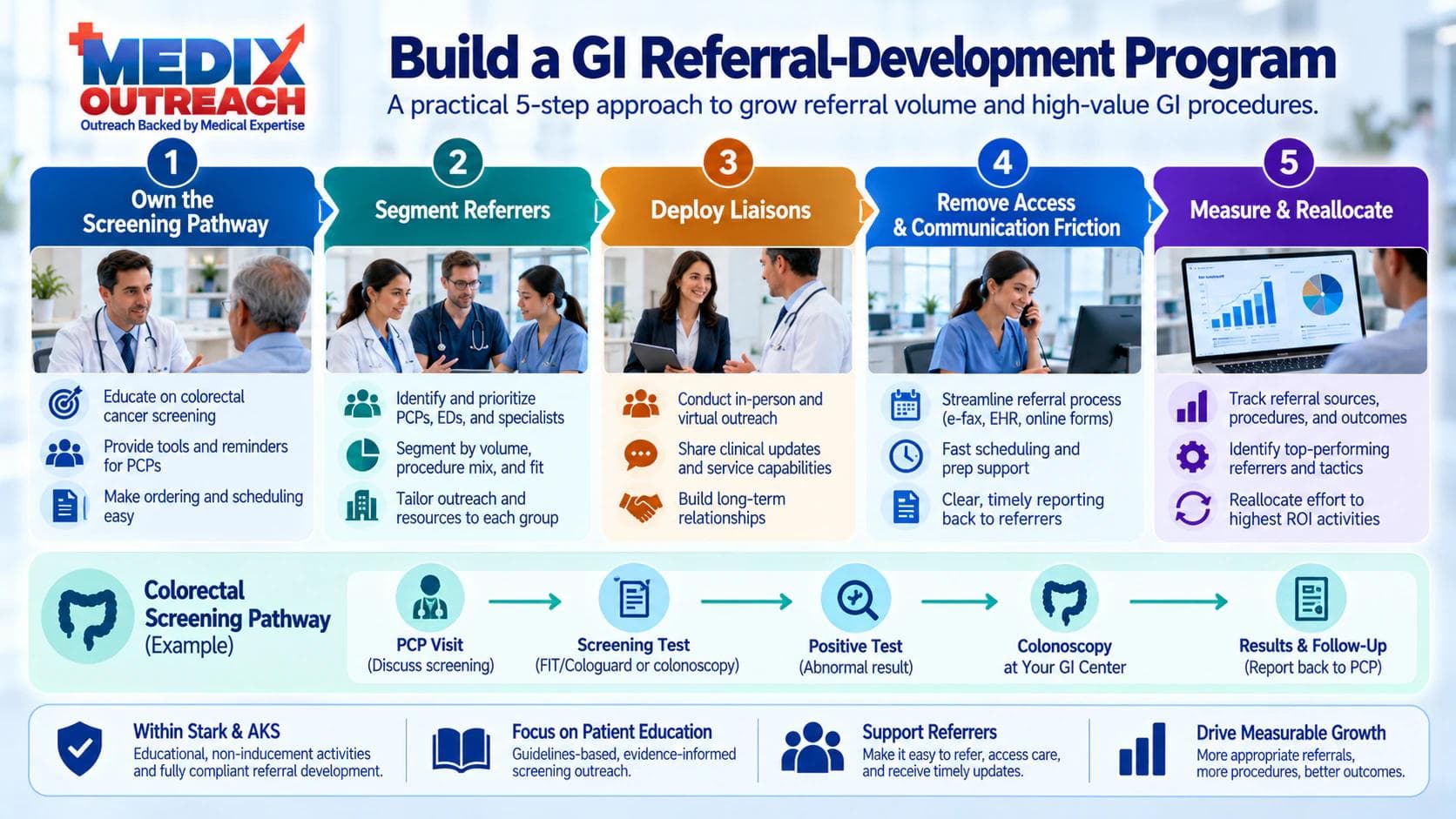
Sustainable GI referral growth is a repeatable system, the same structure Medix applies across specialties such as infusion-center referral growth:
- Own the screening pathway — make screening referrals and positive-test conversions effortless for PCPs.
- Segment referrers into grow, protect, and win-back groups.
- Deploy physician liaisons to build relationships and surface friction — see the Medix physician-liaison program guide.
- Remove access and communication friction — scheduling speed, prep support, closed-loop reporting.
- Measure and reallocate based on referral volume and conversion by source.
Measure what grows the practice
- Screening referral volume and positive-test-to-colonoscopy conversion.
- Referral volume by source and trend (PCP, ED, specialist, lab/screening program).
- Time-to-appointment for screening and symptomatic referrals.
- New referrers activated and lapsed referrers recovered.
Frequently asked questions
How do gastroenterology practices get more referrals? By owning the colorectal-screening pathway, mapping and managing referral sources, delivering fast access and closed-loop communication, and building referrer relationships through liaisons — all within Stark and Anti-Kickback limits.
Why is colorectal screening so important to GI growth? Because the USPSTF recommends colorectal cancer screening from age 45 for average-risk adults, screening is a large, recurring, guideline-driven source of colonoscopy volume. Practices that make screening referrals and positive-test conversions effortless capture a durable demand stream.
Who refers patients to gastroenterologists? Primarily primary care physicians (for screening and symptoms), plus emergency departments and hospitalists for acute GI issues, other specialists, and non-invasive screening programs that generate positive results needing colonoscopy.
What is the biggest GI referral-growth mistake? Letting the screening pathway leak — slow scheduling or no clear route from a positive stool test to colonoscopy — and failing to close the loop with referrers, which pushes both patients and PCPs to a competitor.
Becoming the GI practice referrers rely on
Gastroenterology referral growth is won by capturing screening demand, making referral and follow-up effortless, and developing referrer relationships compliantly — all measured rigorously. Practices that build that system turn a guideline-driven demand stream into durable, predictable growth.
Medix Outreach builds compliant referral-development programs and provider networks for gastroenterology and other specialty practices. To grow your GI referral base, book a free strategy call or explore our Provider Network Development service.