

Ambulatory infusion centers grow by winning referrals from the specialists who prescribe infusible therapies - rheumatology, neurology, gastroenterology, oncology, allergy and immunology, and nephrology - and by becoming the preferred site of care for those patients. Unlike consumer-facing practices, infusion growth is almost entirely a prescriber-referral game shaped by drug economics and site-of-care dynamics. This guide maps the referral sources, explains site-of-care, and lays out the levers that make specialists choose your center.
Infusion sits alongside specialty and compounding pharmacy commercial growth in the specialty-therapy landscape, and it grows on the same foundation as any provider referral engine: relationships, access, and reliability.
The infusion referral map and site-of-care dynamics
Infusion referrals originate with prescribing specialists, but where the patient actually receives therapy is increasingly contested among sites of care. Both dynamics shape your growth.
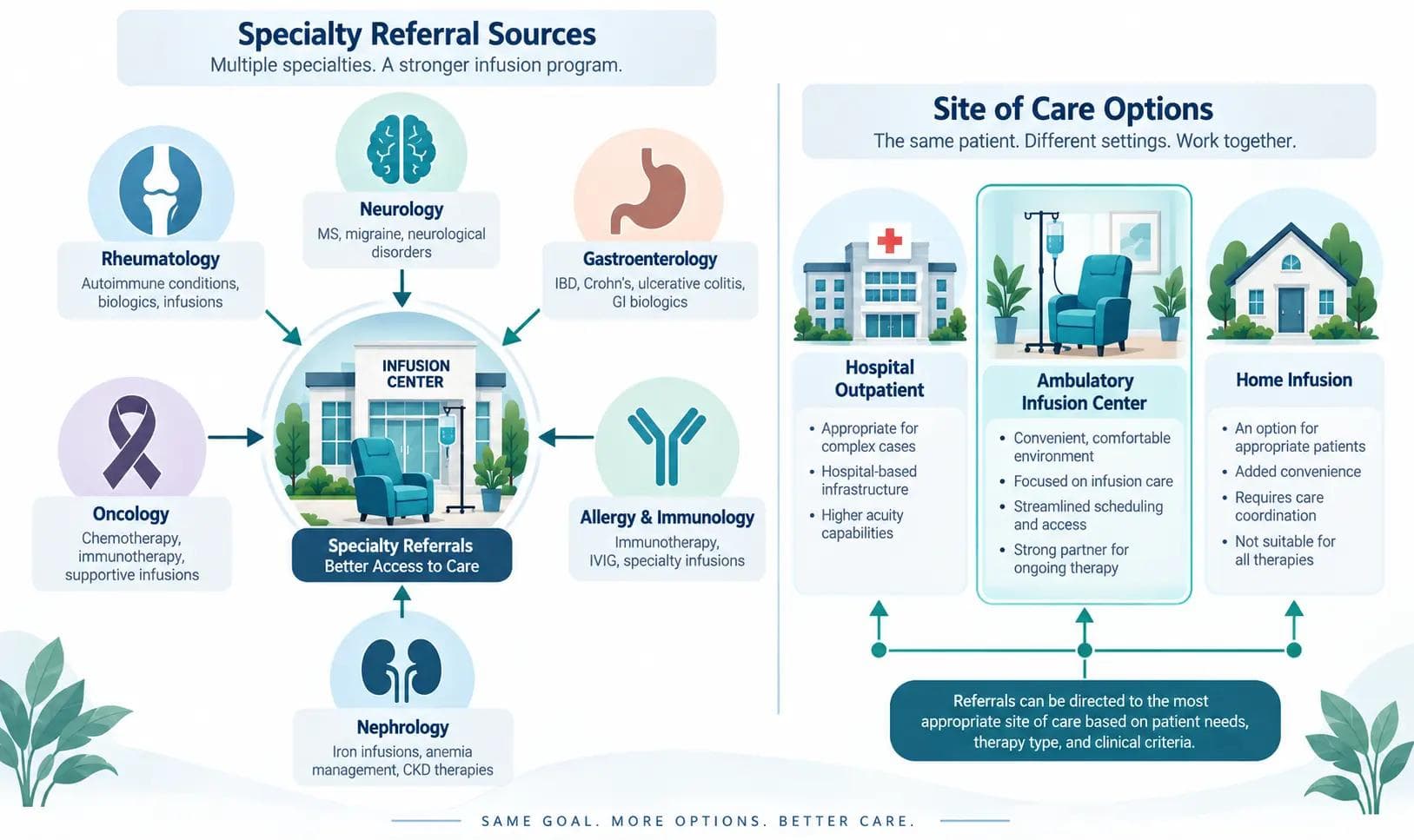
- Rheumatology - biologics for inflammatory conditions; a cornerstone infusion referral source.
- Neurology - infusible therapies for multiple sclerosis, migraine, and other conditions.
- Gastroenterology - biologics for inflammatory bowel disease.
- Oncology - though many practices infuse in-house, community relationships and overflow exist.
- Allergy and immunology - immunoglobulin and related therapies.
- Nephrology and others - additional infusible-therapy prescribers.
Layered on top is site-of-care. An infusion can be delivered in a hospital outpatient department, an ambulatory infusion center, or the patient's home - and payers and prescribers increasingly steer patients toward lower-cost, more convenient sites. The Medicare home infusion therapy benefit and industry bodies like the national home infusion association reflect how actively site-of-care is evolving. For an ambulatory center, this is an opportunity: you are often the convenient, lower-cost alternative to hospital outpatient infusion, and being the preferred site is a growth strategy in itself.
The levers that win infusion referrals
Speed to therapy start
For a patient waiting to begin a biologic, time to first infusion is everything - clinically and experientially. The center that starts therapy fastest, with the least back-and-forth, wins the prescriber's confidence and the next referral.
Prior authorization and benefits support
The biggest barrier in infusion is the administrative burden of prior authorization and benefits verification for high-cost drugs. A center that owns this process - handling it quickly, transparently, and off the prescriber's plate - removes the single largest source of delay and becomes the preferred destination.
Communication with the prescriber
Specialists need to know their patient started therapy, tolerated it, and is on schedule. Reliable closed-loop communication is as important here as in any referral relationship, and it is what turns a first referral into a standing one.
Patient experience
Because patients often return repeatedly over months or years, a comfortable, efficient, caring experience drives both retention and word-of-mouth - and prescribers hear about it, good or bad.
Building the infusion referral engine
- Map prescribing specialists in your area by therapy area and volume potential.
- Lead with administrative relief. Position your center around fast starts and owning prior authorization - the prescriber's biggest pain.
- Assign relationship ownership. As volume grows, a physician liaison program keeps specialist relationships managed and measured.
- Be the preferred site of care. Make your value as a convenient, lower-cost alternative to hospital outpatient explicit to prescribers and payers.
- Close the loop and track sources, the same discipline behind broader provider network development.
Mid-article CTA
Need help building your healthcare growth engine?
Medix helps healthcare startups, clinics, pharma companies, and provider-focused platforms build scalable commercial pipelines.
Book a Strategy CallInfusion referral KPIs
- Referrals by prescriber and specialty, tiered and trended.
- Time from referral to first infusion - the headline access metric.
- Prior-authorization turnaround and approval rate.
- Patient retention across the therapy course.
- Chair utilization relative to referral volume.
A prior-authorization workflow that wins referrals
Because prior authorization is the biggest barrier between a prescription and a first infusion, owning it is the clearest way to become a prescriber's preferred center. A disciplined workflow:
- Capture complete clinical information at referral - incomplete intake is the number-one cause of PA delays.
- Verify benefits and PA requirements immediately - know the payer's rules before you start, not after a denial.
- Assign a dedicated PA owner - a specialist who lives in payer portals moves faster than shared, part-time effort.
- Track PA status like a pipeline - every pending authorization is a patient waiting and a referral at risk.
- Handle denials and appeals proactively - a center that wins appeals keeps patients who would otherwise be lost.
- Report turnaround back to prescribers - visible speed is what earns the next referral.
Infusion is a relationship-and-reliability business dressed up in clinical complexity. The centers that grow are the ones that make prescribers' lives easier and patients' therapy start faster. Medix's Provider Network Development team helps infusion centers and specialty pharmacies build the prescriber relationships and access reputation that grow census.
Frequently Asked Questions
Where do infusion center referrals come from?
Primarily from specialists who prescribe infusible and injectable therapies: rheumatology, neurology, gastroenterology, oncology, allergy and immunology, and nephrology. The prescriber and their staff decide where a patient receives therapy, which makes those relationships the core of infusion growth.
What is site-of-care and why does it matter for infusion referrals?
Site-of-care refers to where an infusion is administered - hospital outpatient, an ambulatory infusion center, or the patient's home. Payers and prescribers increasingly steer patients toward lower-cost, convenient sites, so an infusion center's growth depends partly on being the preferred site for referring specialists and payers.
How does an ambulatory infusion center win referrals from specialists?
By being reliable and easy: fast scheduling, smooth benefits and prior-authorization support, excellent communication back to the prescriber, and a comfortable patient experience. Specialists refer to centers that make their patients' therapy start quickly and without administrative burden.
What is the biggest administrative barrier in infusion referrals?
Prior authorization and benefits verification for high-cost drugs. An infusion center that handles this quickly and transparently removes the biggest source of delay and becomes the prescriber's preferred referral destination.