
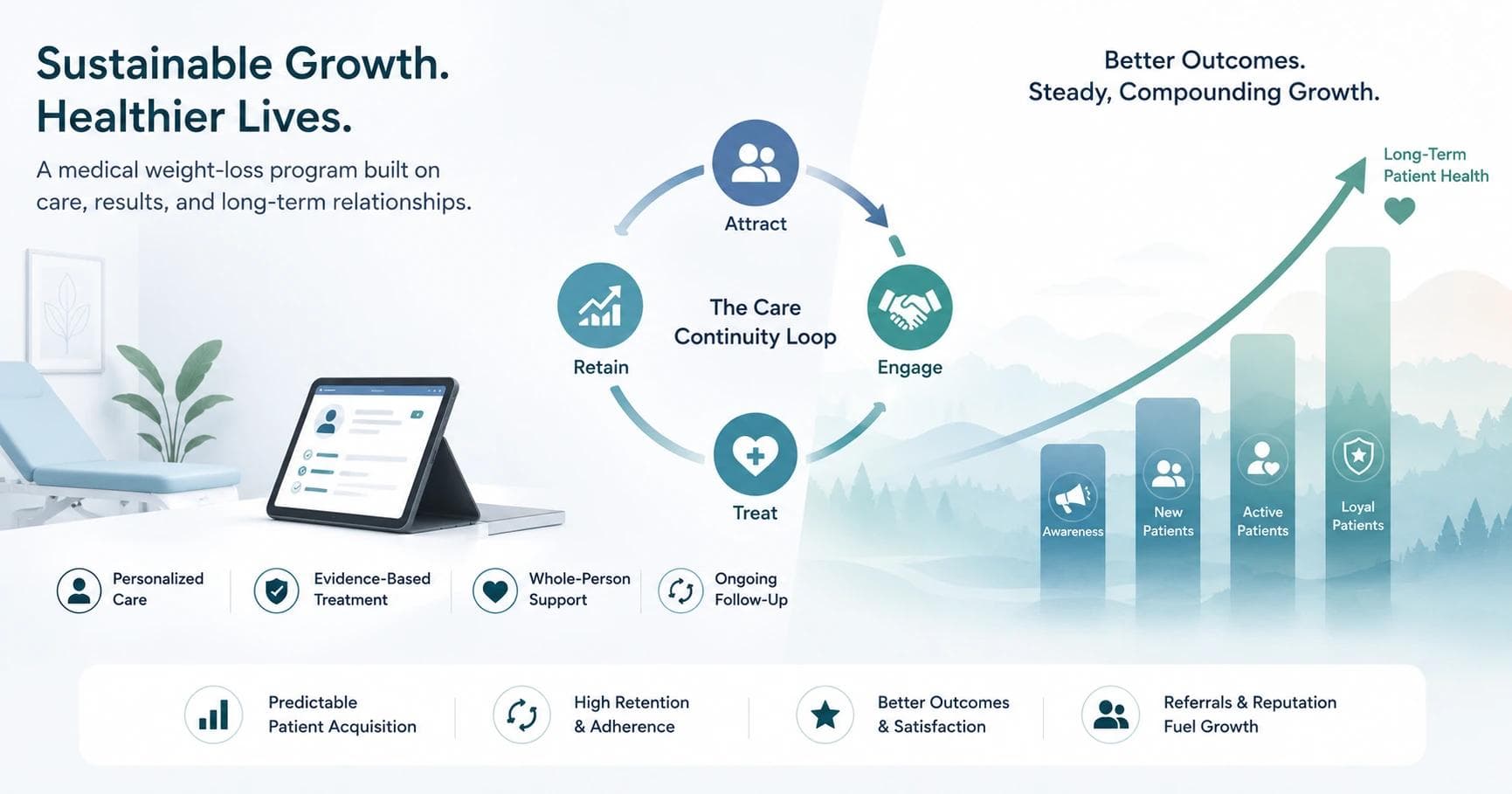
Few categories in healthcare have grown as fast as medical weight management. GLP-1 medications turned obesity care from a neglected corner of medicine into one of the most in-demand services a clinic can offer, and thousands of practices, telehealth companies, and new programs rushed to meet the demand. That surge created a real problem hiding behind the opportunity: when everyone offers the same thing, demand alone stops being an advantage.
The programs that will still be thriving in a few years are not the ones that captured the first wave of interest. They are the ones building durable differentiation and, above all, retention. A weight-loss program that acquires patients cheaply and loses them in three months is a treadmill. A program that keeps patients engaged for a year or more compounds. This is a commercial and practice-growth guide to building the second kind, and it is deliberately about business strategy, not clinical protocols.
Short version: in a crowded GLP-1 market, growth comes from differentiating on the care experience rather than the drug, treating retention as the core economic engine, diversifying acquisition beyond paid ads into referrals and partnerships, and marketing within the real advertising and regulatory constraints. Programs built on those fundamentals survive the hype cycle. Programs built on cheap medication access do not.
Stop Selling the Drug, Start Selling the Program
The single most common strategic error is positioning the medication as the product. The medication is a commodity - patients can get a GLP-1 prescription from countless clinics, telehealth apps, and, at various times, compounding channels whose regulatory status shifts with drug shortage designations tracked by the U.S. Food and Drug Administration. If your entire value proposition is access to the drug, you are competing purely on price and convenience against players with deeper pockets, and you have no defensibility.
The programs that win sell the program, not the prescription. That means the whole experience around the medication: clinical oversight, nutrition and behavioral support, side-effect management, progress monitoring, and the relationship that helps a patient actually succeed and sustain results. Patients do not lack access to GLP-1s; they lack support in using them well over time. A program that delivers that support is a genuinely different product, and it can command loyalty and price that a prescription mill cannot.
This is the same principle behind all durable practice growth: compete on the experience and the outcome, not on the commodity input everyone else also has.
Retention Is the Whole Business
Here is the economics that most new entrants miss. In a weight-loss program, the money is not in the first visit; it is in the months of continued care. GLP-1 treatment is not a one-and-done event, and the patients who stay engaged generate the vast majority of a program's value while also becoming its best marketing.
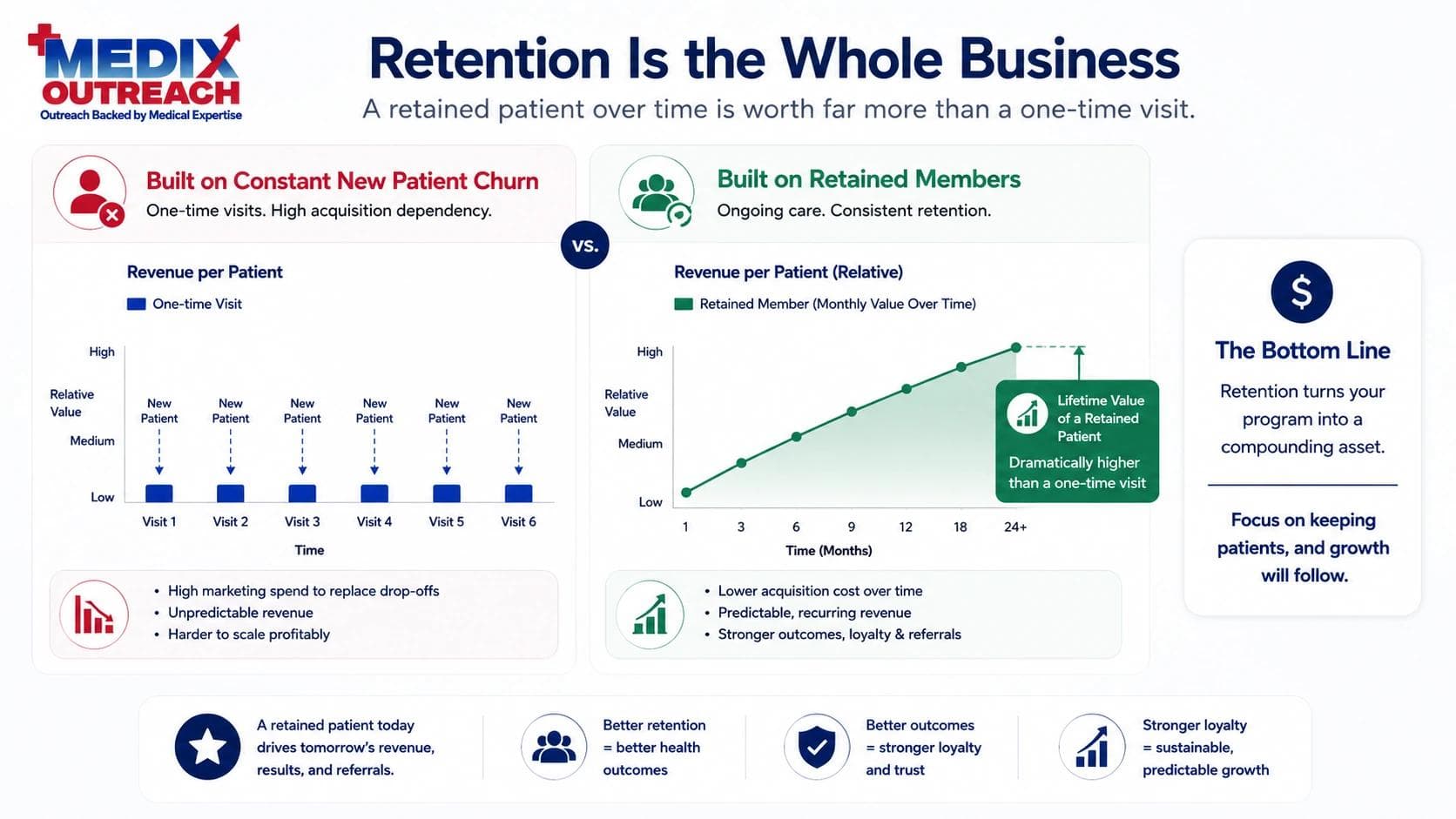
Treating retention as the core metric changes how you build the program:
- Design for the long arc. Onboarding, check-ins, and support should be built to keep patients engaged through the plateaus, the side effects, and the life events that cause people to drop out.
- Make progress visible and supported. Patients who feel supported and see progress stay; patients who feel like a transaction leave. The clinical relationship is the retention mechanism.
- Plan for the maintenance phase. What happens when a patient reaches a goal, or when medication access or cost changes? Programs that have a durable answer keep patients; programs that do not lose them at the first disruption.
A retained patient is worth many times a one-time visit, and retained patients refer others. That is why retention is not a customer-service nicety but the central growth lever. Fix acquisition without fixing retention and you are pouring patients into a leaky bucket.
Where Growth Actually Comes From
New weight-loss programs almost always over-rely on paid advertising, and paid ads for a commoditized service in a crowded market get expensive fast. Durable programs diversify their acquisition across channels that compound and cost less over time.

- Direct patient acquisition through digital presence, local reputation, and, most powerfully, referrals from satisfied patients. Word of mouth in weight management is strong because results are visible and personal.
- Provider referrals. Primary care physicians, endocrinologists, cardiologists, OB-GYNs, and other clinicians see patients who need weight management but cannot always provide the program themselves. Becoming their trusted referral partner is a durable, low-cost channel, and it is built with the same provider network development discipline used across healthcare.
- Partnerships with employers, pharmacies, and adjacent clinics (for example, aesthetic or wellness practices whose patients overlap) that create steady referral flow. Our work building a nationwide B2B peptides pipeline is an example of reaching patients through a network of clinic and provider partners rather than one-off ads.
The programs that scale sustainably treat provider referrals and partnerships as primary channels, not afterthoughts, because those channels get cheaper and stronger as your reputation grows, while paid acquisition only gets more expensive. For programs run inside a clinic, the underlying motion is the same one in our guide to selling to and growing clinics and private practices.
Mid-article CTA
Need help building your healthcare growth engine?
Medix helps healthcare startups, clinics, pharma companies, and provider-focused platforms build scalable commercial pipelines.
Book a Strategy CallMarketing Within the Rules
Weight-loss marketing sits in one of the most scrutinized corners of health advertising, and the rules are not optional. The Federal Trade Commission enforces standards on health and weight-loss claims, and the bar is high: claims must be truthful and substantiated, testimonials and before-and-after results must reflect what patients can generally expect and be handled honestly, and endorsements must follow disclosure rules.
The practical guardrails:
- Do not promise specific results you cannot substantiate, and avoid the exaggerated weight-loss claims the FTC actively polices.
- Handle testimonials and reviews honestly, with appropriate disclosures, and never fabricate or incentivize deceptive endorsements.
- Keep medical and privacy compliance intact, because you are handling protected health information and, in many cases, operating under medical direction and state scope-of-practice rules that vary by location.
Compliant marketing is not a constraint on growth so much as a moat. Programs that make reckless claims attract regulatory risk and the wrong patients; programs that build a credible, honest brand attract patients who stay. Generating qualified interest the right way is the same discipline as any healthcare lead generation effort, and honesty is part of what makes it qualified.
Differentiation Beyond the Medication
Because the medication is commoditized, your durable differentiation has to come from somewhere else. The strongest programs differentiate on one or more of the following:
- A distinctive care model - more clinical oversight, integrated behavioral and nutrition support, or a specialty focus (for example, cardiometabolic health, menopause-related weight management, or athletes) that makes you the obvious choice for a specific population.
- A specific patient experience that is dramatically better than the transactional norm - responsiveness, continuity, and genuine support.
- A trusted brand and reputation in a local market or niche, which compounds through referrals.
- Adjacent services that increase value and retention, connecting weight management to broader wellness, aesthetics, or primary care.
The pattern across all of these is the same: stop competing on the thing everyone has (the drug) and compete on the things that are hard to copy (the model, the experience, the relationships, the reputation). That is what durable provider and patient marketing has always rewarded.
Where Medix Fits
Medix Outreach helps clinics and programs grow patient volume and retention without betting the business on a single hype cycle. Our patient acquisition and practice growth work builds diversified acquisition across direct, referral, and partnership channels, sharpens your differentiation beyond the medication, and keeps the marketing compliant and credible - so the growth compounds instead of evaporating. We help you build a program patients stay in and refer to, which is the only kind that lasts.
Frequently Asked Questions
How do you grow a GLP-1 or medical weight-loss program in a crowded market?
Stop competing on access to the medication, which is commoditized, and compete on the program around it: clinical oversight, behavioral and nutrition support, and the relationship that helps patients succeed over time. Diversify acquisition beyond paid ads into provider referrals and partnerships, and treat retention as the core growth lever. Programs built on differentiation and loyalty outlast programs built on cheap drug access.
Why is retention more important than acquisition for a weight-loss program?
Because the value of a weight-management patient comes from months of continued care, not the first visit. A program that acquires patients cheaply but loses them in a few months is a treadmill, while a program that keeps patients engaged for a year or more compounds and generates referrals. Retained patients are worth many times a one-time visit and become the program's best marketing, so retention drives the economics.
What are the best acquisition channels for a medical weight-loss program?
The most durable channels are provider referrals (from primary care, endocrinology, cardiology, and other clinicians), partnerships (with employers, pharmacies, and adjacent clinics), and referrals from satisfied patients. These compound and get cheaper as your reputation grows. Over-reliance on paid advertising is common and expensive, because paid acquisition for a commoditized service in a crowded market only gets more costly over time.
What are the marketing rules for GLP-1 and weight-loss programs?
Health and weight-loss advertising is heavily scrutinized by the FTC. Claims must be truthful and substantiated, exaggerated weight-loss promises are actively policed, testimonials and before-and-after results must be handled honestly with appropriate disclosures, and endorsements must follow disclosure rules. Programs must also maintain medical and privacy compliance and operate within state scope-of-practice and medical-direction requirements, which vary by location.
How do you differentiate a GLP-1 program when everyone offers the same drugs?
Differentiate on things that are hard to copy: a distinctive care model or specialty focus, a dramatically better patient experience, a trusted brand and reputation, and adjacent services that increase value and retention. Since the medication itself is commoditized, competing on the model, the experience, and the relationships is what creates loyalty, referrals, and pricing power that a prescription-only competitor cannot match.