

B2B healthcare lead generation is the process of identifying, attracting, and qualifying the specific healthcare organizations and decision-makers that are a genuine fit for your product, then moving them toward a real commercial conversation. In healthcare, the goal is not more leads. It is qualified leads: named accounts and buying-committee members who match your ideal customer profile, have a reason to act, and can realistically buy. A pipeline built on that definition converts. A pipeline built on raw contact volume usually does not.
Most healthcare companies discover this the hard way. They run outbound campaigns, buy lists, and book meetings, yet the pipeline stalls after the first call. The problem is rarely effort. It is that generic lead generation was never designed for how hospitals, clinics, health systems, and pharmacies actually evaluate vendors. This guide breaks down what a qualified healthcare lead is, why healthcare lead generation is different, and how to build a repeatable system that produces pipeline you can forecast.
What is B2B healthcare lead generation?
B2B healthcare lead generation is the demand and pipeline function that sits at the top and middle of the commercial process. It covers three jobs: defining who you are trying to reach, creating enough qualified interest to fill a pipeline, and qualifying that interest so your sales effort goes to the right conversations.
It is worth separating two ideas that often get blurred. Demand generation creates awareness and interest across a market. Lead generation captures and qualifies specific people and accounts you can pursue. Both matter, and in healthcare they work best together, because clinical buyers rarely respond to a cold ask from a company they have never heard of. Lead generation is also distinct from what happens after a lead is qualified. Closing, negotiation, and expansion belong to the selling motion and to your healthcare sales pipeline. Lead generation's job is to hand sales a steady flow of qualified, sales-ready opportunities.
What counts as a qualified healthcare lead
A qualified healthcare lead is an account and contact that meets two tests at once: fit and intent. Fit means the organization matches your ideal customer profile on the attributes that predict a good deal, such as setting, size, specialty, and buying model. Intent means there is a reason to engage now, whether that is an active initiative, a budget cycle, a pain that your solution addresses, or an explicit request to learn more.
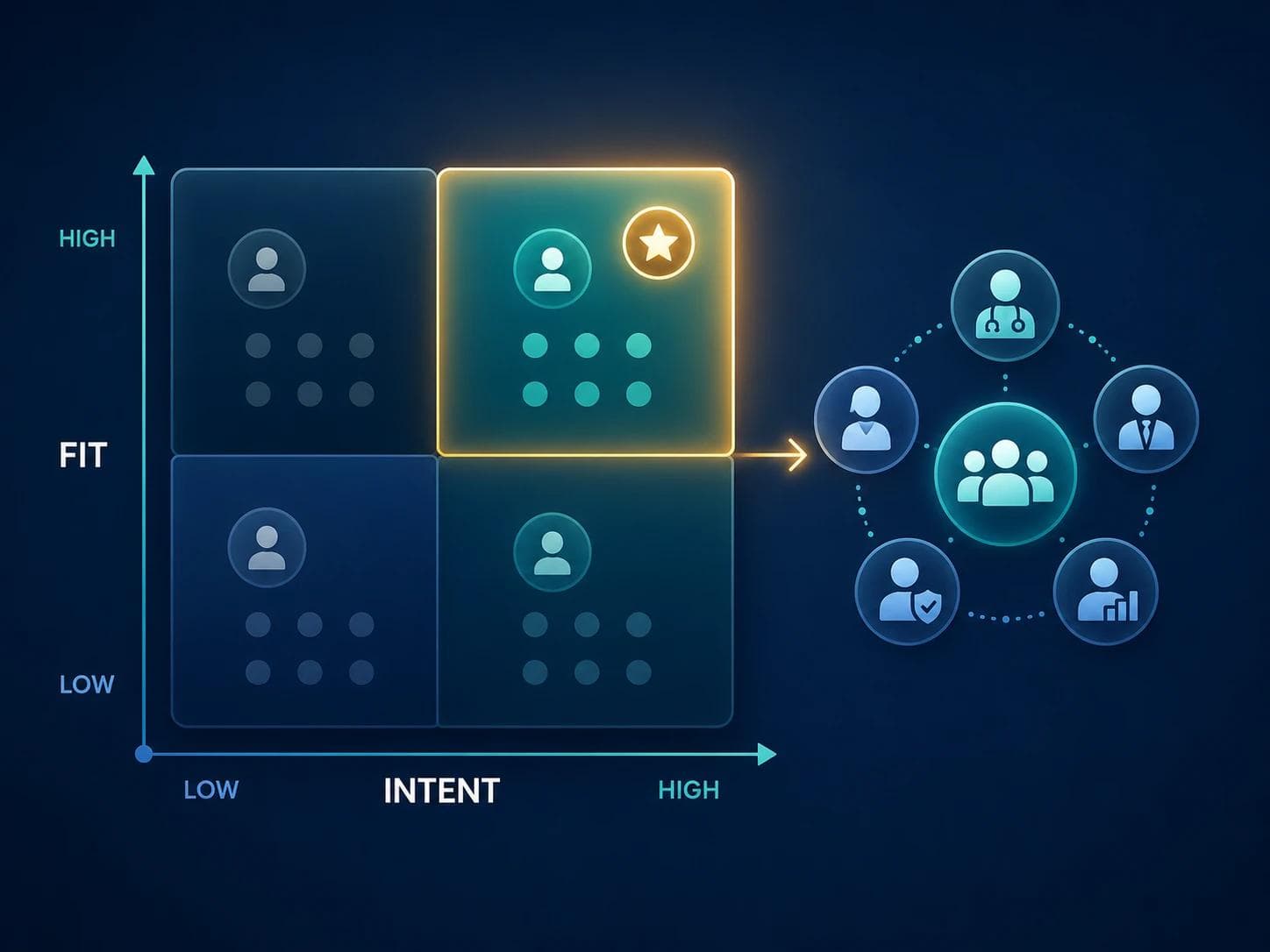
Healthcare adds a third layer that most B2B frameworks miss: the buying committee. A single interested contact is not a qualified opportunity if that person cannot influence a purchase. Hospital and health-system decisions usually involve several roles at once, including a clinical champion, an economic buyer, procurement, and, depending on what you sell, pharmacy or a value analysis committee. A lead is meaningfully qualified when you have identified the account, confirmed fit, established intent, and mapped a path to the people who actually decide.
That is why a useful working definition of a qualified healthcare lead is simple to state and hard to fake: the right account, with a real reason to act, and a credible route to the decision. Everything in a good lead generation system is built to produce leads that pass that bar.
Why healthcare lead generation is different from generic B2B
Healthcare is one of the most relationship-driven and risk-sensitive B2B markets. The tactics that work in generic software or manufacturing outreach often backfire when the buyer is a physician, a practice manager, or a hospital administrator. Understanding these differences is what separates healthcare lead generation from volume-based prospecting. It is also why cold outreach so often fails in healthcare when it is copied straight from a general B2B playbook.
- Buyers screen for clinical relevance first. If your message does not show that you understand their specialty, workflow, and constraints, it gets ignored before your product is ever considered.
- Trust precedes interest. Providers evaluate credibility before they evaluate features, which is why clinical credibility functions as a commercial asset.
- The buying committee is larger and slower. More stakeholders means more qualification work and longer timelines.
- Compliance shapes the channels. Outreach that touches protected health information, or that ignores rules for email and calling, creates real risk. Provider outreach should follow the same standards described in HIPAA-compliant sales and marketing, and companies should treat privacy and communication rules as a design constraint, not an afterthought. The U.S. Department of Health and Human Services publishes the governing standards for how protected health information may be used (https://www.hhs.gov/hipaa/for-professionals/index.html).
- Volume is a vanity metric. Sending more messages to a poorly defined list does not produce more revenue. It produces more noise and faster list burnout.
The practical takeaway is that healthcare lead generation rewards precision over reach. A smaller, sharper effort aimed at the right accounts almost always beats a larger, generic one.
Step 1: Define a sharp ideal customer profile
Everything downstream depends on targeting. Before you generate a single lead, define an ideal customer profile that is specific enough to disqualify most of the market. A strong healthcare ideal customer profile names the setting (for example independent specialty clinics, mid-size hospitals, or specialty pharmacies), the specialties or service lines that benefit most, the organization size and structure, the buying model, and the trigger events that signal readiness.
The disqualification part is the point. A profile that includes everyone qualifies no one. When Medix helped a specialty pharmacy build local demand, the work started by narrowing to the exact provider types and geographies where the offer was clearly relevant, which is what made the outreach land. You can see that pattern in the specialty pharmacy provider outreach case study. Sharper targeting reduces wasted effort and raises the quality of every lead that follows.
Write the profile down, share it across marketing and sales, and treat it as a living document. As you learn which accounts convert and which stall, tighten the profile. Targeting is not a one-time exercise. It is the control panel for the entire system.
Step 2: Build the right channel mix
No single channel carries healthcare lead generation on its own. The strongest programs combine a few channels that reinforce each other, so a prospect sees your organization more than once and in more than one context before a sales conversation begins.

- Provider outreach and outbound. Targeted, personalized outreach to named accounts remains effective when it is specific and clinically relevant. This is the disciplined version of what account-based marketing formalizes for named-account selling.
- Content and demand generation. Educational content that answers real buyer questions builds credibility before the ask and gives outbound something worth referencing. It is how you earn attention rather than interrupt for it.
- Referrals and partnerships. Warm introductions from existing relationships, channel partners, and complementary vendors produce some of the highest-converting healthcare leads because trust transfers with the introduction.
- Events and communities. Conferences, associations, and professional networks put you in front of concentrated, relevant audiences and create natural reasons to follow up.
- Inbound and search. When buyers research a problem, being present in search and answer engines captures demand you did not have to chase.
Two rules keep the mix healthy. First, match the channel to how the specific buyer prefers to engage rather than defaulting to whatever is easiest to automate. Second, resource the channels you choose properly. A shallow presence across ten channels loses to a strong presence across three. If you lack the capacity to run outbound consistently, that specific function is often the first thing companies delegate, as covered in outsourced healthcare SDR and appointment setting. Note that appointment setting is one execution service inside a lead generation strategy, not the strategy itself.
Step 3: Qualify with a healthcare-specific framework
Generating interest is only half the job. Without qualification, sales drowns in low-quality leads and stops trusting marketing. A healthcare qualification framework should score both fit and intent, then define a clean handoff.
Use a simple two-part scoring approach. Score fit against the ideal customer profile: setting, specialty, size, and buying model. Score intent against observable signals: content engagement, meeting requests, initiative timing, and stated need. A lead that is high fit and high intent is sales-ready. High fit and low intent belongs in nurture. Low fit is disqualified, regardless of how engaged the contact seems.
Then define the handoff explicitly. Decide what a marketing-qualified lead means, what a sales-qualified lead means, and what information travels with the lead when it moves to sales. In healthcare, that information should include the account, the identified buying-committee roles, the trigger event, and any compliance-relevant context. A clean handoff is what turns qualified leads into a functioning healthcare sales pipeline rather than a pile of contacts nobody trusts.
A practical lead generation system
Put the three steps together and you get a system rather than a set of disconnected campaigns. A healthcare lead generation system runs in a repeatable loop:
- Define and refine the ideal customer profile and target account list.
- Run a coordinated channel mix aimed at those accounts.
- Capture and score every lead for fit and intent.
- Hand sales-ready leads to sales with full context, and route the rest to nurture.
- Measure what converts, then feed that learning back into targeting and messaging.
The loop is what makes pipeline predictable. Each cycle sharpens the profile, improves the messaging, and raises conversion quality. This is also the difference between hiring a vendor to run tactics and building a durable commercial capability. The strategic version of that choice is explored in healthcare sales outsourcing versus lead generation, which looks at when a company needs a partner rather than another campaign.
Mid-article CTA
Need help building your healthcare growth engine?
Medix helps healthcare startups, clinics, pharma companies, and provider-focused platforms build scalable commercial pipelines.
Book a Strategy CallMetrics that matter, and vanity metrics to ignore
Measurement in healthcare lead generation should track pipeline quality, not activity. The most common mistake is celebrating metrics that feel productive but do not predict revenue.
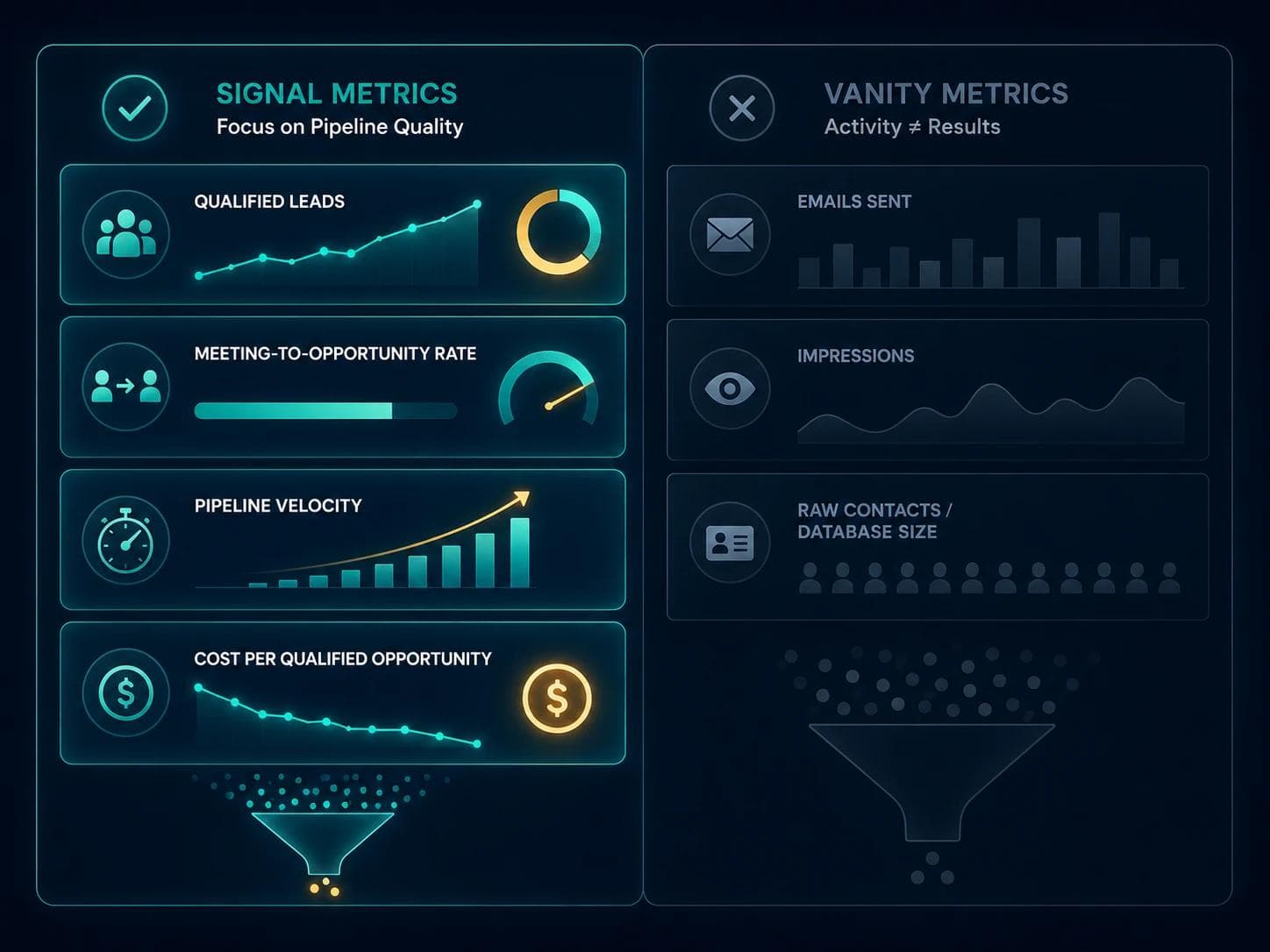
Track these:
- Qualified leads by fit and intent, not raw lead count.
- Meeting-to-opportunity rate, which shows whether your leads are truly qualified.
- Pipeline created and pipeline velocity, which show whether the system produces movement.
- Conversion by channel and by segment, which tells you where to invest.
- Cost per qualified opportunity, which keeps the program honest.
Downweight these:
- Emails sent, open rates in isolation, and total contacts in the database.
- Raw meeting count with no qualification behind it.
- Follower and impression counts that never map to a real account.
The test for any metric is simple: does it help you decide where to put the next dollar or hour? If not, it is a vanity metric.
Common healthcare lead generation mistakes
A few patterns account for most underperforming healthcare lead generation programs. Naming them makes them easier to avoid.
- Targeting everyone. A vague ideal customer profile guarantees weak leads. Precision is the highest-impact fix.
- Leading with product instead of relevance. Clinical buyers engage with messages that reflect their world, not feature lists.
- Treating appointment volume as the goal. Meetings without qualification waste the most expensive resource you have, which is sales time.
- Running one channel and expecting it to carry the program. Healthcare buyers need to see you in more than one place.
- Ignoring compliance until it becomes a problem. Build privacy and communication rules into the design from day one.
- Confusing lead generation with the whole commercial function. Lead generation fills the pipeline. It does not replace strategy, positioning, or the selling motion.
How Medix approaches healthcare lead generation
Medix Outreach builds healthcare lead generation as a system, not a campaign. Because the team is pharmacist-led, the starting point is clinical relevance: who the real buyer is, what they care about, and how they evaluate a vendor. From there, Medix defines a sharp ideal customer profile, runs a channel mix suited to the buyer, and qualifies leads on fit and intent before they reach sales.
That approach has produced results across very different healthcare segments, from a nationwide clinic pipeline for a peptides company to local provider demand for a specialty pharmacy. You can see the range in the nationwide B2B peptides pipeline case study and in the broader healthcare commercial growth and go-to-market service. The common thread is a pipeline built on qualified conversations, not contact volume.
The bottom line
B2B healthcare lead generation works when it is treated as a targeting and qualification discipline rather than a volume game. Define an ideal customer profile sharp enough to disqualify most of the market, run a coordinated channel mix that reflects how clinical buyers engage, qualify every lead on fit and intent, and measure pipeline quality instead of activity. Do that consistently and lead generation stops being a series of campaigns and becomes a predictable engine for growth.
Frequently Asked Questions
What is B2B healthcare lead generation?
B2B healthcare lead generation is the process of identifying the right healthcare organizations and decision-makers, generating qualified interest from them, and qualifying that interest so sales can pursue real opportunities. In healthcare, a qualified lead means the right account, with a genuine reason to act, and a credible path to the buying committee. The objective is pipeline quality, not lead volume.
How is healthcare lead generation different from general B2B lead generation?
Healthcare buyers screen for clinical relevance and credibility before they evaluate a product, decisions usually involve a buying committee rather than one person, sales cycles are longer, and outreach is shaped by privacy and communication rules. Generic, high-volume tactics that work in other industries often fail in healthcare because they ignore how providers and health systems actually evaluate vendors. Precision and relevance outperform reach.
What makes a healthcare lead qualified?
A qualified healthcare lead passes two tests at once. Fit means the account matches your ideal customer profile on setting, specialty, size, and buying model. Intent means there is a reason to engage now, such as an active initiative, a budget cycle, or a stated need. Because healthcare purchases involve several stakeholders, a lead is fully qualified only when you have also mapped a realistic path to the people who decide.
Which channels work best for B2B healthcare lead generation?
No single channel is enough. The strongest programs combine targeted provider outreach, educational content and demand generation, referrals and partnerships, events and professional communities, and inbound search. The right mix depends on how your specific buyer prefers to engage. It is better to run three channels well than ten channels poorly, and to match each channel to a clear role in the system.
Should healthcare companies outsource lead generation?
Outsourcing makes sense when a company lacks the capacity or specialized healthcare expertise to run lead generation consistently, or needs to build pipeline faster than an in-house team can ramp. The key is to outsource to a partner who understands healthcare buyers and can build a system, not just run tactics. Appointment setting is one function a company might delegate, while the broader strategy, targeting, and qualification are what actually determine whether the pipeline converts.