

Plenty of healthcare products get cleared and still fail to sell. The science is sound, the regulatory file is clean, and the launch deck looks great. Then the revenue does not show up. The reason is almost never the product. It is that nobody built a plan for how the product would actually get paid for.
Market access is the work of turning a legal-to-sell product into a paid-for one. It answers three questions a founder often ignores until launch is close: will a payer cover this, does a billing code exist for it, and how much gets paid when a claim goes in. Miss any one and the commercial model stalls, no matter how strong the clinical story is.
This guide explains healthcare market access strategy in plain terms for commercial and founder-level readers. You will get a clear model of coverage, coding, and payment, an honest look at why FDA clearance and reimbursement are not the same thing, and a sense of the evidence and pricing decisions that shape whether payers say yes. It is educational, not legal or regulatory advice. For coding determinations, coverage submissions, and pricing negotiations, you should bring in specialist market-access and reimbursement counsel.
What market access actually means
Market access is the bridge between regulatory approval and real revenue. Getting a product cleared or approved means you are allowed to sell it. Market access is the separate, longer job of making sure the people who use it can get paid, or reimbursed, for using it.
For most healthcare products, the buyer and the payer are not the same party. A physician orders a test. A hospital stocks a device. A patient uses a digital therapeutic. But the money that funds all of that usually comes from a health plan or a government program. If that plan will not pay, the person using your product either eats the cost or stops using it. Market access is how you keep that from happening.
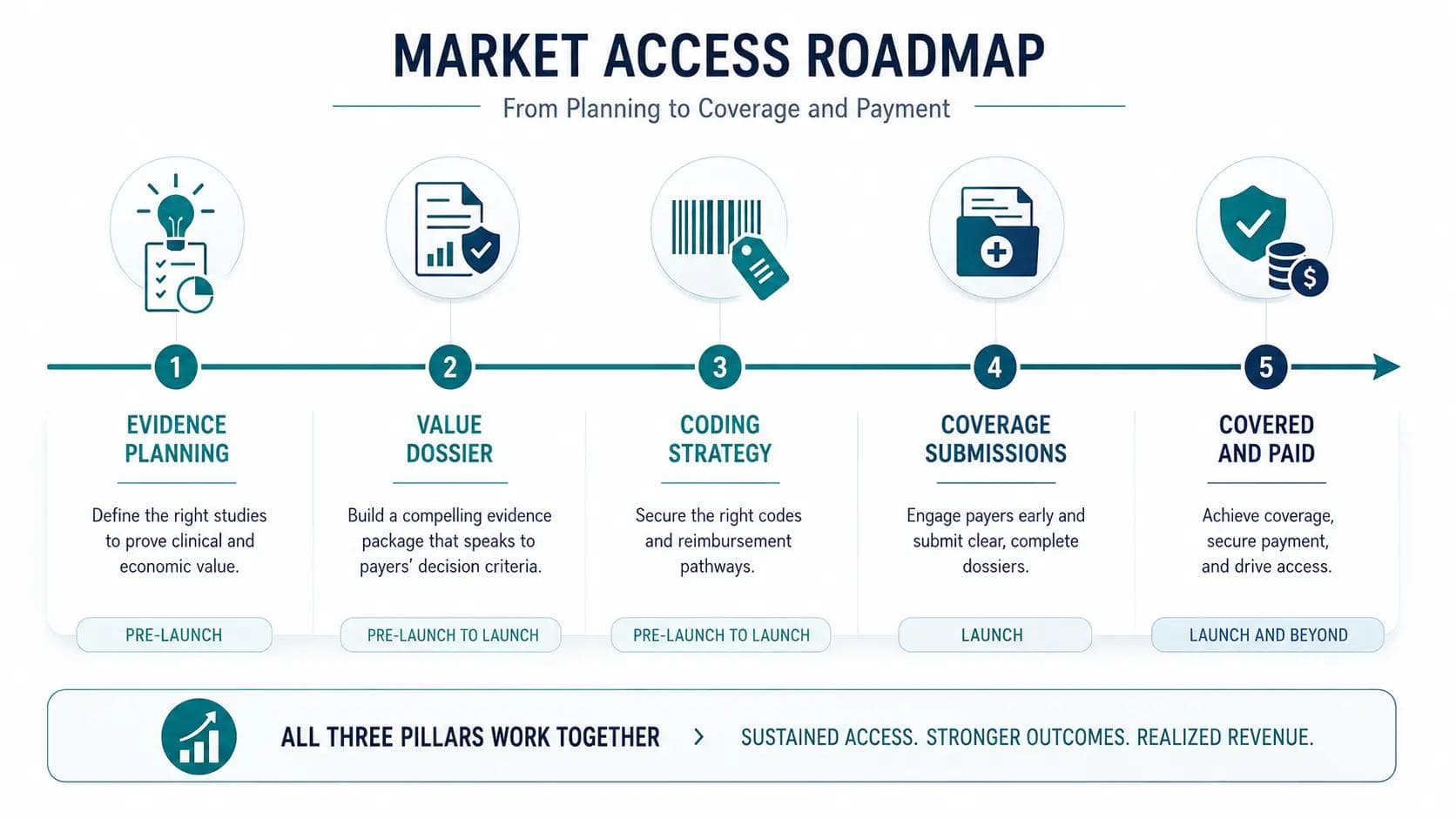
That is why a market access plan belongs in your commercialization strategy early, not bolted on after launch. It shapes what evidence you collect, how you price, what you say to buyers, and how much runway you need. Companies that treat it as an afterthought discover the gap at the worst moment, when the product is live and the sales team cannot understand why deals keep dying.
The three pillars of market access
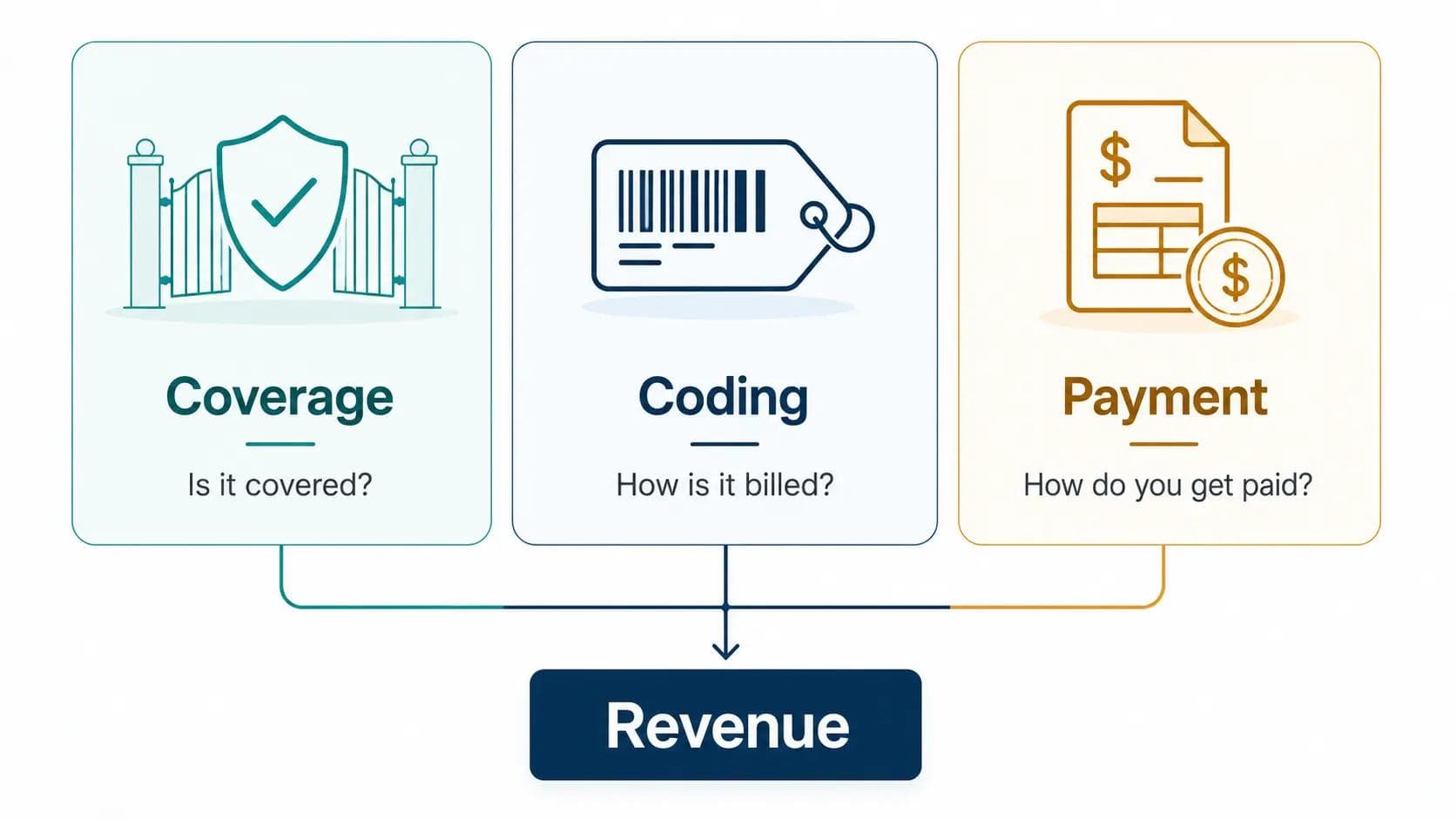
Every reimbursement question comes down to three things: coverage, coding, and payment. They are related but distinct, and a product needs all three to generate reliable revenue.
Coverage
Coverage is a payer's decision that a product or service is eligible to be paid for, for a defined group of patients under defined conditions. A payer might cover a diagnostic test only for patients with a specific diagnosis, or cover a device only after a more conservative treatment has failed. Coverage is a yes-or-no gate with rules attached. If you are not covered, claims get denied, and denied claims mean no revenue.
Coding
Coding is the standardized language that tells a payer what was done. When a provider submits a claim, they use codes to describe the service or product. If there is no code that fits your product, or if the closest code pays poorly or invites denials, providers struggle to bill for what they did. Coding is the plumbing. When it is missing or wrong, everything upstream backs up.
Payment
Payment is the amount a payer actually pays when a covered service with a valid code is billed. Two products can both be covered and coded and still have very different outcomes, because one is paid at a rate that supports adoption and the other at a rate that makes providers lose money every time they use it. Payment rates are set through fee schedules and negotiated contracts, and they change over time.
Hold these three together. Covered but not coded is a product providers cannot bill for cleanly. Coded but not covered is a claim that gets denied. Covered and coded but paid too low is a product providers quietly stop using. You need all three working at once, which is exactly why market access is harder than it looks from the outside.
FDA clearance is not reimbursement
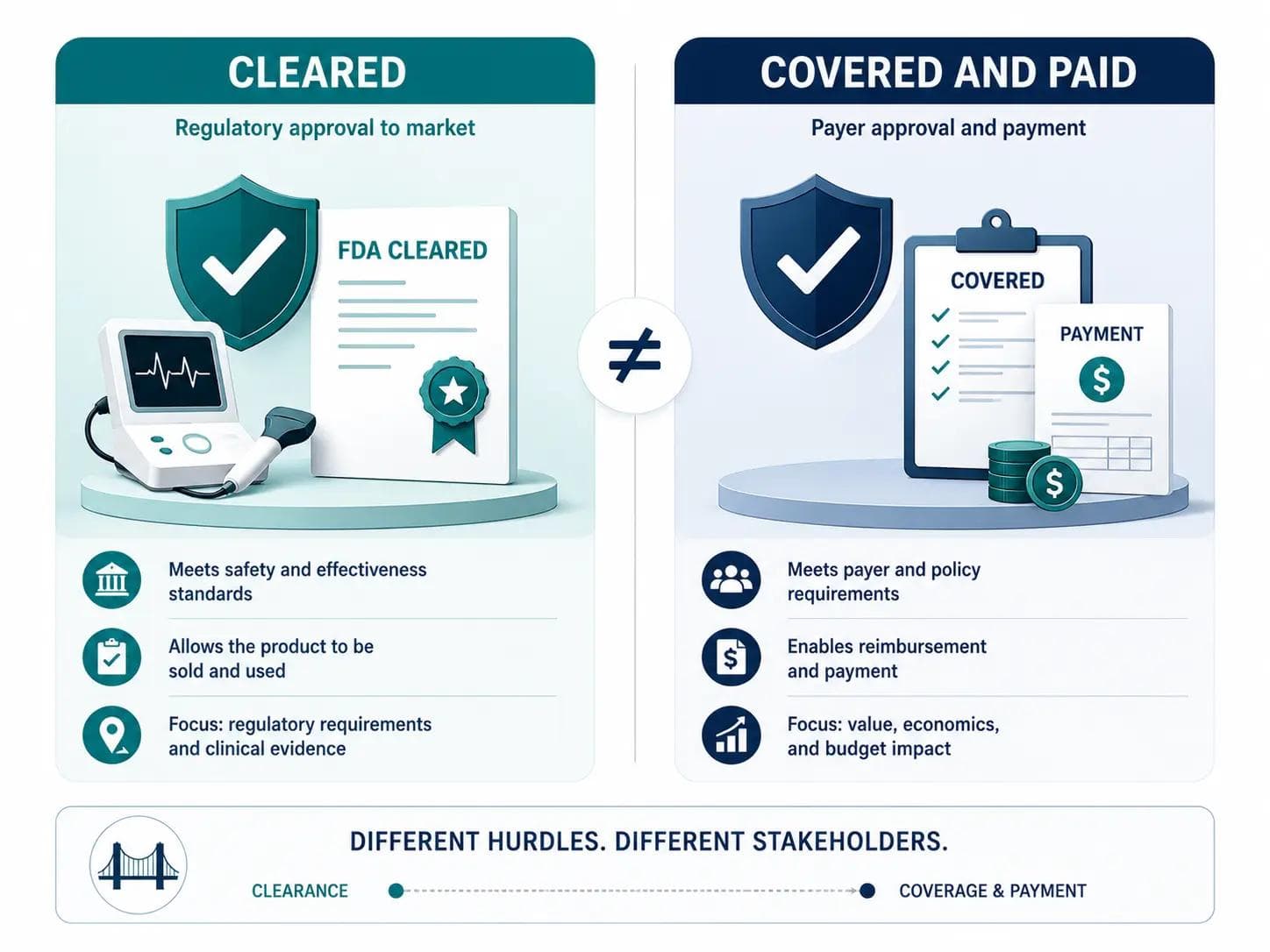
This is the single most expensive misunderstanding in healthcare commercialization. A regulatory clearance or approval from the FDA tells you the product is safe and effective enough to be sold. It says nothing about whether a payer will cover it, whether a billing code exists, or what will get paid. Regulators and payers are different institutions with different jobs and different standards of proof.
Cleared means allowed to sell. Covered means a payer agrees to pay for it in defined situations. Paid means a real dollar amount lands when the claim is submitted. A product can be cleared and not covered. It can be covered and still paid so little that no one wants to use it. Treating clearance as the finish line is how teams end up with a launch and no revenue.
The proof each side wants differs too. Regulators care most about safety and whether the product does what you claim. Payers care about that, then ask a harder question: does using this change patient outcomes or total cost of care enough to justify paying for it, compared with what they already cover. That second question decides your commercial fate, and it usually is not answered by the data you collected to get cleared.
If you take one thing from this section, take this. Plan your evidence and budget for two separate approvals, the regulatory one and the reimbursement one. Founders who assume the first buys them the second get caught off guard when the move into the US market turns into a fight over coverage they did not budget for.
Who the payers are and how coverage decisions get made
In the United States, three broad kinds of payers matter, and each decides coverage in its own way. A useful primer on how coverage and insurance work sits at KFF.
Commercial payers are private health plans, the insurers people get through an employer or buy on their own. They set their own medical policies about what they cover and under what conditions. Coverage is not automatic and not uniform. One plan may cover your product while another excludes it. Each plan you want to sell into is, in effect, its own coverage decision, which is why national commercial access takes time and a plan-by-plan strategy.
Medicare is the federal program primarily for people 65 and older and some younger people with specific conditions. Its coverage decisions carry weight far beyond its own members because commercial plans often watch what Medicare does. Coverage can happen nationally through a formal determination, or regionally through the contractors that administer Medicare in different parts of the country, which means access can start in some regions before others. The rules, coverage policies, and fee schedules that govern this live at CMS.
Medicaid is the joint federal and state program for lower-income individuals. Because states run their own Medicaid programs within federal rules, coverage and payment vary from state to state. A product covered generously in one state may be handled very differently in another.
The practical takeaway is that there is no single yes. Coverage in the US is a patchwork of decisions, each payer with its own policy, timeline, and evidence bar. A real strategy sequences them, picking the payers and regions where the evidence and economics land best, winning there, and using those wins to build the case with the next tier. Trying to win everyone at once spreads teams thin and lands nowhere.
Coding basics without the jargon
Coding scares non-specialists more than it should. You do not need to become a coder. You need to understand enough to know whether your product has a clean path to being billed, because that path shapes your entire revenue model.
Two code families come up most often. CPT codes describe medical procedures and services and are maintained by the American Medical Association. If a physician performs a procedure or runs a test, a CPT code usually describes it. HCPCS codes cover items, supplies, and some products and services that CPT does not, including many devices and drugs administered in a clinical setting. A helpful starting point on how procedural coding works is the AMA's CPT overview.
The question that shapes a lot of your strategy is whether an existing code already fits your product or whether you need a new one. If your product maps cleanly to an established code that is well covered and reasonably paid, you have a shorter road. Providers bill for it in language payers already understand, and adoption has one less obstacle.
If no existing code fits, you are looking at the harder path of pursuing a new or more specific code. That process runs on its own timeline, often measured in a year or more, and it usually asks for evidence that the service is distinct and clinically meaningful. In the gap, providers sometimes bill under a general or unlisted code, which tends to trigger manual review, inconsistent payment, and more denials. That friction alone can slow adoption even when the clinical value is obvious.
So when you assess a product's commercial prospects, ask early: is there a code, does it fit, is it covered, and does it pay enough. The answers change how you price, how you sell, and how much runway you need before revenue becomes predictable. This is squarely the kind of question to work through with reimbursement specialists rather than guessing, because a wrong assumption here compounds across every claim.
Mid-article CTA
Need help building your healthcare growth engine?
Medix helps healthcare startups, clinics, pharma companies, and provider-focused platforms build scalable commercial pipelines.
Book a Strategy CallThe evidence payers actually want
Payers pay for value they can measure, and the value they care about is not always the value you are proud of. They want to know two things. Does the product improve clinical outcomes in a way that holds up, and does it affect total cost of care. A faster result, a smaller incision, or a slicker interface only matters to them if it connects to better outcomes or lower spending.
This is where a value dossier earns its keep. Think of it as the evidence package that answers a payer's questions before they ask, built from two halves. The clinical half shows the product works and for whom, drawn from your trials and real-world use. The economic half translates that into money and outcomes a payer understands, showing how it changes downstream costs, avoids complications, or replaces something more expensive. The strongest dossiers let a reviewer see both the clinical case and the budget case in the same story.
Timing matters more than most teams expect. The evidence a payer wants is often broader than the evidence you gathered to get cleared. Wait until launch to start collecting it and you are already a year or more behind, because credible outcome and cost data takes time you cannot compress. The companies that access markets fastest decide early what payers will ask for and build the evidence on a schedule that has it ready when coverage conversations begin. For a digital product, the pattern in our look at moving a digital health pilot to a contract shows how much smoother the path is when the evidence is designed for the buyer, not just the regulator.
Pricing and the value story for payers and providers
Pricing in healthcare is not one number aimed at one audience. You are telling a value story to at least two very different groups, and the story has to work for both at once.
Payers weigh your price against outcomes and total cost. The question in their heads is whether covering your product at your price saves money or improves results enough to justify the spend, compared with the alternatives they already pay for. If you cannot connect your price to that math, coverage stalls, and a lower price will not rescue a value story the payer does not believe.
Providers ask a more immediate question: does using this product make financial and clinical sense for my practice or institution. Even when a payer covers a product, the provider weighs what they get paid for using it against what it costs them in time, supplies, and workflow. If the payment does not cover the real cost of delivering the service, adoption quietly stops regardless of coverage. That is the gap between covered and actually used, and it is where a lot of well-funded launches die.
A credible pricing and value strategy holds both audiences in view. It sets a price the economic case can defend to payers and makes sure the payment providers receive leaves them whole. Get that balance wrong in either direction and you either never win coverage or win coverage that no one acts on. Working the value story out early, as part of your commercial growth and go-to-market planning, keeps you from finding the mismatch after launch, when it is far more expensive to fix.
How market access connects to adoption
Market access and sales are not separate tracks. Reimbursement is often the quiet reason a deal closes or dies, and the best commercial teams treat it as part of the sale rather than a back-office detail.
Consider how a hospital decides. As we cover in our playbook on selling to hospitals, a health system does not buy because one champion likes the product. It buys when clinical value, economics, risk, and workflow all line up for a group of people at once. Reimbursement sits at the center of that. If a device is not covered, or the payment does not cover the cost of using it, the economic argument collapses no matter how strong the clinical champion is. Your access position is often the difference between a deal that clears committee and one that stalls for months. For a physical device, reimbursement is one gate inside a broader medical device go-to-market strategy, and it should be planned alongside the rest of the launch.
The same holds for providers and practices. A clinician who believes in your product still has to bill for it and get paid at a rate that works. When coding is clean, coverage is in place, and payment is fair, the sales conversation gets much simpler, because you are no longer asking a provider to lose money to use something they like. When any of those is broken, your team spends its energy explaining away a reimbursement problem instead of selling value.
This is also why market access strengthens partnership and expansion conversations. A clear coverage and payment story makes your product far easier for a larger commercial partner or licensee to say yes to, because you are handing them a path to revenue instead of an open question. It is a recurring theme in strategic partnerships and market expansion work and in outreach like our pharma licensing case study, where the strength of the access story shaped how seriously partners engaged.
Where to start
If you are early, start by being honest about the gap between cleared and paid. Map your product against the three pillars. Ask whether a code already fits, whether the payers you care about are likely to cover it, and whether the payment would leave providers whole. Usually one pillar is weaker than the others, and that is where the work begins.
From there, decide what evidence payers will ask for and start building it now. Pick the payers and regions where your economics are strongest and sequence your plan around them rather than chasing everyone at once. Set pricing your value story can defend to payers that still works for the providers who deliver it. And bring in specialist reimbursement and market-access counsel for the parts that carry real consequences, coding determinations, coverage submissions, and pricing decisions. This guide is meant to make you a sharper client for that expertise, not a substitute for it.
Most of all, treat market access as part of your commercial strategy from the beginning. A great product with no reimbursement plan is a slow, expensive lesson in why cleared and paid are not the same thing. A good product with a clear coverage, coding, and payment story reaches patients and generates revenue, which is the entire point.
If you are planning a US launch and want the reimbursement question built into your commercial strategy instead of discovered after launch, Medix Outreach can help. Our pharmacist-led team works on healthcare commercial growth and go-to-market, and you can see the range of what we do across our case studies. Book Your Free Growth Strategy Session and let us pressure-test how your product gets covered, coded, and paid.
Frequently Asked Questions
What is the difference between market access and reimbursement?
Market access is the broad work of getting a product covered, coded, and paid so it can generate revenue. Reimbursement is the payment side of that: whether payers pay, and how much, when a claim is submitted.
Does FDA clearance guarantee insurance coverage?
No. Clearance means a product is legal to sell. Coverage is a separate decision each payer makes about whether to pay for it and under what conditions. A product can be cleared and still not covered or paid.
What are the three pillars of market access?
Coverage (will a payer pay for it), coding (is there a billing code that fits), and payment (how much is paid). A product generally needs all three working together to produce reliable revenue.
When should a healthcare startup start market access planning?
Early, well before launch. The evidence payers want is often broader than the data used to get cleared, and it takes time to gather, so the strongest teams plan coverage and evidence while the product is still in development.
What is a CPT code and why does it matter?
A CPT code is a standardized code, maintained by the American Medical Association, that describes a medical procedure or service on a claim. Whether a clean code fits your product shapes how easily providers can bill for it, which affects adoption.