
The U.S. healthcare market is one of the largest and most attractive opportunities for healthcare startups worldwide. It offers access to thousands of hospitals, physician groups, healthcare systems, payers, pharmaceutical companies, and private practices actively seeking innovative solutions.
Yet entering the U.S. market successfully is about much more than having a great product.
Every year, healthcare startups invest heavily in marketing, hire sales teams, and attend industry conferences, only to discover that generating interest is far easier than generating revenue.
The challenge isn't market size.
It's market entry strategy.
Healthcare organizations buy differently than almost every other industry. Clinical credibility, regulatory understanding, provider relationships, operational fit, and commercialization planning all influence purchasing decisions.
Without a structured healthcare market entry strategy, even the most innovative healthcare startups can struggle to gain traction.
What Is a Healthcare Market Entry Strategy?
A healthcare market entry strategy is a structured plan that helps healthcare companies successfully launch, position, and grow within the U.S. healthcare ecosystem.
It aligns commercial objectives with market realities by defining:
- Target customer segments
- Healthcare go-to-market strategy
- Competitive positioning
- Healthcare business development
- Provider outreach
- Commercial partnerships
- Revenue generation
- Long-term healthcare commercialization
Rather than focusing only on customer acquisition, an effective market entry strategy builds the foundation for sustainable growth.
Why the U.S. Healthcare Market Is Different
Healthcare buyers don't purchase solutions based solely on features or pricing.
Every decision affects patient care, clinical workflows, compliance, operational efficiency, and financial performance.
Healthcare organizations ask questions such as:
- Will this improve patient outcomes?
- Does it integrate with existing systems?
- Is implementation realistic?
- Does the company understand healthcare?
- Can we trust this partner long term?
These questions make healthcare market entry fundamentally different from entering other B2B industries.
Companies that treat healthcare like software sales often face long sales cycles and disappointing results.
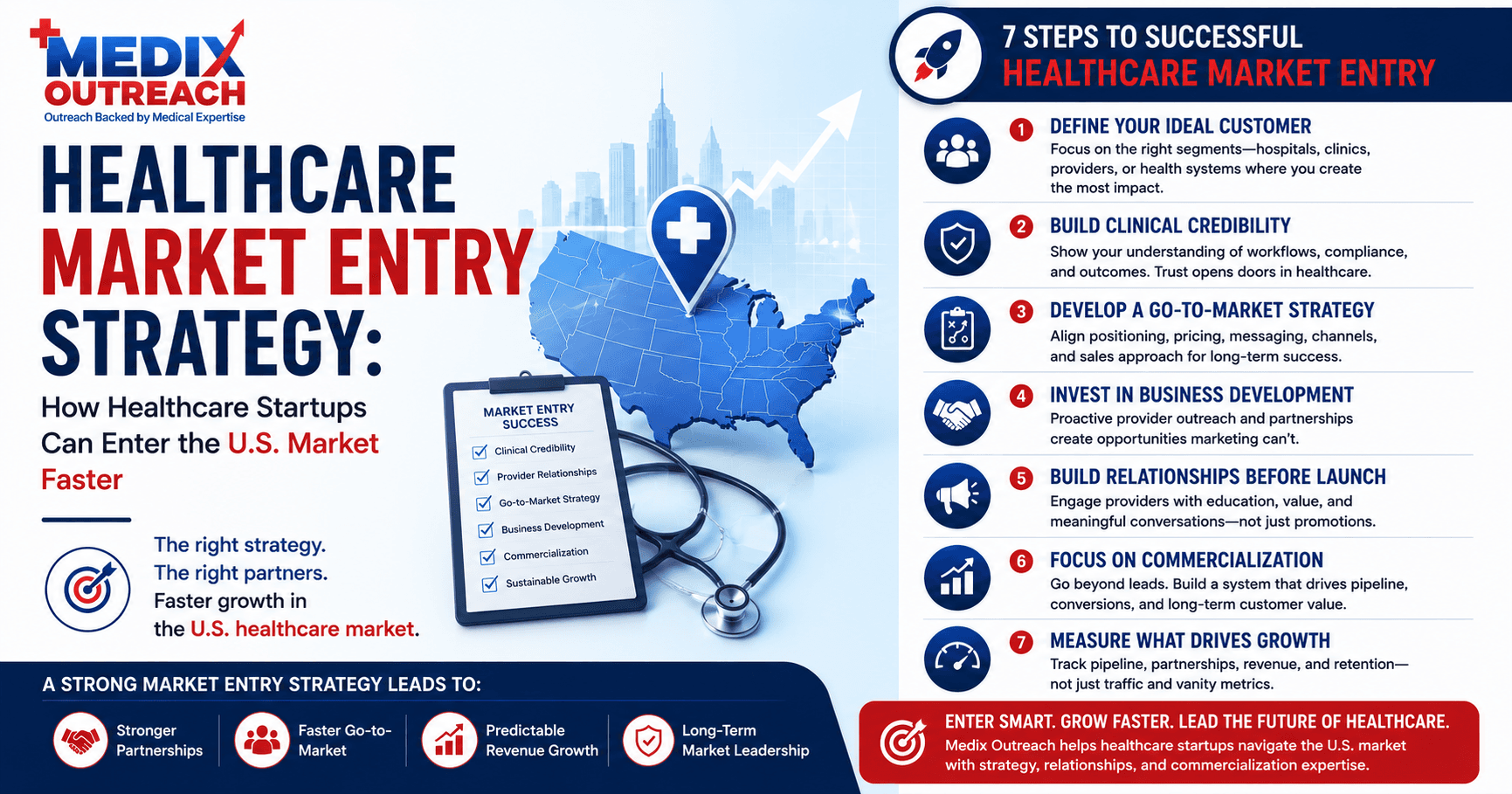
The Seven Steps to a Successful Healthcare Market Entry Strategy
1. Define Your Ideal Healthcare Customer
Many startups target the entire healthcare market.
That approach rarely works.
Instead, identify the organizations most likely to benefit from your solution.
Examples include:
- Hospitals
- Physician groups
- Specialty clinics
- Healthcare SaaS providers
- Pharmaceutical companies
- Medical device manufacturers
- Clinical diagnostics organizations
- Digital health companies
- Private practices
A focused healthcare go-to-market strategy allows your messaging and outreach to become significantly more relevant.
2. Build Clinical Credibility Before Selling
Healthcare organizations buy from companies they trust.
Clinical credibility comes from demonstrating an understanding of provider workflows, reimbursement challenges, compliance requirements, and operational realities.
Ways to establish credibility include:
- Publishing educational content
- Sharing healthcare case studies
- Participating in industry events
- Producing thought leadership
- Demonstrating healthcare expertise in every conversation
Trust accelerates commercialization.
3. Develop a Healthcare Go-to-Market Strategy
Your product launch should be built around a clear commercialization plan.
A successful healthcare go-to-market strategy defines:
- Market positioning
- Value proposition
- Pricing strategy
- Buyer personas
- Sales process
- Marketing channels
- Partnership opportunities
- Revenue milestones
Companies with structured go-to-market plans consistently outperform organizations relying on reactive sales efforts.
4. Invest in Healthcare Business Development
Business development creates opportunities that marketing alone cannot.
Healthcare business development includes:
- Provider outreach
- Strategic partnerships
- Industry networking
- Executive introductions
- Referral relationships
- Commercial collaborations
Instead of waiting for inbound leads, proactive business development creates predictable growth opportunities.
5. Build Relationships Before Launching Large Campaigns
Healthcare is relationship-driven.
Companies often spend heavily on advertising before building trust with providers.
A better approach combines healthcare outreach with relationship development.
Successful organizations engage decision-makers through:
- LinkedIn networking
- Industry conferences
- Educational webinars
- Healthcare email marketing
- Personalized provider outreach
- Strategic introductions
Meaningful relationships generate stronger commercial outcomes than high-volume outreach.
6. Focus on Commercialization, Not Just Lead Generation
Lead generation creates activity.
Healthcare commercialization creates revenue.
Commercialization connects every stage of growth, including:
- Healthcare demand generation
- Provider engagement
- Business development
- Sales execution
- Strategic partnerships
- Pipeline management
- Customer expansion
Healthcare startups that prioritize commercialization build scalable revenue systems instead of isolated marketing campaigns.
7. Measure Growth Using Commercial Metrics
Healthcare startups often measure success using vanity metrics.
Website traffic, impressions, and downloads are useful, but they don't necessarily indicate business growth.
Better KPIs include:
- Qualified opportunities
- Provider meetings
- Pipeline value
- Partnership growth
- Sales velocity
- Customer acquisition cost
- Revenue generated
- Lifetime customer value
Commercial metrics provide a far clearer picture of market entry success.
Mid-article CTA
Need help building your healthcare growth engine?
Medix helps healthcare startups, clinics, pharma companies, and provider-focused platforms build scalable commercial pipelines.
Book a Strategy CallCommon Healthcare Market Entry Mistakes
Many healthcare startups make the same mistakes when entering the U.S. market.
These include:
- Targeting every healthcare organization instead of an ideal niche
- Leading with product features instead of clinical outcomes
- Ignoring provider relationships
- Underestimating long healthcare sales cycles
- Treating healthcare like traditional SaaS sales
- Relying only on paid advertising
- Building marketing without healthcare expertise
Avoiding these mistakes significantly increases the likelihood of long-term success.
Why Healthcare Commercialization Matters
Launching a product is only the beginning.
Healthcare commercialization transforms market interest into predictable revenue.
It combines:
- Healthcare business development
- Healthcare go-to-market strategy
- Provider outreach
- Healthcare sales outsourcing
- Healthcare demand generation
- Strategic partnerships
- Revenue pipeline execution
Instead of focusing on isolated marketing activities, commercialization aligns every function around sustainable business growth.
How Medix Outreach Helps Healthcare Startups Enter the U.S. Market
At Medix Outreach, we help healthcare startups accelerate U.S. market entry through commercialization strategies built specifically for healthcare.
Unlike traditional marketing agencies, we combine pharmacist-led expertise with healthcare business development, provider outreach, go-to-market strategy, strategic partnerships, healthcare sales outsourcing, and end-to-end revenue pipeline development.
Whether you're launching a healthcare SaaS platform, medical device, pharmaceutical product, clinical diagnostics solution, biotech innovation, peptide company, or digital health platform, our team helps you navigate the complexities of the U.S. healthcare market while building meaningful relationships with providers and decision-makers.
Our focus isn't simply helping companies generate leads.
It's helping them build sustainable commercial growth.
Conclusion
Entering the U.S. healthcare market requires more than a strong product.
It requires a structured healthcare market entry strategy built around trust, provider relationships, commercialization, and long-term business development.
Healthcare startups that invest in clinical credibility, healthcare go-to-market strategy, provider outreach, and strategic partnerships consistently outperform competitors relying solely on traditional marketing and sales tactics.
As competition continues to increase in 2026, the organizations that succeed will be those that approach healthcare as a relationship-driven ecosystem rather than a conventional B2B market.
With the right commercialization strategy, healthcare startups can enter the U.S. market faster, build stronger partnerships, and create predictable, long-term revenue growth.