
Most healthcare companies invest heavily in hiring salespeople and almost nothing in equipping them. They assume that a good rep, dropped into a healthcare market, will figure it out. In most industries that assumption is merely inefficient. In healthcare it is fatal, because a rep who cannot speak credibly to a clinical or financial buyer does not get a second meeting.
Healthcare sales enablement is the work of closing that gap. It is the system of positioning, playbooks, training, content, and tools that turns a hired rep into a productive one. It is not outbound tactics, and it is not marketing. It is the internal capability that makes everything the commercial team does more effective, faster.
This guide breaks down healthcare sales enablement into its building blocks and shows how to build each one. It is written for founders and commercial leaders who have a product worth selling and a team to sell it, and who want that team to reach productivity without a year of trial and error.
What Healthcare Sales Enablement Actually Is
Sales enablement is often used loosely, so it helps to be precise. Enablement is everything that equips your sellers to have better conversations and close more deals. That includes how you position the product, the playbooks reps follow, the training that builds their credibility, the content they use in deals, and the tools that keep it all organized.
It is distinct from a few related things it often gets confused with:
- It is not outbound execution. Running sequences and booking meetings is a motion, covered in our guide to healthcare SaaS outbound sales. Enablement is what makes those motions work.
- It is not overall growth strategy. The wider plan for how the company grows is covered in healthcare business development strategy. Enablement is the layer that equips the people executing that plan.
- It is not hiring. Finding people with healthcare backgrounds is its own challenge, one we examine in why it is so hard to find healthcare salespeople. Enablement is what you do after you hire, so that reps who lack years of clinical experience can still sell credibly.
Think of enablement as the difference between handing a rep a product and handing a rep a way to sell it.
Why Healthcare Needs Enablement More Than Most Industries
Enablement matters everywhere, but healthcare raises the stakes in ways generic sales training never addresses.
The credibility bar is higher. Healthcare buyers test whether a rep understands their world within the first few minutes, and they end conversations that fail the test. A generic pitch does not just underperform. It disqualifies the rep. This is why clinical credibility is such a durable advantage and why our pharmacist-led sales teams close faster than generalists.
The buying group is complex. Healthcare deals involve clinical, financial, operational, and often technical stakeholders, each with different concerns. A rep needs a way to speak to all of them, which requires prepared messaging, not improvisation.
The cycles are long and the details matter. With deals that run many months, a small misstep early, such as misframing value for the wrong persona, compounds over time. Enablement front loads the preparation that prevents those mistakes.
Compliance is real. Reps who touch regulated products need to understand what they can and cannot say. Training on promotional boundaries and privacy basics is part of enablement, not an optional extra.
Put together, these pressures mean that in healthcare, the difference between an enabled team and an unenabled one is not a few percentage points. It is whether the team gets in the door at all.
The Building Blocks of Healthcare Sales Enablement
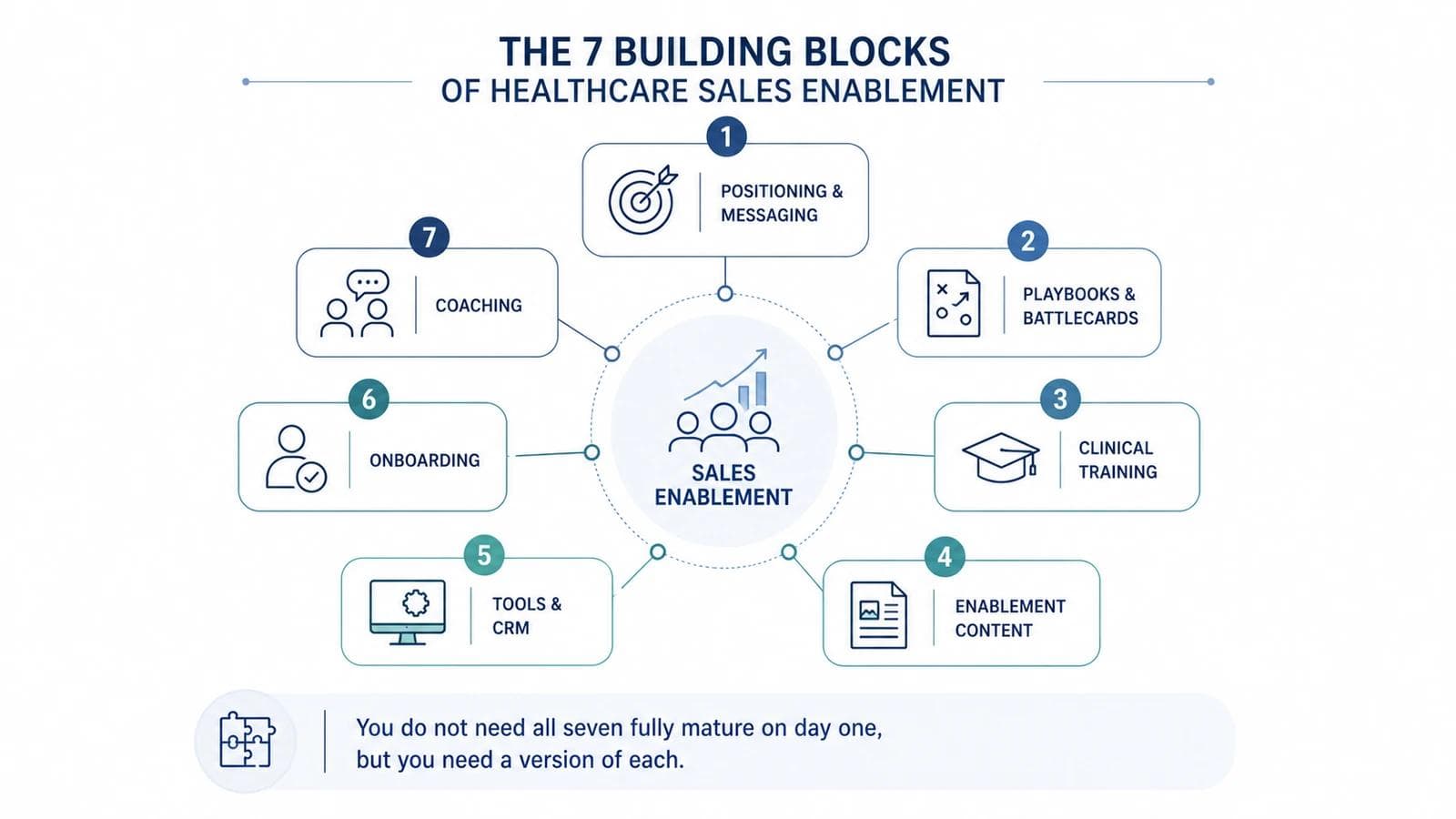
A complete healthcare sales enablement function has a handful of components. You do not need all of them at full maturity on day one, but you need a version of each.
- Positioning and messaging framework. The foundation everything else is built on.
- Playbooks and battlecards. The practical guides reps use in real deals.
- Clinical and domain training. What makes reps credible with healthcare buyers.
- Enablement content. The proof and materials that move deals forward.
- Tools and CRM. The systems that keep the motion organized and measurable.
- Onboarding and ramp. How new reps reach productivity.
- Coaching and reinforcement. How the team keeps improving.
The rest of this guide takes the most important of these in turn.
Build the Message Before the Motion
The most common enablement mistake is jumping to activity before the message is clear. If reps do not have a sharp, shared way to explain why the product matters, no amount of outreach volume will save them. Positioning comes first.
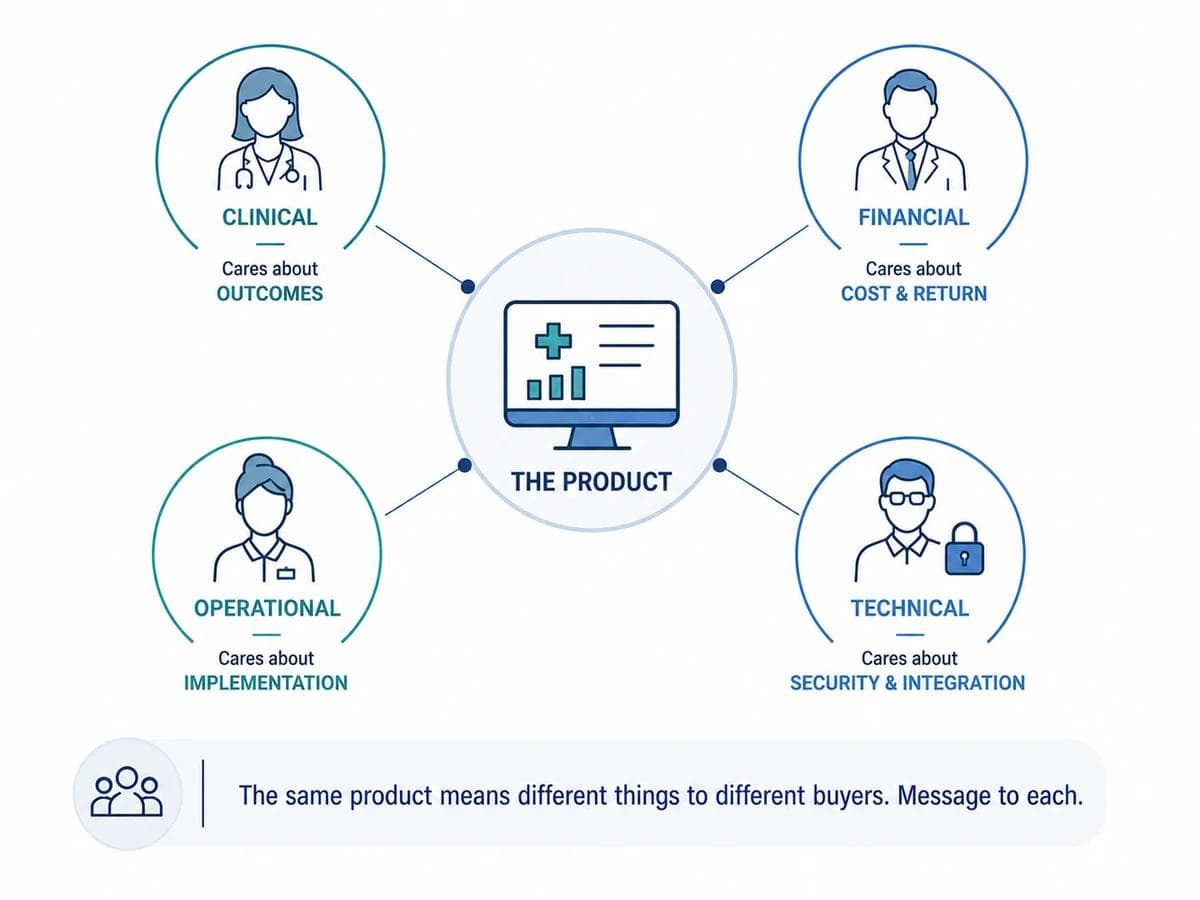
Strong healthcare positioning connects your product to what the buyer already cares about, in the buyer's own terms. That means translating features into clinical outcomes, operational relief, and financial impact. It also means building distinct messaging for distinct personas, because the same product means different things to different people:
- Clinical buyers care about outcomes, safety, and whether the product fits their workflow.
- Financial buyers care about total cost, return, and risk.
- Operational buyers care about implementation, staff burden, and reliability.
- Technical buyers care about integration, security, and data handling.
Give reps a messaging framework that maps each persona to the value they care about and the language that resonates. This single artifact prevents more lost deals than any other piece of enablement, because it stops reps from pitching the wrong value to the wrong person.
Playbooks and Battlecards Reps Actually Use
Positioning becomes useful when it turns into practical tools reps reach for in the moment. Two matter most.
Playbooks give reps a repeatable approach for a specific situation, such as selling into a particular segment or running a particular stage. A good playbook includes the target buyer, the discovery questions that surface real need, the value narrative, the likely objections, and the next step that advances the deal.
Battlecards give reps quick answers when they need them. A competitor battlecard explains how to position against a named alternative. An objection battlecard gives crisp, credible responses to the objections reps hear repeatedly, such as concerns about compliance, integration, or budget.
The test of a playbook or battlecard is simple. Do reps actually use it? Tools built in isolation and dropped on the team get ignored. Build them with input from the people selling, keep them short, and update them as the market teaches you what works.
Train for Clinical Credibility
Training is where healthcare enablement diverges most from generic sales enablement. Product training alone is not enough. Reps need enough domain fluency to hold a credible conversation with a clinical or financial buyer.
Effective healthcare sales training covers:
- Domain context. Enough understanding of the clinical and operational world of the buyer to ask good questions and interpret answers.
- The buyer's economics. How the buyer makes and loses money, including reimbursement and budget realities, so reps can frame value in real terms.
- Compliance boundaries. What reps can and cannot claim, especially for regulated products, and the basics of handling protected information. The U.S. Food and Drug Administration regulates how medical products are promoted, and reps selling regulated products need to understand those boundaries.
- Practice through role-play. Simulated conversations with realistic buyer objections, because credibility is built by doing, not by reading slides.
Reps will not become clinicians, and they do not need to. They need enough fluency to earn the buyer's respect and enough judgment to bring in a clinical expert when the conversation calls for one.
Mid-article CTA
Need help building your healthcare growth engine?
Medix helps healthcare startups, clinics, pharma companies, and provider-focused platforms build scalable commercial pipelines.
Book a Strategy CallContent, Tools, and CRM
Enablement content is the material that helps reps advance deals: one page value summaries, case studies, return on investment tools, objection guides, and persona specific decks. The goal is not volume. It is having the right proof available at the right moment, and making sure reps can find and use it. Content nobody can locate might as well not exist.
Tools and CRM keep the motion organized and measurable. A well run CRM is not administrative overhead. It is how you see pipeline health, spot stalled deals, and learn what is working. The discipline of managing a healthcare pipeline, covered in our guide to the healthcare sales pipeline, depends on reps actually capturing what happens in deals. Enablement makes that easy rather than burdensome.
Onboarding and Ramp
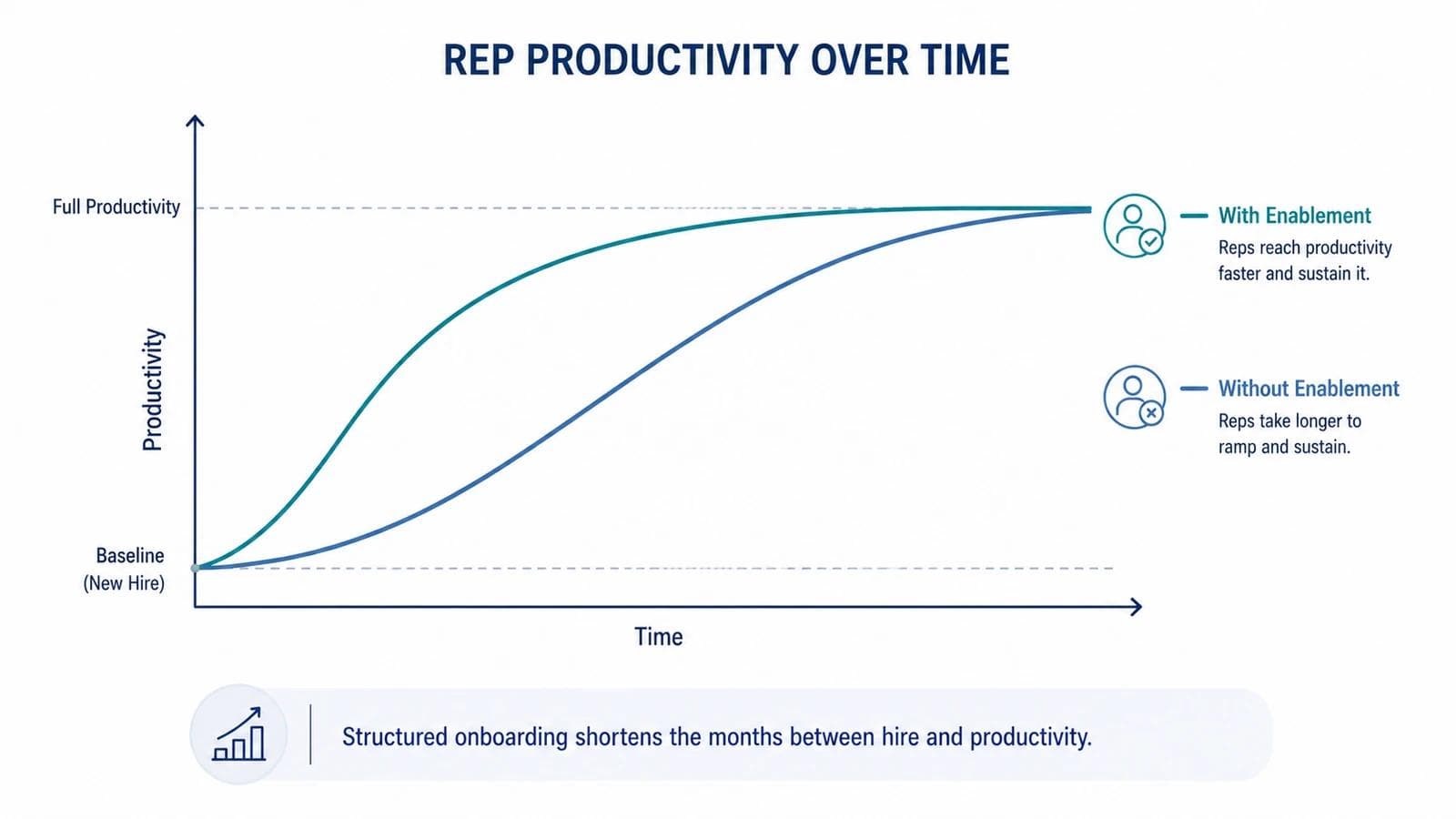
New reps in healthcare take time to become productive, and the difference between a structured onboarding and an unstructured one is measured in months of lost pipeline. A deliberate ramp is one of the highest return investments in enablement.
A strong ramp gives a new rep a clear path through product knowledge, domain training, the messaging framework, the playbooks, and supervised practice before they are expected to carry a full quota. It sets milestones for the first thirty, sixty, and ninety days, and it pairs new reps with coaching so mistakes are caught early.
The payoff is faster time to productivity and fewer early deals lost to avoidable errors. In a market where every buyer conversation is hard to earn, you cannot afford to waste a new rep's first months learning by trial and error on live prospects.
Measure Enablement So You Can Improve It
Enablement that is not measured drifts into activity for its own sake. Track a small set of outcomes that tell you whether it is working.
- Ramp time. How long new reps take to reach productivity, and whether it is shortening.
- Win rate. Whether enabled reps close at a higher rate, especially at the stages enablement targets.
- Content usage. Which materials reps actually use in deals, so you build more of what works and retire what does not.
- Pipeline quality. Whether deals are better qualified and progressing, not just more numerous.
- Rep autonomy. Whether reps increasingly handle objections and conversations without escalation.
These measures turn enablement from a cost center into a system you can tune. If ramp time is falling and win rate is rising, enablement is doing its job.
Common Healthcare Sales Enablement Mistakes
- Investing in hiring but not in equipping, then blaming reps for slow results.
- Starting with activity before the positioning and messaging are clear.
- Building playbooks and content in isolation that reps never actually use.
- Treating product training as sufficient and skipping domain and compliance training.
- Letting onboarding be unstructured, so every new rep learns by trial and error.
- Never measuring enablement, so it cannot be improved.
Frequently Asked Questions
What is the difference between sales enablement and sales training?
Training is one part of enablement. Enablement is the broader system that equips reps to sell, including positioning, playbooks, content, tools, onboarding, and coaching, in addition to training. Training builds skills. Enablement builds the whole capability around the rep.
When should a healthcare company invest in sales enablement?
As soon as you have more than one seller or plan to scale the team. Early on, founders often carry the selling and the knowledge lives in their heads. Enablement is how you make that knowledge repeatable so new reps can reach productivity without reinventing the approach.
What makes healthcare sales enablement different?
The credibility bar and the complexity of the buying group. Healthcare buyers quickly test domain fluency and end conversations that fail the test, and deals involve clinical, financial, operational, and technical stakeholders. Enablement must build credibility and give reps a way to speak to every persona.
Do reps need to be clinicians to sell in healthcare?
No, but they need enough domain fluency to earn a buyer's respect and the judgment to bring in a clinical expert when needed. Enablement provides that fluency through domain training, messaging frameworks, and practice, which is why non clinical reps can still sell effectively when properly equipped.
How do you measure whether sales enablement is working?
Track ramp time for new reps, win rate on targeted deals, which content reps actually use, and whether pipeline quality is improving. If new reps reach productivity faster and enabled reps close at a higher rate, enablement is delivering.
Start With a Minimum Viable Enablement Stack
None of this requires a large team or a long project to begin. Early-stage companies often skip enablement because they picture a heavy program they cannot staff. The better approach is a minimum viable enablement stack, built in priority order.
Start with the message. A clear, shared positioning and a persona-based messaging framework is the highest-leverage artifact you can create, and it costs nothing but thought. Next, capture what already works. If the founder or best rep closes deals, document how they do it into a simple playbook and a short objection guide. Then add the essentials of domain and compliance training, so new reps do not embarrass the company in front of clinical buyers. Finally, put basic CRM discipline in place so you can see pipeline and learn from it.
That is enough to start. It fits on a few pages and in a shared drive, not an expensive platform. The point is to make the founder's hard-won knowledge repeatable so the next hire does not start from zero. You can add sophistication as the team grows, but the sequence matters more than the tooling.
Enablement Is How a Product Becomes a Business
A great healthcare product does not sell itself, and great reps do not enable themselves. The companies that scale commercially are the ones that treat enablement as a real function, not an afterthought. They build the message before the motion, turn positioning into playbooks reps actually use, train for the credibility healthcare buyers demand, and onboard new reps deliberately instead of hoping they figure it out.
None of this requires a large team to start. It requires deciding that equipping your sellers is worth doing well. Do that, and every hire you make afterward becomes productive faster, every deal is better run, and the knowledge that used to live only in the founder's head becomes a system the whole team can use.
Build Your Healthcare Sales Enablement With Medix
Turning a group of reps into a healthcare commercial team that consistently wins takes clear positioning, practical playbooks, and training built for clinical and financial buyers. That is central to Medix Outreach's commercial growth and go-to-market work.
Our pharmacist-led team helps healthcare companies build the enablement foundation that makes reps effective and shortens the path to productivity. If you are building or scaling a commercial team, book a strategy call and we will design your sales enablement plan together.