
Generating a demo is often seen as a major milestone for healthcare companies.
It means your healthcare marketing worked. Your provider outreach captured attention. Your healthcare business development efforts created an opportunity.
Yet for many healthcare SaaS companies, medical device manufacturers, pharmaceutical organizations, and digital health startups, that's exactly where momentum stops.
The first meeting goes well.
The prospect is engaged.
Everyone agrees to "follow up."
Then...nothing.
Weeks pass. Emails go unanswered. Internal reviews drag on. The opportunity stalls before eventually disappearing from the healthcare sales pipeline.
The problem isn't always the product.
More often, it's what happens after the demo.
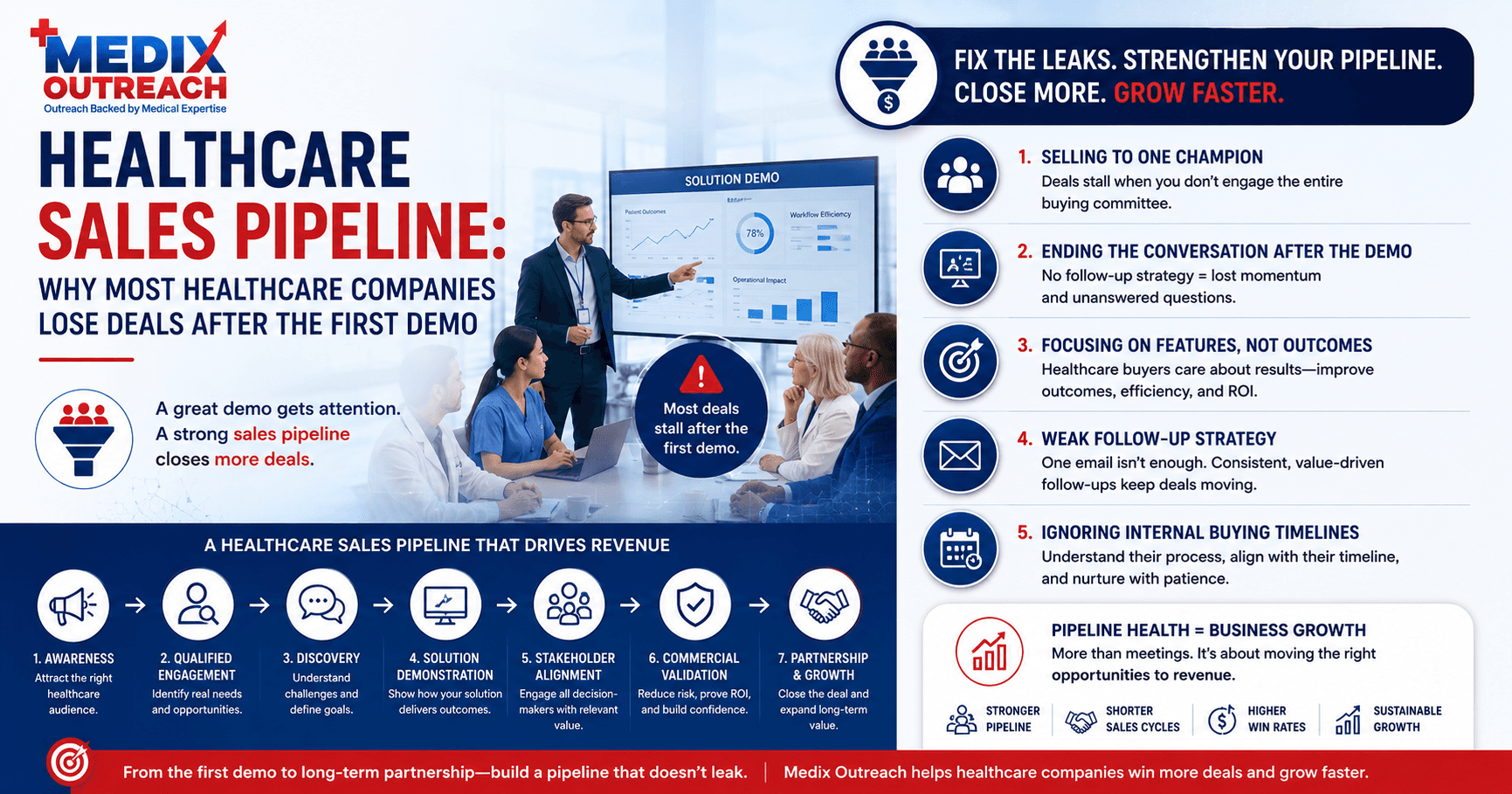
A healthy healthcare sales pipeline isn't built by generating more meetings. It's built by moving qualified opportunities through every stage of the buying journey with the right commercial strategy.
Why Healthcare Sales Pipelines Stall
Healthcare organizations don't make purchasing decisions overnight.
Unlike traditional B2B sales, healthcare buying involves multiple stakeholders, clinical validation, operational reviews, compliance assessments, and financial approvals.
A successful demo creates interest.
It doesn't create consensus.
That's why companies that focus only on booking meetings often struggle to convert opportunities into revenue.
Healthcare commercialization requires managing the entire buying process, not just the first conversation.
Mistake #1: Selling to One Champion Instead of the Buying Committee
One enthusiastic physician rarely closes a deal.
Healthcare purchases often involve:
- Clinical leaders
- Department managers
- Operations teams
- IT departments
- Procurement
- Compliance officers
- Finance
- Executive leadership
Each stakeholder evaluates your solution from a different perspective.
If your healthcare business development strategy focuses only on one champion, your opportunity is likely to stall during internal review.
Successful organizations prepare messaging for every decision-maker before the second meeting is scheduled.
Mistake #2: Ending the Conversation After the Demo
Many sales teams assume the demo speaks for itself.
Healthcare buyers don't.
After every demonstration, prospects begin asking new questions.
- How difficult is implementation?
- Will staff adopt the solution?
- Does it integrate with existing systems?
- How long is onboarding?
- What are the compliance risks?
- What outcomes have similar organizations achieved?
If you disappear after the demo, someone else will answer those questions.
Your healthcare sales funnel should include a structured post-demo engagement strategy that keeps conversations moving forward.
Mistake #3: Focusing on Features Instead of Business Outcomes
Healthcare buyers remember outcomes.
They rarely remember feature lists.
Instead of repeating technical capabilities after the demo, reinforce measurable value.
Talk about:
- Improved patient outcomes
- Reduced administrative workload
- Time savings for providers
- Operational efficiency
- Better staff productivity
- Revenue opportunities
- Workflow improvements
Healthcare commercialization succeeds when business value becomes easier to explain internally than product functionality.
Mistake #4: Weak Follow-Up Strategy
One email isn't a follow-up strategy.
Healthcare organizations operate on busy schedules, competing priorities, and long approval cycles.
That doesn't mean they're uninterested.
It means your healthcare outreach strategy should extend beyond a single email.
An effective post-demo sequence includes:
- Educational content
- Relevant case studies
- Industry insights
- Personalized follow-up emails
- LinkedIn engagement
- Phone conversations
- Stakeholder-specific resources
Every interaction should add value instead of simply asking whether they've made a decision.
Mid-article CTA
Need help building your healthcare growth engine?
Medix helps healthcare startups, clinics, pharma companies, and provider-focused platforms build scalable commercial pipelines.
Book a Strategy CallMistake #5: Ignoring Internal Buying Timelines
Healthcare companies often try to accelerate deals based on quarterly sales targets.
Hospitals and providers don't.
Purchasing decisions are influenced by:
- Budget planning
- Compliance reviews
- Technology assessments
- Clinical evaluations
- Leadership meetings
- Contract negotiations
Understanding these timelines allows your healthcare business development team to nurture opportunities instead of forcing them.
Patience combined with consistent value creates stronger commercial relationships.
What a Healthy Healthcare Sales Pipeline Looks Like
A predictable healthcare sales pipeline isn't based on volume.
It's based on progression.
Each opportunity should move through clearly defined stages:
Stage 1: Market Awareness
Healthcare content marketing, healthcare SEO, thought leadership, conferences, and provider education create awareness among the right audiences.
Stage 2: Qualified Engagement
Provider outreach identifies organizations with a genuine commercial need rather than relying on mass prospecting.
Stage 3: Discovery
Business conversations focus on operational challenges, workflow gaps, and organizational priorities.
Stage 4: Solution Demonstration
The demo connects product capabilities directly to measurable healthcare outcomes.
Stage 5: Stakeholder Alignment
Decision-makers across clinical, operational, financial, and executive teams receive customized messaging relevant to their role.
Stage 6: Commercial Validation
Implementation planning, ROI discussions, partnership opportunities, and operational readiness reduce uncertainty before purchase.
Stage 7: Partnership and Growth
Successful commercialization continues beyond the sale through relationship management, provider engagement, and strategic expansion.
Healthcare Sales Funnels Should Build Trust, Not Pressure
Many organizations think a healthcare sales funnel exists to accelerate purchasing decisions.
Healthcare buyers think differently.
Every stage of the funnel should reduce uncertainty.
Trust is built through:
- Clinical credibility
- Educational content
- Transparent communication
- Industry expertise
- Provider relationships
- Consistent follow-up
The stronger the trust, the shorter the sales cycle.
Why Healthcare Commercialization Matters
Most agencies stop after generating leads.
Commercialization begins there.
Healthcare commercialization connects:
- Healthcare business development
- Provider outreach
- Healthcare demand generation
- Strategic partnerships
- Healthcare sales outsourcing
- Revenue pipeline management
Instead of measuring activity, commercialization measures business growth.
That's the difference between filling a CRM and building a predictable revenue engine.
How Medix Outreach Helps Healthcare Companies Build Stronger Pipelines
At Medix Outreach, we don't believe the goal is simply booking more demos.
The goal is converting qualified opportunities into long-term commercial relationships.
Our team combines pharmacist-led expertise with healthcare business development, provider outreach, healthcare go-to-market strategy, healthcare sales outsourcing, and end-to-end commercialization to help healthcare organizations strengthen every stage of their healthcare sales pipeline.
From healthcare SaaS and medical devices to pharmaceuticals, diagnostics, biotech, and healthcare startups, we help organizations build commercial systems that generate measurable growth instead of inconsistent activity.
Conclusion
The first demo shouldn't be the high point of your sales process.
It should be the beginning of a structured commercialization strategy.
Healthcare companies that strengthen their healthcare sales pipeline through provider outreach, stakeholder engagement, healthcare business development, and commercialization consistently close more deals, shorten sales cycles, and build stronger long-term partnerships.
In healthcare, growth doesn't come from generating more opportunities.
It comes from guiding the right opportunities through a sales process built around trust, relevance, and measurable business value.